

You are using an out of date browser. It may not display this or other websites correctly.
You should upgrade or use an alternative browser.
You should upgrade or use an alternative browser.
Can wind knock down my garage?
- Thread starter tom23
- Start date
ZRX61
Well-known member
Has your house blown away yet?

I'll huff, and I'll puff, and I'll blow yer house down
nadogail
Well-known member
Properly built, not very likely, but under the right circumstances, IMHO, very definiatly.
I have seen a gust of wind blow out a wall of an exterior stairwell that had been standing for probably 50 years.
I have seen a gust of wind blow out a wall of an exterior stairwell that had been standing for probably 50 years.
Bolson32
Well-known member
I'm currently building a 16x32 with 10ft walls and we've been hit with like 4 hail storms in the last month while I'm building it. Nothing bad yet.
I think the main concern with garages is when the doors are open, they're essentially a big balloon, which had led to some anxiety while I build this thing and these storms hit. Once it starts to get closed up you may want to board up the doors while you wait for proper overhead doors, etc. But once it's built, if it's done right, you should be fine. Timber screws on the trusses, heavy anchor bolts with big washers, etc.
But really, it's smaller than 90% of houses so it will be fine unless something REALLY bad comes through. And then that's what insurance is for.
Sent from my SM-G965U using The Garage Journal mobile app
I think the main concern with garages is when the doors are open, they're essentially a big balloon, which had led to some anxiety while I build this thing and these storms hit. Once it starts to get closed up you may want to board up the doors while you wait for proper overhead doors, etc. But once it's built, if it's done right, you should be fine. Timber screws on the trusses, heavy anchor bolts with big washers, etc.
But really, it's smaller than 90% of houses so it will be fine unless something REALLY bad comes through. And then that's what insurance is for.
Sent from my SM-G965U using The Garage Journal mobile app
johnnyradiant
Well-known member
It's always fun putting up walls when you look off in the distance and see a storm blowing in. The race is on to get things up and braced and braced and then clear out of the way in case you didn't get enough bracing on. Other than getting hit with 'normal' storms for the region winds or storms while building you're generally pretty safe following code for your region once built.
matt_i
Well-known member
It is important to pay attention to a few details. I'm assuming stud construction here.
- you want to nail off plywood with #10d at 6" on center on all panel edges. Then nail thru the field at 12" on center.
- you want to have a solid path of "uplift connection" from foundation to roof. So thats the anchor bolts into the foundation...the aforementioned plywood nailing....a metal connector from top plate to truss or rafter....the Simpson H1Z bracket is designed for this although a person can make great use of flat metal strapping. Alternatively is a system I think TimberLok designed which is a long structural screw from under the double top plate all the way thru into the bottom chord of the truss. All good except where there's blockage due to a stud right below or nearly so.
One of the biggest holes I think is lack of large washers under the anchor bolts. I used HDG hot dipped galvanized because of the treated timber bottom plate but found the largest I could go in McMaster Carr. The ones that come with the anchor bolts themselves are very wimpy.
- you want to nail off plywood with #10d at 6" on center on all panel edges. Then nail thru the field at 12" on center.
- you want to have a solid path of "uplift connection" from foundation to roof. So thats the anchor bolts into the foundation...the aforementioned plywood nailing....a metal connector from top plate to truss or rafter....the Simpson H1Z bracket is designed for this although a person can make great use of flat metal strapping. Alternatively is a system I think TimberLok designed which is a long structural screw from under the double top plate all the way thru into the bottom chord of the truss. All good except where there's blockage due to a stud right below or nearly so.
One of the biggest holes I think is lack of large washers under the anchor bolts. I used HDG hot dipped galvanized because of the treated timber bottom plate but found the largest I could go in McMaster Carr. The ones that come with the anchor bolts themselves are very wimpy.
JamesW84
Well-known member
Alternatively is a system I think TimberLok designed which is a long structural screw from under the double top plate all the way thru into the bottom chord of the truss. All good except where there's blockage due to a stud right below or nearly so.
One of the biggest holes I think is lack of large washers under the anchor bolts. I used HDG hot dipped galvanized because of the treated timber bottom plate but found the largest I could go in McMaster Carr. The ones that come with the anchor bolts themselves are very wimpy.
Simpson also has truss screws. I used 2 on each side of my trusses. Their numbers are amazing, but it does depend on how you put them in. IIRC, as described, straight up through the top plate into the bottom of the truss is the strongest. I couldn't do that as my trusses sat over studs, so I used the next best way. They have the ratings on their website.
Simpson also has bigger washers - as do other companies. What you're looking for are called bearing plates. I believe mine are 3" - way better than the small washers. I actually had a wind blow mine down when it was framed with trusses up (18 ft walls, though). It pushed the wall over and the bottom plate tore through the little washers.
-Make sure you understand shear strength.
-Run your braces to the top of the wall to the ground
-Look into simpson HTT5 brackets for at least around your doors. You likely will need something similar for inspection if you don't have the metal pieces that go down into the concrete.
58Yeoman
Well-known member
It should be a requirement of joining to at least put in which state you live in.
twistedstang
Well-known member
Agreed, but it should also be a requirement to read the post before commenting on it. It states that he is in Nebraska.
Innovate1
Well-known member
Matt_I had some good points.
Another issue is the wall with the OHDs. That's the weakest wall to racking (tipping over sideways) because of the small amount of sheathing. There are rules in the code on how high the walls can be as a ration of the width of the wall sections beside the door. I used the guidelines from St. Louis County even though I live outside it. They require the header to be placed directly under the top plate so it can extend out past the door opening and across the rest of the wall. Then the sheeting has to have blocking at the joints and additional nails. I also used hold down brackets on the studs to the foundation on each side of the wall sections for that wall. Here's the county info sheet on bracing:
https://stlouisco.com/Portals/8/docs/Document%20Library/Public%20Works/code%20enforcement/guides/residential/Simplified-Bracing.pdf
10' really isn't that high so some basic attention to bracing details should be fine.
Another issue is the wall with the OHDs. That's the weakest wall to racking (tipping over sideways) because of the small amount of sheathing. There are rules in the code on how high the walls can be as a ration of the width of the wall sections beside the door. I used the guidelines from St. Louis County even though I live outside it. They require the header to be placed directly under the top plate so it can extend out past the door opening and across the rest of the wall. Then the sheeting has to have blocking at the joints and additional nails. I also used hold down brackets on the studs to the foundation on each side of the wall sections for that wall. Here's the county info sheet on bracing:
https://stlouisco.com/Portals/8/docs/Document%20Library/Public%20Works/code%20enforcement/guides/residential/Simplified-Bracing.pdf
10' really isn't that high so some basic attention to bracing details should be fine.

driftpin
Well-known member
You worried about wind loads? Build it to the Miami-Dade County requirements under the Florida Building code, for HVHZ ratings, look for Miami-Dade County Product Approval of building components. HVHZ=high velocity hurricane zone.
I've been in southeast Florida for nearly 50 years, I've survived dozens of hurricanes, and I've gone building to building looking for trapped survivors after hurricanes (firefighter/paramedic). The damage a windstorm can do is substantial. CBS walls w/concrete tiebeams blown down. Places where metal industrial buildings were, all that's left, a slab. Remember, code is usually a minimum prescriptive declaration of building materials and techniques, you can exceed that, it's "how-much do you want to-spend?"
I've been in southeast Florida for nearly 50 years, I've survived dozens of hurricanes, and I've gone building to building looking for trapped survivors after hurricanes (firefighter/paramedic). The damage a windstorm can do is substantial. CBS walls w/concrete tiebeams blown down. Places where metal industrial buildings were, all that's left, a slab. Remember, code is usually a minimum prescriptive declaration of building materials and techniques, you can exceed that, it's "how-much do you want to-spend?"
Last edited:
spudley
Well-known member
10' is not too high to be built strong enough to resist wind loads. Larry Huan, a fellow Nebraskan, has videos on framing you might enjoy.
That said, most anything you build out of wood can blow down. Keep reading these posts and you'll be building a three foot thick concrete bunker.
That said, most anything you build out of wood can blow down. Keep reading these posts and you'll be building a three foot thick concrete bunker.
Last edited:
Bolson32
Well-known member
Simpson also has truss screws. I used 2 on each side of my trusses. Their numbers are amazing, but it does depend on how you put them in. IIRC, as described, straight up through the top plate into the bottom of the truss is the strongest. I couldn't do that as my trusses sat over studs, so I used the next best way. They have the ratings on their website.
Simpson also has bigger washers - as do other companies. What you're looking for are called bearing plates. I believe mine are 3" - way better than the small washers. I actually had a wind blow mine down when it was framed with trusses up (18 ft walls, though). It pushed the wall over and the bottom plate tore through the little washers.
-Make sure you understand shear strength.
-Run your braces to the top of the wall to the ground
-Look into simpson HTT5 brackets for at least around your doors. You likely will need something similar for inspection if you don't have the metal pieces that go down into the concrete.
Interesting that Simpson screws recommend straight up, TimberLok recommends 22.5 degrees towards the interior of the building. I haven't seen their numbers based on angle, but yea, they're pretty much the exact same uplift ratings as the H1 and you save yourself about 6 nails per truss.
I also did the bearing plates on about 80% of my anchor bolts. I built most of it myself and hired out roof sheathing and the roof. They commented that it was way overbuilt
 hopefully it won't blow away.
matt_i
Well-known member
This is another cheap and easy method to help out strengthen the frame. Flat metal strapping like Simpson CS-16 that you nail in X or V pattern to the stud walls. I did this for reasons other than wind but its directionally helpful for wind.

aggie113
Well-known member
Shoot, I'm 18' high to the rafters... Not too worried though as two sides are nearly full OSB panels. Other two are as well but have garage door openings. With the interior bracing between the 2x6s and the corner bracing I'm confident of it standing. And of course it's bolted to the slab.
Bolson32
Well-known member
This is another cheap and easy method to help out strengthen the frame. Flat metal strapping like Simpson CS-16 that you nail in X or V pattern to the stud walls. I did this for reasons other than wind but its directionally helpful for wind.
]
I think I might do this on my one short wall with an OHD. Mine is 16x32 but with a 9ft door on the 16ft side. Feels like it could maybe use a V strap over the top of the door. Seems easy enough and would probably strengthen the hell out of it.
Last edited:
csp
Well-known member
No, the limit on wind resistance is 9' 2-3/4". Exceed that and you're asking for trouble and difficulty finding someone that will insure the building.
p_mori7
Well-known member
Mine is 16'x30'x10'
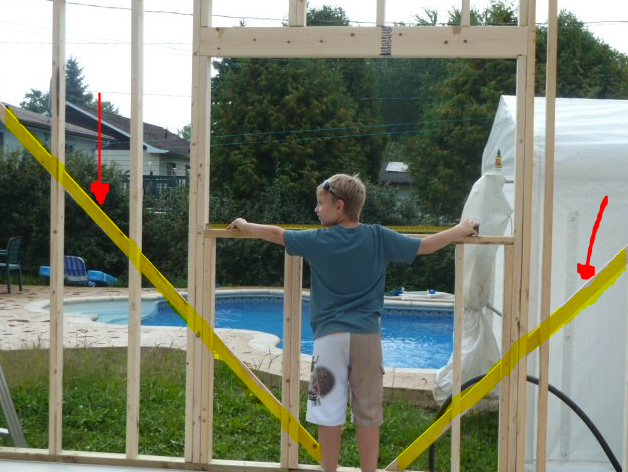
I added inset diagonal bracing at every corner except the front where the garage door is.
It will stand for 50+ years easy.
While your stud wall is on the floor and squared, take some 1"x 4" x 12' or 14' strapping (if you're really worried use 1x6 boards); lay them diagonally from 12" ~ 24" below the top plate all the way down to the bottom plate. With somebody holding it at each end, trace the outline along each stud. Lift it off, set your circular saw to a shallower depth (equal to thickness of the board) and cut inside the penciled lines on your studs. also cut every 1/2" ~ 3/4" slicing up the meat in between. Knock all that out with your hammer. Set the board into the channel you've just created. It should need to be lightly persuaded with your hammer as the fit should be well snug. Nail it home with your framing hammer (or screw it in if you're really worried). Trim the excess off each end.
~Phil.
I added inset diagonal bracing at every corner except the front where the garage door is.
It will stand for 50+ years easy.
While your stud wall is on the floor and squared, take some 1"x 4" x 12' or 14' strapping (if you're really worried use 1x6 boards); lay them diagonally from 12" ~ 24" below the top plate all the way down to the bottom plate. With somebody holding it at each end, trace the outline along each stud. Lift it off, set your circular saw to a shallower depth (equal to thickness of the board) and cut inside the penciled lines on your studs. also cut every 1/2" ~ 3/4" slicing up the meat in between. Knock all that out with your hammer. Set the board into the channel you've just created. It should need to be lightly persuaded with your hammer as the fit should be well snug. Nail it home with your framing hammer (or screw it in if you're really worried). Trim the excess off each end.
~Phil.
Last edited:
rburke65
Well-known member
Built to code, I don’t think do. They were building a log home down the road from me....had outer walls up...2 story...not braced....I was driving to work and wondering why I was seeing pink Fiberglas insulation all over the area....and there was the log home in a big pile. A real mess.
Iron-Iceberg
Well-known member
Yes it can. LOL
https://garagejournal.com/forum/showthread.php?t=436901
https://garagejournal.com/forum/showthread.php?t=436901
Firebrick43
Well-known member
I live in Nebraska and the climate here can be windy. Thank you.
I heard that a windsock in Nebraska is a log chain attached to a steel post set in a yard of concrete.
MushCreek
Well-known member
'Wind' is one thing; and F5 tornado is another. The only secure place in a big tornado is under ground. As others have mentioned, there are ways to build a reasonably strong structure with conventional framing. Read up on what they do in places like FL. Everything is tied to the foundation. I built my house out of ICF, which is good to 200 MPH (allegedly), but my roof would be long gone. Wind code here is 90 MPH, but I had my trusses built to 120. I used the biggest hurricane clips they make, H50. It only added $50 to my build. The building inspectors were amused with my overbuilt house, but I lived in FL for 30 years, so I worry about wind.
driftpin
Well-known member
Have you seen any garage in your area that (sic) haven't been blown away? That may provide you with some clues to your question....
Because you surely won't see any that have been blown-away!
I see your response. As I previously mentioned, code is a minimum prescriptive requirement. You can exceed that to provide additional structural support for severe wind loads.
Consider adding shear walls by your openings, this will strengthen them considerably. It's not expensive, do it in the planning stage of the bid for your work to be done. If you aren't familiar with that term, research it.
Here's an extreme example of windstorm damage and the difference between 'the minimum' and what you can choose to-do:
https://www.nytimes.com/2018/10/14/us/hurricane-michael-florida-mexico-beach-house.html
The comment about tying the structure together from the foundation through the rafters/joists is what provides a better path for wind loads and uplift to be resisted. Once your doors blow-in the entire building becomes a balloon, "up, up and away! In my beautiful balloon," as the Fifth Dimension sang. Request/demand that your overhead doors, your windows, and passage doors have Miami-Dade County FL Product Approval and you greatly-lessen the chances of seeing your building demolished in a windstorm. Yes, it costs-more. Should-have, could-have, would-have, "if only I knew that windstorm was gonna hit me!"
http://www.miamidade.gov/building/product-control.asp
You want a high-degree of resistance to windstorm damage, design and build to the Florida Building Code for high-velocity hurricane zone (HVHZ) compliance.
What do you think the neighbors of this guy (attach.) were thinking, as they considered rebuilding in Mexico Beach FL after the windstorm?
Attachments

Last edited:
driftpin
Well-known member
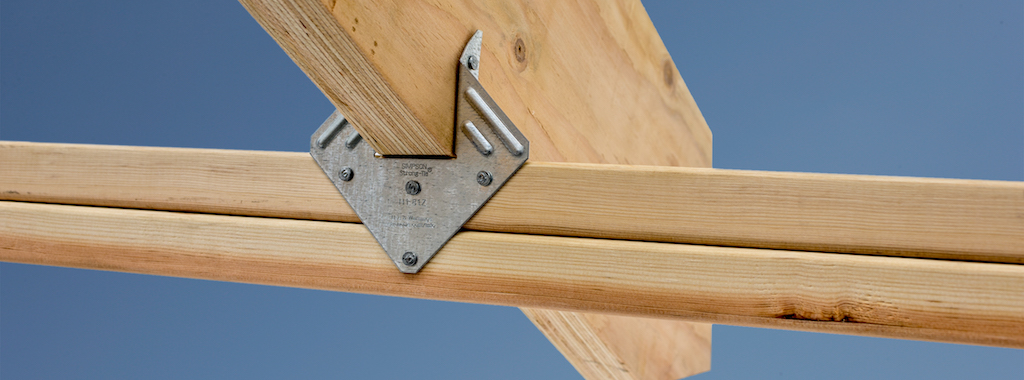
Bolt it to the slab and nail it to the top. Although not required by code, my inspector said I was smart for doing it. About the first smart thing I've done, I reckon.
That's 'a good start.' To make it meet HVHZ standards, a strap up, across the top, and down, fastened on both sides w/multiple fasteners. See the Florida Building Code HVHZ typical fastening drawings for hardware, fasteners and applications.