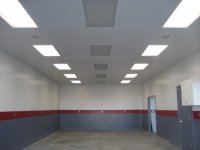
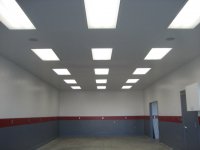
The electrician is just winging it.... What type of fixture? I think ordinary 4' T8 lamps may not be the best choice. Without getting into a proper calculation, it looks like to low a lighting level and uneven distribution. It might even be that fluorescent is not the best choice either.
First question is - what light level do you need? 10 footcandles, 50, 75 or 100? Makes a huge difference. Depends on the tasks being done in the room/area and could also be that you may even want it brighter in one area and less in another. Too low a level can affect productivity, work quality and cause fatigue. Too high can also cause problems. Glare from a fixture can also be a problem - bare lamps vs. a prismatic diffuser. Too much lumen output from a light with a small fixture can be too bright and cause glare if in the field of view. A fixture with an appropriate diffuser or reflector can help this, or install more lights with less output.
One thing that is commonly done is providing multi-level lighting by switching alternate lights or rows. I would suggest this regardless. Sometimes one light is left on as a night or safety light.
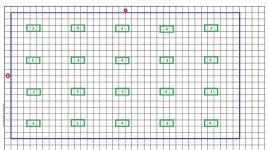
For even lighting distribution, lights should generally be spaced no farther apart than the vertical distance from work surface to the lights. If work surfaces are say 36" above the floor, lights would want to be 12' (144") apart max., not 185". This also depends partly on whether or not the lights have a prismatic lens and/or reflector that distributes the light more evenly to the sides.
Lights are usually spaced evenly by using the "1/4 spacing" method. Take overall dimension and divide by twice the number of lights. This number is the distance to an end wall then double that number to get the spacing between lights. This makes the distance from an end wall 1/2 the distance between lights and gives the most ideal lighting level distribution. For your shop and no. of lights shown, this would make the distance to an end wall 106" and between lights, 212". This automatically means the lights are too far apart.
Your dimensions show the overall length to be 88'-9". I would consider 8' fixtures of some sort in 10 per row to be an option. Would be cheaper to install as you'd have fewer points to wire to. 8' high output lamps may be the way to go.
You're not only investing a lot of money into this, you want the lighting level and quality to be good. The proper way of doing lighting design is by calculation using the lumen output of lamps, height of fixtures above work surface, coefficient of utilization (efficiency) of the light fixture and a light loss factor (LLF) to take into account the loss of lumen output over the life of the particular lamp being used and dirt buildup in the light fixture. A calculation also takes into account the color of the walls and whether or not it's a clean area or dirty environment which would darken the walls and reduce reflectance. A room with white walls and ceiling will always be the most efficient for lighting but will not work in a shop of course.
If you know how to do lighting calculations, it only takes minutes if you have the light fixture data handy. For a shop that size and cost, I would find someone who knows how to do it like say an electrical engineer. A bit of their time would not cost much. They can give you some options too.
I'm an EE and used to do this stuff for a living. Haven't done it for a long time now tho. - gives me a headache just thinking about it...