

You are using an out of date browser. It may not display this or other websites correctly.
You should upgrade or use an alternative browser.
You should upgrade or use an alternative browser.
Capri makes the best bolt cutter?
- Thread starter qqzj
- Start date
I don't agree that Capri beat all others. Capri did do very well and they proved once again that Taiwan made tools are noticeably better than China made tools, but ultimate tool strength isn't that important in the real world where the tool will always be limited by hand grip strength level forces. In general, single item comparison testing also isn't super reliable. Cutting edge hardness will often vary by 1-3 degrees for the same tool fresh from the factory, even for a quality brand.
The Capri did often cut with less effort, which indicates their cutting edges probably have a sharper angle to them. That is likely their downfall as well, because the Capri had quite a bit of cutting edge damage at the end of the testing compared to the Knipex cutters. Cutting edge damage is the most important factor when it comes to long term usefulness of a tool in real world scenarios. Hard but thin items (like piano wire) are actually more likely to damage cutting edges, because the cutting edge forces are more focused. It looked to me like the Capri would struggle a bit in a test like that. It's like hitting a sword edge against a plate of steel vs hitting a sword edge against another sword edge. Edge on edge hits will damage a sword in a deeper or more severe manner.
I have been using my Knipex cobolt cutters regularly for 6-7 years now and the cutting edges still cut like new. I don't feel like I'm missing out on anything. For the occasional to moderate use home handyman, maybe the $19 saved on the Capri (at current Amazon prices) would be worth it. The Capri are noticeably better than all the other big box store homeowner type brands tested by PF. Home handymen aren't really the target market for Knipex tools though, so it is sort of an apples to oranges comparison in that regard. People who use tools regularly will likely continue to choose Knipex, and they should.
The Capri did often cut with less effort, which indicates their cutting edges probably have a sharper angle to them. That is likely their downfall as well, because the Capri had quite a bit of cutting edge damage at the end of the testing compared to the Knipex cutters. Cutting edge damage is the most important factor when it comes to long term usefulness of a tool in real world scenarios. Hard but thin items (like piano wire) are actually more likely to damage cutting edges, because the cutting edge forces are more focused. It looked to me like the Capri would struggle a bit in a test like that. It's like hitting a sword edge against a plate of steel vs hitting a sword edge against another sword edge. Edge on edge hits will damage a sword in a deeper or more severe manner.
I have been using my Knipex cobolt cutters regularly for 6-7 years now and the cutting edges still cut like new. I don't feel like I'm missing out on anything. For the occasional to moderate use home handyman, maybe the $19 saved on the Capri (at current Amazon prices) would be worth it. The Capri are noticeably better than all the other big box store homeowner type brands tested by PF. Home handymen aren't really the target market for Knipex tools though, so it is sort of an apples to oranges comparison in that regard. People who use tools regularly will likely continue to choose Knipex, and they should.
Based on what I saw, I think the video was a fair representation of the various hand held bolt cutters available. I bought these Knipex cutters MANY years ago and they‘ve held up extremely well and performed beyond my expectations. Although they were expensive, I’d still say the Knipex mini bolt cutter was easily one of my top ten best hand held tool purchases ever. I wouldn’t trade these for the Capri, or any other model tested. This pair of cutters has withstood one test not discussed in the video; the test of time. Just my experience and my opinion.
Jim C.
Jim C.
Attachments


KnurledNut
Well-known member
Im just glad he cut drill bits again...because everybody does that.

Anyways, Knipex won, as we already knew. Nothing to see here.

Anyways, Knipex won, as we already knew. Nothing to see here.
ptgarcia
Well-known member
Yep, Knipex won in my book for real world use as their cutting edges held up best. Capri definitely did well but, they are just more China/Taiwan garbage that people shouldn't be supporting imo.
I am totally anti-China, but I don't agree with this. Taiwan is not China, and the tools coming from Taiwan are very good. I have no problem buying from American companies (Capri is less than 15 miles from me here in southern CA) selling quality tools from Taiwan. I would absolutely prefer those tools be made here in the USA; but, in my mind, in terms of COO, made in Taiwan is no worse than made in Germany.
And the few times I have dealt with Capri they couldn't have been more responsive and friendly. I will be buying from them again.
While I definitely commend Taiwan's fight to be free from China and hope one day they achieve democratic freedom, as well as agree they generally make better stuff then China, they are still basically China and a lot of money going there is likely being funneled directly to the CCP. In fact many companies there are likely CCP owned or controlled.I am totally anti-China, but I don't agree with this. Taiwan is not China, and the tools coming from Taiwan are very good. I have no problem buying from American companies (Capri is less than 15 miles from me here in southern CA) selling quality tools from Taiwan. I would absolutely prefer those tools be made here in the USA; but, in my mind, in terms of COO, made in Taiwan is no worse than made in Germany.
And the few times I have dealt with Capri they couldn't have been more responsive and friendly. I will be buying from them again.
I see Taiwan as a way for companies to skirt anti Chinese consumers. I think many companies are moving production to Taiwan just to limit customer loss due to the current Chinese political situation and not to make better products solely(China the capability to make some of the best products in the world if customers are willing to pay for it). I am pretty sure some pretty deplorable stuff goes on there as well too albeit likely less then mainland China.
Furthermore, I don't like to support companies that offshore outsource to increase profits and that is basically the reason why they are having stuff made in China/Taiwan in the first place. As different countries wages, working conditions, environmental laws and other things get worse(aka less profitable) companies move to cheaper poorer countries for manufacture who havent been used up yet. Its like a form of modern slavery. They just keep moving to new poor countries to use up and abuse their poor workers for more profit until they get wise to the game too. Its deplorable imo...
Last edited:
Handyandy23
Well-known member
I've got the Capri Klinge and have been happy with their performance. For a fraction of the price of the Knipex they seemed like a good alternative for a tool I don't use all that often. Good to see them test out well.
KnurledNut
Well-known member
I almost think the Klein heavy duty diagonal cutters would have survived the hex key test. Too bad he didn’t include those.
toddmorr
Well-known member
wow, any evidence or source at all for your assertion?While I definitely commend Taiwan's fight to be free from China and hope one day they achieve democratic freedom, as well as agree they generally make better stuff then China, they are still basically China and a lot of money going there is likely being funneled directly to the CCP. In fact many companies there are likely CCP owned or controlled.
Taiwan is not "basically China". Their own military, their own elections, their own legal system, their own currency, their own educational system, their own free press. geez
Handyandy23
Well-known member
Im just glad he cut drill bits again...because everybody does that.
Anyways, Knipex won, as we already knew. Nothing to see here.
The Capri cut everything with much lower force required than the Knipex, up until they both failed on the Allen key (which Knipex broke at a lower force than Capri).
So I wouldn't say the Knipex won, personally. I guess it depends what you want out of them. If you're going to be using them to make a million cuts and need to squeeze longevity out, the Knipex jaws sustained less damage. But for me I'd rather have the higher leverage of the Capri so that I'm not having to squeeze as hard to make the same cuts.
The Capri were also less than half the price, so the longevity of those Knipex would need to be twice that of Capri's cutting surface for that argument to fly.
Bubba Fett
Well-known member
I'd be surprised if the J2000 diagonal cutters didn't cut them.I almost think the Klein heavy duty diagonal cutters would have survived the hex key test. Too bad he didn’t include those.
I don't have any miniature bolt cutters. I do have some HK Porter bolt cutters that are quite good, though. Been kinda looking, but I feel like a extra-heavy duty diagonals would serve most purposes.
reader2580
Well-known member
Man, does that guy on the video ever stop to take a breath? He sounds like he should be doing informercials on TV.
I personally have the Knipex and they have done everything I have asked of them. I mostly cut 16 gauge metal wire that was dulling regular wire cutters in a hurry. I have cut a few larger bolts with them too.
I personally have the Knipex and they have done everything I have asked of them. I mostly cut 16 gauge metal wire that was dulling regular wire cutters in a hurry. I have cut a few larger bolts with them too.
Handyandy23
Well-known member
I'd be surprised if the J2000 diagonal cutters didn't cut them.
I don't have any miniature bolt cutters. I do have some HK Porter bolt cutters that are quite good, though. Been kinda looking, but I feel like a extra-heavy duty diagonals would serve most purposes.
I think the advantage of the mini bolt cutters is the extra leverage you get with that design. Diagonals are just a single pivot, so even if they are strong enough to cut through larger stock, you have to squeeze the handles with a lot of force. The Kleins in this test held up very well, but they needed a lot of force to cut because of that single pivot design.
The mini bolt cutters like Knipex, Capri, etc are designed with linkage to multiply the force you're squeezing the handles with. I have tendinitis in my fingers and this makes a big difference for me.
Bubba Fett
Well-known member
Maybe in places where a saw or grinder won't fit. Plus they don't require power/batteries. Yep. I just talked myself into getting a pair.Can't say I've ever used a bolt cutter.
What application would they work better than something like a grinder or saw?
Or simply using the right length bolt?
kudakev615
Well-known member
- Joined
- Jan 10, 2017
- Messages
- 178
Yep, Knipex won in my book for real world use as their cutting edges held up best. Capri definitely did well but, they are just more China/Taiwan garbage that people shouldn't be supporting imo.
second quote is from the "all from the same factory" thread that you just posted less then two hours ago. where you cried about your post being deleted over political topics such as these. no one brought up COO, supporting other countries, or any other political banter in this thread, you didRoger, thanks for the heads up. I generally avoid politics anyway but, at the same time I don't like censorship and if I get banned I won't cry myself to sleep as I only came on here to research European and Japanese ratchets and offer help if anyone needs it in the short time I'm on.
Handyandy23
Well-known member
Can't say I've ever used a bolt cutter.
What application would they work better than something like a grinder or saw?
Or simply using the right length bolt?
I don't think I've ever used mine to actually cut a bolt. They are just like a pair of diagonals but with more power and strength. I find they are handy for random tasks that just pop up unexpectedly. Steel cables or bands that are thick enough that side cutters would struggle, these will cut through like butter. Smaller diameter chain link I've used it on, like the kind you'd hang light fixtures with.
You certainly could cut that stuff with a grinder, but it's not easy cutting something that isn't rigid with a grinder, almost need a pair of pliers to hold it tight. You also get better control and less mess.
Barb wire. Easier to pocket some mini bolt cutters as I walk down the fence line than a cordless grinder. Works well on the staples too.I don't think I've ever used mine to actually cut a bolt. They are just like a pair of diagonals but with more power and strength. I find they are handy for random tasks that just pop up unexpectedly. Steel cables or bands that are thick enough that side cutters would struggle, these will cut through like butter. Smaller diameter chain link I've used it on, like the kind you'd hang light fixtures with.
You certainly could cut that stuff with a grinder, but it's not easy cutting something that isn't rigid with a grinder, almost need a pair of pliers to hold it tight. You also get better control and less mess.
It's also way quicker if you're just clipping something off than grinding it away. Fits in tighter spots too and makes less noise.
Plus they're just neat - it's kind of fun when you realize how much you can with them.
KnurledNut
Well-known member
His testing jig was all over the place. Climbing out of the jaws. You believe these numbers were accurate?The Capri cut everything with much lower force required than the Knipex, up until they both failed on the Allen key (which Knipex broke at a lower force than Capri).
So I wouldn't say the Knipex won, personally. I guess it depends what you want out of them. If you're going to be using them to make a million cuts and need to squeeze longevity out, the Knipex jaws sustained less damage. But for me I'd rather have the higher leverage of the Capri so that I'm not having to squeeze as hard to make the same cuts.
The Capri were also less than half the price, so the longevity of those Knipex would need to be twice that of Capri's cutting surface for that argument to fly.
I own the Knipex and they have been thoroughly abused. Which ones do you have? In my book, they win.
His testing jig was all over the place. Climbing out of the jaws.
I noticed that as well, to be consistent he should have had the "bolt" in the same position of the cutters on all the tests and he did not.
paulsomlo
Well-known member
I have the Knipex and use them a fair amount, cutting nails and cutting bolts down to size. Based on the video, the Gedore seems like a better value.
Ton ton
Well-known member
Bolt cutters are a handy tool to have on fencing jobs.
Handyandy23
Well-known member
His testing jig was all over the place. Climbing out of the jaws. You believe these numbers were accurate?
I own the Knipex and they have been thoroughly abused. Which ones do you have? In my book, they win.
If the testing jig was bad then none of the results can be believed, but every pair of bolt cutters dealt with the cutting material slipping in the jig, and all the brands seemed to produce similar results in terms of where they placed in each test. So whether the actual force number is accurate or not, the relative values brand to brand seemed to be.
Are you just saying you own Knipex and like them, therefore they win in your competition of 1?
I've got some Knipex pliers and they are very nice tools for sure, and well made. But I do have the Capri Klinge as tested here, and they have worked very well for me as well. I wouldn't lose sleep if the Knipex were indeed "better", but I do think the Capri's were the best value for how I use them.
KnurledNut
Well-known member
Yes.Are you just saying you own Knipex and like them, therefore they win in your competition of 1?

Is there another option?

First off, it's amazing that there are so many mini-bolt cutters available.
Pretty good test, but as others have said, the object being cut needs to be in the same place every time in relation to the jaw pivot in order to make a force comparison; and it clearly wasn't. Moving the object a few mm makes a substantial change in the results: the difference between 10 mm and 8 mm is only 2mm, sounds inconsequential, but that's 20%.
Saying that, there is some value in this video as far as jaw life and overall strength- not that anyone can break these with their hands, but it does show the robustness of the design.
The Capri did very well for the $, but again I would not put a lot of faith in the force numbers providing an accurate comparison; the testing was nowhere near accurately controlled enough to draw conclusions unless the force numbers were probably more than 50% difference.
I personally have the Knipex and NWS and both have zero jaw damage; but I've only cut nails, etc, and not drill bits LOL.
Pretty good test, but as others have said, the object being cut needs to be in the same place every time in relation to the jaw pivot in order to make a force comparison; and it clearly wasn't. Moving the object a few mm makes a substantial change in the results: the difference between 10 mm and 8 mm is only 2mm, sounds inconsequential, but that's 20%.
Saying that, there is some value in this video as far as jaw life and overall strength- not that anyone can break these with their hands, but it does show the robustness of the design.
The Capri did very well for the $, but again I would not put a lot of faith in the force numbers providing an accurate comparison; the testing was nowhere near accurately controlled enough to draw conclusions unless the force numbers were probably more than 50% difference.
I personally have the Knipex and NWS and both have zero jaw damage; but I've only cut nails, etc, and not drill bits LOL.
Playing devils advocate, perhaps the object placement is part of the test and makes it even better,
I.e. I don't have a jig to line up my cuts, I just put things in and squeeze. It could be that the design of the tool (where the pivot its relative to the blades, the blade angles, surface coatings, what have you...) makes objects want to naturally want to sit in a particular place in the jaws for some tools. In that case, even if you designed a jig to force the object to stay in a consistent place, it wouldn't represent real-world results.
Also, consider that "high-leverage" plier design tries to put the pivot as close as possible to the cutting blades. This means that if you put the object to be cut at the very back of the cutting edge of high-leverage pliers, the blades are at a more obtuse angle. Cutting round objects with the blades at an obtuse angle would tend to force the object out of the jaws as you make the cut.
When the object has a small diameter, the difference is probably negligible. Same thing if you're cutting softer material because it's easier for the blades to "bite" and overcome the tendency for the object to be pushed out. However, if you're cutting something thick and hard - say a drill bit or hex key - the force it takes to start the cut also applies a lot of pressure pushing the object out of the jaws.
In that case, the tendency for some pliers to push objects further away from the pivot in the testing jig might just reflect the same way they would behave in your hands.
I.e. I don't have a jig to line up my cuts, I just put things in and squeeze. It could be that the design of the tool (where the pivot its relative to the blades, the blade angles, surface coatings, what have you...) makes objects want to naturally want to sit in a particular place in the jaws for some tools. In that case, even if you designed a jig to force the object to stay in a consistent place, it wouldn't represent real-world results.
Also, consider that "high-leverage" plier design tries to put the pivot as close as possible to the cutting blades. This means that if you put the object to be cut at the very back of the cutting edge of high-leverage pliers, the blades are at a more obtuse angle. Cutting round objects with the blades at an obtuse angle would tend to force the object out of the jaws as you make the cut.
When the object has a small diameter, the difference is probably negligible. Same thing if you're cutting softer material because it's easier for the blades to "bite" and overcome the tendency for the object to be pushed out. However, if you're cutting something thick and hard - say a drill bit or hex key - the force it takes to start the cut also applies a lot of pressure pushing the object out of the jaws.
In that case, the tendency for some pliers to push objects further away from the pivot in the testing jig might just reflect the same way they would behave in your hands.
KnurledNut
Well-known member
This is why they sell mini bolt cutters with a notch.Playing devils advocate, perhaps the object placement is part of the test and makes it even better,
I.e. I don't have a jig to line up my cuts, I just put things in and squeeze. It could be that the design of the tool (where the pivot its relative to the blades, the blade angles, surface coatings, what have you...) makes objects want to naturally want to sit in a particular place in the jaws for some tools. In that case, even if you designed a jig to force the object to stay in a consistent place, it wouldn't represent real-world results.
Also, consider that "high-leverage" plier design tries to put the pivot as close as possible to the cutting blades. This means that if you put the object to be cut at the very back of the cutting edge of high-leverage pliers, the blades are at a more obtuse angle. Cutting round objects with the blades at an obtuse angle would tend to force the object out of the jaws as you make the cut.
When the object has a small diameter, the difference is probably negligible. Same thing if you're cutting softer material because it's easier for the blades to "bite" and overcome the tendency for the object to be pushed out. However, if you're cutting something thick and hard - say a drill bit or hex key - the force it takes to start the cut also applies a lot of pressure pushing the object out of the jaws.
In that case, the tendency for some pliers to push objects further away from the pivot in the testing jig might just reflect the same way they would behave in your hands.
Oh wait, Knipex is the only one that does that.
Sorry Crapi, didnt mean to hurt your feelings.

I think for the budget-minded, the Capri was the winner. Better than Knipex? Maybe, but the test doesn't prove that because of the lack of consistency in how he tested. And that's ok, but I also say don't look at the tables and say A is better than B because it took 20% less force to cut... And he does mention that at some point, about the varying distance from the pivot/start of the cutting jaw, but there should also be a note on the tables saying it. Because most people will just look at the tables and say, Capri is the best. Maybe it is, but it's not proven from this testing IMO. But it appears to be the best for the $.
Besides the above, where I think this could be better is why try and cut a 3/16 (.19") drill bit? The Knipex is rated at 3.6mm (.14") piano wire; NWS at 3.0 (.12"); why not try all the cutters at their rated capacity, if listed, by hand, and see how it works out 10 times for each? This would actually be relevant, and not lead to fatal destruction. And then you can crush them afterwards if desired.
Again, I think the test has value, but IMO he misses the obvious sometimes
Besides the above, where I think this could be better is why try and cut a 3/16 (.19") drill bit? The Knipex is rated at 3.6mm (.14") piano wire; NWS at 3.0 (.12"); why not try all the cutters at their rated capacity, if listed, by hand, and see how it works out 10 times for each? This would actually be relevant, and not lead to fatal destruction. And then you can crush them afterwards if desired.
Again, I think the test has value, but IMO he misses the obvious sometimes
Iridium rand
Well-known member
- Joined
- Sep 23, 2021
- Messages
- 218
Projectfarm videos are for mostly entertainment with some informational value, wouldn’t base my decision off of one test especially when you’re cutting single objects that a human can’t possibly do rather than hundreds/thousands of more reasonable cuts over the lifetime of the tool.
having low cutting force is great, but often comes at the expense of the cutting edge being dramatically less durable, sharper angle means it dulls faster, knipex cutters usually don’t win in this category but they always win in durability and always having a sharp pair of cutters is priceless when many other pairs spend so much time in that valley between sharp and worn out where it’s getting dull but still works well enough to not justify replacing them
having low cutting force is great, but often comes at the expense of the cutting edge being dramatically less durable, sharper angle means it dulls faster, knipex cutters usually don’t win in this category but they always win in durability and always having a sharp pair of cutters is priceless when many other pairs spend so much time in that valley between sharp and worn out where it’s getting dull but still works well enough to not justify replacing them
neophyte
Well-known member
Gedore manufactures mini bolt cutters similar to the Knipex, but for some reason the test only used regular Gedore Dykes.
Also, the HK Porter cutters were the angled version, although HKP also manufactures straight versions.
Also, the HK Porter cutters were the angled version, although HKP also manufactures straight versions.
KnurledNut
Well-known member
Yep, and why include Klein at all, only to not use their heavy duty ones at that?Gedore manufactures mini bolt cutters similar to the Knipex, but for some reason the test only used regular Gedore Dykes.
Also, the HK Porter cutters were the angled version, although HKP also manufactures straight versions.

I appreciate the effort he puts into the videos, but usually scratch my head at the products he chooses to test.
rick carpenter
Well-known member
Can't say I've ever used a bolt cutter.
What application would they work better than something like a grinder or saw?
Or simply using the right length bolt?
I used to do quite a bit of post-disaster demolition work. I could go all day long with just a flat bar, Kobalt end nippers, and Knipex mini bolt-cutters taking a house down to the studs. If I got back into that heavily I'd have to look at the Capris to replace the Knipex. You don't always come back from a day of that kind of work with every tool you brought in the morning.
I too would have liked to see what the Klein lineman-style cutters might have done, I bet they would have performed well. They look beastly.
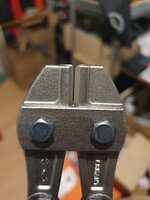
Hi everyone  I recently bought two C.K pocket 10 inches Bolt cutters. I found that both of them have a gap. What do you guys think about it? Is it a faulty production or is meant to be like this? It's a german tool, I don't understand. Thank you for your help
I recently bought two C.K pocket 10 inches Bolt cutters. I found that both of them have a gap. What do you guys think about it? Is it a faulty production or is meant to be like this? It's a german tool, I don't understand. Thank you for your help Attachments
General Geoff
Well-known member
A very slight gap may be intentional to prevent the cutter edges from pressing against each other, avoiding unintentional wear. If they need to close tighter to finish cutting through what you need to cut, you should be able to loosen the mounting bolts and adjust the jaws so they close more tightly.
ZRX61
Well-known member
Klinge is a bit too close to Clunge for my liking...
I've got a couple Knipex CoBolt cutters. I got them because they were on sale. I've also got some specific wire-cutting pliers (sharper jaws).
They are quality tools, no doubt about that. Much better engineered and finished than any Asian product. But they are quite a bit more expensive too. So I'm not sure I'd recommend them, since they do not have a particularily high peformance to price ratio.
I think most of you missed that the Knipex are constructed differently. They have a rolling pin / insert between the jaws that allows them close in a much more controlled fashion; and that none of the other brands have. Jaws don't misalign or slip as easily because of that.
Still, the mini bolt cutter is not really meant to cut hardened material. You will wear out any tool if you do that. It's for quick cutting of softer materials that are too thick to cut with diagonal pliers.
For hardened stuff I'd get carbide lined jaw bolt cutters, but I'm not aware of such a thing.
P. S. Please stop bad-mouthing the Chinese. You might not like their politics (why?) but there is no question that we all benefit from the hard work of the Chinese people as a whole.
They are quality tools, no doubt about that. Much better engineered and finished than any Asian product. But they are quite a bit more expensive too. So I'm not sure I'd recommend them, since they do not have a particularily high peformance to price ratio.
I think most of you missed that the Knipex are constructed differently. They have a rolling pin / insert between the jaws that allows them close in a much more controlled fashion; and that none of the other brands have. Jaws don't misalign or slip as easily because of that.
Still, the mini bolt cutter is not really meant to cut hardened material. You will wear out any tool if you do that. It's for quick cutting of softer materials that are too thick to cut with diagonal pliers.
For hardened stuff I'd get carbide lined jaw bolt cutters, but I'm not aware of such a thing.
P. S. Please stop bad-mouthing the Chinese. You might not like their politics (why?) but there is no question that we all benefit from the hard work of the Chinese people as a whole.