To avoid these ads, REGISTER NOW!

Carlyle Locking Flex Head Question

transam701

Member
Joined
Nov 7, 2021
Messages
16
I ordered some Carlyle locking flex head ratchets from the NAPA website this week due to the sale they're currently running and the overall high praise I've seen for these ratchets on this website.

However, the lock for the flex head appears to be unique. I haven't seen any other brands online that use this style of lock.

Does anyone have experience with this "new and improved" style of locking flex head wrench?

Pictures below show what I'm talking about and I'll include links to what I purchased for reference.

Thanks in advance!


IMG20231118064537_1.jpgIMG20231118064626_1.jpgIMG20231118064548_1.jpg
 
To avoid these ads, REGISTER NOW!

lardy1

Well-known member
Joined
Mar 17, 2019
Messages
3,397
Location
Michigan
Interesting. I have the older style and love them. If I do see a negative it's that they can't be used in as an unlocked flex. This seems to address that.
 
OP
T

transam701

Member
Joined
Nov 7, 2021
Messages
16
Interesting. I have the older style and love them. If I do see a negative it's that they can't be used in as an unlocked flex. This seems to address that.

The lock/unlock mechanism is a slider, but it isn't spring loaded.


Honestly, one of the reasons I bought this ratchet is to see it in person since there's very little about it online.
 

Fedwrench

ALLIANCE MEMBER
Joined
Dec 9, 2007
Messages
14,952
Location
Valley of the sun
New design. I haven't seen a Carlyle or any other brand with that style of locking flex head. It's also a 120 tooth version which is also new for Carlyle. Carlyle flex heads started out with 90 teeth and moved to the locking 72 tooth. I haven't paid much attention to Carlyle ratchets since, I have what I need from them. Very interesting indeed. :thumbup: Please share your experiences with this ratchet as you use it. Thanks for sharing :beer:
 

boxy30

Well-known member
Joined
Jul 6, 2022
Messages
61
I got the 24” long 1/2” locking flex version recently, and haven’t found much about them online either. I’d be curious if you feel the same, but I thought there was a fair bit of play when the flex joint was locked. I don’t have much experience with other locking flexes to compare play to other mechanisms.

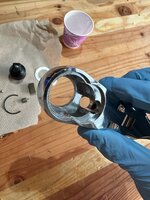
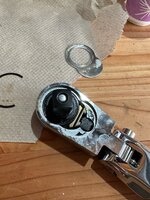
While I haven’t had a need for it yet, curiosity did get the better of me and I disassembled the ratchet head. It’s not a sealed head, which might be obvious as its secured with a snap ring vs screws. The face plate was pretty thin as well. Not a lot of grease from the factory. It’s also a single pawl, true 120 tooth ratchet mechanism, unlike the GearWrench 120XP and the Craftsman Overdrive which I understand are two stacked, offset 60 tooth pawls. The selector has a spring/ball underneath as well (in addition to the spring between the selector and the pawl).
 

Attachments

  • IMG_1778.jpeg
    IMG_1778.jpeg
    439.3 KB · Views: 59
  • IMG_1779.jpeg
    IMG_1779.jpeg
    326 KB · Views: 57
  • IMG_1780.jpeg
    IMG_1780.jpeg
    529.8 KB · Views: 56
  • IMG_1781.jpeg
    IMG_1781.jpeg
    463.3 KB · Views: 60
OP
T

transam701

Member
Joined
Nov 7, 2021
Messages
16
I got the 24” long 1/2” locking flex version recently, and haven’t found much about them online either. I’d be curious if you feel the same, but I thought there was a fair bit of play when the flex joint was locked. I don’t have much experience with other locking flexes to compare play to other mechanisms.

While I haven’t had a need for it yet, curiosity did get the better of me and I disassembled the ratchet head. It’s not a sealed head, which might be obvious as its secured with a snap ring vs screws. The face plate was pretty thin as well. Not a lot of grease from the factory. It’s also a single pawl, true 120 tooth ratchet mechanism, unlike the GearWrench 120XP and the Craftsman Overdrive which I understand are two stacked, offset 60 tooth pawls. The selector has a spring/ball underneath as well (in addition to the spring between the selector and the pawl).

You beat me to the punch. I've thought about taking my ratchets apart to inspect and lube. given your comments, I think I'll go ahead and do that.

I'm pretty sure I see the play you're talking about when I handle mine. Here's my caveat, I don't have any high end locking swivel head ratchets to compare with (I have no idea if this is excessive or normal). The only other swivel had ratchets I have is a set of 120xp non locking.


My gut tells me that this won't be a huge issue, but we'll see when I use the ratchets on my station wagon rebuild in the coming months.
 

boxy30

Well-known member
Joined
Jul 6, 2022
Messages
61
You beat me to the punch. I've thought about taking my ratchets apart to inspect and lube. given your comments, I think I'll go ahead and do that.

I'm pretty sure I see the play you're talking about when I handle mine. Here's my caveat, I don't have any high end locking swivel head ratchets to compare with (I have no idea if this is excessive or normal). The only other swivel had ratchets I have is a set of 120xp non locking.


My gut tells me that this won't be a huge issue, but we'll see when I use the ratchets on my station wagon rebuild in the coming months.
Be careful when/if you remove the selector switch - the ball underneath wants to pop out at you before escaping into the unknown!
 

boxy30

Well-known member
Joined
Jul 6, 2022
Messages
61
I used my locking flex ratchet this weekend and figured I'd share some thoughts.

Since the sliding pin to lock the flex joint is on the side of the ratchet and protrudes when in the locked position, it's easy to bump and unlock the joint when swinging the handle. This is similar to the reversing switch on the well-received Kabo/Mountain/Icon flex head ratcheting wrenches that most GJers are familiar with. To me, accidentally unlocking the flex joint is not as bad as accidentally reversing ratchet direction. Unlike those wrenches though, it does not "click" into the lock/unlock positions - it just slides, a bit too easily - so it's not as positive of a feel, and also easy to accidentally lock/unlock when grabbing the ratchet head. I actually found myself using it with the flex joint unlocked more since it has just 7 lockable positions across 180 degrees, and unlocked, I could adjust to the position that worked best.

The 120T ratchet mechanism is smooth and I really appreciate the high tooth count, especially with the 24" handle.

Overall, I'm happy with it, especially for the price. The flex joint locking mechanism could be better - if someone figures out a way to increase the resistance of the sliding pin, that'd make it much more functional in my opinion.
 
OP
T

transam701

Member
Joined
Nov 7, 2021
Messages
16
I used my locking flex ratchet this weekend and figured I'd share some thoughts.

Since the sliding pin to lock the flex joint is on the side of the ratchet and protrudes when in the locked position, it's easy to bump and unlock the joint when swinging the handle. This is similar to the reversing switch on the well-received Kabo/Mountain/Icon flex head ratcheting wrenches that most GJers are familiar with. To me, accidentally unlocking the flex joint is not as bad as accidentally reversing ratchet direction. Unlike those wrenches though, it does not "click" into the lock/unlock positions - it just slides, a bit too easily - so it's not as positive of a feel, and also easy to accidentally lock/unlock when grabbing the ratchet head. I actually found myself using it with the flex joint unlocked more since it has just 7 lockable positions across 180 degrees, and unlocked, I could adjust to the position that worked best.

The 120T ratchet mechanism is smooth and I really appreciate the high tooth count, especially with the 24" handle.

Overall, I'm happy with it, especially for the price. The flex joint locking mechanism could be better - if someone figures out a way to increase the resistance of the sliding pin, that'd make it much more functional in my opinion.

This (unintentional unlock of the flex mechanism) was my concern when first looking at the ratchet. I already have a set of Gearwrench 120xp flex head ratchets, and thought that some locking variants would be a good set for comparison.

I'll take mine apart and hit them with some Super Lube before heavy use this winter. I'll do my best to report back with my findings.
 

Bigblue&Goldie

Well-known member
Joined
Mar 12, 2009
Messages
10,674
Location
AZ
I used my locking flex ratchet this weekend and figured I'd share some thoughts.

Since the sliding pin to lock the flex joint is on the side of the ratchet and protrudes when in the locked position, it's easy to bump and unlock the joint when swinging the handle. This is similar to the reversing switch on the well-received Kabo/Mountain/Icon flex head ratcheting wrenches that most GJers are familiar with. To me, accidentally unlocking the flex joint is not as bad as accidentally reversing ratchet direction. Unlike those wrenches though, it does not "click" into the lock/unlock positions - it just slides, a bit too easily - so it's not as positive of a feel, and also easy to accidentally lock/unlock when grabbing the ratchet head. I actually found myself using it with the flex joint unlocked more since it has just 7 lockable positions across 180 degrees, and unlocked, I could adjust to the position that worked best.

The 120T ratchet mechanism is smooth and I really appreciate the high tooth count, especially with the 24" handle.

Overall, I'm happy with it, especially for the price. The flex joint locking mechanism could be better - if someone figures out a way to increase the resistance of the sliding pin, that'd make it much more functional in my opinion.

How much does the handle/head flex when you really pull on it? I want a ~24" ratchet for those times a breaker bar is too slow and the 18" is just not enough. I don't want to spend SnapOn money, so it's between the Carlyle or one of the new Gearwrench 120XP's. I'm not a GW fan in general, so the Carlyle has appeal.
 

boxy30

Well-known member
Joined
Jul 6, 2022
Messages
61
How much does the handle/head flex when you really pull on it? I want a ~24" ratchet for those times a breaker bar is too slow and the 18" is just not enough. I don't want to spend SnapOn money, so it's between the Carlyle or one of the new Gearwrench 120XP's. I'm not a GW fan in general, so the Carlyle has appeal.
I can't say I was specifically watching for flex since I was focused on getting the job done, but I didn't notice any, which is a good thing. This was me using it to break loose fasteners torqued around 80-85 ftlb. On another bolt, I was using a ~14" 3/8" drive telescoping ratchet and when a ratchet handle flexes like that one did, you immediately take note.

I saw some videos of the new GW 120XP's with locking flex (since I too was debating it vs the Carlyle), and the button to lock the flex joint seemed like it could develop enough play where you could easily defeat the lock mechanism by pushing/pulling the ratchet head.
 
To avoid these ads, REGISTER NOW!

VolvoRyan

Well-known member
Joined
Dec 29, 2019
Messages
1,339
Location
Kentuckiana, USA
I can't say I was specifically watching for flex since I was focused on getting the job done, but I didn't notice any, which is a good thing. This was me using it to break loose fasteners torqued around 80-85 ftlb. On another bolt, I was using a ~14" 3/8" drive telescoping ratchet and when a ratchet handle flexes like that one did, you immediately take note.

I saw some videos of the new GW 120XP's with locking flex (since I too was debating it vs the Carlyle), and the button to lock the flex joint seemed like it could develop enough play where you could easily defeat the lock mechanism by pushing/pulling the ratchet head.

If you get a chance to measure the thickness of the handle, that would be really helpful. The thickness of the handle is a good proxy for "flex". The 24" Snap-On ratchet handle is thicker than that of the breaker bars. Flexes less.

-Ryan
 

boxy30

Well-known member
Joined
Jul 6, 2022
Messages
61
If you get a chance to measure the thickness of the handle, that would be really helpful. The thickness of the handle is a good proxy for "flex". The 24" Snap-On ratchet handle is thicker than that of the breaker bars. Flexes less.

-Ryan
Sure thing - I'll measure and post the handle thickness tonight. Thickness might not correlate well across brands to evaluate flex though, since a lot depends on the steel used. (I have an 17" HF Pittsburg 3/8" breaker bar that is fatter than a 24" Ko-ken 1/2" breaker bar)

I'll add that it's interesting Napa has priced the 24" 1/2" flex head Carlyle ratchet on sale at $88 (was somehow $80 for me before), while the equivalent 19" version is on sale for $102. It's also categorized under "breaker bars" instead of "ratchets" on their website...
 

Bigblue&Goldie

Well-known member
Joined
Mar 12, 2009
Messages
10,674
Location
AZ
I think my other hang up on the Carlyle is how the flex lock button is incorporated into the head bolt. It seems that that could weaken that whole assembly, or if slop develops can that bolt be tightened?

I have a lot of Snap On ratchets, and a few locking flex Armstrong 88's (probably my favorite), but I just can't justify the ~$250 for something I will use infrequently. At the same time, when I do use it I will be reefing on it, so I want the thing to hold up. I don't trust that parts will be available for the Carlyle down the road (they change their ratchet line like most people change their underwear), but presumably GW will. Neither company has a stellar reputation for warranties.
 

boxy30

Well-known member
Joined
Jul 6, 2022
Messages
61
That's a valid concern. I don't think that joint is necessarily any weaker being a pin vs being a bolt, but I haven't figured out how to disassemble it to take a closer look.

There's no way to tighten the joint like you could with a more traditional flex joint since the pin slides side to side to lock/unlock. The head is held in its indexed positions by a sprung ball that sits in detents on the head side. I would say that design is more robust to any slop that develops from the fork spreading or the bolt/pin stretching, since you'd still have your indexable positions so long as the ball/spring/detents are okay, none of which should see significant wear during normal use. That said, I prefer a smooth flex joint over indexing, but I don't think there are any locking flex ratchets that aren't indexing.
 

boxy30

Well-known member
Joined
Jul 6, 2022
Messages
61
Handle on the 24” long ratchet is 16.65 mm (~21/32”) thick.
 

Earp69

Well-known member
Joined
Sep 20, 2016
Messages
859
Hopefully they're tougher than the last version, I busted my pawl on mine without even really given her the beans. Took almost a year for my local Napa to get me a rebuild kit in.
 
OP
T

transam701

Member
Joined
Nov 7, 2021
Messages
16
I got the 24” long 1/2” locking flex version recently, and haven’t found much about them online either. I’d be curious if you feel the same, but I thought there was a fair bit of play when the flex joint was locked. I don’t have much experience with other locking flexes to compare play to other mechanisms.

While I haven’t had a need for it yet, curiosity did get the better of me and I disassembled the ratchet head. It’s not a sealed head, which might be obvious as its secured with a snap ring vs screws. The face plate was pretty thin as well. Not a lot of grease from the factory. It’s also a single pawl, true 120 tooth ratchet mechanism, unlike the GearWrench 120XP and the Craftsman Overdrive which I understand are two stacked, offset 60 tooth pawls. The selector has a spring/ball underneath as well (in addition to the spring between the selector and the pawl).

Follow up question. How did you get the snap ring out? I'm interested in regreasing mine, but unsure what the trick is for removal.
 

boxy30

Well-known member
Joined
Jul 6, 2022
Messages
61
Follow up question. How did you get the snap ring out? I'm interested in regreasing mine, but unsure what the trick is for removal.
Hopefully this is clear without pictures…

You can use a pick/flatblade to push one end of the snap ring and rotate it so the other end is more exposed. Then you can use a hook to pry up that exposed end and work it out of its groove.
 
OP
T

transam701

Member
Joined
Nov 7, 2021
Messages
16
Hopefully this is clear without pictures…

You can use a pick/flatblade to push one end of the snap ring and rotate it so the other end is more exposed. Then you can use a hook to pry up that exposed end and work it out of its groove.

Thanks!
I was finally able to get my ratchets apart for greasing this week. I'm ashamed to admit that I didn't follow the plastic bag idea, though. So my first snap ring shot across the shop and I had to looking around to find it.

I'm admittedly very new to lubricating ratchets, but I realized quickly that these fine tooth assemblies are easy to over lube.

If anyone has a better process for understanding how much lube needs to be added to a fine tooth mechanism without causing it to lock up, please share.

I used a trial and error method and eventually got good results.
 

Steve_P

Well-known member
Joined
Sep 15, 2010
Messages
5,182
The typical new design ~90T 1/4 and 3/8 ratchets don't like grease as it causes the pawl to stick to the gear and then it locks up. I've used the Super Lube grease in the past in the old school coarser tooth ratchets with great success, but not in the ~90T ratchets. The 1/2" 90T ratchets are usually ok for a light coating of Super Lube from what I've tried. Some type of oil of your choice is a safe bet for all of them- engine oil, Super Lube oil.... but generally not grease.
 

Rinspeed

Well-known member
Joined
Apr 26, 2020
Messages
1,819
Location
NY
Thanks!
I was finally able to get my ratchets apart for greasing this week. I'm ashamed to admit that I didn't follow the plastic bag idea, though. So my first snap ring shot across the shop and I had to looking around to find it.


My eyesight ***** compared to where it was 10 years ago so I simple soak a new ratchet in ATF overnight. Then I let it drain out a couple days and hit it with a cordless for a minute each direction. Works pretty damn well.
 
To avoid these ads, REGISTER NOW!
Top Bottom