To avoid these ads, REGISTER NOW!

Cast-In-Place Max Jax Anchors

carusso1

Member
Joined
Feb 1, 2012
Messages
12
Hi All,

I recently have had an issue with my wej-it anchors for my Max Jax. It seems that one has become loose in the socket and I am unable to re-set it. So now I am nerved out about all of them! In addition, I was never real crazy about the whole expandable anchor thing anyway. Therefore, I have decided to saw cut out of my original garage floor slab some 2'x2' squares so that I can re-pour a thicker and more re-enforced pad to anchor my Max Jax to. I would like to use some cast-in-place anchors that would have an overall "L" or "J" shape to them. I am a civil engineer and do a lot of work within the bridge building industry, so I know they make studs similar in shape to what I am looking for but I can't really find threaded insert type anchors that would fit the mold and/or supply the same load carrying capacities of the originally supplied wej-it anchors. Has anyone done anything similar?

Thanks for the help in advance!

CAR
 
To avoid these ads, REGISTER NOW!

rburke65

Well-known member
Joined
Nov 10, 2007
Messages
12,349
Location
Canfield, Ohio
Could you take a threaded insert and have them welded to the L or J bolts, and with your template of the Max Jax base, form these into the concrete? I'm sure as a CE, you will come up with the answer. Seems lots of folks have trouble with the Wej-its..
 
OP
C

carusso1

Member
Joined
Feb 1, 2012
Messages
12
Could you take a threaded insert and have them welded to the L or J bolts, and with your template of the Max Jax base, form these into the concrete? I'm sure as a CE, you will come up with the answer. Seems lots of folks have trouble with the Wej-its..
Thanks Burke, that is a good idea. I was thinking about doing something similar but was just wondering if there was something out there that was pretty much ready made for what I would like to do. I can stick woo pieces of metal together but probably would not trust my welds. Do you think a weld shop would have any concerns about what I was asking them to do?

Also, I see you are from Canfield. We are practically neighbors. I just live across the border in PA.
 

ConCretin

Well-known member
Joined
Jan 20, 2011
Messages
3,379
Location
Central Maine
Most of the jobs we do have gotten away from L shaped anchor bolts. They can apparently deform and pull out of the concrete.

How about imbedding a length of threaded rod with nuts and a plate washer at the bottom and a coupler at the top. All the hardware is rated so you could size it appropriately.
 
OP
C

carusso1

Member
Joined
Feb 1, 2012
Messages
12
I don't think an "L" shaped 5/8" anchor bolt will deform under the resulting stresses of a 6000# load. Especially since the lift consists of 2-posts with 5-anchors each to distribute the load. My problem is I can't seem to find a cast-in-place anchor that meets the same specifications as the wej-it anchor that is provided by Danmar. I have been looking at these:

http://www.mcmaster.com/#concrete-anchors/=g2pciu (the adhesive grip type)
http://www.heckmannbuildingprods.com/PInsert.htm

Any thoughts?
 

ConCretin

Well-known member
Joined
Jan 20, 2011
Messages
3,379
Location
Central Maine
I agree that a standard anchor bolt would be fine in this application. I just thought threaded rod with a coupler would be convenient. The coupler could be bolted temporarilly to a template to hold it in place during the placement. Couplers and rod are load rated so you'd know what you have. Seems more substantial than the other anchors you found.

By the way, I'm with you on the expandible anchor thing. They obviously work for most of the guys that use em but they worry me a bit. I like the idea of a cast in plate anchor.
 
Last edited:
OP
C

carusso1

Member
Joined
Feb 1, 2012
Messages
12
You have me scratching my head with this threaded rod idea. You may be on to something here. The only possible problem that I could see is that when these types of anchors fail they blow the concrete out in a cone shaped pattern. The cone being wider at the surface of the concrete and tapering down to the anchor size where it is embedded. All the bolts and plate washers would have to be sized and spaced such that none of the potential failure "cones" would overlap. If the proper spacing is not set up and the failure "cones" overlap you would have the same sections of concrete being stressed by multiple anchors.

See this link for images:

http://m.plantengineering.com/index.php?id=2831&tx_ttnews[tt_news]=26520&cHash=f994c13b86
 

ConCretin

Well-known member
Joined
Jan 20, 2011
Messages
3,379
Location
Central Maine
I get your point but by using threaded rod with a plate washer deep in the concrete, you'd be engaging more of the concrete than most other anchors regardless of the cone. If you installed some rebar above the plate washer, wouldn't you effectively engage the entire concrete section?

I think you mentioned that you're an engineer and I'm not so I'll leave that end of things to you. My experience is more on the construction side and we put in a lot of threaded rod anchor bolts in tight patterns for monster steel columns. Seems like it should work.
 

moserjj

Well-known member
Joined
Oct 17, 2010
Messages
155
Location
WI, USA
How about make a plate that matches the bolt pattern of the lift and put bolts through it and embed the whole thing in the concrete? I haven't done this, don't have a maxjax but if I did, I might consider doing something like this
 

38Chevy454

Well-known member
Joined
Dec 26, 2006
Messages
4,036
Location
Cincinnati, OH
One problem with studs sticking out of the concrete would be to place the side frames over the studs without damaging the threads. The studs would also be sticking out of the ground when you (or if you do) remove the lift. This ssumes you get it lined up right, the tolerance on the hole pattern is fairly tight, at least for the original design bolts and Wej-It anchors.

I think the people that have had trouble with the anchors not seating properly have used epoxy set anchors as an alternate to the Wej-It anchors. That seems a lot less trouble than cutting out and repouring the concrete section.
 

95vette

Banned
Joined
Jul 24, 2011
Messages
119
Hello, Buy some coupling nuts and screw onto L shaped anchors any Lowes sells and tack weld the bottom so it won't unscrew on you and set into cement before you pour. Coupling nuts look just like nuts but they are one to two inches long. Jim
 
OP
C

carusso1

Member
Joined
Feb 1, 2012
Messages
12
One problem with studs sticking out of the concrete would be to place the side frames over the studs without damaging the threads. The studs would also be sticking out of the ground when you (or if you do) remove the lift. This ssumes you get it lined up right, the tolerance on the hole pattern is fairly tight, at least for the original design bolts and Wej-It anchors.

I think the people that have had trouble with the anchors not seating properly have used epoxy set anchors as an alternate to the Wej-It anchors. That seems a lot less trouble than cutting out and repouring the concrete section.
I thought about that 38chevy454. Only problem is that I didn't have to drill all the way through my slab to install the wej-it anchors. I don't know that I can pull them all out and not damage the slab. I did read where people were doing that but I think they were able to drive the wej-it's on down into the ground below the slab. My main concern with fabricating something is being able to provide an anchor that meets the same specs as the wej-it. I kind of like LLWillyfan's idea of the 5/8" rod and plate washer buried in the concrete with a coupling attached to create the threaded sleave. Just trying to figure out how to insure the rod and washers can't pull out under a heavy load.
 
OP
C

carusso1

Member
Joined
Feb 1, 2012
Messages
12
Here is a post I did from another thread that outlines my dilemma from the start:

Hi,

This is my first ever post here on The Garage Journal so I apologize if this is a repeat issue.

I have had my MaxJAx for a little over a year now and have not really experienced any problems. My issue is with the anchors. The instructions included with the lift explained to set the anchor, first remove the Set Tool hex bolt and add a washer to give better support during the setting procedure. Tighten the hex nut while holding the bolt head (to assure the anchor does not spin) and until the Power Drop Anchor sets flush with the concrete surface. Upon beginning the installation of these anchors, as outlined in the included instructions, it appeared that once the anchor became flush with the top of the concrete it essentially "topped out" at the washer and would lead one to believe the anchor had set itself. After further inspection of the anchor, I could see that it still appeared loose in the socket and not adequately set. This lead me to call customer service who explained that the anchor should be set with a max torque of 90 ft-lbs. As stated above, if the anchor "tops out" at the washer one would believe that the necessary 90 ft-lbs of torque has been reached, but alas this was not the case. In order to insure that I had reached the 90 ft-lbs of torque, I placed a steel "cup" over the anchor and continued the setting process as outlined above and found that in some cases the top of anchor would actually set slightly higher (1/8" - 1/4") than the wearing surface of my concrete floor slab upon reaching 90 ft-lbs of torque. I trimmed the portion of the anchor above the floor slab off so that the anchor is now flush with the floor.

The scary part is that after using the lift for about 13 months, as explained above, with no notable problems, I found that one of my anchors appeared to be loose in the socket last night. So I installed the set tool in order to re-set the anchor at 90 ft-lbs of torque, if necessary. I used the same process as before but this time pulled the entire anchor out of the concrete floor slab with little torque. Therefore, I am concerned about the anchors and have decided to saw cut out portions of my existing 6" floor slab to re-install a thicker more reinforced slab. I am going to dowel the new slab to the old and also mushroom the new slab under the old to "key" them together. I would rather cast-in-place some "L" shaped anchors in lieu of drilling and using a wedge type anchor. Has anyone done something similar and if so where did you purchase your cast-in-place anchors?

Thanks in advance for any help!
 

skamp

Well-known member
Joined
Jul 20, 2007
Messages
644
Location
Cypress, TX
The best thing to do is repour the pad, wait the 28 days then drill and use the epoxy based sleeve anchor. It is not the cheapest route but I think would be the best. GES has the epoxy anchor kit for $150.00.

Steve
 

snorky18

Well-known member
Joined
Oct 1, 2007
Messages
1,170
Location
Southeast Tennessee
The best thing to do is repour the pad, wait the 28 days then drill and use the epoxy based sleeve anchor. It is not the cheapest route but I think would be the best. GES has the epoxy anchor kit for $150.00.

Steve

I don't know about for this application, but epoxy anchors in certain industrial settings have been known to creep over time.
 
To avoid these ads, REGISTER NOW!

regguy1

Well-known member
Joined
Dec 15, 2009
Messages
4,056
Location
On Mount Olympus with Zeus
Hello, Buy some coupling nuts and screw onto L shaped anchors any Lowes sells and tack weld the bottom so it won't unscrew on you and set into cement before you pour. Coupling nuts look just like nuts but they are one to two inches long. Jim

This is a suggestion worth considering, just be sure you have enough thread bite into the CN's. You also might consider the round cardboard tubes, you could dig down to 24" or more with rebar ties to the new pad area for a super secure system
 
OP
C

carusso1

Member
Joined
Feb 1, 2012
Messages
12
I spoke with a representative from Wej-It today regarding the replacement of my MaxJax anchors. He recommended the POWER-sert epoxy anchors. It looks like you can buy an installation kit with 10 anchors from Danmar for $149. I think I am going to go this route. I just hate to deviate from what Danmar and/or Wej-It recommend. Has anyone removed any of the original Wej-it anchors after they have been installed? If so how did you do this?

Thanks!

CAR
 

metal1313

Well-known member
Joined
Apr 28, 2009
Messages
3,416
Location
clinton NJ
my plan, since if i get a maxjack i cant fit it in the garage was to pour a slap in the driveway, and before doing so install some 1/2 plates with solid bar stock welded on, that has been drilled and tapped to the right diameter. installing the plates first then the rebar should lock them in well, and when i am not using the max jack i can unbolt it, and install a flush cap.
 

Brad Beam

Well-known member
Joined
Jan 5, 2010
Messages
343
Check out Hilti they have all sorts of anchors wether embedded or drilled and epoxied in place
 

olytdi

Well-known member
Joined
Dec 3, 2011
Messages
2,202
Location
Olympia, Washington
I spoke with a representative from Wej-It today regarding the replacement of my MaxJax anchors. He recommended the POWER-sert epoxy anchors. It looks like you can buy an installation kit with 10 anchors from Danmar for $149. I think I am going to go this route. I just hate to deviate from what Danmar and/or Wej-It recommend. Has anyone removed any of the original Wej-it anchors after they have been installed? If so how did you do this?

Thanks!

CAR

What I understand is that you cannot remove them so much as you pound them down through the bottom of the slab. But, beware that this will undoubtedly result in a large, cantilevered or conical piece of concrete breaking off of the underside of the slab.
 
OP
C

carusso1

Member
Joined
Feb 1, 2012
Messages
12
I contacted Gabe at Danmar and explained my anchor situation. He, as well as the Wej-It representative, recommend the use of the POWER-sert epoxy anchors. I ordered them through Danmar yesterday and should have them, hopefully, later this week. Next step...saw-cut my floor. I don't want to deviate from what they suggest just in case something where to happen. All of my direction has pretty much been by way of the manufacturer.

The only issue I see with the bar stock idea is the ability of the threads to hold under the applied load and the constant tighten/re-tighten. I think (and I stress think) the anchors supplied by Wej-It are case hardened steel. I do believe that the MaxJAx is over designed to allow for the do-it-yourselfer to install the thing so the bar stock idea may work just fine. I would confirm with Gabe at Danmar first though.
 

skamp

Well-known member
Joined
Jul 20, 2007
Messages
644
Location
Cypress, TX
I would do more than 2'x2' squares if you are going to redo this. I think most lift makers say 3-4' square and 12" deep.

Steve
 

PatL

Active member
Joined
Sep 25, 2011
Messages
27
I experienced the same fastener problems (creeping up, not setting, etc) and have real concerns with my recent installation. I am lifting a Tahoe and old (heavy) '64GTO. I plan to drive all of the original fasteners supplied with the MaxJax through the hole into the substrate and buy the Power Set epoxy system to replace them.

The concrete is about 4" thick so after I drive them through, I will be pouring epoxy into the substrate and this would not work I am thinking that I will buy some of that expanding spray insulation foam and squirt it into the 7/8" hole, let it expand and set, then drill the foam to provide a containment cavity for the epoxy. Then I can envision the new Power Set epoxy working well, especially if I can undercut the foam a little to let the epoxy mushroom out under the slab and provide more pull out resistance.

Does anyone see any concerns with this approach? The Power Set fasteners say they need a 6 1/4" deep hole but I am thinking the 4" of concrete with this approach should be sufficient.
 

PatL

Active member
Joined
Sep 25, 2011
Messages
27
Thanks Steve, this helps my thinking. What you do you think of the idea I had above with drilling a cavity in that expanding foam material? I am thinking that this will provide good cavity to force the epoxy around the anchor.

Pat
 

skamp

Well-known member
Joined
Jul 20, 2007
Messages
644
Location
Cypress, TX
Thanks Steve, this helps my thinking. What you do you think of the idea I had above with drilling a cavity in that expanding foam material? I am thinking that this will provide good cavity to force the epoxy around the anchor.

Pat

I would just use extra epoxy and let it fill the cavity. That would give you a cone under the concrete. It may cost a bit more but I don't like the idea of foam as it crumbles and could create issues with adhesion.

Steve
 
OP
C

carusso1

Member
Joined
Feb 1, 2012
Messages
12
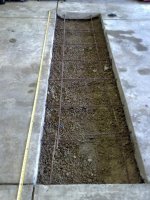
Well, I finally received my POWERsert anchors last week and removed a section of my garage floor. Hopefully you can see the removed section in the attached picture. The removed section is 11' long x 3' wide x 8" deep. In addition to undercutting the existing slab to "key" the new pour to the old, I also installed some No. 5 bars to dowel the new slab to the old. The cost of this new pour including labor and material is $625.00.

Originally, I was going to remove/replace 2' x 2' squares and mushroom the new pour under the existing slab to key it in-place. After some additional thought I decided to pour a full slab the width of my post spacing to form a "beam". I was more concerned with the lift wanting to "tip" front to back in the event of an off-centered load. I believe the car actually acts as a "kind-of" support between the posts allowing the posts to act in together. This way if the driver side post tried to fail in toward the car the passenger side post would have to move out away from the car and vice versa. But a front to back failure could result with just the movement of one post. The average weight of a cubic foot of concrete is 150 lbs. Therefore, the new concrete I am pouring should way approximately 3300 lbs. With the weight of the new pour and it being both doweled and mushroomed under the old slab I feel this should be sufficient to prevent any overturning.

Next step......install the new anchors!
 

Attachments

  • 2012-02-19_17-02-17_891.jpg
    2012-02-19_17-02-17_891.jpg
    144.5 KB · Views: 70

hanksgarage

Member
Joined
Oct 1, 2013
Messages
6
Location
Cerritos, CA
... Upon beginning the installation of these anchors, as outlined in the included instructions, it appeared that once the anchor became flush with the top of the concrete it essentially "topped out" at the washer and would lead one to believe the anchor had set itself. After further inspection of the anchor, I could see that it still appeared loose in the socket and not adequately set. This lead me to call customer service who explained that the anchor should be set with a max torque of 90 ft-lbs. As stated above, if the anchor "tops out" at the washer one would believe that the necessary 90 ft-lbs of torque has been reached, but alas this was not the case. In order to insure that I had reached the 90 ft-lbs of torque, I placed a steel "cup" over the anchor and continued the setting process as outlined above and found that in some cases the top of anchor would actually set slightly higher (1/8" - 1/4") than the wearing surface of my concrete floor slab upon reaching 90 ft-lbs of torque. I trimmed the portion of the anchor above the floor slab off so that the anchor is now flush with the floor.

The scary part is that after using the lift for about 13 months, as explained above, with no notable problems, I found that one of my anchors appeared to be loose in the socket last night. So I installed the set tool in order to re-set the anchor at 90 ft-lbs of torque, if necessary. I used the same process as before but this time pulled the entire anchor out of the concrete floor slab with little torque...

Thanks in advance for any help!

i have the same exact issue ^

only 2 of my bolts pulled out with the cup trick. the rest came up a little less than an inch but still hold. was able to put the lift on top of the anchors and lock the existing 4 down to 100ft/lbs but still would like to find a way to fix the missing 1 on each side.
 

PoorOwner

Well-known member
Joined
Feb 10, 2007
Messages
5,032
Location
CA
Old post but I wanted to ask

you have the boss or coupling nuts before you pour, but how did you keep it flush with the concrete top when you are finishing the concrete. Ideally the boss don't stick out of the concrete, and yet don't want the concrete seeping into the threads
 
To avoid these ads, REGISTER NOW!
Top Bottom