To avoid these ads, REGISTER NOW!

Cast Iron Spokeshave from England

patack2

Well-known member
Joined
Mar 30, 2020
Messages
79
Location
virginia
Hello,
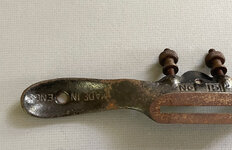
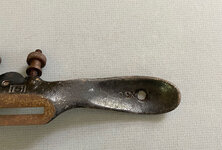
Can anyone tell me how to read the number on this spokeshave? Are there bars on either side of the number which would make this #5? Or?
Does anyone know the English manufacturer?
I look forward to your thoughts.
Many thanks.
 

Attachments

  • IMG_9249.jpg
    IMG_9249.jpg
    337.3 KB · Views: 61
  • IMG_9250.jpg
    IMG_9250.jpg
    425.6 KB · Views: 55
  • IMG_9251.jpg
    IMG_9251.jpg
    291.5 KB · Views: 50
  • IMG_9252.jpg
    IMG_9252.jpg
    358.5 KB · Views: 48
  • IMG_9253.jpg
    IMG_9253.jpg
    487 KB · Views: 56
To avoid these ads, REGISTER NOW!

RTM

Well-known member
Joined
May 13, 2019
Messages
13,259
Location
SF Bay Area
Yup, Stanley 151 missing the cutting bit and the lever cap. 1 easily bought, the other easily made.


You can see the cap here, big chunk o metal, a hacksaw, and some files, and good to go.


Or probably find one on Ebay if you are in a rush.
 

neophyte

Well-known member
Joined
Apr 23, 2012
Messages
9,798
Location
Pennsylvannia
Looks like a Stanley 151.
This.
At a certain point, all the “better” Stanley woodworking tools started to be made in England.
The Spokeshaves were one of these.

To use that, you need a blade and a blade cap and screw.
Older Stanley English made blades held a good edge, but you needed to remove a stubborn lacquer coating before using the blades, and then either spend a crapload of time flattening the blade, or you needed to slightly back bevel the blade, using a method similar to that taught by David Charlesworth.
Nowadays, an aftermarket blade by Hock, or Lee Valley, etc. would probably be worth it.
You would also likely need to derust the spokeshave (not hard using Evaporust) and flatten the spokeshave sole.

Buying a new spokeshave might be just as cheap, and easier.
 

WisJim

Well-known member
Joined
Dec 20, 2010
Messages
2,308
Location
Menomonie, WI
At some time in the past I bought a lot of plane and spokeshave bits and pieces, blades, screws, etc., at a hardware store going out of business sale, and if needed I can check to see what I might have on hand. I think I had a box of blades for 151 size spokeshave, probably "made in England" stamped.
Stanley used some odd screw and thread sizes on their fasteners, and I have no idea if old Stanley "made in America" threaded parts would work with newer Stanley "made in England" tools.

Edit to add--found them, took a picture
 

Attachments

  • Spokeshave parts.jpg
    Spokeshave parts.jpg
    939.6 KB · Views: 45
Last edited:
  • Like
Reactions: RTM
OP
P

patack2

Well-known member
Joined
Mar 30, 2020
Messages
79
Location
virginia
At some time in the past I bought a lot of plane and spokeshave bits and pieces, blades, screws, etc., at a hardware store going out of business sale, and if needed I can check to see what I might have on hand. I think I had a box of blades for 151 size spokeshave, probably "made in England" stamped.
Stanley used some odd screw and thread sizes on their fasteners, and I have no idea if old Stanley "made in America" threaded parts would work with newer Stanley "made in England" tools.

Edit to add--found them, took a picture
If you could check, that would be wonderful. My intent is to clean this up and sell it. I am probably most interested in the cap and the cost. Thanks.
 

Dave455

Well-known member
Joined
Mar 19, 2013
Messages
5,832
Location
Sussex, England
Stanley used some odd screw and thread sizes on their fasteners, and I have no idea if old Stanley "made in America" threaded parts would work with newer Stanley "made in England" tools.
With regard to planes, the threads are actually Whitworth threadform.

Stanley inherited their plane designs from Bailey. Leonard Bailey first patented planes in the 1850’s, so used a standard thread of the day. But this was before the Sellers thread was conceived, and long before it became standardised in the U.S. as “National” threadform.

Stanley continued to use those threads till the end of U.S. production. The British factory used the same threads, as it was no drama for them to use a Whitworth thread, although some of the sizes (I think 9/64 was used) were “non standard”, as were some of the thread pitches (I think there are some that are neither BSW or BSF).

Some later Stanley tools used threads from the American National “Numbered” series that are now obsolete (the larger ones that overlapped fractional sizes) but again, that was standard for the day.

Some tools produced by the British factory were revised to use metric dimensions in the 1990’s. Examples are the “Yankee” screwdrivers, where a “B” after the part number indicates it uses metric sized bits. Personally, I think this was a daft decision, as every Yankee screwdriver from an original North Brothers, to a late 80’s tool uses the same bits, but the newest don’t!

Don’t know much about Spokeshaves, but I suspect U.S. and British tools (with a question mark over the very newest) use the same threads.

Taps and dies for Stanley threads are available if needed. I’ve encountered a couple of tools where threads appeared to be different, but in reality just needed cleaning out!
 

RTM

Well-known member
Joined
May 13, 2019
Messages
13,259
Location
SF Bay Area
Some parts were metric threaded on England made planes. I had a junker 78 rabbet I brought back to life, and bought a fence and rod, made for the made in England series. Metric threads, retapped the hole, and away we went.
 
To avoid these ads, REGISTER NOW!

neophyte

Well-known member
Joined
Apr 23, 2012
Messages
9,798
Location
Pennsylvannia
With regard to planes, the threads are actually Whitworth threadform.

Stanley inherited their plane designs from Bailey. Leonard Bailey first patented planes in the 1850’s, so used a standard thread of the day. But this was before the Sellers thread was conceived, and long before it became standardised in the U.S. as “National” threadform.

Stanley continued to use those threads till the end of U.S. production. The British factory used the same threads, as it was no drama for them to use a Whitworth thread, although some of the sizes (I think 9/64 was used) were “non standard”, as were some of the thread pitches (I think there are some that are neither BSW or BSF).

Some later Stanley tools used threads from the American National “Numbered” series that are now obsolete (the larger ones that overlapped fractional sizes) but again, that was standard for the day.

Some tools produced by the British factory were revised to use metric dimensions in the 1990’s. Examples are the “Yankee” screwdrivers, where a “B” after the part number indicates it uses metric sized bits. Personally, I think this was a daft decision, as every Yankee screwdriver from an original North Brothers, to a late 80’s tool uses the same bits, but the newest don’t!

Don’t know much about Spokeshaves, but I suspect U.S. and British tools (with a question mark over the very newest) use the same threads.

Taps and dies for Stanley threads are available if needed. I’ve encountered a couple of tools where threads appeared to be different, but in reality just needed cleaning out!
To be fair about Whitworth threads, they were designed for cast and wrought iron, which is what the planes are usually made from, do it’s a better thread design for the material, and possibly just a better thread design overall.
 

neophyte

Well-known member
Joined
Apr 23, 2012
Messages
9,798
Location
Pennsylvannia
If you could check, that would be wonderful. My intent is to clean this up and sell it. I am probably most interested in the cap and the cost. Thanks.
It’s probably not worth it unless you know someone who really wants a Stanley spokeshave.
The handle might be worth something to someone who dropped and broke theirs.
 
  • Like
Reactions: RTM

neophyte

Well-known member
Joined
Apr 23, 2012
Messages
9,798
Location
Pennsylvannia
With regard to planes, the threads are actually Whitworth threadform.

Stanley inherited their plane designs from Bailey. Leonard Bailey first patented planes in the 1850’s, so used a standard thread of the day. But this was before the Sellers thread was conceived, and long before it became standardised in the U.S. as “National” threadform.

Stanley continued to use those threads till the end of U.S. production. The British factory used the same threads, as it was no drama for them to use a Whitworth thread, although some of the sizes (I think 9/64 was used) were “non standard”, as were some of the thread pitches (I think there are some that are neither BSW or BSF).

Some later Stanley tools used threads from the American National “Numbered” series that are now obsolete (the larger ones that overlapped fractional sizes) but again, that was standard for the day.

Some tools produced by the British factory were revised to use metric dimensions in the 1990’s. Examples are the “Yankee” screwdrivers, where a “B” after the part number indicates it uses metric sized bits. Personally, I think this was a daft decision, as every Yankee screwdriver from an original North Brothers, to a late 80’s tool uses the same bits, but the newest don’t!

Don’t know much about Spokeshaves, but I suspect U.S. and British tools (with a question mark over the very newest) use the same threads.

Taps and dies for Stanley threads are available if needed. I’ve encountered a couple of tools where threads appeared to be different, but in reality just needed cleaning out!
Stanley sold the Yankee Trademark to Walter Schroeder (sometimes spelled Schroder, or with an Umlaut over the “o”) Gmbh of Germany.
Schroeder was the main manufacturer in Europe of the spiral ratcheting screwdrivers for decades after Stanley stopped manufacturing the Yankee screwdrivers in England and USA, and Schroeder was the company that made the screwdrivers for Craftsman, as well as for brands like Facom.
I think Schroeder has mostly switched to just making the screwdrivers to use hex bits nowadays.
 

RTM

Well-known member
Joined
May 13, 2019
Messages
13,259
Location
SF Bay Area
It’s probably not worth it unless you know someone who really wants a Stanley spokeshave.
The handle might be worth something to someone who dropped and broke theirs.
Yup, typically those go $15 to 25, so definitely don’t go there to make money. I personally don’t see the reason everyone loves them, but my expert friends tell me they are great.
 
OP
P

patack2

Well-known member
Joined
Mar 30, 2020
Messages
79
Location
virginia
With regard to planes, the threads are actually Whitworth threadform.

Stanley inherited their plane designs from Bailey. Leonard Bailey first patented planes in the 1850’s, so used a standard thread of the day. But this was before the Sellers thread was conceived, and long before it became standardised in the U.S. as “National” threadform.

Stanley continued to use those threads till the end of U.S. production. The British factory used the same threads, as it was no drama for them to use a Whitworth thread, although some of the sizes (I think 9/64 was used) were “non standard”, as were some of the thread pitches (I think there are some that are neither BSW or BSF).

Some later Stanley tools used threads from the American National “Numbered” series that are now obsolete (the larger ones that overlapped fractional sizes) but again, that was standard for the day.

Some tools produced by the British factory were revised to use metric dimensions in the 1990’s. Examples are the “Yankee” screwdrivers, where a “B” after the part number indicates it uses metric sized bits. Personally, I think this was a daft decision, as every Yankee screwdriver from an original North Brothers, to a late 80’s tool uses the same bits, but the newest don’t!

Don’t know much about Spokeshaves, but I suspect U.S. and British tools (with a question mark over the very newest) use the same threads.

Taps and dies for Stanley threads are available if needed. I’ve encountered a couple of tools where threads appeared to be different, but in reality just needed cleaning out!

With regard to planes, the threads are actually Whitworth threadform.

Stanley inherited their plane designs from Bailey. Leonard Bailey first patented planes in the 1850’s, so used a standard thread of the day. But this was before the Sellers thread was conceived, and long before it became standardised in the U.S. as “National” threadform.

Stanley continued to use those threads till the end of U.S. production. The British factory used the same threads, as it was no drama for them to use a Whitworth thread, although some of the sizes (I think 9/64 was used) were “non standard”, as were some of the thread pitches (I think there are some that are neither BSW or BSF).

Some later Stanley tools used threads from the American National “Numbered” series that are now obsolete (the larger ones that overlapped fractional sizes) but again, that was standard for the day.

Some tools produced by the British factory were revised to use metric dimensions in the 1990’s. Examples are the “Yankee” screwdrivers, where a “B” after the part number indicates it uses metric sized bits. Personally, I think this was a daft decision, as every Yankee screwdriver from an original North Brothers, to a late 80’s tool uses the same bits, but the newest don’t!

Don’t know much about Spokeshaves, but I suspect U.S. and British tools (with a question mark over the very newest) use the same threads.

Taps and dies for Stanley threads are available if needed. I’ve encountered a couple of tools where threads appeared to be different, but in reality just needed cleaning out!
Thank you, Dave, for all that great information. Can you explain "threads" for me. Does that have to do with plane handles and knobs rather than spokeshaves? Sorry for the delay. My internet went down. Boy, you never realize how much you use it!!
 
OP
P

patack2

Well-known member
Joined
Mar 30, 2020
Messages
79
Location
virginia
Yup, typically those go $15 to 25, so definitely don’t go there to make money. I personally don’t see the reason everyone loves them, but my expert friends tell me they are great.
Thank, you for your help.
 

Dave455

Well-known member
Joined
Mar 19, 2013
Messages
5,832
Location
Sussex, England
Thank you, Dave, for all that great information. Can you explain "threads" for me. Does that have to do with plane handles and knobs rather than spokeshaves? Sorry for the delay. My internet went down. Boy, you never realize how much you use it!!
Yes, I was referring to the “odd” screw sizes that WisJim mentioned, which are predominantly found on planes. There are the screws holding the handle and front knob, another holding the cap iron, and the depth adjustment screw.

You may find similar on spokeshaves, but I can’t be sure. I have examples of most Stanley planes that I can check, but I don’t have many Spokeshaves, and certainly not British and U.S. examples of the same tool!

The relevant point is that, in most cases, the components of the British produced Stanley tools are interchangeable with the American produced ones.
 
OP
P

patack2

Well-known member
Joined
Mar 30, 2020
Messages
79
Location
virginia
Yes, I was referring to the “odd” screw sizes that WisJim mentioned, which are predominantly found on planes. There are the screws holding the handle and front knob, another holding the cap iron, and the depth adjustment screw.

You may find similar on spokeshaves, but I can’t be sure. I have examples of most Stanley planes that I can check, but I don’t have many Spokeshaves, and certainly not British and U.S. examples of the same tool!

The relevant point is that, in most cases, the components of the British produced Stanley tools are interchangeable with the American produced ones.
Thank you. I am a novice, but really love woodworking tools.
 

Dave455

Well-known member
Joined
Mar 19, 2013
Messages
5,832
Location
Sussex, England
Thank you. I am a novice, but really love woodworking tools.
With the exception of power tools, I hardly have any newer woodworking tools.

Unless you spend serious money, the older tools are generally far better made. If you take the time to keep them clean and rust free (not to mention sharp) they will serve you well.

I’ve probably “wasted” far too much time cleaning up and refurbishing old tools than should theoretically be justified, but I’ve unwound after a stressful day, entertained myself for little cost, and have some some very useable tools.

Here in the U.K. I can acquire new, British made, blades for any standard (Stanley / Record) spokeshave. I’d be surprised if the situation was vastly different in the U.S.
 
To avoid these ads, REGISTER NOW!
Top Bottom