To avoid these ads, REGISTER NOW!

Casted Veneer Stone & Dirt Overlap Question

tommyboy1211

New member
Joined
Oct 26, 2018
Messages
2
Location
Foley, Minnesota
Hello Everyone,

Does anyone have any recommendations / suggestions on what the dimension for overlap of black dirt when using casted stone veneer? I live in Minnesota where there can be extreme temperature swings and it gets extremely cold at times. Is there a certain dimension of black dirt that should cover the veneer stone at the ground condition? I am trying to avoid an expansion issue where the heaving of black dirt would cause the stone to break or come off. However, at the same time the concrete block underneath needs to be covered to a certain degree so it is not exposed to the elements. Any suggestions? Thanks in advance!
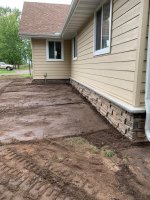
 

Attachments

  • IMG_0106-1 copy.jpg
    IMG_0106-1 copy.jpg
    148.1 KB · Views: 112
To avoid these ads, REGISTER NOW!

yeldogt

Well-known member
Joined
Jan 2, 2012
Messages
18,184
I don'r really understand?

The block could be exposed ? The veneer stone is just decorative to hide the block .... the exposure is based on what is needed for splash protection against the siding ..looks
 

kj_mustang

Well-known member
Joined
Feb 9, 2011
Messages
1,213
Location
Harrisonburg, VA
You should read the install instructions from the stone veneer manufacturer. The veneer I used they state to end the stone a couple inches or so above ground to allow moisture weep.
 

ssdave

Banned
Joined
Apr 11, 2015
Messages
2,913
Location
Eastern Oregon
2 inches minimum from bottom of the stone to the top of the earth, to prevent water from seeping in and breaking it off. Preferably 4 to 6 inches. It should not be below the dirt surface, in any circumstance.
 

yeldogt

Well-known member
Joined
Jan 2, 2012
Messages
18,184
Around here nonody hols the stone above grade. I have never seen damage as a result.

Same here ... what's the point of the product if it does not hide the foundation.


I'm a stone or stone dust stucco guy myself
 
To avoid these ads, REGISTER NOW!

jkeyser14

Well-known member
Joined
Dec 19, 2008
Messages
1,820
Location
(rural) Maryland
Any idea of what mortar they are using? Usually the mortar delaminates.

No clue, but block foundations with mortar joint live below grade year round here too. My last house was 70 years old and the mortar was still perfect below grade. We have a ton of freeze thaw cycles since we are a transition zone climate.
 

scottydosnntkno

Well-known member
Joined
Aug 8, 2010
Messages
670
Same here ... what's the point of the product if it does not hide the foundation.


I'm a stone or stone dust stucco guy myself

No veneer company I have ever seen will recommend installation at or below grade.

99% of veneer companies recommend the stone stop 2-6” above grade. Typically, You would fill this space with mulch, rocks, plants or just leave the foundation exposed. The foundation should be waterproofed to 2”+ above finished grade, or it’s not doing anything. Here in michigan every house has the poured or block wall exposed up to a couple feet depending on the final grade with no issues.

Having the veneer at or below grade, is prone to sucking moisture up, freezing and popping off the veneer
 

yeldogt

Well-known member
Joined
Jan 2, 2012
Messages
18,184
No veneer company I have ever seen will recommend installation at or below grade.

99% of veneer companies recommend the stone stop 2-6” above grade. Typically, You would fill this space with mulch, rocks, plants or just leave the foundation exposed. The foundation should be waterproofed to 2”+ above finished grade, or it’s not doing anything. Here in michigan every house has the poured or block wall exposed up to a couple feet depending on the final grade with no issues.

Having the veneer at or below grade, is prone to sucking moisture up, freezing and popping off the veneer

I'm not a huge fan of fake stone ... but it gets used around me in PA as stone foundations are big. I have never seen it the way you describe -- but, I'm in no way saying you are not correct.

I had to do a tiny match 5' on my current project and used real stone -- that's why I use dusted stucco when I do an outbuilding or addition --- I match the tone of the stone building
 

kj_mustang

Well-known member
Joined
Feb 9, 2011
Messages
1,213
Location
Harrisonburg, VA
No clue, but block foundations with mortar joint live below grade year round here too. My last house was 70 years old and the mortar was still perfect below grade. We have a ton of freeze thaw cycles since we are a transition zone climate.

Those block foundations should have waterproofing over the mortar joints and blocks that are under ground. Stone veneer will not have any waterproofing so the mortar adhering the stones and the mortar grout will be porous and can absorb water.
 

joes169

Well-known member
Joined
Sep 19, 2011
Messages
663
Location
WI
As mentioned, every cultured stone manufacturer highly recommends termnatiing their material at least 2" above grade. Culutured stone is far from other typical masonry materials when it comes to water resistance. Quite the opposite, actually, as it acts more like a sponge. When set below grade, it will eventually wick moiture up the wall, several inches, if not more. If you don't belive me, weigh a chunk of cultured stone, and then soak it in a bucket of water for 30 minutes, and re-weigh it.............
 

joes169

Well-known member
Joined
Sep 19, 2011
Messages
663
Location
WI
Around here nonody hols the stone above grade. I have never seen damage as a result.

Perhaps that's because you don't get called out to look at it after it fails below grade? I do get called, and subsequntly see it quite often. Unfortunately, it rarely ONLY damges the stoen assembly itself. Usually, it's well infested into the sheating, sill plate, and rim joist by the time I see it..........
 
To avoid these ads, REGISTER NOW!
Top Bottom