To avoid these ads, REGISTER NOW!

Caulk or Mortar?

To avoid these ads, REGISTER NOW!

CNGsaves

Well-known member
Joined
Sep 26, 2012
Messages
13,233
Location
KS and OK
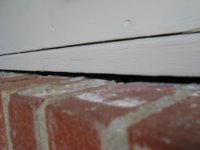
I've lived in 3 houses in row that had same problem as yours.

Those joints REQUIRE lots of maintenance (ie caulk, primer, then paint).

With such a big gap, go buy couple tubes of the cheapest latex caulk you can get and use that as your "filler" caulk. Shove the tip of caulking gun up in there and fill almost all that space with the cheap caulk. Leave about 1/4" gap so you can add better caulk as final layer, but let that filler caulk dry first.

For final caulk, you'll want to put down the blue masking tape on brick about 1/8" inch onto the brick to be ready for last caulking run. Purchase GOOD QUALITY caulk like DAP or GE as your final run with good healthy bead that completely fills space that wasn't filled with the cheap stuff.

Then use "wet finger in cold water" technique to smooth out the caulk to create angle for water between wood and brick. Let dry overnight. Paint several coats of primer, AND couple coats of final paint. Then remove the blue tape and you'll have nice clean line.

Use same top quality DAP caulk for the nail holes and other gaps for boards above (again the wet finger technique to smooth out). Same paint technique of couple coats primer, then final paint.
 

djjsr

Well-known member
Joined
Sep 4, 2006
Messages
4,796
Location
In the cornfields
Latex caulk will not last. Silicone caulk will not bond well.

Fill the big gaps with backer rod. Mask both edges and apply urethane caulk. It can be painted if desired but you can find it in a color very similar to mortar.
 
OP
G

grissom

Well-known member
Joined
Apr 27, 2012
Messages
280
Location
Northern California
I will go with caulking unless someone else posts a different alternative

Maybe this stuff:
Sikaflex® 1a

Sikaflex 1a is a premium-grade, high-performance, moisture-cured, one-component polyurethane-based, non-sag elastomeric sealant used in certain Sika Sarnafil roofing or waterproofing system flashing details. Typical applications include wall, curb and drain terminations. It is also used as a sealant at pipe penetrations and under certain metal flashings
 
OP
G

grissom

Well-known member
Joined
Apr 27, 2012
Messages
280
Location
Northern California
I've lived in 3 houses in row that had same problem as yours.

Those joints REQUIRE lots of maintenance (ie caulk, primer, then paint).

With such a big gap, go buy couple tubes of the cheapest latex caulk you can get and use that as your "filler" caulk. Shove the tip of caulking gun up in there and fill almost all that space with the cheap caulk. Leave about 1/4" gap so you can add better caulk as final layer, but let that filler caulk dry first.

For final caulk, you'll want to put down the blue masking tape on brick about 1/8" inch onto the brick to be ready for last caulking run. Purchase GOOD QUALITY caulk like DAP or GE as your final run with good healthy bead that completely fills space that wasn't filled with the cheap stuff.

Then use "wet finger in cold water" technique to smooth out the caulk to create angle for water between wood and brick. Let dry overnight. Paint several coats of primer, AND couple coats of final paint. Then remove the blue tape and you'll have nice clean line.

Use same top quality DAP caulk for the nail holes and other gaps for boards above (again the wet finger technique to smooth out). Same paint technique of couple coats primer, then final paint.


Did you use the blue tape to give a straight line when caulking or just when painting?
 

1/2 Cup

Member Emeritus
Joined
Apr 28, 2012
Messages
19,283
Location
Shepparton. Victoria. Australia
Latex caulk will not last. Silicone caulk will not bond well.

Fill the big gaps with backer rod. Mask both edges and apply urethane caulk. It can be painted if desired but you can find it in a color very similar to mortar.

This is the method I have used in the past and it still looks good an works effectively.:thumbup:
 

boiler7904

Well-known member
Joined
Apr 4, 2006
Messages
3,414
Location
NW IN
Foam backer rod and a quality urethane or polyurethane sealant. Sealants are only meant to stretch / move in one direction across two surfaces so the backer rod keeps it from bonding to the back of the gap (third surface) and preventing movement.

Sonneborn Sonolastic NP-1 if you want gun ready in one of 12 standard colors

Sonneborn Sonolastic NP-2 if you aren't afraid of mixing 3 components to get one of 450+ available colors.

Sonneborn Product List

Sika makes some similar products

Both should be available through local commercial construction supply houses with some stock colors available over the counter at big boxes.
 
To avoid these ads, REGISTER NOW!

CNGsaves

Well-known member
Joined
Sep 26, 2012
Messages
13,233
Location
KS and OK
Did you use the blue tape to give a straight line when caulking or just when painting?

Both . . . scrape off any old caulk or paint, and/or wire brush the brick to get it to clean surface.

The tape trick is what my older neighbor showed me (and have seen again on This Old House, ie home improvement shows). It works great to give nice clean line for both caulk and paint ; thus, don't have to be real careful when painting since you have the blue tape as protection.

Others are recommending colored caulk which will get you close in color. However, I've found you'll get best results by painting everything in primer first (both wood and caulk), then follow-up with couple coats of final paint.

IF that gap ends up being massive, then go with the backer rod to fill up the space, and skip the cheap caulk and just use DAP or GE quality caulk. Good luck.
 

kbs2244

Well-known member
Joined
Nov 11, 2006
Messages
14,065
I would do some examineing first.

Do you have any kind of moisture gap behind the siding and then behind the brick?
You should, and you do not want to block it.

All exterior siding will pass a driving rain through to the back side.
That is why there is a moisture barrier over the sheathing.

That moisture has to be allowed to drip down to the very bottom.
It then will seep out some gaps between the bricks that have some poly webbing in them instead of mortar.
They are called, strangely enough, “weep holes.”

So, if you want to caulk it, go ahead.
Just do not push your backing too far in.
 
OP
G

grissom

Well-known member
Joined
Apr 27, 2012
Messages
280
Location
Northern California
Both . . . scrape off any old caulk or paint, and/or wire brush the brick to get it to clean surface.

The tape trick is what my older neighbor showed me (and have seen again on This Old House, ie home improvement shows). It works great to give nice clean line for both caulk and paint ; thus, don't have to be real careful when painting since you have the blue tape as protection.

Others are recommending colored caulk which will get you close in color. However, I've found you'll get best results by painting everything in primer first (both wood and caulk), then follow-up with couple coats of final paint.

IF that gap ends up being massive, then go with the backer rod to fill up the space, and skip the cheap caulk and just use DAP or GE quality caulk. Good luck.

The reason why I asked about the blue tape and the caulking was when I did another section of the house the caulking would tear out when I waited to remove the tape and I called DAP customer service and they told me to remove it as soon as I filled the joint

So you had good luck with waiting? How long have you been able to leave the tape in place and have a clean removal from the caulking and painting?

Thanks
 

cburnscrx

Well-known member
Joined
Jan 15, 2013
Messages
1,751
Location
Indianapolis
Use this...best stuff ever!

LEXEL

http://www.sashco.com/hi/lexel.html

Elastomeric with powerful adhesion—stretches but won't tear, crack or pull away and will not rip apart the substrate when joints expand
Can be applied to joints up to 2" wide
Paintable
Water and mildew resistant
Full 10.5 oz. in every cartridge
Lexel sticks to itself, making repairs easy
Won't freeze
Limited Lifetime Warranty
Stop-flow plunger
Available in Clear and White *
Available in 10.5 oz. cartridges and 5.5 oz. squeeze tubes
Lexel white is available in a VOC-compliant formula *

I have used this in a lot of applications, and it's great. I even used it to seal a basement leak (where the sump pump dumps into the drain) and it's fantastic. It is however expensive in the world of caulk. Around here it's $10 a tube, so depending on how much you need to do...
 

kd3pc

Well-known member
Joined
Aug 10, 2013
Messages
3,630
Location
Northern Neck
I will go with caulking unless someone else posts a different alternative

Maybe this stuff:
Sikaflex® 1a

Sikaflex 1a is a premium-grade, high-performance, moisture-cured, one-component polyurethane-based, non-sag elastomeric sealant used in certain Sika Sarnafil roofing or waterproofing system flashing details. Typical applications include wall, curb and drain terminations. It is also used as a sealant at pipe penetrations and under certain metal flashings

sikaflex is good stuff. it holds up well in marine environments. For best results make sure both sides are clean, dry and the temp is reasonable.

Other polyurethanes are similar..and may be as good at a more reasonable price as sika can be pricey.
 

CNGsaves

Well-known member
Joined
Sep 26, 2012
Messages
13,233
Location
KS and OK
The reason why I asked about the blue tape and the caulking was when I did another section of the house the caulking would tear out when I waited to remove the tape and I called DAP customer service and they told me to remove it as soon as I filled the joint

So you had good luck with waiting? How long have you been able to leave the tape in place and have a clean removal from the caulking and painting?

Unless you're smearing tons of caulk onto the blue tape, there shouldn't be enough on there to pull out caulk (from house/wood joint) when you later remove tape.

I probably left tape on there a couple days while going through the steps of caulk, primer, then final paint. If you've got a thick spot of caulk, then run sharp utility knife down the tape line since you have brick underneath.

Couple spots on bay windows I did leave tape up there too long (like a week) and the blue tape left residue on brick. Some light wire brush work cleaned up the brick.

Good comment by post above about installing with proper temperature - - thus don't caulk at low temps, or super high temps.
 

cburnscrx

Well-known member
Joined
Jan 15, 2013
Messages
1,751
Location
Indianapolis
Temp - depends on what kind of caulk you're using. You can apply Lexel when wet and as long as it's above freezing!
 

MrMark

Well-known member
Joined
Jan 25, 2010
Messages
4,626
Location
Southern Cal.
You are missing the flashing is what I see. If it is what I think it is, that joint is not meant to be caulked at all. The flashing gets slipped under the building paper or wrap and that gap must be kept clear for the flashing to do its job.
 
OP
G

grissom

Well-known member
Joined
Apr 27, 2012
Messages
280
Location
Northern California
You are missing the flashing is what I see. If it is what I think it is, that joint is not meant to be caulked at all. The flashing gets slipped under the building paper or wrap and that gap must be kept clear for the flashing to do its job.

If there is some flashing missing :dunno:, the house was built in the mid 50's and the exterior has never been remodeled.

The area were this gap is should not get a lot of rain unless its wind driven and proper caulking along with painting should keep it out - I hope as I have not seen any issues

Thanks to all for the advice
 

Kevin54

MEMBER EMERITUS
Joined
Jan 12, 2005
Messages
29,341
Location
Urbana, Ohio
You are missing the flashing is what I see. If it is what I think it is, that joint is not meant to be caulked at all. The flashing gets slipped under the building paper or wrap and that gap must be kept clear for the flashing to do its job.

Back at that time, they didn't use flashing. My parents house was built the same way back in the 50's. There is a slight space between the brick and the subsiding, but when they did that, they never thought too much about flashing, weep holes, or even insulation.

If it were me, get some of the best caulk you can find, lay down a couple strips of tape, one on the brick and one on the siding, caulk it, clean up, and call it a day.
 
To avoid these ads, REGISTER NOW!
Top Bottom