To avoid these ads, REGISTER NOW!

Ceiling fan and the "area of effect"

Tremelune

Well-known member
Joined
Jun 23, 2010
Messages
129
Location
USA
I just installed a 60" Minka Lavery ceiling fan, and it's great but for one thing: its area of effect is a sharp cylinder. If you're directly under the blades, its great. If you're an inch outside of them, there is no wind. This isn't a massive garage, it's my bedroom. My ceilings are maybe 9ft.

I tried to search around to see if this was measured or distinguishable between different kinds of blades/fans, but it doesn't seem like this is spoken about much. I'm hoping for a wide cone to cover more of the room with the single fan.

My recourse is just to buy a different fan, but without knowing how to gauge the "blow cone", the best I can do is get fan that is 72" or pay nearly a grand for something even larger...Maybe get one that moves so much air the whole room swirls...?
 
To avoid these ads, REGISTER NOW!

quattro_sinko

Well-known member
Joined
Jun 10, 2014
Messages
417
Location
Upstate NY
If I couldn't return it, I'd experiment with blade shape using tinfoil and masking tape, or something similarly scientific-like. If I found that a modification produced a wider cone, I'd think about permanently modifying the blades. Are they PVC or Masonite?

(Experiment at your own risk:shocking:)
 

LS6 Tommy

Well-known member
Joined
Dec 27, 2013
Messages
26,162
Location
Northern NJ
A straight blade vane axial fan is only going to move air in a relatively straight column. It's just the physics of the design. You need something with angled winglets on the ends to expand the affected area. Winglets add to motor load, so a DIY version may damage the motor.

Tommy
 

quattro_sinko

Well-known member
Joined
Jun 10, 2014
Messages
417
Location
Upstate NY
A straight blade vane axial fan is only going to move air in a relatively straight column. It's just the physics of the design. You need something with angled winglets on the ends to expand the affected area. Winglets add to motor load, so a DIY version may damage the motor.

Tommy

Agreed on all counts, check out the winglets on the BAF. I wonder about the possibility of ever so slightly adjusting the "trim" of the blades. I would think that a 1-2 degree tip up at the ends (from perfectly horizontal) would increase the diameter of the area of effect. Balancing it would be interesting...
 

4xdog

Well-known member
Joined
Aug 18, 2012
Messages
5,629
Location
Santa Fe, NM
I don't use my ceiling fans for "wind". I use them for "circulation".

Doesn't that downward blowing column result in air movement throughout the room? The physics would seem to insist that it would.

This fan provides adequate circulation in my BR on its lowest setting. But not really "wind".

i-f9cwgjB-X3.jpg
 
Last edited:

TractorJeff

Well-known member
Joined
Dec 8, 2013
Messages
3,309
Location
Elkhorn, WI
Yes, it is my understanding that the fan in summer pushes down creating a cooling effect on a person, then glides across the floor to return up the wall, back across the ceiling to the fan. Assuming it is reversible, then in winter it ***** up pushing air across the warm ceiling, down the walls to the floor, then back up to the fan. The theory being that you will not perceive a cold draft this way!
 

matt_i

Well-known member
Joined
Mar 14, 2008
Messages
10,753
Location
SE Michigan
My experience is this, if the fan is close up to the ceiling with minimal downrod it throttles the airflow.

I have something like a 72" in my house, has about a 4 foot down rod on an angled side of th scissor truss ceiling and it moves a good amount of air all around the great-room.

I put an 84" in my shop and it has the same effect as you noted above...a cylinder of air but that's it, but its mounted tight to the ceiling. I put in a couple of 54" to boost the big central one I felt certain would take care of the entire shop...those are the same but again I pushed them tight to the ceiling for clearance below.

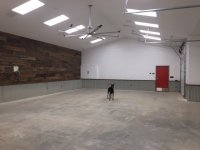
Note the BAF above has around a 2-3ft down rod as well...
 
To avoid these ads, REGISTER NOW!
OP
T

Tremelune

Well-known member
Joined
Jun 23, 2010
Messages
129
Location
USA
I wonder how much of it is blade shape, how much is distance from ceiling, and how much is overall height above me...

WHERE ARE THE SCIENTIFIC STUDIES
 

PoorOwner

Well-known member
Joined
Feb 10, 2007
Messages
5,032
Location
CA
Mine can be felt on the other side of the garage. I have a 72” one

It depends of blade pitch and number of blades and rod length all affect the effeciency a little.
 
OP
T

Tremelune

Well-known member
Joined
Jun 23, 2010
Messages
129
Location
USA

This is fantastic. Unfortunately, it does not touch upon the cone of effect too much, and ends in a lament that is really hitting home:

I have to admit that at the end of my research, I feel a little helpless. While I am now more aware on what makes an efficient ceiling fan, I am also aware that it is difficult to tell if a ceiling fan is efficient simply based on its individual design features. As mentioned earlier, these individual design features all act simultaneously to give the net outcome on whether the given ceiling fan is efficient.

I suspect my best bet is to look into a fan that moves so much damn air there just isn't a static piece of paper anywhere in the room...
 

James-W

Well-known member
Joined
Feb 3, 2013
Messages
12,432
Location
Southeastern Wisconsin
We have fans in the bedrooms, living room and dining room. They circulate the air and we don't really feel a "wind" anywhere in the room, but if we are right under the fan we do feel a "breeze" from it. Thing is though, we don't sit under the fans to cool off because we have central air, all the fans do is keep the air circulating.
 

TractorJeff

Well-known member
Joined
Dec 8, 2013
Messages
3,309
Location
Elkhorn, WI
We have a "big" Fan (60"?) in our Living Room where the Wood Stove is.
From experience We can tell you that the Fan will move air as it will move the "accidental" Smoke tests we have performed over the years! :lol_hitti
 
To avoid these ads, REGISTER NOW!
Top Bottom