SpiderDave
Well-known member
- Joined
- Feb 17, 2018
- Messages
- 207
Hi all! I have a work area in my pole barn. I want to put in a finished ceiling, but I'm not sure how entirely. The biggest factor here is for it to absorb noise from tools and be fire proof, both. This is hard to explain short so bare with me please? I'm not good at this.
I'd like to use sheet rock, but I don't know if the ceiling can handle the weight? And doing it myself with no help, that's won't be possible anyway.
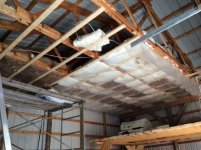
I have a metal roof, under that is roll fiberglass insulation with a vinyl backing facing the interior that's sandwiched between the roofing and the joists. I'd like to fill the left over void between the 2x6's with fiberglass batting and put something over that. Then I planned on putting a layer of Rockwool insulation batts over that too. This'll help absorb noise and help shield form sparks when I'm welding and grinding. I bought the batts super dirt cheap and decided to roll with it since 4x8 panels were too expensive. I plan on using a lightweight fencing wire or even chicken wire to make a barrier that'll hold back the Rockwool. I'll be accounting for stretching and even tension along the way. Think of it like a dropped ceiling full of Rockwool batting, but snug against the ceiling with no air space. I know it sounds pretty extreme but there are reasons for putting the Rockwool up. Just trust me on that one.
If I used a 1/4" plywood, it would be expensive but I 'would' be able to screw into any area needed to accommodate the screen that holds the rockwool up as I put it in. (Might not even need a screen then.) And it would help reduce noise as well.
I'd much rather use styrofoam sheet as it's super lightweight. But I'd be limited to screwing into the studs only and that would prove more tedious, harder, take longer, but still do-able. And not as sound retardant as plywood though. I could just put up corrugated roofing and call it a day. But the noise would be terrible and it would likely sweat at some point and trail down to the wall wouldn't it? Even then, it would be noisy.
The vapor barrier under the roofing is a concern. If I put styrofoam up, that might trap moisture between them. I forgot to mention that the interior ends of the rafter cavities (ceiling) would still be open to interior of the shop. The other end is a dead end exterior wall. So I was wondering if that was enough to let moisture out? Or would plywood be light enough, if I keep it at 1/4" thick ply? If I use ply, should I not use a vapor barrier beneath it? Not sure I'm explaining it right and I couldn't get pics to load.
I had considered adding more 2 x 6 joists or even doubling them? Or every other one maybe - if I had to. I was hoping someone might have ideas to toss my way here? (Fire proof and sound retardant/absorbant)
Rafters are 2x6's, 24" on center at an 11ft span. Room will be heated on occasion. Rockwool is 2'x4' @ 3" thick.
Thanks everybody who hung in there reading all that. Heh. I couldn't make that any shorter. I really appreciate it.
I'd like to use sheet rock, but I don't know if the ceiling can handle the weight? And doing it myself with no help, that's won't be possible anyway.
I have a metal roof, under that is roll fiberglass insulation with a vinyl backing facing the interior that's sandwiched between the roofing and the joists. I'd like to fill the left over void between the 2x6's with fiberglass batting and put something over that. Then I planned on putting a layer of Rockwool insulation batts over that too. This'll help absorb noise and help shield form sparks when I'm welding and grinding. I bought the batts super dirt cheap and decided to roll with it since 4x8 panels were too expensive. I plan on using a lightweight fencing wire or even chicken wire to make a barrier that'll hold back the Rockwool. I'll be accounting for stretching and even tension along the way. Think of it like a dropped ceiling full of Rockwool batting, but snug against the ceiling with no air space. I know it sounds pretty extreme but there are reasons for putting the Rockwool up. Just trust me on that one.
If I used a 1/4" plywood, it would be expensive but I 'would' be able to screw into any area needed to accommodate the screen that holds the rockwool up as I put it in. (Might not even need a screen then.) And it would help reduce noise as well.
I'd much rather use styrofoam sheet as it's super lightweight. But I'd be limited to screwing into the studs only and that would prove more tedious, harder, take longer, but still do-able. And not as sound retardant as plywood though. I could just put up corrugated roofing and call it a day. But the noise would be terrible and it would likely sweat at some point and trail down to the wall wouldn't it? Even then, it would be noisy.
The vapor barrier under the roofing is a concern. If I put styrofoam up, that might trap moisture between them. I forgot to mention that the interior ends of the rafter cavities (ceiling) would still be open to interior of the shop. The other end is a dead end exterior wall. So I was wondering if that was enough to let moisture out? Or would plywood be light enough, if I keep it at 1/4" thick ply? If I use ply, should I not use a vapor barrier beneath it? Not sure I'm explaining it right and I couldn't get pics to load.
I had considered adding more 2 x 6 joists or even doubling them? Or every other one maybe - if I had to. I was hoping someone might have ideas to toss my way here? (Fire proof and sound retardant/absorbant)
Rafters are 2x6's, 24" on center at an 11ft span. Room will be heated on occasion. Rockwool is 2'x4' @ 3" thick.
Thanks everybody who hung in there reading all that. Heh. I couldn't make that any shorter. I really appreciate it.