To avoid these ads, REGISTER NOW!

Ceiling insulation damp near heater.

Skewkk

Member
Joined
Jan 1, 2023
Messages
5
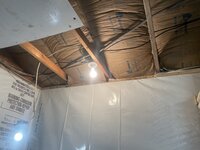
I recently installed insulation in my garage ceiling. I put in foam rafter vents as the only ventilation for the roof is from the soffits. Noticed that I had trouble sealing where the truss meets the wall and tried putting in some insulation scraps to help seal the area. It worked but I began to second guess that as I figured it would put too much pressure on the rafter vents and block them off. I pulled the insulation out and discovered that the area near the heater had some moisture in the bottom section where it meets the wall near the soffit. I’ve come to understand that this is due to the cold air mixing with warm air condensing.

I decided to run 2 1x4s along the bottom of the trusses on the wall and use a small amount of scrap insulation to seal the gap. Then I intend to use white 8mil poly to seal it up like I did on the walls.

If I continue to go along with this plan am I creating a future nightmare for myself? I thought I had researched this enough but apparently I had not and finding answers regarding this has been difficult.

 

Attachments

  • IMG_5653.jpeg
    IMG_5653.jpeg
    781.7 KB · Views: 43
  • IMG_5652.jpeg
    IMG_5652.jpeg
    556.2 KB · Views: 43
  • IMG_5651.jpeg
    IMG_5651.jpeg
    533.4 KB · Views: 42
  • IMG_5650.jpeg
    IMG_5650.jpeg
    538.1 KB · Views: 42
To avoid these ads, REGISTER NOW!

billconner

Well-known member
Joined
Jul 20, 2021
Messages
6,971
Location
Thousand Islands NYS
Are the vent baffles below the insulation? ( The white tray things in first photo?) And what are you sealing with insulation? It doesn't stop warm moist bouyant interior air from passing through.

What surface is the condensation on? I can only guess it was chilled to below the dew point.
 
OP
S

Skewkk

Member
Joined
Jan 1, 2023
Messages
5
Are the vent baffles below the insulation? ( The white tray things in first photo?) And what are you sealing with insulation? It doesn't stop warm moist bouyant interior air from passing through.

What surface is the condensation on? I can only guess it was chilled to below the dew point.
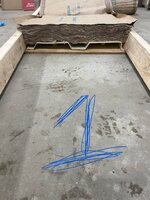
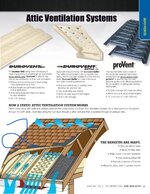
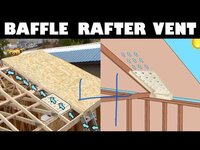
Im having a bit of difficulty explaining this in a coherent manner and for that I apologize. Pic 1 This is what a cross section of what I have in the rafters. Pic 2 I have durovent baffles on the very bottom of the truss. I have the regular durovent above that all the way to the peak(ridge) to allow airflow from one side of the building to another. This is what I was recommend to do by the supply desk at the green midwestern hardware store Picture 3 The circled portion is where I’m finding moisture under the durovent and on the top of the insulation. I think this is caused by where the cold air meets the warm air. I have steel clips that hold the trusses to the top of the frame of the building and it prevented me from creating a good seal to keep the outside air from coming into the workspace. Picture 4 is an additional picture showing what it’s supposed to do.

For reference the temp is 21°F real feel is 15° the humidity is at 89% and the dew point is 19° we have also recently gotten 3 inches of wet snow with lots of wind.
 

Attachments

  • IMG_5662.jpeg
    IMG_5662.jpeg
    943.4 KB · Views: 23
  • IMG_5664.jpeg
    IMG_5664.jpeg
    110.1 KB · Views: 21
  • IMG_5663.jpeg
    IMG_5663.jpeg
    52.1 KB · Views: 20
  • IMG_5665.jpeg
    IMG_5665.jpeg
    53.7 KB · Views: 28
Last edited:
OP
S

Skewkk

Member
Joined
Jan 1, 2023
Messages
5
Is that a ventless heater? If so those put a lot of moisture in the air.
Yes it’s a Dyna-Glo 30,000 BTU Dual Fuel Vent Free Infared wall heater. It was recommended over the convection one for uninsulated spaces. But after a week of not choking on the fumes from the torpedo heater in the garage I figured insulation was the way to go.
 
To avoid these ads, REGISTER NOW!

Shiftless

Well-known member
Joined
Mar 9, 2014
Messages
14,580
Location
East Bay SFO
Any vent free heater that burns hydrocarbon fuels, natural gas, propane or other, ALWAYS gives off moisture. That’s an inescapable law of science. The heaters WITH vents of course also give off moisture, but that goes out the vent into the outdoors.

If you have a heater that produces 30,000 BTU’s per hour, you will get a bit more than a quart of water added to the interior of your space for every hour that your heater runs. The water comes off at first as vapor, but when it cools, it turns to liquid water. That‘s what is soaking your insulation.
 
Last edited:
OP
S

Skewkk

Member
Joined
Jan 1, 2023
Messages
5
Any vent free heater that burns hydrocarbon fuels, natural gas, propane or other, ALWAYS gives off moisture. That’s an inescapable law of science. The heaters WITH vents of course also give off moisture, but that goes out the vent into the outdoors.

If you have a heater that produces 30,000 BTU’s per hour, you will get a bit more than a quart of water added to the interior of your space for every hour that your heater runs. The water comes off at first as vapor, but when it cools, it turns to liquid water. That‘s what is soaking your insulation.
Any vent free heater that burns hydrocarbon fuels, natural gas, propane or other, ALWAYS gives off moisture. That’s an inescapable law of science. The heaters WITH vents of course also give off moisture, but that goes out the vent into the outdoors.

If you have a heater that produces 30,000 BTU’s per hour, you will get a bit more than a quart of water added to the interior of your space for every hour that your heater runs. The water comes off at first as vapor, but when it cools, it turns to liquid water. That‘s what is soaking your insulation.
I’ll look into finding something to track the humidity in the area and purchase a dehumidifier to run in the area if needed. I appreciate the assistance.

Edit: I’ll find a dehumidifier that matches the output of my heater.
 
OP
S

Skewkk

Member
Joined
Jan 1, 2023
Messages
5
You have no ridge vent?

Soffit vents are useless with out a ridge vent in this application.
That makes for an unfortunate oversight on my part. I’ll have to either pull the insulation back on the top and bottom of the rafters or install a ridge vent in December with the cold weather. I’m leaning towards the former as opening up the roof right now seems unwise.
 
To avoid these ads, REGISTER NOW!
Top Bottom