I'm looking at putting a piece of square tubing in the ground upright inside my garage at the back wall so I can mount a winch. It would be used for pulling in vehicles that don't run. My thoughts are to put the square tube in a 5 gallon bucket, pour Cement in it and bury the bucket in the ground a little, then do my rebar and Cement floor after. Winch will be removable because I will also put on my trailer. My question is, would this be enough support or should I add something to strengthen it? Worried after time the cement might start to crack there or break on a pull.


You are using an out of date browser. It may not display this or other websites correctly.
You should upgrade or use an alternative browser.
You should upgrade or use an alternative browser.
Cement and winch
- Thread starter 70staged
- Start date
couch67
Well-known member
Sounds like a good idea. I think you would need to consider how high the winch/square tube will extend from the slab, if too high the lever effect could bend the tube at the slab (depending on load and tube size of course).
Dumber than lumber
Well-known member
- Joined
- Dec 19, 2015
- Messages
- 2,028
There is some physics involved here. But I don’t know the answer or how to get it. The install might be better if your upright is mounted to a base plate. Add to that, an I-beam might be stronger depending on what you can find.
I would think that you want to go at least 24 inches deep with the embed. And a 5 gallon bucket seems too small for the job.
What did that old-timer say? Never time to do it right, until you have to do it over.
I would think that you want to go at least 24 inches deep with the embed. And a 5 gallon bucket seems too small for the job.
What did that old-timer say? Never time to do it right, until you have to do it over.
Last edited:
wssix99
Well-known member
Cracks will radiate from any penetration or object installed in the floor. To avoid cracking, you need to isolate the object from the slab and (depending on the location) address it with saw cut joints. Being along the wall, you should be able to avoid cracking by making the hold in the slab larger than the penetration, using foam or something like that.
If you are building new, why not reinforce your wall for the winch and attach the winch to that? Your wall attaches to the foundation and that isn't moving... A winch attached to a strudy wall (attached to a solid foundation or monolithic slab) should do better for you than one attached to a makeshift counterweight.
The anchor pots that wyattrose69 mentions, being embedded in the slab, would also do a better job and would resist more shear than a counterweight under the slab. However, you'd need to pay attention to shrinkage cracks radiating from the anchor pots. (depending on their location)
If you are building new, why not reinforce your wall for the winch and attach the winch to that? Your wall attaches to the foundation and that isn't moving... A winch attached to a strudy wall (attached to a solid foundation or monolithic slab) should do better for you than one attached to a makeshift counterweight.
The anchor pots that wyattrose69 mentions, being embedded in the slab, would also do a better job and would resist more shear than a counterweight under the slab. However, you'd need to pay attention to shrinkage cracks radiating from the anchor pots. (depending on their location)
Viper98912
Well-known member
What kind of vehicles are we talking about? It sounds like you're creating a cantilever, which really needs some calculation behind it. But it all depends on the vehicle and the amount of force it takes to get it rolling. Have you figured out how you're going to stop the vehicle once it gets into your garage?
CraigStu
Well-known member
I think you would be fine. I don't know the answer but pulling a 3000# car up a bit of a slope is only going to need a few 100#s of effort. If 4 guys could push it in, your floor will be fine. But I am not sure I'd bother w/ the bucket. I'd be tempted to go w/ dumber's idea. You could make the tube a little longer and dig out a little more in just that area so you have more than the usual 4-6 inch slab thickness. You could also set the tube so it sticks a little above the expected floor level just in case. And then trim it flush after the concrete sets. Keep your pull concentrated right at floor level vs above it somewhere it.
Fasthotrod
Well-known member
Seems like an interesting idea... the question would be, what are the design forces that you're going for here? Will it be a smooth approach into the shop, or will you be having a lip at the door to keep water out? I ask, because any obstruction to the rolling of the tires will add additional resistance that the winch will have to overcome. Will you be dragging things off of a trailer that cannot easily be rolled off? If so, that's going to require more force.
Couch67 is correct about the height... the taller the post, the more force that is going to be transferred into the base. As an example, if the post was 1 foot tall off the floor, and you had a pulling force of 200 lbs, that's 200 ft lbs applied at the base. If the post is 2 ft, that's now 400 ft lbs. 3 ft, is 600 ft lbs. All of that torque would be applied at the base of the post where it penetrates the concrete, so you need to know the forces to design it correctly. The deeper the post, the more force than can be counteracted and spread across the post.
As WSSLX99 mentioned, unless you design the floor for that type of stress, it could cause your slab to crack. Isolation with the top slab to prevent cracks is a good idea in that regard, and if you are still in the planning stages then I'd be talking to an engineer about adding some additional concrete in that area to really beef it up.
All things considered, raw concrete is cheap compared to the labor for forming it up, screeding it, and finishing it. I haven't priced a yard of concrete in a while, but last time I checked it was less than $150/yard. A yard is basically a 3' x 3' x 3' cube. (27 cu ft) The deeper and wider you go, the more the Earth and the weight of the concrete will help in counteracting the force put on the post. So why not plan on just setting the post in place during the pour, with that section of the slab being deeper and longer in the direction of the pull? Use rebar reinforcement, and I'd even weld the rebar to the post in each direction to hold it in place during the pour, and spread out the forces across a greater area.
If you are going to be pouring a footing, then the slab, then you could account for an additional form for the footing for the post mounting. Pour the footing with the post and rebar solid, with no gaps. Then when you pour the slab, use a piece of PVC pipe around the receiver to give it some space around it relative to the slab. Then come back and fill that gap with something soft/pliable. (Foam, sand, caulk, etc...)
All of that being said, you mentioned removing the winch to use on your trailer... so would you want this receiver flush with the floor? My first thought was to have your typical receiver hitch style post in the ground that sticks up a few inches or so, making the inner post capable of sliding into the receiver in the floor when in use, and easily removed when not. A simple receiver hitch cover would keep it protected from debris when not in use. But that might be a trip hazard unless you cover it with a cone, or stick something in there to keep you aware of it.
But what if you wanted to use it for more than one purpose? Why not make a post and pad to mount a bench grinder on it? Drill two holes, then weld a nut on two sides of the receiver 90 degrees from each other, so that when you slide the post in you can use two bolts screwed into the nuts to cinch the post down so that it doesn't wobble on you. When you need to use the winch, simply loosen the bolts, slide the post and grinder out and set it aside. When you're done, put it back in place.
Just throwing ideas out there... I hope that they are useful. To me, a few hundred in extra concrete up front to make a solid base for the post is a good investment.
Mark
Couch67 is correct about the height... the taller the post, the more force that is going to be transferred into the base. As an example, if the post was 1 foot tall off the floor, and you had a pulling force of 200 lbs, that's 200 ft lbs applied at the base. If the post is 2 ft, that's now 400 ft lbs. 3 ft, is 600 ft lbs. All of that torque would be applied at the base of the post where it penetrates the concrete, so you need to know the forces to design it correctly. The deeper the post, the more force than can be counteracted and spread across the post.
As WSSLX99 mentioned, unless you design the floor for that type of stress, it could cause your slab to crack. Isolation with the top slab to prevent cracks is a good idea in that regard, and if you are still in the planning stages then I'd be talking to an engineer about adding some additional concrete in that area to really beef it up.
All things considered, raw concrete is cheap compared to the labor for forming it up, screeding it, and finishing it. I haven't priced a yard of concrete in a while, but last time I checked it was less than $150/yard. A yard is basically a 3' x 3' x 3' cube. (27 cu ft) The deeper and wider you go, the more the Earth and the weight of the concrete will help in counteracting the force put on the post. So why not plan on just setting the post in place during the pour, with that section of the slab being deeper and longer in the direction of the pull? Use rebar reinforcement, and I'd even weld the rebar to the post in each direction to hold it in place during the pour, and spread out the forces across a greater area.
If you are going to be pouring a footing, then the slab, then you could account for an additional form for the footing for the post mounting. Pour the footing with the post and rebar solid, with no gaps. Then when you pour the slab, use a piece of PVC pipe around the receiver to give it some space around it relative to the slab. Then come back and fill that gap with something soft/pliable. (Foam, sand, caulk, etc...)
All of that being said, you mentioned removing the winch to use on your trailer... so would you want this receiver flush with the floor? My first thought was to have your typical receiver hitch style post in the ground that sticks up a few inches or so, making the inner post capable of sliding into the receiver in the floor when in use, and easily removed when not. A simple receiver hitch cover would keep it protected from debris when not in use. But that might be a trip hazard unless you cover it with a cone, or stick something in there to keep you aware of it.
But what if you wanted to use it for more than one purpose? Why not make a post and pad to mount a bench grinder on it? Drill two holes, then weld a nut on two sides of the receiver 90 degrees from each other, so that when you slide the post in you can use two bolts screwed into the nuts to cinch the post down so that it doesn't wobble on you. When you need to use the winch, simply loosen the bolts, slide the post and grinder out and set it aside. When you're done, put it back in place.
Just throwing ideas out there... I hope that they are useful. To me, a few hundred in extra concrete up front to make a solid base for the post is a good investment.
Mark
Walkers
Well-known member
I welded a face plate to a 2.5" receiver tube, cored a hole in the concrete, excavated some ABC and concreted it flush. The face plate has some tapped holes for bolting. It is one of the handiest things. I have mounted a winch, vise on a post, manual tire machine, etc. Works very well.
billconner
Well-known member
Anchor column to go floor and roof framing, then just shear at anchors, easily handled. Would be same as reinforcing wall framing, but perhaps more flexible. Anything that avoids the cantilever out of floor will avoid most problems.
nadogail
Well-known member
Your Anchor can also be called a "Dead Man" and it will have to support the weight of the winch plus the force applied to the cable, or chain, that will be pulling the car. The force needed to pull the car will vary by the weight of the car, the rolling resistance and any incline in the path of the pull. Any pull, other than a Straight Line, will be increased by the angularity of the strain.
As previously mentioned by others you will need a way to stop the rolling car as you pull it in, maybe a bumper to pull it against or chocks for the wheels, two tons of rolling car can be formidable to try and stop with a human body.
I stopped for breakfast while writing this, and i see Fast Hot Rod has given you some, what I consider, Very Good Advice. WORK SAFELY
As previously mentioned by others you will need a way to stop the rolling car as you pull it in, maybe a bumper to pull it against or chocks for the wheels, two tons of rolling car can be formidable to try and stop with a human body.
I stopped for breakfast while writing this, and i see Fast Hot Rod has given you some, what I consider, Very Good Advice. WORK SAFELY
My heated shop is about 5" over 20' above the outer (not heated, tensioned fabric covered) outer shop door, and I am usually working alone. As others have mentioned: I just put a lag in the pad near the front and center of the main working bay and just use a block and tackle (4:1) to pull stuff inside. I can move my 9,000 lb. F450 without too much stress. Could just as easily use a 2,000 lb. ATV winch mounted to a plate. Usually have to connect to bottom of vehicle anyway, so works extremely well.
FredWanaker
Well-known member
another option is to park your truck behind the non-runner, run the winch line under it, to a ****** block anchored to a base plate, and back to the non-runner. That way you don't need to remove your winch all the time. Don't over think it.
Kaizen
Well-known member
agree overthinking this. i mounted a hf ac 110 volt winch on a hf tailgate vice mount (i think) and welded it to a receiver tube. I used it to build my garage by mounting it to other things. I put a lag through it into my 2x walls and pulled my truck in once. If the vehicle is rolling you won't need much. If this is something you do often drill a pull pot after concrete is done.
Plan on keeping the winch low, my winch now mount to a receiver hitch on my trailer. Use would be in the ground and don't plan on having much tube sticking up. Would be a smooth approach indide garage and Cement outside. I'll be able to back the trailer fairly close so it wouldn't be pulling all that far. Floor once poured would have 6" 0f Cement.
ZRX61
Well-known member
I once had to push my 6000lb F350 LB, CC Dually into my garage.. there was about a 2in in 20ft slope & a small 3/4in hump by the door. It took about 45 minutes, front wheels stopped at the small hump, so then had to back the truck up & try again. That happened about 5 or 6 times.. then it stopped again when the rear wheels hit the hump, but I could only back it up so the front wheels were up against the garage side of the hump.. that took about 10 attempts.Considering that its pretty easy to push by hand a car with inflated tires on flat ground you may be over thinking this.
I'm older, wiser & slower now, I'd just sell the damn thing rather than push it
The best hack I have seen was at a rented building
The shop owner put a wood 4x6x 20 feet snug up against the back wall outside the building
He wrapped a chain around the 4x6 and a half brick sized hole in the back wall let him fish a chain through the wall and under his tool boxes that lined that wall
When he had to pull in a truck, he pulled the chain out from under the tool box, hooked a come along to it and pulled the truck in
The strain was spread out along the bottom of the whole back wall
He had been in the building over 10 years and had been using this setup once a week for most of that time when I saw it in action
The shop owner put a wood 4x6x 20 feet snug up against the back wall outside the building
He wrapped a chain around the 4x6 and a half brick sized hole in the back wall let him fish a chain through the wall and under his tool boxes that lined that wall
When he had to pull in a truck, he pulled the chain out from under the tool box, hooked a come along to it and pulled the truck in
The strain was spread out along the bottom of the whole back wall
He had been in the building over 10 years and had been using this setup once a week for most of that time when I saw it in action
Pull a car? A 1/2" redhead anchor in the concrete will do it just fine, as long as you don't get crazy. If the car has major issues and the tires won't roll then something more substantial will be needed.
I probably would sink a couple 1/2" redheads in the floor after the walls are up. Leave them sticking out of the floor a couple inches and bolt a plate with the winch mounted to it. Or weld a square tube reciever to a plate and bolt that to the floor. The winch is mounted to a tube that you can slide in like a ball mount with a pin to keep it in place. Do the same on the trailer.
I probably would sink a couple 1/2" redheads in the floor after the walls are up. Leave them sticking out of the floor a couple inches and bolt a plate with the winch mounted to it. Or weld a square tube reciever to a plate and bolt that to the floor. The winch is mounted to a tube that you can slide in like a ball mount with a pin to keep it in place. Do the same on the trailer.
rburke65
Well-known member
A perpendicular force on an embedded item in concrete will handle a tremendous amount
quickfarms
Well-known member
I mounted a boat winch on my tilt bed equipment trailer are it works great. Part of it depends on the vehicle weight, are the tires inflated, are the brakes free and what is the grade.
winching a boat up a ramp only requires a winch capacity of about 3/4 of the weight
I would just put anchors in the floor and mount the winch on a plate with a couple of weld on chain hooks welded on
winching a boat up a ramp only requires a winch capacity of about 3/4 of the weight
I would just put anchors in the floor and mount the winch on a plate with a couple of weld on chain hooks welded on
HoosierMark
Well-known member
When I poured my pole barn floor. I got a couple of sleeves just larger then a slide in trailer hitch. I think they were about a foot long. I positioned them in a hole with the top flush with the new concrete, put tape over them and poured the floor. Now i just slide a hitch in, attach what I want and have my anchor. If it fills up with dirt I can shop vac it out or make a simple wood plug and use a screw in it when I want to remove it. I also ran some conduit to the wall from where I planned to put my free standing work bench . Now I can run air and water to the bench under the floor. If I do not use it, no big deal. But I have no anchors or cords on the surface of the floor to deal with .
Yankeefarmer
Well-known member
This thread would be better with pictures! I got two 12” pieces of receiver tube (which I ended up cutting down to about 8”}, welded a bout a 6” x 6” square of 1/4” plate to the end, and set them into the base before my floor was poured. Apparently I didn’t take a picture of the weldment, but here’s a couple showing before and after floor pour. They are close enough to the wall to not be a trip hazard. My builder and the floor guy thought it was a brilliant idea, but I told them I got it from here on the GJ.

mike93lx
ALLIANCE MEMBER
The floor is a lot stronger than the wall, especially in the direction that force will be appliedI like the receiver tube idea, but I would like it better coming out of the wall...
Nice building...
The floor is a lot stronger than the wall, especially in the direction that force will be applied
Yeah, but if it is being installed during construction, I don't see that it makes a lot of difference.
In any event, it looks like he could pull Hell up out of the ground with it....
Yankeefarmer
Well-known member
Thought I should add that, after 19 months, there is no signs of cracks at the corners of my two "pull points." I have not had occasion to use them yet, but I doubt the pulling load from a rolling vehicle would initiate a crack where curing stresses didn't. For the sake of completeness, my slab is 5" thick, no reinforcement..... Worried after time the cement might start to crack there or break on a pull.
I‘ve been winching vehicles into the garage for ten yrs. w/ just lags installed in the slab. Winches are at slab level, not elevated, easily removed.
Why not just bolt/anchor a mounting plate to the floor?
I welded a rebar loop on a steel plate and bolted it to the floor in the garage near the back wall. My winch is mounted on a plate with loops on the back of the plate. I can chain the winch via the loops on the back of the winch plate to that loop on the garage floor or chain it to loops on the front of the trailer. So one winch can be used in either place.
Once I got older and could afford it, I got a tractor and now I use the tractor to push cars in the garage and mounted the winch on the trailer.
I agree that a plate bolted to the concrete floor is very strong.
Alternatively, take a look at chain pots. The down side to chain pots is if you don’t put them in when you pour the concrete you need to rent a core drill to put them in.
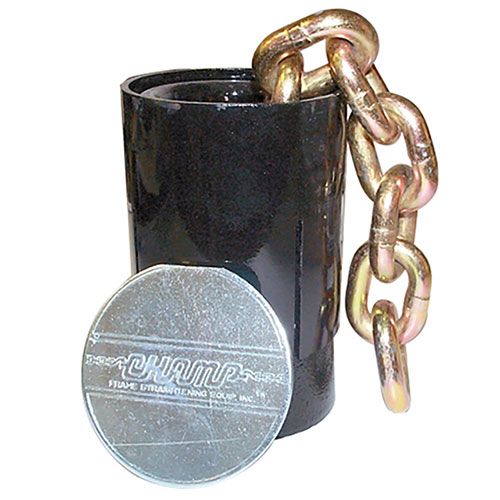
CHAMP® Floor Anchor Pot 1600
Chain cars to the floor in your auto body shop firmly with the Champ Floor Anchor Pot 1600 and it will help you work efficiently. Made in the USA with premium quality materials, this anchor pot with a removable chain is capable of a sturdy, 10-ton performance. The removable chain ensures that...
www.autobodytoolmart.com
Agreed. Pop a few anchor pots in. Also useful for many other projects. If you haven't poured concrete yet, even better: get the "Instant Floor Plates." I put in 4 and found them to be handy for all sorts of things - wish I put in more.Lookup anchor pots, that's what you need.
Attachments


Last edited:
A simple D-ring bolted to the floor with concrete anchors and a come-a-long will easily pull a car into the garage up a slight slope. This has worked regularly in my garage for the last 12 years without issue. If I was building from scratch I would over-engineer like some of the pictured examples but it really hasn't been necessary.
HoosierMark
Well-known member
Forgot to mention, I put my sleeves about 4 foot out from the wall so I could slide a post in to use with a grinder or vise. Handy when needed and out of the way when not.
Klokwerk
Well-known member
Don't know if this is anyone on the site, but this is the solution I'm going to use in my garage. More or less.
I've already had a need for something like this when I had my car towed home. Fuel pump dead. Ended up using a come-along winch anchored to a post in the ground.
This worked well, but I'd like a 'push button' operation. An electric winch would be perfect!
I've already had a need for something like this when I had my car towed home. Fuel pump dead. Ended up using a come-along winch anchored to a post in the ground.
This worked well, but I'd like a 'push button' operation. An electric winch would be perfect!
Jagmandave
Well-known member
I have a really old 120V boat winch mounted to the lower legs of my steel workbench (about 8" off the floor), the bench is anchored to the floor and wall so it's solid. The winch pulls a car up my sloped drive and onto my scissor lift easily. I agree, mounting the winch close to the floor will make sure it doesn't tear out under a sudden load (like a wheel getting jammed or something).
Of course, the cars I'm using mine on are 1500lb Minis and such!
Of course, the cars I'm using mine on are 1500lb Minis and such!
Klokwerk
Well-known member
Love me some Mini's. My old one doing the dirty. Wish I had a 60's-70's one though....Of course, the cars I'm using mine on are 1500lb Minis and such!

Weight is definitly a factor. So having the wench low and anchored well is key.
Having a car on wheels that turn help too!
Wow! A 9500 pound winch to rag a dead vehicle up a shallow incline. a 1500pound winch would do it easily. Plus the eight 3/8ths anchor bolts are a bit much too. Well at least he shouldn't have any issues with it!Don't know if this is anyone on the site, but this is the solution I'm going to use in my garage. More or less.
I've already had a need for something like this when I had my car towed home. Fuel pump dead. Ended up using a come-along winch anchored to a post in the ground.
This worked well, but I'd like a 'push button' operation. An electric winch would be perfect!
bradpac
Well-known member
I have one of those receiver mount winches as well. My plan for my garage is to get a bolt on receiver mount like this https://www.amazon.com/dp/B07HKWWNPT/?tag=atomicindus08-20
Then, just drill some holes and use drop in anchors in my concrete so I can have a completely flat https://www.amazon.com/dp/B002KI9AJM/?tag=atomicindus08-20
Then, just drill some holes and use drop in anchors in my concrete so I can have a completely flat https://www.amazon.com/dp/B002KI9AJM/?tag=atomicindus08-20