To avoid these ads, REGISTER NOW!

Center drill bits

atch

Well-known member
Joined
Apr 4, 2006
Messages
843
Location
Columbia, Missouri
I use a center drill bit only occasionally; probably once a month or so. Not very often. I've got a couple of center drill bits that came to me used. Now that I have them I see their usefulness. It's time to replace the dull ones that I have.
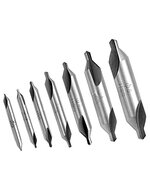
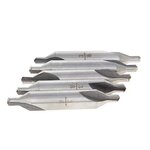
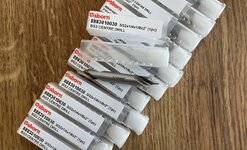
  • I use them to start a hole when otherwise I'd be using (and probably breaking) small size bits. I see sets of multiple sized bits. Is there a reason to have multiple sizes? There are also sets of one size, such as 1/8" for instance. My peabrain tells me to just buy 5-10 1/16" or 1/8" bits and be done with it. Then throw them away when the get dull. Am I missing something? Do you use different sizes often?
  • Amazon has several sets and for those of us who live out in the boonies they save us lots of trips to town. H-F has them for about the same price as Amazon but that's another trip to town. Then there are the much more expensive ones; both on-line and some places in town, including tool stores and box stores. To be used 10-15 times a year is there any reason to spend the extra bux?
  • b-t-w; I occasionally use these in my lathe but mostly in a drill press or hand-held drill. If I was a machinist that used these things 10 times a day I'd already know the answers.
  • I read on another thread on here that some one really likes their Irwins. Are they spendy and where do you get them? Granted they were talking about step bits and not center bits, but I bet the quality is similar across their different lines.
Here are a couple of pix. I got these off of Amazon 'cause that's the easiest way for me to get a pic.

61mAPPCh-UL._SX342_.jpg 51+QfuHgy0L._SX425_.jpg
 
To avoid these ads, REGISTER NOW!

no704

Well-known member
Joined
Apr 27, 2016
Messages
5,229
Different sizes for different size drills or lathe centers. Want the center>the web of your drill.
 

RoninB4

Well-known member
Joined
Jul 22, 2020
Messages
3,605
Location
Under My House
They can also be used in the lathe to cut a feature in the end of a shaft you want to support with a live center in the tailstock. Long shafts in the lathe need the support of a live center. A dead center can also be used but I don't suggest using one unless you know how to use them. Also second the post stating that a spot drill is a better choice for starting a hole.
 

alfadan

Well-known member
Joined
Mar 9, 2007
Messages
2,115
Location
Augusta, ks
Not being snobbish, but I've found the chinese center drills to be more dull than the US made. They consistently need more force to start cutting.

Despite the technical "incorrectness" of using them for drill starting, I still do.
 

Magnum440d100

Well-known member
Joined
Dec 2, 2018
Messages
3,581
Location
Indiana
I never knew what a center drill was until I started at this machine shop.

Some holes, I’ll go one size larger on the center drill so that there’s a chamfer when done drilling with the drill bit and then if it gets reamed to size.

Mostly use them in stainless or thick steel to keep the bit from deviating if it’s a “hold to” spec.

I too have been looking online for good center drills for home use. Unfortunately, the ones at work have no name left visible. No one knows the brand except that the tool rep brings them. And he comes by like once every couple months lol.
 

RoninB4

Well-known member
Joined
Jul 22, 2020
Messages
3,605
Location
Under My House
I never knew what a center drill was until I started at this machine shop.

Some holes, I’ll go one size larger on the center drill so that there’s a chamfer when done drilling with the drill bit and then if it gets reamed to size.

Mostly use them in stainless or thick steel to keep the bit from deviating if it’s a “hold to” spec.

I too have been looking online for good center drills for home use. Unfortunately, the ones at work have no name left visible. No one knows the brand except that the tool rep brings them. And he comes by like once every couple months lol.
-Drilling larger for the chamfer is a good habit, saves time. I would urge you to be careful doing this with a semi-dull center drill. I've had the tip break off more than once when the depth of the center drill chamfer reaches full size or too much downward force is applied. A simple hole then becomes a session of digging out the broken/shattered HSS tip, not always a fun endeavor when the boss comes by to check progress. Center drills can be re-sharpened like any other drill. If you're new to center drill I would also suggest you check out a spotting drill for better locational accuracy when starting a hole. Hope this was of some help.
 

metalmagpie

Well-known member
Joined
Nov 1, 2011
Messages
799
Location
Seattle
I buy KEO center drill sets. They last a very long time. I have had some luck sharpening them, too. They come in nice round wood boxes. Very good value.

But in a pinch I'd buy a Chinese set and just see how they work. I've bought cheap Chinese jobber drills and after regrinding them with my Darex drill sharpener, they work fine. But they need to be sharpened a bit more often, that's all.

metalmagpie
 

RoninB4

Well-known member
Joined
Jul 22, 2020
Messages
3,605
Location
Under My House
Whatever McMaster-Carr sends you will be great quality.

At best, the HF versions will cut a few holes then quickly get dull. At worst, you might as well use your fingernails.
-Nothing wrong with ordering from McMaster, MSC, or Grainger but the price is usually a bit high. There are several other industrial supply houses that cater to machine shops (Astral Tool, Traverse City, Fastenal, etc.) that most shops order cutting tools/supplies from at a better price. If you're in a larger city there's a good chance there are a couple of industrial supply houses you can even walk in or "will call". There's really not many reasons to buy the inferior tooling from Horrible Freight simply to throw it away after a few uses. As posted, the tooling is often improperly sharpened when new and the material it's made from is the cheapest/worst choice. If you don't burn up the tool from running it too fast you might find that a better quality cutting tool will last longer and be more economical than a cheap import. Consider hack saw blades, does a better one last longer and cost-per-cut is less than some no-name blade?

This was not directed at bwringer or anybody else in particular, it's just a suggestion to those unfamiliar with cutting tools. I hope this helps someone.
 
OP
A

atch

Well-known member
Joined
Apr 4, 2006
Messages
843
Location
Columbia, Missouri
Thanks everyone. This has been very enlightening for me. I've learned several things I never knew. For instance, I'd never heard of a "spotting bit." I've also learned quite a few sources that I wasn't aware of.
 

AEAdam

Well-known member
Joined
May 27, 2023
Messages
2,784
Location
SE PA
Keo center drills, made in USA, available on MSC and Zoro or your favorite industrial supply house.

Spotting drill is really the right tool for the job. But SO many machinists I know use center drills, even as countersinks or touch countersinks. They are not good for counter sinks because they are too steep (90 degrees)
 
To avoid these ads, REGISTER NOW!

Magnum440d100

Well-known member
Joined
Dec 2, 2018
Messages
3,581
Location
Indiana
Dug around and found out at least “one” that I’m using at work is a KEO(?). It’s pretty worn. Dunno if it’s worn off from use (in/out of chuck or collet) or worn off from handling. If the latter, that means it’s been around for a while.

-Drilling larger for the chamfer is a good habit, saves time. I would urge you to be careful doing this with a semi-dull center drill. I've had the tip break off more than once when the depth of the center drill chamfer reaches full size or too much downward force is applied. A simple hole then becomes a session of digging out the broken/shattered HSS tip, not always a fun endeavor when the boss comes by to check progress. Center drills can be re-sharpened like any other drill. If you're new to center drill I would also suggest you check out a spotting drill for better locational accuracy when starting a hole. Hope this was of some help.
Thanks for the tips!

When I get allowed to do more precise work, I’ll get into spotting drills. Right now I’ve only had one “hold to” I think and that’s because it got tapped 1/4-20. So precise is key.

The rest have +.000/-.005 type specs.

They haven’t had me do anything “critical” yet. “Yet”. lol
 

Nick Rivers

Well-known member
Joined
Mar 19, 2024
Messages
261
Location
USA
From the web:

A center drill is used for drilling a hole on the axis of a shaft to hold it between lathe centers. It was also used to drill center holes on machining centers, but has been replaced by the spot drill (which has a simpler geometry) for this purpose. The point angle of a center drill is 60 degrees. Most drill bits are 118 or 135 degrees. It’s better to use a 140 degree spot drill than a 60 degree center drill (or even a 90 degree spot drill as shown below) to accommodate the larger point angle of drill bits.

Spot drills are more accurate and help to prevent the secondary drilling cycles from wandering.

Center drills are used to drill support holes in the workpiece for a lathe center and create a starting point for a larger diameter hole.


1724781050845.png

1724780998004.png
 

PopcornSutton

Well-known member
Joined
Jun 10, 2024
Messages
800
Location
Northern Tip of VA
I have the set of KEO drills, but have bought a few 5/16" drills to use for every day stuff. If I need a smaller diameter than the point of the 5/16 I'll grab one from the KEO. But otherwise I use the 5/16 for the majority. If the drill that will follow is larger, I'll sink the center drill to full size. Otherwise this serves the "spotting" purpose quite well, never had a drill not follow the hole.
 

no704

Well-known member
Joined
Apr 27, 2016
Messages
5,229
I’ve alwas used center drills. I have a couple of spotting drills but never use them. Mostly manual Bridgeport work. Alwas thought spotting drills were for more rigid set ups ie cnc.
 

308guru

Well-known member
Joined
Jun 17, 2017
Messages
463
Whether using a spot or center drill, it's always nice to go just deep enough to leave a (required) chamfer on a hole. If you're going to be tapping the hole, you can chamfer to the major diameter (+) as well. You or the customer will have to decide how critical the chamfer angles are, or if they are, and chose your tool based on that.
 

Dave455

Well-known member
Joined
Mar 19, 2013
Messages
5,829
Location
Sussex, England
From the web:

A center drill is used for drilling a hole on the axis of a shaft to hold it between lathe centers. It was also used to drill center holes on machining centers, but has been replaced by the spot drill (which has a simpler geometry) for this purpose. The point angle of a center drill is 60 degrees. Most drill bits are 118 or 135 degrees. It’s better to use a 140 degree spot drill than a 60 degree center drill (or even a 90 degree spot drill as shown below) to accommodate the larger point angle of drill bits.

Spot drills are more accurate and help to prevent the secondary drilling cycles from wandering.

Center drills are used to drill support holes in the workpiece for a lathe center and create a starting point for a larger diameter hole.


1724781050845.png

1724780998004.png
You are absolutely correct, with regard to the shoulder angle of a centre drill.

However, the tip angle is perfectly suited to spotting tasks, and with centre drills generally being considerably cheaper than spotting drills, I have no hesitation in using them. Just touch the tip against the work, rather than using the shoulder.

I keep a couple of popular size centre drills in a block of wood on my bench, together with drills for pilot holes, and use them regularly.

While I can’t speak for the O.P’s location, where I am in the U.K. good quality mid size centre drills are very inexpensive, if you buy wisely (by which I mean from an engineers tool supplier) and maybe buy in 5’s.
IMG_0360.jpeg

Which isn’t to say that I’d pass on the chance to buy any new / surplus at reasonable prices.
IMG_0361.jpeg
 
Last edited:

cherrybomb

Well-known member
Joined
Oct 18, 2016
Messages
893
Location
Near Madison Wi.
While we are talking center drills and their advantages,I have in my arsenal,from Fastenal,left hand center drills,left hand twist drills.They work really well for the rare event you break off a bolt.Just make sure you keep them separately,I use a eye glass case,and don't ask how I know,double check the rotation of your drill
 

Steve_P

Well-known member
Joined
Sep 15, 2010
Messages
5,185
I have a generic Amazon set that had great reviews, and they're fine. I also have some Keo stuff, also good quality.
 

matthew

Well-known member
Joined
Dec 4, 2009
Messages
1,347
Most centre drills are 60 degrees, I think, to match the lathe deadcentres.

If you look a bit, you can also find 82 degree centre drills. Which matches.the angle of countersunk screws, avoiding another operation.

I think it is the #3 I particularly like, I think I was using with #8 screws.
 

Dave455

Well-known member
Joined
Mar 19, 2013
Messages
5,829
Location
Sussex, England
Most centre drills are 60 degrees, I think, to match the lathe deadcentres.

If you look a bit, you can also find 82 degree centre drills. Which matches.the angle of countersunk screws, avoiding another operation.

I think it is the #3 I particularly like, I think I was using with #8 screws.
Yes, absolutely correct, but if you look at the Dormer above it’s actually a smooth curve. This is considered to give slightly more accurate positioning, at the expense of a little strength.
 

cannuck

Well-known member
Joined
Nov 30, 2021
Messages
4,656
Location
Rural SK
I bought some of the center drills in my shop long before Chinese junk was in the market. I suppose one day I will buy some spotting bits (maybe when I tool up new-to-me BP clone) but the thousands of lathe jobs and thousands of bolt circles most of those ancient center drills still work just fine. IIRC I have only broken 2 or 3 (so they were probably dull).

What I DID find last time I bought some along with 10 packs of a few sizes of fractionals is just how crazy the prices of cutting tools has become. I have a few gaps in my Prentice bit rack that I am afraid to even ask about filling!!

Similar story for countersinks. I deburr BOTH sides of every through hole I drill, and again for many thousands of holes over decades, the same 82 degree countersink keeps doing the job. It IS getting dull, but I am starting to use a new one for countersinking but will keep using the old one for deburring. Buying decent cutting tools is far cheaper in the long run that low bux up front.
 
Last edited:
To avoid these ads, REGISTER NOW!
Top Bottom