To avoid these ads, REGISTER NOW!

Champion compressor after cooler question

j-becker

Member
Joined
Nov 26, 2017
Messages
8
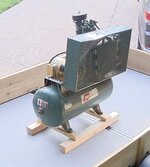
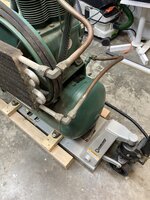
I bought a damaged champion HR23 that had some damage for cheap and am in the process of restoring it. One thing has me puzzled: The cooler between the second stage and the tank does not have a separate drain but drains directly into the tank. That seems to invite trouble as the drain with the attached hose is unlikely to get all the water out when draining. Did anybody modify the aftercooler to include a water separator or additional drain? Any advice?
 

Attachments

  • Champion_as_delivered.jpg
    Champion_as_delivered.jpg
    456.6 KB · Views: 74
  • aftercooler plumbing.JPG
    aftercooler plumbing.JPG
    918.4 KB · Views: 72
Last edited:
To avoid these ads, REGISTER NOW!

GeoBruin

Well-known member
Joined
May 5, 2018
Messages
3,734
Yes. Is it necessary? Who knows. If you have a coalescing filter, it could theoretically decrease the amount of water vapor in the air before it enters the tank, which could, theoretically minimize the amount of moisture being withdrawn from the tank. That said, the point of the aftercooler is to bring The air temp down to the point where the water condenses out of the air, so if it just dumps the water into the tank and it falls to the bottom (whereas the air you're pulling from the tank comes from the top) that might be enough physical separation to prevent the moisture from being drawn out of the tank though the outlet.

And in any case, you should have a water trap after your tank anyway so that should take care of any latent moisture.

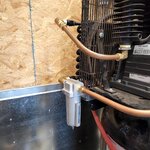
All that said, this trap between the aftercooler and the tank on my setup catches way more water than makes it into my tank.

Is has a float valve that auto drains when the pump cuts off and the unloader release the pressure so you can see it squirt every time the compressor shuts off. Here's a video.

Edit: added a couple photos of a similar setup from another member here. You have to look closely because we happen to have the same compressor and otherwise similar setups but they are different. Posting because this was my inspiration.
 

Attachments

  • 20220424_145718.jpg
    20220424_145718.jpg
    1 MB · Views: 69
  • 20220424_145731.jpg
    20220424_145731.jpg
    1.3 MB · Views: 54
  • aftercooler (1) (1).jpeg
    aftercooler (1) (1).jpeg
    153.5 KB · Views: 46
  • aftercooler (1).jpeg
    aftercooler (1).jpeg
    153.5 KB · Views: 65
Last edited:

rdoty

ALLIANCE MEMBER
Joined
Feb 7, 2018
Messages
637
Location
Massachusetts
Hmm, this setup is missing one of the main advantages of an aftercooler. It looks like what they are doing is effectively increasing the volume of the tank - cool air takes up less volume than the equivalent mass of hot air (at the same pressure). The tank will hold a greater mass of 70 degree air than 250 degree air, so the aftercooler lets you stuff more air in the tank.

The other advantage of an aftercooler is that it condenses most of the water out of the air. If you capture and drain this water before it goes into the tank you will have dryer air. Unless you live in a really dry area like Arizona or New Mexico I would suggest adding an automatic drain float valve in the line going into the tank.
 
OP
J

j-becker

Member
Joined
Nov 26, 2017
Messages
8
That makes sense and confirms my thinking. It seems a bit of a waste to have the cooler without a water seperator. Anyway, that should be easy to add once I have it running again. Thanks GeoBruin and rdoty!
 

dscheidt

Well-known member
Joined
Apr 26, 2017
Messages
2,888
Hmm, this setup is missing one of the main advantages of an aftercooler. It looks like what they are doing is effectively increasing the volume of the tank - cool air takes up less volume than the equivalent mass of hot air (at the same pressure). The tank will hold a greater mass of 70 degree air than 250 degree air, so the aftercooler lets you stuff more air in the tank.

The other advantage of an aftercooler is that it condenses most of the water out of the air. If you capture and drain this water before it goes into the tank you will have dryer air. Unless you live in a really dry area like Arizona or New Mexico I would suggest adding an automatic drain float valve in the line going into the tank.
While it would be better to have the water dumped out of the system, liquid water in the tank doesn't make it out the outlet, assuming the tank isn't full to the top, because the liquid water is at the bottom, and air isn't drawn through a dip tube, but just a port on the top of the tank. If there's not enough seperation between where the cooler is feeding the tank, and where air is withdrawn, you might get some sucked out at high draw operation, but I doubt it would matter much.
 

Jswain

Well-known member
Joined
Apr 26, 2013
Messages
2,457
Location
Calgary, AB
The aftercoolers job is to cool the air so the water can be removed out of it. The air entering into the large tank will also help in removing the water, as long as you drain the tank regularly or setup an auto drain you will have no problem.

The only way you will get water in your airlines is like said if the tank is full of water, or hot air leaves the tank and then cools in your lines. Your aftercooler cooling the air prevents this.
 

rdoty

ALLIANCE MEMBER
Joined
Feb 7, 2018
Messages
637
Location
Massachusetts
I understand the point you are making, but my experience is different. I was having trouble with moisture (not water) in my airlines - vapor clouds from air tools, problems with moisture contaminated paint when spray painting, and desiccant filters getting saturated quickly.

After adding an aftercooler with automatic drain I have almost no water in the tank and dry air in the lines.
 

Jswain

Well-known member
Joined
Apr 26, 2013
Messages
2,457
Location
Calgary, AB
Sure, but if you put the aftercooler into the tank & the auto drain on the tank you still end up with no moisture in the lines.

Pretty standard for any of the major compressor brands with aftercoolers = pump, aftercooler, tank, auto drain.

I'd just HAVE to imagine if champion can engineer a pump that works as well as it does they could somehow manage to figure out the plumbing
 

The Tool Tyrant

ALLIANCE MEMBER
Joined
Dec 19, 2011
Messages
2,182
Location
Bonita, Ca. (San Diego)
Others have explained the principals regarding how aftercoolers function and what you have pictured is the 'standard' plumbing set-up. You can add a trap before the receiver, but either way, the condensation needs to be drained from either the trap or the receiver. My compressors are plumbed as yours is with the addition of an auto-drain on the receiver.
 
To avoid these ads, REGISTER NOW!
OP
J

j-becker

Member
Joined
Nov 26, 2017
Messages
8
Others have explained the principals regarding how aftercoolers function and what you have pictured is the 'standard' plumbing set-up. You can add a trap before the receiver, but either way, the condensation needs to be drained from either the trap or the receiver. My compressors are plumbed as yours is with the addition of an auto-drain on the receiver.

That is what I figured. It is just that an inspection of the tank shows that there is some rust in the bottom of the tank where the pickup tube slipped up the side wall of the compressor. Hard to take a picture of but there is a hose on the inside of the tank attached to the drain valve that lies in the bottom of the tank to pick up any water. The tank looks very solid so I am not too concerned ablut some rust but think it may be better to not let any condensate into the tank if it can be avoided. As you said, it may come at the cost of two autodrains...
 

pcmeiners

Well-known member
Joined
Aug 13, 2009
Messages
7,861
Location
In the only town in Pennsylvania, Bloomsburg.
An aftercooler with a water separator before the tank is a waste of time, only adds a small amount of friction loss, and expense.

" but think it may be better to not let any condensate into the tank if it can be avoided."

You could put 10 water separators in series, there will still be condensation in the tank. The only way not to get water in the tank would be to cool the air below the coldest the ambient air in the shop will ever get, and use a water separator; only way that is happening is a refrigerant drier or using cold winter air to cool the coil.
 

Shoreline_

Well-known member
Joined
Aug 1, 2022
Messages
969
Location
Springfield, MA
I wouldn't challenge the design of air compressor engineering company. I'm pretty sure it's not a bunch of guys spit balling ideas to see what works. It looks like these compressors come from an era of mechanical engineers and thermal dynamicists.
 
OP
J

j-becker

Member
Joined
Nov 26, 2017
Messages
8
After some more reading I installed a water separator (THB F7000A) after the cooler. I think the original design is discharging it into the tank as the tank is fine to rust a bit during it's design lifespan of about 20 years. I would like to avoid that and it turns out the separator is very effective. While I regularly get some water out of the separator's auto drain, I have yet to get (liquid) water out of the tank itself, even when the temperature outside is around 100F / 95% humidity. So I would recommend putting one in if you are thinking about it.
 

Attachments

  • Champion_HR23.JPG
    Champion_HR23.JPG
    639.8 KB · Views: 26
Last edited:
OP
J

j-becker

Member
Joined
Nov 26, 2017
Messages
8
That is an enclosure for the VFD. The original compressor has a 3 phase motor and I only have single phase 220.
 
To avoid these ads, REGISTER NOW!
Top Bottom