To avoid these ads, REGISTER NOW!

Changing a 220v circuit to a 110v.

chadster1

Well-known member
Joined
Aug 25, 2009
Messages
4,023
Location
Terrell, Texas
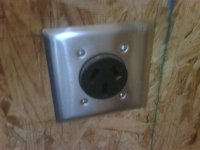
When I had my house built, I had them run a 220v circuit to a spot in my garage. I am not using that circuit. I have a need for a 110v circuit where that unused 220v circuit is. Can it be done at the plug or do connections have to be changed at the circuit box.
 
To avoid these ads, REGISTER NOW!

LoneGunman

Well-known member
Joined
Mar 27, 2007
Messages
2,081
Location
The Gunshine state
You have to change one of the ungrounded conductors (a hot) to a grounded conductor (a neutral). Then obviously you have to change the receptacle. It's very easy to do as long as you are careful. If you are unsure about ANYTHING don't hesitate to ask.

Edit: It could be done at the box if they ran a neutral, depending on what you told them the line was for they may have. Shut the breaker off, remove the receptacle and tell us what you have for wires, number of wires and color.
 
Last edited:

mrb

Well-known member
Joined
Dec 31, 2008
Messages
3,734
what is the 220 circuit? 3 wire or 4 wire? How many amps?
 
OP
C

chadster1

Well-known member
Joined
Aug 25, 2009
Messages
4,023
Location
Terrell, Texas
I told them that it would be for a welder or air compressor. It is on a 50 amp breaker. 3 wires. White, black and bare. Pics attached.

Believe me when I say that I will not be making any changes unless I know 100% what I am doing.
 

Attachments

  • outlet1.jpg
    outlet1.jpg
    148.5 KB · Views: 64
  • outlet2.jpg
    outlet2.jpg
    144.8 KB · Views: 100

GeorgiaHybrid

Well-known member
Joined
Sep 9, 2008
Messages
3,763
Location
Extreme NW Georgia
chad,

You will need to change out the plug in the wall and the breaker in the load center. The white and black wires should be attached to the "hot" on a double breaker and the bare ground to the neutral. Replace the double breaker with a single, run the black to the new breaker, the white to the neutral bar and the bare ground to the other neutral bar. Note that some people run the neutral and the ground to the same neutral bar. Not a good practice but I have seen it done....

The recepticle is wired the same as any other 120v outlet. The easy way to remember is "black to brass, white to bright" and then hook up the ground wire. When getting a new breaker, unless you need something with a higher capacity, I would use a 20 amp.
 

mrb

Well-known member
Joined
Dec 31, 2008
Messages
3,734
you obviously wont be able to put that #6 ontoa 15amp receptacle, so you will have to pigtail some #12 to it with the appropriately sized wirenuts.
 

Stuart in MN

Well-known member
Joined
Sep 8, 2005
Messages
23,120
Location
Minneapolis
Replace the 240vac receptacle with a 120vac receptacle, and replace the 240vac circuit breaker with a 120vac circuit breaker (I'd put in a 20 amp breaker, but a 15 amp will work, too.) Reconnect the wire: in the panel, the black wire goes to the circuit breaker, the white wire goes to the neutral bus and the bare wire goes to the ground bus. At the receptacle, the black wire goes to the brass screw, the white wire goes to the silver screw and the bare wire goes to the green screw.

There is another issue: since the existing circuit is 50 amps, the wire is probably #8 gauge. Most likely the circuit breaker in the panel will accept a wire that large, but the screw terminals on the receptacle usually only work with up to #10 or #12. You can look at the panel, determine what brand it is, and look up the specs for the breaker online to make sure the wire will fit. At the receptacle you'll probably have to pigtail some 6" pieces of #12 wire of the appropriate colors to the #8 wires using wire nuts, and then connect them to the receptacle.
 

Gary S

Well-known member
Joined
Dec 27, 2008
Messages
2,972
Location
Bismarck, ND
Would it make sense for you to find a 50 or 60 amp panel that takes a half dozen or so breakers? Then replace the 220v receptacle with this breaker panel. This way you have a new subpanel and you can run separate 110v circuits from that point to whatever you might need in the future. You will probably need to run a 4th wire if there currently isn't one in the cable to the 220v receptacle.
 

mrb

Well-known member
Joined
Dec 31, 2008
Messages
3,734
Would it make sense for you to find a 50 or 60 amp panel that takes a half dozen or so breakers? Then replace the 220v receptacle with this breaker panel. This way you have a new subpanel and you can run separate 110v circuits from that point to whatever you might need in the future. You will probably need to run a 4th wire if there currently isn't one in the cable to the 220v receptacle.

cant do that. All 4 wires have to be in the same conduit or cable. What he could do though, is simply install it as a 120v subpanel. Not ideal but it is possible to do.
 
To avoid these ads, REGISTER NOW!

snorky18

Well-known member
Joined
Oct 1, 2007
Messages
1,170
Location
Southeast Tennessee
Note that some people run the neutral and the ground to the same neutral bar. Not a good practice but I have seen it done...

It's OK to hijack a thread once the OP's question is answered, right? ;)

I don't want to take this too far off track, but what's wrong with having neutrals and grounds run to the same neutral bar? (assuming we're talking about a main panel, I know it's generally a no-no with sub-panels)

I ask b/c my box only has one bar, so obviously it is set up as you described as being not a good practice. Electrically isn't it all the same point (ie all ground/neutral bars connected to the same panel), so is it just a manner of aesthetics?
 

Charles (in GA)

Well-known member
Joined
Jan 11, 2006
Messages
12,489
Location
50 mi south of Atlanta
It's OK to hijack a thread once the OP's question is answered, right? ;)

I don't want to take this too far off track, but what's wrong with having neutrals and grounds run to the same neutral bar? (assuming we're talking about a main panel, I know it's generally a no-no with sub-panels)

I ask b/c my box only has one bar, so obviously it is set up as you described as being not a good practice. Electrically isn't it all the same point (ie all ground/neutral bars connected to the same panel), so is it just a manner of aesthetics?

If all you have is one bar that both neutrals and grounds are connected to, then your main panel is serving as your service disconnect and yes, it would be OK (necessary actually) to run the neutral and ground to the same bar.

If You have a service disconnect outside the house (very common nowdays, many localities require it) then the panel inside is actually a subpanel and will have isolated neutral and grounds, in this case, they both have to be run to their respective bars.

Charles
 

horizontallyopposed

Well-known member
Joined
Jul 31, 2007
Messages
123
Location
Calgary, Alberta, Canada
I know this is digging one out of the archives a bit, but I am in the same situation as the OP on this one.

I am out of circuits in the attached garage, was a complete numbskull when I built the house and have no subpanel. Have an unused 40A 220V outlet in the garage.

What I'd like to do is attach a load center to the 220V circuit and take two 120V circuits off it - one to add more lights, one for more outlets. I have the 4 wires to the existing receptacle (black, red, white, ground). How do I connect to the receptacle box in a tidy way? In other words, so I don't have a mittfull of wire nuts poking out all over the place. What can I cover the box with and connect to it? Or, would it make sense to just wire the load center to a plug in to the receptacle (on the offchance I buy a welder or compressor that needs 220V sometime in the future).

I'm not concerned about what to do, just how to do it so it doesn't look like a hack job - I have no problems wiring - have done my basement, wired in an outdoor hot tub, etc.

Thanks,
Keith
 
Last edited:

VHF

Well-known member
Joined
Oct 27, 2008
Messages
420
Location
NW Wisconsin
If you surface mounted your new load center (subpanel) on the wall above your existing 220V outlet, you could use a box-extender with a blank cover plate over the existing box and conduit up to the panel. Of course, you would need to splice the 4 conductors to reach up to your panel. If they are #10 then wire nuts would be fine, altough you could use a set-screw type **** splice or even Polaris InsulTaps.
 

pprince

Well-known member
Joined
Feb 18, 2011
Messages
143
Maybe I have a silly solution but can't you not simply take one of the conductors out of the circuit at both the breaker and box then wire in a 110v receptacle to the remaing conductor, neutral and ground?
 

csp

Well-known member
Joined
Mar 23, 2010
Messages
5,719
Location
Franktown, CO
Maybe I have a silly solution but can't you not simply take one of the conductors out of the circuit at both the breaker and box then wire in a 110v receptacle to the remaing conductor, neutral and ground?

That's the suggestion. The only thing is as it is wired now, there is no neutral. The white is a hot lead that should have been colored red, or had red tape added to the ends. It will go from being a hot conductor to being the neutral.

Edit: I didn't realize that your response wasn't directed to the OP.
 
Last edited:

horizontallyopposed

Well-known member
Joined
Jul 31, 2007
Messages
123
Location
Calgary, Alberta, Canada
Maybe I have a silly solution but can't you not simply take one of the conductors out of the circuit at both the breaker and box then wire in a 110v receptacle to the remaing conductor, neutral and ground?
that was my first thought, but it doesn't give me the two circuits I need, however. I will be adding 6 or 7 8' T12 110W HO light fixtures, which will eat up one circuit. I'd still like to be able to add the second circuit for more receptacles.
 
Last edited:

horizontallyopposed

Well-known member
Joined
Jul 31, 2007
Messages
123
Location
Calgary, Alberta, Canada
If you surface mounted your new load center (subpanel) on the wall above your existing 220V outlet, you could use a box-extender with a blank cover plate over the existing box and conduit up to the panel. Of course, you would need to splice the 4 conductors to reach up to your panel. If they are #10 then wire nuts would be fine, altough you could use a set-screw type **** splice or even Polaris InsulTaps.
That seems straightforward enough!
 

Norcal

Well-known member
Joined
Mar 16, 2008
Messages
13,754
This is a comment directed at the OP, the circuit cannot be converted to a 15,20, or 30A circuit & comply w/ code as it will run afoul of 250-122(B)

(B) Increased in Size. Where ungrounded conductors are
increased in size, equipment grounding conductors, where
installed, shall be increased in size proportionately according
to the circular mil area of the ungrounded conductors.

A 6 or 8 AWG NM cable has a 10 AWG equipment grounding conductor so it will not comply w/ the requirements of 250.122(B)


Copied from the 2008 NEC ,Bold print by me.
 
To avoid these ads, REGISTER NOW!
Top Bottom