To avoid these ads, REGISTER NOW!

Changing out vent termination options (wind problems)

giantsean

Well-known member
Joined
Dec 8, 2014
Messages
61
Location
CT Shore
HI All... looking for some consensus on approaches before I pull the trigger (and yes I have indeed read the other threads, but could not find an answer to one of the questions). I have a horizontally vented Big Maxx. Works fine UNLESS winds kick up and I get regular flameouts and relights (no errors though). I tried reorienting the pressure switch but it still happens. I have asked myself about dampers and agree they are a bad idea (and wind might just hold them closed anyway, triggering the pressure switch instead)

Right now I have this style cap:

1673806063090.png

so looking at other 2-opening options:

1673806218911.png1673806504778.png

- Any experiences on which of these would work best for wind in general, or are there other better choices?
- Since is is all installed and sealed up, and I have sufficient length (about 13" sticking out) I was going to just get a universal (double female) adapter with two hose clamps, lop off the old one (will probably convert it to a dryer vent) and stick on the new one. Does anyone know if this is ok to use outdoors? I imagine so but was thinking about the clamps etc, and there is really no definitive info on it

1673806794327.png

Thanks for any info!
 
To avoid these ads, REGISTER NOW!

Jackfre

Well-known member
Joined
Dec 26, 2010
Messages
4,410
Location
N CA
All side wall equipment is tested to a 40 mph wind. I had a lot of issues with venting products across coastal New
England over the years. Is there a direct vent option that can be added to yoour unit? DV’s are better able to handle the heavy, gusty winds as the wind kinda balances both side of the combustion process. Your first step is to contact the manuf for factory options on this. Follow their guidelines or kiss the warranty goodbye. Also be aware that simply altering the termination may affect the burn operation. IN the worst case situations I dealt with moving the termination to a “better” location was necessary. As the unit isn’t throwing error codes and is operating properly you may find that you simply learn to live with its Jeckyl/Hyde personality.
 
OP
G

giantsean

Well-known member
Joined
Dec 8, 2014
Messages
61
Location
CT Shore
If it helps, the manufacturer's own kit comes with the roundish T. That said, I have read additional comments on here from others who have it that they still have wind issues even with this version. Might be correct that it is what it is!
 

Jackfre

Well-known member
Joined
Dec 26, 2010
Messages
4,410
Location
N CA
The tee should relieve direct pressure some. If it is a factory part try it out and report back.
 
OP
G

giantsean

Well-known member
Joined
Dec 8, 2014
Messages
61
Location
CT Shore
Do you guys think a horizontal or vertical alignment works best overall? Was thinking horizontal would allow the wind to blow through rather than straight into the vent.
 

ridgepatrol

Well-known member
Joined
Nov 22, 2015
Messages
45
Location
Grand Bend Ontario
I had the same problem that you are experiencing last year with a new 50,000 Big Maxx. I started a thread about it.

I tried putting flaps on the termination tee, and that seemed to work well most of the time, as the side towards would be forced closed by the wind, and the other side was free to open. The problem I found was the annoying rattle of the flaps when the heater was not in operation, and it did not completely solve the flame-outs..

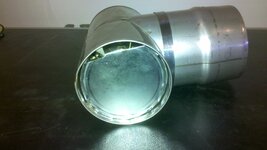
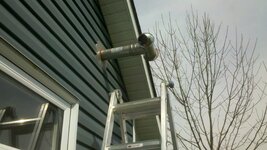
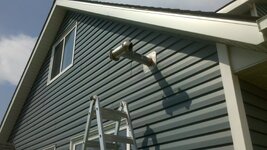
Since then I purchased two additional stainless terminations which fit into the tee. They allow the exhaust to be directed away from the wind. This works much better than the flaps did.

I have only had one day this year that the wind caused continuous flame-out/re-lights, but it eventually produced enough heat to satisfy the thermostat.

I believe that what is happening is that when there is a strong wind against the side of the garage opposite to the garage doors, high pressure is created. As the wind travels over and around the garage to the side with the garage doors, it creates low pressure on the outside of the garage doors, causing the higher pressure air inside of the garage to vent out through the garage door seals. Since my garage is spray foamed, it is very tight, and the only opening this lost air pressure can be made up from is the heater vent.

When there is equally strong winds from the garage door side, the heater works normally, since the high pressure against the garage doors is forced through the seals, and the only place for the inside air pressure relief is through the heater vent.
 

Attachments

  • 2022-02-23_17-00-31_958.jpg
    2022-02-23_17-00-31_958.jpg
    495.1 KB · Views: 28
  • 2022-05-01_15-54-09_899.jpg
    2022-05-01_15-54-09_899.jpg
    520.5 KB · Views: 29
  • 2022-05-01_15-54-23_216.jpg
    2022-05-01_15-54-23_216.jpg
    500.6 KB · Views: 29
Last edited:
OP
G

giantsean

Well-known member
Joined
Dec 8, 2014
Messages
61
Location
CT Shore
Thanks! I am not sure whether the dynamics are the same in my case as my 80K Big Maxx is battling a completely uninsulated and poorly sealed building, but it's possible the poor sealing is not enough and the pressure relief takes the path of least resistance. At this point I really wish I left the damper flap on to see if it would have made any difference, but most advised against it and it's probably still the right choice.

Where did you end up getting those end caps? I have also debated putting a 90 degree elbow pointing straight up to see if that helps at all (or double if I go with the tee) but maybe those are all it needs. I also thought of maybe riveting some sort of sheet metal shield to block the wind, but wouldn't know where to begin.

Did you consider that one w/ the square shape? (left of the tee in my pics above) or did you always have the tee? Thanks again!
 
To avoid these ads, REGISTER NOW!

ridgepatrol

Well-known member
Joined
Nov 22, 2015
Messages
45
Location
Grand Bend Ontario
The vent caps I have came from amazon:


I am in Canada, so yours are probably a lot cheaper.

I have tried a 90 degree elbow as well as orienting the tee in a vertical position. Neither worked as well as the end caps.
 
OP
G

giantsean

Well-known member
Joined
Dec 8, 2014
Messages
61
Location
CT Shore
The vent caps I have came from amazon:


I am in Canada, so yours are probably a lot cheaper.

I have tried a 90 degree elbow as well as orienting the tee in a vertical position. Neither worked as well as the end caps.

Thanks yes they are pretty cheap from Amazon US! So it looks like they slip over the ends of the tee. Any issues getting them to stay on? Looks like they have some tabs to keep them fitted but you also have the wire. Have you thought of attaching w/ a sheet metal screw?

Also, did you have to experiment w/ the exhaust direction for them, or did it just work well enough the first time you put them on? I was thinking of pointing them back to the wall but maybe not practical due to heat or crossflow.
 
OP
G

giantsean

Well-known member
Joined
Dec 8, 2014
Messages
61
Location
CT Shore
You might want to look at barometric dampers:
Thanks... I did get venting w/ damper flaps (really backflow preventers) but I ended up pulling them off based on tech support and other feedback that dampers in general should not be used w/ this unit. I'm guessing it would work well actually, but I'm sure they have a reason to avoid them (probably that it could cause backup of CO and death :D)
 

ridgepatrol

Well-known member
Joined
Nov 22, 2015
Messages
45
Location
Grand Bend Ontario
The vent caps fit inside of the tee, but will not go in all of the way because the tee has grills. I did not want to remove the grills from the tee, so I used some copper ground wire to fasten them to either side of the tee. If the grills in the tee were removed, I believe the caps would fit perfectly inside and the wire straps would not be needed.

I have played with the orientation of the caps, and I have found that having them pointed midway between the ground and the building, say at 4 o'clock, seems to work best for my application.

I am also investigating whether the pressure switch in the heater could be changed to a less sensitive one, or possibly one that has a delay in it, so that any short gusts of wind would not cause a flame-out.
 

DenisG

Well-known member
Joined
Jul 14, 2013
Messages
1,278
Location
Milwaukee
Thanks... I did get venting w/ damper flaps (really backflow preventers) but I ended up pulling them off based on tech support and other feedback that dampers in general should not be used w/ this unit. I'm guessing it would work well actually, but I'm sure they have a reason to avoid them (probably that it could cause backup of CO and death :D)
Some installations use spill switches to shut off the furnace -

... but, good luck with your choice!
 

luvtheheat

Well-known member
Joined
Jan 28, 2017
Messages
489
Location
Tucson AZ
Years ago some dude in NM died of CO poisoning when the steady overnight wind blew against his CO exhaust pipe on his vacation house, preventing it from properly venting fumes. Also dead, his mistress he had over that night. Karma Karma.....
 
OP
G

giantsean

Well-known member
Joined
Dec 8, 2014
Messages
61
Location
CT Shore
Years ago some dude in NM died of CO poisoning when the steady overnight wind blew against his CO exhaust pipe on his vacation house, preventing it from properly venting fumes. Also dead, his mistress he had over that night. Karma Karma.....
At least he died happy... and now he doesn't have to worry about that big divorce settlement. A CO detector probably would have been his best bet though :D
 
To avoid these ads, REGISTER NOW!
Top Bottom