To avoid these ads, REGISTER NOW!

Cheap hydraulic hand crimpers megathread?

OP
I

Ign

Well-known member
Joined
Jul 7, 2006
Messages
12,769
Location
Butte Peak ND
Would they really need to be heat treated though? We're talking about crimping aluminum and copper, I would think that steel dies would hold up pretty well to that without heat treatment.

This. I see zero need to heat treat unless you're doing a production run, and then you'd just start w a better crimper.

If you're really worried about it (and you shouldn't be) start w better material or grab some Kasenite.
 
To avoid these ads, REGISTER NOW!

ncfh

Well-known member
Joined
Jul 1, 2011
Messages
777
A furnace and tabulated formulas are witchcraft, while CNC operations are child's play?

lol. This must be why Elon Musk keeps blowing up his rockets, he doesn't know to preheat the oven!
 

QtrHorse13

Well-known member
Joined
Dec 16, 2014
Messages
181
Location
TX
"Midrange hydraulic hand crimper megathread."?

I wanted to post the same question.

I have three heavy duty crimpers. Two are the bolt cutter name brand type with rotating dies. They both work great but you need either the wire and lug being held by something or the crimper needs to be attached to something. It can be somewhat difficult to hold the wire, lug on the wire, hold it in the crimper and use the crimper. I bought both of them off Ebay for $35-$55 shipped. The name brand type run $1500-200 new.

I wanted a hydraulic crimper but did not want to pay the ridiculous price. A friend went to China for business and brought me back one of these Chinese hydraulic type crimpers. The dies are not perfect but it makes good crimps if you do them correctly. I used to make large gauge battery cables for people on the audio forums. I have used all three types I listed and they all work well.
 

soj

Well-known member
Joined
Dec 3, 2007
Messages
729
Location
North Georgia
Here's a more serious question: do the crimps have to be hex?. 'Cause if they could be round it'd be a simple affair to drill a hole in plate (could either drill and then part using a narrow kerf tool or drill two opposing plates for a perfect circle when closed together) and add the holes for the little locator pins.

IOW custom dies w round holes = easy, if they'd work?

If you've got access to CNC custom hex is easy too.

The answer to that question... NO, they can be round.

It had crossed my mind about making AWG sized dies, but I knew I would have to go to a machine shop for that. I had not considered round. Another reason to love GJ, thanks for jump starting my brain.:D

All I had to work with was a scrap of 1/2" X 1 1/2" hot rolled bar. Based on the size of the original dies you really need 1/2" X 1 5/8". So I improvised by cutting off a piece 1 5/8" long.

I measured the lug OD and the inside of the hex die I had used to make the first crimp (post #22). Then I use the WAG method and decided a 3/8", or slightly smaller hole might be a good starting point. I made one with a 23/64" bit, it seemed kinda small, so I made one with a 3/8" bit. After drilling the hole I split them in half. Of course it makes a slightly oval opening, and if I decide to make more I will split first, clamp together and then drill.

Results were much the same as with the hex dies. If I had crimped the lug in one pass it would have produced a flag on each side where the dies came together. Instead I partially crimped and rotated and repeated until I had a round (well, slightly oval) crimp.

The wire and lugs I am using should be the same size, but I am not 100% sure. I know I bought them at the same time, the lugs are marked with a "2", and the wire (unmarked) measures close to .30, which is closer to 0 GA. The lug fits the wire slightly loose. I believe much better results could be achieved (with the hex or homemade round dies) with wire and lugs that fit tightly together.

My next step is to shop for tighter fitting lugs.

I didn't take any pics of the homemade dies, or the crimp, but will post some if anyone is interested.
-jp
 

mikegt4

Well-known member
Joined
Sep 12, 2005
Messages
3,277
Location
sw ohio
CNC the die is the easy part, now properly heat treat it.

Any luck grinding, or altering the dies the cheap crimpers come with?

Heat treat?

Probably the only heat treat these cheap Chicom crimpers get is roasting inside the container on their way over.

A few years ago I was in the market for a Cheap hydraulic hand crimper and through research found that YQK crimpers have the vast majority of the market. Everyone and their brother rebadges them. I found massive differences in price for the exact same product. Google "YQK' and the model number for some interesting price shopping.
 

skruft

Well-known member
Joined
May 9, 2011
Messages
759
I have two or three but have not seen a real need for hydraulic crimpers for occasional use. If I used them several times a day, perhaps.
 

astroracer

Well-known member
Joined
Jun 22, 2005
Messages
3,001
Location
Mid_Michigan
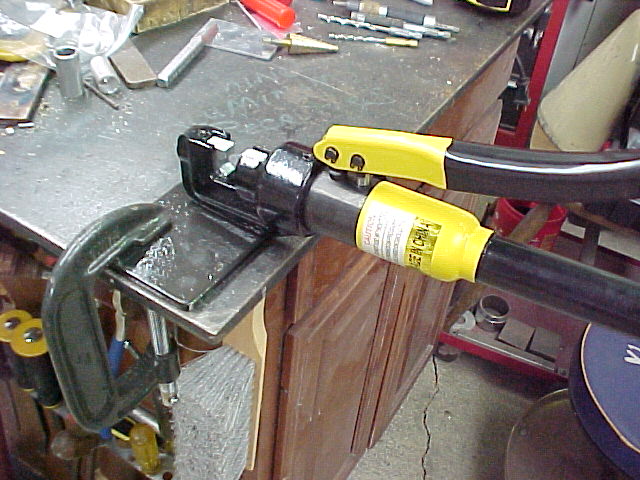
I got one of the HF style hydraulic crimpers off eBay for about 35 bucks shipped a couple of years ago. I built this mounting plate right after I got it. :)
MVC006F-vi.jpg

Trying to hold it one hand and keep a cable and fitting together and aligned in the other was next to impossible! I clamped it in a vise for a while but tired of it slipping around.
I made a mounting plate out of some 1/4" scrap, drilled and tapped the head of the crimper and bolted on the plate.
MVC068F-vi.jpg


MVC077F-vi.jpg


MVC017F-vi.jpg

Now I can clamp it to any bench or, as you see here, right to the vehicle I am working on. Much better!
Mark
 
OP
I

Ign

Well-known member
Joined
Jul 7, 2006
Messages
12,769
Location
Butte Peak ND
^^^nice. A Kant Twist might be a consideration on that fender too so your clamp handle isn't buried down in the body for tightening. It'll stick up higher than a C, though
 
To avoid these ads, REGISTER NOW!

astroracer

Well-known member
Joined
Jun 22, 2005
Messages
3,001
Location
Mid_Michigan
^^^nice. A Kant Twist might be a consideration on that fender too so your clamp handle isn't buried down in the body for tightening. It'll stick up higher than a C, though
A machinists clamp wouldn't work in there. What you don't see is the 1 1/4" lip on the back side of the radiator support. A Kant twist wouldn't clear it. :)
Mark
 

warren57

Well-known member
Joined
Nov 4, 2011
Messages
103
Location
Lochbuie, CO
I got one of the HF style hydraulic crimpers off eBay for about 35 bucks shipped a couple of years ago. I built this mounting plate right after I got it. :)
MVC006F-vi.jpg

Trying to hold it one hand and keep a cable and fitting together and aligned in the other was next to impossible! I clamped it in a vise for a while but tired of it slipping around.
I made a mounting plate out of some 1/4" scrap, drilled and tapped the head of the crimper and bolted on the plate.
MVC068F-vi.jpg


MVC077F-vi.jpg


MVC017F-vi.jpg

Now I can clamp it to any bench or, as you see here, right to the vehicle I am working on. Much better!
Mark


Really like this idea. I'm going to do this for sure!
Thanks for sharing...
 

vertigo

New member
Joined
Sep 19, 2017
Messages
2
I've recently been doing a bunch of research into crimping for a couple projects, and after days of research finally settled on some ratcheting crimpers for smaller wire, but now I'm struggling to decide on what to get for larger wire. The problem is I don't see myself using them very often at all, as I primarily am just looking to build a custom set of jumper cables with some welding cable and quick disconnects, but I also don't want to spend the time and money on doing it only to have the crimps be done half-cocked. It would be a much easier choice if the crimpers were something I'd use regularly, as then I could justify the money on a quality set like the FTZs, but since they'll likely be used once then sit unused for who knows how long, only to be used on very rare occasions, I just can't get myself to spend that kind of money.

One thing I've noticed is that the FTZ and AMP crimpers that RC (Maine Sail) recommends in his pbase article (also linked above) both do square / diamond crimps, whereas all the cheaper ones I've seen, both hydraulic and compound action bolt-cutter style, do hexagon crimps. I wouldn't think there would be a difference, but according to this article, it appears hexagonal crimps may actually be the worst type, as they aren't gas-tight. It's the only source I've been able to find that discusses the differences between the various crimp types, so I'd love if someone could provide more info on this, either in the form of other links or their own knowledge.

I started out considering just a hammer crimper based on watching this video where they used one, thinking if they used it then it must be good. But then in reading various threads I found that while a lot of people like them and think they work well, a lot of people don't think they work well, including RC in his article. So I was then considering one of the TEMCo crimpers, especially the TH0012 dieless one, though possibly the TH0020, until I saw his post about them being nothing but rebranded Chinese import crimpers with a markup for the name and warranty (which confirms OP's concerns from his first post).

I don't really want hydraulic crimpers since I won't be using them much, so the cost and risk of failure due to leaking isn't worth it. I like the idea of the TEMCo dieless ones, since they're not hydraulic and are reasonably priced, but now I'm questioning just how good that crimp type actually is, and I really don't like the idea of overpaying for rebranded stuff, especially when the company is misleading about it. I'm also not fond of how difficult the cable-cutter style are to use (needing three hands), but I'd be willing to deal with it, especially since I wouldn't be doing a ton of crimps, if the crimp quality I'd get is really that much better. But then, I'm left trying to figure out if the hexagonal crimps made by the cheaper versions really are inferior to the square/diamond ones done by the more expensive ones (and the same goes for the hydraulic ones as well), so that seems to be the biggest question I'm left with at this point.

I'm also curious if there's a difference between double thin crimps done by the FTZ crimper and single wide crimps done by crimpers like the HF. Also, slightly OT, but I wonder if rotating the crimp 90 degrees and doing it again like he does in the pbase article might actually weaken the cold weld and, as a result, the crimp itself.
 

quattroJoe

Well-known member
Joined
Jan 9, 2014
Messages
586
Location
FL
I bought the Harbor Freight model about a year and a half ago. I typically look at HF tools as disposable, if it's something I'll rarely/never use again and it gets me through one project it doesn't owe me anything. I was contemplating hydraulic crimpers and figured this was a cheap trial run that would help me decide if it was worth investing a couple hundred into a decent one.

Surprisingly, it has held up great! It does not stick, jam, lose pressure, or malfunction in any way. I use it a few times a month to crimp stranded copper 4AWG wire. The complaints about needing three hands to use it effectively are valid. The best way around this I've found is to close the jaws just enough to hold the terminal, then hold the tool in such a way that the wire won't fall out of the terminal and continue. I like the idea shown above though, screwing a plate to it so it can be clamped to a bench.

I am usually using ring terminals with split barrels. To get repeatable solid crimps I've found that it helps to use a set of hand crimpers first and overlap one side of the split over the other, which also helps keep the wire from falling out when you move to the hydraulic crimper by snugging it up. Despite reading that the hexagonal crimps it makes are not ideal, I've yet to have a problem. I've tried putting the ring in a vice and all my weight pulling on the cable, haven't seen one pull out yet. The ends of the strands appear very solid too. Maybe not ideal in marine environments, but under the hood I see no problem.

I'll take some pics to share next time I use it. This is one of the very few HF tools I'd recommend, particularly if it only sees occasional use.

Sent from my Nexus 6P using Tapatalk
 

vertigo

New member
Joined
Sep 19, 2017
Messages
2
I definitely understand about HF tools being great for single use, but in this case it doesn't seem to be a great value. There are similar, cheaper ones on Amazon, or for about the same price I could get the TEMCo dieless crimper and not have to worry about a leak causing them to not work after several months. But then, I'm back to being unsure about the crimp quality and if I'm spending a good amount of time and money on a project only to have subpar crimps. I get the feeling that even if they could be better, they'd still be really good, and I probably wouldn't notice the difference for my use. But if I can get better quality without spending much more money, or if I can save money for the same quality, then even better. I'm also just trying to make sense of this for curiosity's sake.
 

larry4406

Well-known member
Joined
Jan 27, 2006
Messages
19,560
Location
Northern Virginia
Waking up this thread. It has been a good read.

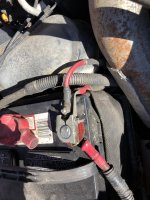
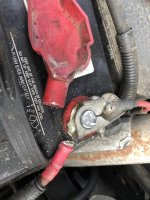
I need to repair a battery cable on my 2002 Ford F350 6.0 PSD. In particular, the positive lead on the passenger side battery.

Ford used a single lug that receives the positive crossover cable from the driver's side battery (crimped on), the starter cable (crimped on) and the relay (bolted terminal). My lug broke where the positive crossover connects to the passenger positive terminal. This is towards the front of the vehicle as the crossover runs in front of the radiator. At the back of the terminal you can see that the starter lead turns 90 degrees and goes down.

From what I have read, the factory wire sizes are:
Battery-Battery crossover 1/0
Battery-Starter 2/0
Battery-Relay 6

I am thinking on installing a Mil-Spec style thru bolted terminal and then crimping all of the above cables using 3/8" eyelets. Something like these https://www.amazon.com/gp/product/B01LLWKXV6/?tag=atomicindus08-20

My preference is to do the work in the engine bay. I really do not want to dig in and disconnect it from the starter as I understand that is a PIA.

I like Astroracers plate mod to hold the tool although I suppose I could get another person to help me.
 

Attachments

  • Passenger Positive.jpg
    Passenger Positive.jpg
    115.1 KB · Views: 40
  • Failed Crossover Positive.jpg
    Failed Crossover Positive.jpg
    105.3 KB · Views: 43

usdemt

Well-known member
Joined
Nov 1, 2010
Messages
644
Location
South Dakota
I do not see the appeal of the hydraulic crimpers. Why not just use a manual one (similar size to a bolt cutter?) I have never had issues getting good crimps on mine and its way faster. Also an over crimp can cause the copper to work harden and snap, if it hasnt already from over crimping. I just dont see the need.
 

upper_tanker

Well-known member
Joined
Apr 2, 2019
Messages
318
Location
Michigan
I've had one of these crimpers for a few years now and have made hundreds of crimps with it. from 4 awg to 2/0, and have only had one issue right after I got it where the jaws wouldn't release. A few taps with a hammer and they released.

I used to do the ole solder and heat shrink, but that either required a third hand or spending 10 minutes trying to find out how to hold the lug with vice grips. I have had zero lug failures due to bad crimps. I always use adhesive lined heat shrink after the crimp. I KNOW that there are way better hydraulic crimpers for the money, but these ones have served me well. Most of my crimps have been on plow trucks and/or dump trucks. My dads entire fleet has dual batteries and the big-6 on them. They get used and abused, and the crimps have held up fine.

Just a tip, and the way I do it, is I snug the lug in the crimper just enough to where it's not loose. Then, I'll feed the cable in, and then while I'm holding the handle that you pump, I'll push the stationary handle against something that won't move (like a core support). Once I get the crimp tight enough where it won't wiggle, then I'll use both hands and tighten it the rest of the way.

It's SO much quicker and easier than the soldering route. Also, there is enough data out there that suggests that a proper crimp is at least just as good as a proper solder joint.
 

59 wagon man

Well-known member
Joined
Oct 25, 2010
Messages
1,589
Location
hollywood fla
i've had my hf crimpers for at least 5 yrs now , they still work . I just made some cables a few weeks ago for my mustang. may not be the best but I can't remember any problems occurring from cable ends I crimped with them.
 
To avoid these ads, REGISTER NOW!
Top Bottom