To avoid these ads, REGISTER NOW!

Cheap Refrigerated Air Drying Solution?

btdobie

Well-known member
Joined
Mar 21, 2016
Messages
611
Location
Southern Minnesota
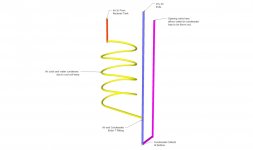
So I may end up building a new shop in the near future, but that's a story for another thread. As I was considering what I wanted in a new shop, I thought it would be nice to have a refrigerated air dryer, but they are expensive and use a fair bit of electricity. So I came up with a new plan that I think may work well in cool norther climates. This could get long so just look at the picture for the TLDR version.
Since building a new shop would require having an excavator on site anyway I would have them dig an extra small hole beside the shop while they are there. If they dig down 6 ft and i use my post hole auger to get another 6 feet then I can achieve a depth of 12 ft. At this depth, the soil temp barely changes throughout the year, and it stays close to the yearly average temperature (45 Degrees here).
Once at this depth I will bury a coil of copper tubing with a drip leg at the bottom to catch condensate (actually probably 3 in case one springs a leak; I just hook up to another one rather than dig it all the way back up). The Now dry air will return to an air storage tank in the shop. To empty water from the drip leg I will run a 3rd line from the drip leg to the surface with a valve. Opening the valve will blow air through the drip leg and blow the water out.

So thoughts??????
 

Attachments

  • Underground air dryer.jpg
    Underground air dryer.jpg
    49.3 KB · Views: 137
To avoid these ads, REGISTER NOW!

Kaizen

Well-known member
Joined
Jan 9, 2015
Messages
6,948
Location
New England
Typically these systems use more flexible lines then copper. I’d be concerned it would break. What would you encase it in? Just having it open won’t do much.

I am using 3/4 copper as a precooler to take out water before it gets to the tank. Will have two four feet wide by six feet tall manifolds in the useless wall behind my corner mounted compressor. I’m pretty sure it will take out 99 percent of the moisture. Way easier then your plan. I can also add to it or add a hf unit after the tank if needed.


Sent from my iPhone using Tapatalk
 
OP
B

btdobie

Well-known member
Joined
Mar 21, 2016
Messages
611
Location
Southern Minnesota
Typically these systems use more flexible lines then copper. I’d be concerned it would break. What would you encase it in? Just having it open won’t do much.

I am using 3/4 copper as a precooler to take out water before it gets to the tank. Will have two four feet wide by six feet tall manifolds in the useless wall behind my corner mounted compressor. I’m pretty sure it will take out 99 percent of the moisture. Way easier then your plan. I can also add to it or add a hf unit after the tank if needed.


Sent from my iPhone using Tapatalk

I was thinking the annealed copper tubing that comes in a coil so I could just pull each and and make a helix (in theory). It would be back filled with sand to the top of the coil then plain old dirt the rest of the way.

The after cooler plan you described was the option I was originally considering because it gets the dew point to room temp, but I like the idea of getting the dew point below room temp.

Edit: Actually you've got me thinking now. It would be kinda cool to bury 3 different types of tubing (Copper, Pex, and PE-Al-PE aka rapid air) and see how they perform side by side in the same soil and usage conditions. I do like to experiment.
 
Last edited:

pcmeiners

Well-known member
Joined
Aug 13, 2009
Messages
7,946
Location
In the only town in Pennsylvania, Bloomsburg.
"but I like the idea of getting the dew point below room temp. "

The main issue you have is the sand surrounding the coil will warm in a relatively short time. If the air is used for long periods the dew point you are going for will rise considerably due to the heated sand, and will remain higher for many hours . You would be better off having a decent pre-cooler ( Hayden DB 1260) remove most of the heat before it goes to your in-ground coil.

"I’m pretty sure it will take out 99 percent of the moisture."

With a large fan cooled coil you can only get to a few degrees above ambient temperature. With such a cooler the most moisture you can remove is approx.. 80% .
 
Last edited:
OP
B

btdobie

Well-known member
Joined
Mar 21, 2016
Messages
611
Location
Southern Minnesota
"but I like the idea of getting the dew point below room temp. "

The main issue you have is the sand surrounding the coil will warm in a relatively short time. If the air is used for long periods the dew point you are going for will rise considerably due to the heated sand, and will remain higher for many hours . You would be better off having a decent pre-cooler ( Hayden DB 1260) remove most of the heat before it goes to your in-ground coil.

Hmm. Got me looking at the heat capacity and thermal conductivity of different soil types and you're absolutely right sand is a poor performer on both counts. It looks like any type of sandy clay would be my best bet.
https://www.geothermal-energy.org/pdf/IGAstandard/WGC/2010/2952.pdf
 

Kaizen

Well-known member
Joined
Jan 9, 2015
Messages
6,948
Location
New England
Hmm. Got me looking at the heat capacity and thermal conductivity of different soil types and you're absolutely right sand is a poor performer on both counts. It looks like any type of sandy clay would be my best bet.

https://www.geothermal-energy.org/pdf/IGAstandard/WGC/2010/2952.pdf


I think they use some kind of mud with some systems. Maybe you will get lucky and hit water. I forget the name of the setup that lays the pipe in a larger area but only six feet down. They cover it with normal soil. Has more surface area then a tube. Wonder if that setup with pex connected to under floor aluminum find would work better.


Sent from my iPhone using Tapatalk
 

Kaizen

Well-known member
Joined
Jan 9, 2015
Messages
6,948
Location
New England
".


"I’m pretty sure it will take out 99 percent of the moisture."


With a large fan cooled coil you can only get to a few degrees above ambient temperature. With such a cooler the most moisture you can remove is approx.. 80% .


My setup will not have a fan. Ambient temp won’t matter imo. As long as there is enough tubing is big enough to act as a heat sink to cool the air and allow the water to drain. I ran 50 feet of black pipe in my last setup and it never got more then 30 feet up before it was cool. As I said if needed I can run a hf refrigerated cooler to take the rest out.


Sent from my iPhone using Tapatalk
 

pcmeiners

Well-known member
Joined
Aug 13, 2009
Messages
7,946
Location
In the only town in Pennsylvania, Bloomsburg.
"Hmm. Got me looking at the heat capacity and thermal conductivity of different soil types and you're absolutely right sand is a poor performer on both counts. It looks like any type of sandy clay would be my best bet."

That why I suggested an air cooled coil before the in-ground setup. This would remove most of the heat before the air hit the ground coil.
 

Aerospace Eng

Well-known member
Joined
Jun 2, 2019
Messages
93
Location
Zelienople, PA
I don't know if you have will have hot water in your shop, but what I did was put the compressor and a heat-pump hot water heater in the same enclosure, with an inlet from the outside in the ceiling and a ceiling exhaust fan to the outside.

The hybrid hot water heater pulls heat from the air to heat the water, and has a condensate drain. A pure electric mode acts as a backup when the ambient air is too cold.

In the winter, the outside air coming in doesn't have significant moisture in it, even at 100% humidity (there are more molecules of water in desert air at 10% humidity than in Seattle when 50 and foggy), so you get nice dry air, and a bonus in that colder air is easier to compress. Since you are in MN, you should have even drier air than I do in western PA.

The hybrid part of the hot water heater doesn't work as well in the winter, because it is too cold, but running the compressor heats the air in the enclosure a bit and helps with the efficiency. I also have a space heater set to 40F to keep the water pipes from freezing.

In the summer, the hybrid heater works well, and generally keeps the ambient air in the enclosure cool and dry. If you don't use a lot of air, the compressor gets dry air from the middle of the room, pulling the warmer ambient into the top of the room. After the compressor stops, whenever the water heater kicks on it will dry the air and cool the room, helping with residual drop out in the compressor tank. If you use a lot of air, the benefit diminishes.

If the compressor is running nearly continuously in the summer, the heat from the compressor will overheat the enclosure, so I have an exhaust fan that will exhaust the room air and pull outside air if it gets too hot.
 
OP
B

btdobie

Well-known member
Joined
Mar 21, 2016
Messages
611
Location
Southern Minnesota
That why I suggested an air cooled coil before the in-ground setup. This would remove most of the heat before the air hit the ground coil.

I can actually see 2 benefits to this removing some heat initially like you said, and having less water to blow out from underground.

The hybrid hot water heater pulls heat from the air to heat the water, and has a condensate drain. A pure electric mode acts as a backup when the ambient air is too cold.

Since you are in MN, you should have even drier air than I do in western PA.

I actually didn't even know they made heat pump water heaters until now. Sounds like a pretty effective set up.

Mn does have extremely dry winters, but it can get very hot and humid in the summer. In he winter i will never drain a single drop from my compressor, but on a humid July day with heavy use I can get a pint.
 
To avoid these ads, REGISTER NOW!

mcbane

Well-known member
Joined
Jul 23, 2017
Messages
794
Location
California
... This could get long so just look at the picture for the TLDR version...

I've done gas compression refrigeration, peltier junction, and evaporative cooling. Is TLDR one of those or an entirely new technology?
 

like2wheel

Well-known member
Joined
Oct 29, 2014
Messages
1,693
Location
On an as needed basis
I've done gas compression refrigeration, peltier junction, and evaporative cooling. Is TLDR one of those or an entirely new technology?

Haha, this just means Too Long Didn't Read.

Seems like there are sooo many acronyms these days it take too much time to decipher paragraph anymore.
WTF...
:beer:
 

ZRX61

Well-known member
Joined
Aug 15, 2006
Messages
28,716
Location
Solar Blight Valley, SoCal
You're over thinking it, just run at least 50ft of copper pipe between the compressor & the moisture trap.
If you want it cold, just run the copper line through the freezer part of your garage beer fridge before the moisture trap.


So:
Pump, 50ft of copper, trap, receiver inlet, receiver outlet, air lines.

or:
Pump, 50ft of copper, beer fridge, trap, receiver inlet, receiver outlet, air lines.


& don't run your drill through the freon lines in your beer fridge...
 

engineer2

Well-known member
Joined
Dec 13, 2009
Messages
11,814
Location
Chicago burbs
Or you could just spend $300-$320 on a HF refrigerated air dryer and get a 40 degree dew point. Used air dryers pop up un CL once in a while.

As pointed out, dirt will lose cooling capacity as you run it. Some soils will corrode copper, but it may take a few years. If you fill the hole with aluminum chips or turnings, it will help a lot as a heat sink.

You also need to re-warm the air after it has been chilled or your fingers are going to get cold using a die grinder for example.
 

Kaizen

Well-known member
Joined
Jan 9, 2015
Messages
6,948
Location
New England
I actually gave that possibility some serious consideration. Used mini fridges go for like $20 on craigslist.


I do that a lot :thumbup:


Just not enough btu’s even in a full size fridge to keep up with it. They work as they are sealed and the contents don’t keep getting hot


Sent from my iPhone using Tapatalk
 

sberry

Banned
Joined
Jun 18, 2005
Messages
35,747
Location
Brethren, Michigan
What is it and what are you going to be doing? I do everything a guy can normally do in a shop and don't have any of this ****. Part of tha air design may be based on shop design. I had a couple poorly designed turns on my first system, it was under floor and had water in it. It didn't hurt much, tool it out with a filter but once I re did it some with a proper vertical manifold not a drop, totally passive, don't even get it at drip legs and didn't even install them on some, the filter is the catch if it would occur.
 

sberry

Banned
Joined
Jun 18, 2005
Messages
35,747
Location
Brethren, Michigan
A lot of these schemes really don't work all that well due to the fact they are based on brain farts vs some good basic principles. My first system was fast, needed it now, worked ok for a long time and the second time I did it I had learned a little and revised some features. I actually removed vs adding and if this is rather simple and accessible it can be tuned or modified.
Some of this can be done on as needed basis,, what has brought you to the conclusion you need all this? Has other things not worked? Doesn't mean all the air needs to be special conditioned. I add another last filter on my paint reel, never gets anything in it. Some add a simple desiccant dryer for paint in some places,,, if needed. I paint,,, I know couple paint shops have nothing special.
 

bgarrett

Well-known member
Joined
Feb 11, 2006
Messages
4,393
So I may end up building a new shop in the near future, but that's a story for another thread. As I was considering what I wanted in a new shop, I thought it would be nice to have a refrigerated air dryer, but they are expensive and use a fair bit of electricity. So I came up with a new plan that I think may work well in cool norther climates. This could get long so just look at the picture for the TLDR version.
Since building a new shop would require having an excavator on site anyway I would have them dig an extra small hole beside the shop while they are there. If they dig down 6 ft and i use my post hole auger to get another 6 feet then I can achieve a depth of 12 ft. At this depth, the soil temp barely changes throughout the year, and it stays close to the yearly average temperature (45 Degrees here).
Once at this depth I will bury a coil of copper tubing with a drip leg at the bottom to catch condensate (actually probably 3 in case one springs a leak; I just hook up to another one rather than dig it all the way back up). The Now dry air will return to an air storage tank in the shop. To empty water from the drip leg I will run a 3rd line from the drip leg to the surface with a valve. Opening the valve will blow air through the drip leg and blow the water out.

So thoughts??????
Consider earth tubes
 

dogdog

Well-known member
Joined
Nov 15, 2011
Messages
12,711
I think some one/ probably many people uses an old ice cooler and a coil of copper inside, dump in lots of ice... for a quick and dirty thing...

Not sure if your condensate drain would work.... you'll find it will be hard for the air to push those water up effectively... My compressor in the basement and I run the line (rubber hose) under ground to the detached garage does condensate some water, but not effective at all maybe I was just using a rubber hose inside a 2" GRC,,, and not a geo thermal setup...

Unless you are doing this for experiment or for fun to see if you can build a better mouse trap... or for the heck of it...Generally what you'll find out is that by the time you buy all copper coils, connectors and what not parts... it'll be pretty close to that HF air dryer... or similar....
 
Last edited:
To avoid these ads, REGISTER NOW!
Top Bottom