To avoid these ads, REGISTER NOW!

Cheap welding table!

Kracin

Well-known member
Joined
Mar 25, 2013
Messages
1,666
Location
Omaha, NE
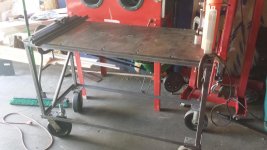
got myself some scrap from work, built mostly out of 1.5x3/4x1/8 tube steel, and 1x1 angle. 4 heavy duty albion 8" wheels, a stop for the swivel side of the table.

and the top is a 1/2"x21"x50" steel plate from a die that we scrapped at work. it took a while waiting for a good piece to show up that wasn't absolutely monstrous or just too puny. everything was bought at .010 or .09c/lbs scrap price so i've got about 20 bucks in total into the table.

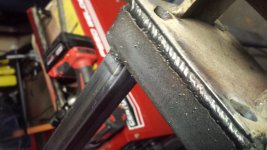
just a teaser pic for now need to finish wire wheeling and cleaning up the slag since i used my little 90 amp flux core century welder (passed down from my dad, its about 20 years old from what i can tell). people who say you shouldn't get a flux core for a first welder and should drop big coin on a good machine or be frustrated probably haven't used one.
 

Attachments

  • welds.jpg
    welds.jpg
    142.8 KB · Views: 584
To avoid these ads, REGISTER NOW!

jimgood

Well-known member
Joined
Aug 4, 2014
Messages
2,394
Location
Marshall, VA
people who say you shouldn't get a flux core for a first welder and should drop big coin on a good machine or be frustrated probably haven't used one.
Looks great. :thumbup:

And people who say that are usually full of ****. They're the same people that say you can't do a decent job of welding with 110v.
 

Willie Makeit

Well-known member
Joined
Dec 30, 2013
Messages
921
What if I tell you there is NASA flight hardware currently on-orbit that contains flux-core welded components. Seriously.
 

Willie Makeit

Well-known member
Joined
Dec 30, 2013
Messages
921
Can't discuss details, but NASA uses flux-core more often than you might think. 99% of parts that go on-orbit are cleaned to a microscopic level post fab so the manufacturing / fabrication process is moot.
 

mike13u

Well-known member
Joined
Mar 1, 2008
Messages
616
Location
S.Florida
Can't discuss details, but NASA uses flux-core more often than you might think. 99% of parts that go on-orbit are cleaned to a microscopic level post fab so the manufacturing / fabrication process is moot.

This is incorrect. Flux core welding is in both MILSPEC and NASA-STD manuals for applications where it may be appropriate for joining certain alloys. But, how well you clean something afterword has absolutely nothing to do with welding specs and standards.
The proper weld process, procedure, and technique for a specific joint and material must be used. Cleaning it afterword to prepare for flight is a given and has nothing to do with welding at all.
Friction stir Welding, fusion welding, electron beam, TIG, etc are all called upon by NASA welders based solely on the alloy to be welded and the joint configuration. Same process with any industry with specific welding procedures/code.
 

beakie

Well-known member
Joined
Feb 21, 2014
Messages
492
Location
Ontario, Canada
This is incorrect. Flux core welding is in both MILSPEC and NASA-STD manuals for applications where it may be appropriate for joining certain alloys. But, how well you clean something afterword has absolutely nothing to do with welding specs and standards.
The proper weld process, procedure, and technique for a specific joint and material must be used. Cleaning it afterword to prepare for flight is a given and has nothing to do with welding at all.
Friction stir Welding, fusion welding, electron beam, TIG, etc are all called upon by NASA welders based solely on the alloy to be welded and the joint configuration. Same process with any industry with specific welding procedures/code.

I think he was talking about the PRE welding cleaning process. Not the post welding cleaning you're talking about in regards to his comment.
 

Willie Makeit

Well-known member
Joined
Dec 30, 2013
Messages
921
This is incorrect. Flux core welding is in both MILSPEC and NASA-STD manuals for applications where it may be appropriate for joining certain alloys. But, how well you clean something afterword has absolutely nothing to do with welding specs and standards.
The proper weld process, procedure, and technique for a specific joint and material must be used. Cleaning it afterword to prepare for flight is a given and has nothing to do with welding at all.
Friction stir Welding, fusion welding, electron beam, TIG, etc are all called upon by NASA welders based solely on the alloy to be welded and the joint configuration. Same process with any industry with specific welding procedures/code.

ok ... next time you're in Huntsville (aka The Rocket City) look me up ;)
 
OP
K

Kracin

Well-known member
Joined
Mar 25, 2013
Messages
1,666
Location
Omaha, NE
Can't discuss details, but NASA uses flux-core more often than you might think. 99% of parts that go on-orbit are cleaned to a microscopic level post fab so the manufacturing / fabrication process is moot.

ok but why flux core over something else is what im wondering?
 

mike13u

Well-known member
Joined
Mar 1, 2008
Messages
616
Location
S.Florida
I don't care if you clean post fab and post weld or pre fab and pre weld. The weld process isn't determined by cleanliness of the weld area. It's determined by metallurgy and the strength of the weld process.
I also don't care where you are from. We put people into space right here in Florida. None of this changes the fact that the above is welding 101.
'We'll just clean it real good so our weld process can be pretty much flux core everywhere' isn't quite the way aerospace welding works
 
Last edited:

Willie Makeit

Well-known member
Joined
Dec 30, 2013
Messages
921
that's not what i said ... but please, go on, tell me more about what i do everyday for a living. ... lol
 
To avoid these ads, REGISTER NOW!

saceone

Well-known member
Joined
Dec 31, 2011
Messages
388
Location
Montreal Canada
77839-internet-fight-gif-star-wars-D7jm.gif
 

woodturner9

Well-known member
Joined
Feb 16, 2007
Messages
576
Location
Indiana(ish)
ok but why flux core over something else is what im wondering?

One reason flux core is used in production is higher build rates - so a welder can get more work finished in a day. Flux core also works better when welding outside in windy conditions.

As a practical matter, flux core is essentially mig welding with the gas supplied in a different way. As a result, it has the same benefits and limitations as mig welding.
 

R.Anderson

Well-known member
Joined
May 26, 2012
Messages
906
Location
Wisconsin
This is incorrect. Flux core welding is in both MILSPEC and NASA-STD manuals for applications where it may be appropriate for joining certain alloys. But, how well you clean something afterword has absolutely nothing to do with welding specs and standards.
The proper weld process, procedure, and technique for a specific joint and material must be used. Cleaning it afterword to prepare for flight is a given and has nothing to do with welding at all.
Friction stir Welding, fusion welding, electron beam, TIG, etc are all called upon by NASA welders based solely on the alloy to be welded and the joint configuration. Same process with any industry with specific welding procedures/code.

I am thinking Mike13u is responding to this:

Can't discuss details, but NASA uses flux-core more often than you might think. 99% of parts that go on-orbit are cleaned to a microscopic level post fab so the manufacturing / fabrication process is moot.

ok ... next time you're in Huntsville (aka The Rocket City) look me up ;)

So you can calm down a bit willie, his comment is valid. You pretty much stated that the parts are cleaned so well that the weld procedure chosen for that weld can be any darn type stick/mig/tig/oxy and does not matter what one is chosen. Mike13u is saying it does matter due to the material and in turn he is correct far as I am reading the posts.


people who say you shouldn't get a flux core for a first welder and should drop big coin on a good machine or be frustrated probably haven't used one.

And people who say that are usually full of ****. They're the same people that say you can't do a decent job of welding with 110v.

One reason not to get such a welder is most people want to weld thicker than 1/8" steel in the future so why buy one machine than later have to buy another? Drop the the coins to get what you need for what you want.

I did start off with a Lincoln MIG/flux core welder that I later switched it to gas and then ended up buying a larger machine to properly weld.

What if I tell you there is NASA flight hardware currently on-orbit that contains flux-core welded components. Seriously.
Do you run shielding gas with the flux core wire you burn?

One reason flux core is used in production is higher build rates - so a welder can get more work finished in a day. Flux core also works better when welding outside in windy conditions.

As a practical matter, flux core is essentially mig welding with the gas supplied in a different way. As a result, it has the same benefits and limitations as mig welding.
It should also be noted that there is flux core wire that is use with shielding gas.
 

R.Anderson

Well-known member
Joined
May 26, 2012
Messages
906
Location
Wisconsin
just a teaser pic for now need to finish wire wheeling and cleaning up the slag since i used my little 90 amp flux core century welder (passed down from my dad, its about 20 years old from what i can tell). people who say you shouldn't get a flux core for a first welder and should drop big coin on a good machine or be frustrated probably haven't used one.

So, how's that welding table coming along?

Sent from my SM-G920V using Tapatalk

So how long ya going to tease us with this? MORE

:needpics:
 
OP
K

Kracin

Well-known member
Joined
Mar 25, 2013
Messages
1,666
Location
Omaha, NE
hah, sorry that is my fault, i'm probably the worst at taking pictures of progress while doing something, i get so into it that i forget about everything else needing to be done. been working on restoring all these fans and things i get that i kept forgetting to upload pictures of how the table is going.

i had my pictures ready to upload yesterday while in my osha class and i didn't have enough signal to upload them. so here they come now.

it's good so far, like i stated before, its a 1/2" plate 21x50, so a good size, thick enough to be a great work surface but thin enough to still be lightweight and handle with my engine hoist and chainfalls so i don't break my back trying to lift it into place when its finally attached permanently.

my plan is to add some cross bracing underneath, just a few more bars so i'll end up picking the plate off of it again, it has a slight bow to it (which is why they tossed it and i got it for scrap price) but i can take the bow out once i fill up my oxy/acet bottles and put a rosebud on it. its not a precision top, although i would have preferred one of the precision ground plates they got rid of earlier, except those plates were much much larger and i would have had to cut it down to a reasonable size, and it still would have been a 1.5" thick plate. so i'm fine with this for now, my garage is too small and cramped for a large table like that. not to mention it's mobile with the great wheels i can grab from the scrap bins and table stops. i could load the table up with a car and it would still roll easy.

only some of the bracing on bottom is done, going to add another truss attached to the current one in place just for added rigidity even though its very solid now, and a sheetmetal plate on bottom for storage and such, probably add in a few shelves and some places to hand clamps and whatnot, like any welding table it will probably be added to constantly for a few years. but this is what i have for now, not bad for 20-30 bucks cost on everything and some of my time to complete.
 

Attachments

  • 20150915_102106.jpg
    20150915_102106.jpg
    143 KB · Views: 85
  • 20150915_102003.jpg
    20150915_102003.jpg
    144 KB · Views: 86
  • 20150915_101918.jpg
    20150915_101918.jpg
    143.6 KB · Views: 136
OP
K

Kracin

Well-known member
Joined
Mar 25, 2013
Messages
1,666
Location
Omaha, NE
I have heard about that but am not familiar with it. When would that method be used and what are the benefits?

same, i'm not sure about the redundancy of gassing flux core. you already get clean welds with flux core, and the gas wont keep the slag from needing to be cleaned off. any info?
 

jhn9840

Well-known member
Joined
Mar 11, 2007
Messages
1,189
Location
Northern Panhandle of WV
I can understand the use of Flux Core shield gas in an industrial/production setting. But for a guy just doing some casual welding at home wouldn't a used Lincoln 225 and a handful of rods from the local welding supply shop be a much cheaper way to go and still achieve the same results?

jhn9840
John
 
To avoid these ads, REGISTER NOW!
Top Bottom