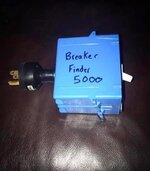
I am using a Klein Tools ET300 Digital Circuit Breaker Finder for witring updates in my 1973 tri-level kitchen remodel, and so far I confirmed four different breakers control all the outlets in the kitchen (secondary breaker panel in the basement). So I should know which breaker to flip to safely work on installing GFI outlets (per circuit) to meet current code, plus to install white new outlets versus the dark brown 50 year old outlets. But I will still confirm with my VOM at each outlet before I put tool or hand to the work. Using the ET300 per instructions has so far identified each breaker specifically, even when a breaker is next to a breaker I just confirmed for another outlet. I have to do the same now for the six wall switches in the kitchen area.
The basement breaker panel is a Cutler Hammer dating back to 1973, and the 200amp primary panel in the attached garage is also 70s vintage Cutler Hammer. I revised all the messy, unlabeled, pooly wired (loose connections, missing neutral connection, shared ground/neutral busbar) in the primary panel back in 2020 when I powered the sub-panel in my new shop garage. The Green Bay electrical inspector was complimentary when I showed him my primary panel updates when he inspected my shop garage sub-panel/wiring. So even though I've not opened it up the secondary basement panel, I assume it is wired with shared ground/neutral bus-bar. I might update that panel to separate ground and neutral bus-bars before I eventually sell the house.
Also, 2024 electrical code wise. I found on the net that any outlet in a kitchen has to be GFI protected, either directly with a GFI outlet or other outlets on a circuit powered by the first GFI in that circuit. My 1973 house had no GFI outlets in the kitchen. Two weeks past I installed one GFI below the sink that had powered the garbage disposal. I do have an outlet in a cabinet over the microwave mounted above the stove, but I can GFI protect that one as it in line from an outlet to the right of the stove for that countertop area.