To avoid these ads, REGISTER NOW!

Circuit Breaker Mapping

MattRMagnum

Well-known member
Joined
May 10, 2012
Messages
225
Location
PNW
Hey Folks,

I've a wall of outlets that I can't readily open up (it's in the house, tbh). Here's my issue: I don't know which end is which. I want to add a GFCI to the circuit, but I don't know where the start of the branch is. I think I know where it ends, but I don't know where it begins. Does anyone know an easy way to trace this? My best idea is to find the outlet I think is first, disconnect the load side of it, and see if the rest of the outlets quit working when re-energized. I don't like that idea, since it's kind of labor intensive (the circuit breaker is in the farthest corner of the house, and I've nobody to help), but I can't think of anything else.

Ideas?
 
To avoid these ads, REGISTER NOW!

LOW1

Well-known member
Joined
Jul 20, 2018
Messages
2,635
Location
ontario
Perhaps just find what breaker or breakers control the outlets and replace them with gfci breakers?
 

dave*99

Well-known member
Joined
May 5, 2009
Messages
4,259
Location
Coastal NJ
Why do you want GFCI on that circuit? Is there one receptacle that needs it or the entire run?
Can you just put a single one in the right spot? You then have the option to have it protect the rest of the chain.
 

SlappyWhite

Well-known member
Joined
Oct 3, 2012
Messages
1,819
Location
Upper Canada
Without any special tools.... some steps you may have done.

Step 1: Turn off the breaker and make sure they all go off and that no other ones do.
Step 2: With the breaker off open the one that you think is first and disconnect the hot only, turn the breaker back on using a volt meter or voltage detector (better) to see what is hot and what is not. If you are lucky you are done.,... if not, rinse and repeat with your next best guess.

If the goal is to GFCI them all by putting a GFCI outlet as the first one, swapping the breaker to a GFCI one may be an easier option if you don't want to work your way through the list.
 

larry4406

Well-known member
Joined
Jan 27, 2006
Messages
19,126
Location
Northern Virginia
I think the above Easter egg hunt methods are pretty much it. The panel gfi breaker is quick but spendy.

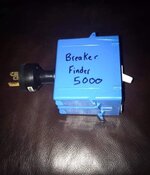
Saw this in the WTF thread so thought it applies here. Plug in, flip the switch, and the switch connects hot to neutral for dead short and trips the breaker finding it for you.

(No don’t do this).
1696357538201.jpeg
 

ybnormal

Well-known member
Joined
Jan 3, 2016
Messages
5,002
use a toner/tracer, aka, fox and hound to find them. alternatively, get a whole bunch of cheap nightlights and plug them in, flip a breaker and see which ones turn off
 
To avoid these ads, REGISTER NOW!

dave*99

Well-known member
Joined
May 5, 2009
Messages
4,259
Location
Coastal NJ
In general....
The circuits are usually wired in a daisy chain. With the breaker off, the first dead outlet closest to the panel will be the first one on the circuit. And the chain will continue to the end of the circuit. This wiring method conserves wire and limits box fill.
 

luvtheheat

Well-known member
Joined
Jan 28, 2017
Messages
489
Location
Tucson AZ
Perhaps just find what breaker or breakers control the outlets and replace them with gfci breakers?
I just wired a new detached garage and put in two brand new 20 amp GE GFCI breakers in the panel for two circuits of 5-8 outlets each. I had many trips for no apparent reason (e.g., no load on the circuit) and one tripped without even being wired in the sub-panel. They were bad out of the box.

The fix...? I removed the GFCI breakers, put in normal ones, and put one GFCI outlet at the head of each circuit, and daisy chained the rest.

Problem solved.
 

SlappyWhite

Well-known member
Joined
Oct 3, 2012
Messages
1,819
Location
Upper Canada
I just wired a new detached garage and put in two brand new 20 amp GE GFCI breakers in the panel for two circuits of 5-8 outlets each. I had many trips for no apparent reason (e.g., no load on the circuit) and one tripped without even being wired in the sub-panel. They were bad out of the box.

The fix...? I removed the GFCI breakers, put in normal ones, and put one GFCI outlet at the head of each circuit, and daisy chained the rest.

Problem solved.
It is possible they were bad out of the box, specially the one that trips without being wired.

It is also possible there is a problem (ground fault) in the run to the garage before the outlets. The now GFCI outlet will only trip on what is downstream of it.
 
OP
M

MattRMagnum

Well-known member
Joined
May 10, 2012
Messages
225
Location
PNW
Why do you want GFCI on that circuit? Is there one receptacle that needs it or the entire run?
Can you just put a single one in the right spot? You then have the option to have it protect the rest of the chain.

The circuit in question is in a kitchen. I historically have gone the "GFCI every outlet" route when doing kitchens. I know this infuriates some people, but I tend to like it. I was thinking of doing a single one, in this case, instead of my traditional route.

I think the above Easter egg hunt methods are pretty much it. The panel gfi breaker is quick but spendy.

Saw this in the WTF thread so thought it applies here. Plug in, flip the switch, and the switch connects hot to neutral for dead short and trips the breaker finding it for you.

(No don’t do this).

This feels like cheating. It's all the functionality of just licking the outlets, but without the artery-cleaning that a good tongue-lash of the outlets will do.

In general....
The circuits are usually wired in a daisy chain. With the breaker off, the first dead outlet closest to the panel will be the first one on the circuit. And the chain will continue to the end of the circuit. This wiring method conserves wire and limits box fill.

I understand that. The issue is that with it being an interior wall, I can't tell where the branch is. It's difficult for me to explain. The area in question is basically an "L" shape, and popping faceplates of outlets hasn't made it 100% obvious which outlet is the start. I suspect I'll be lazy and just put a GFCI on every outlet.
 

dave*99

Well-known member
Joined
May 5, 2009
Messages
4,259
Location
Coastal NJ
Ok you have an L. Disconnect the receptacles at the 2 at the points of the L. Not the corner.
Turn the power back on and see which set of wires sticking out of the wall are live. Put a GFCI there.

Kitchen countertops areas usually have 2 circuits. And they are 20A using 12ga. If you see some 12 and some 14 they will be different circuits.
 
To avoid these ads, REGISTER NOW!
Top Bottom