To avoid these ads, REGISTER NOW!

Circuit for Welder

rvr6000

Well-known member
Joined
Oct 3, 2010
Messages
1,072
Location
St. Paul, MN
Dumb question about running a circuit for a Lincoln arc welder.

Manual says run #10 copper or bigger if running in conduit. Is there anything special about a welder that requires the circuit to be inside conduit? I have some spare 10-3 Romex laying around....my garage is finished but just have OSB on the walls so could easily take down a couple sheets and run the circuit through the studs like any other circuit. The outlet will only be about 16 feet from the panel.
 
To avoid these ads, REGISTER NOW!

Speedy Petey

Well-known member
Joined
Apr 22, 2012
Messages
1,430
Location
NY State
Manual says run #10 copper or bigger if running in conduit.
Makes no sense. Typically you can run smaller wire in conduit as opposed to NM cable.

Please post the specs of the welder as we can assist further. To give advice without knowing the specs is risky at best.
 

luv2diy

Well-known member
Joined
Jun 13, 2011
Messages
79
Location
Ada county, ID
Sorry, I don't mean to hi-jack your thread :evil:, but it falls in the same category that I'm in.

I have the same welder and need to wire a detached garage < 60 ft from my 200 amp house panel.

I have already purchased 125ft of 8/2 nm-b, 40 amp breaker for the welder and 100ft of 12/2 NM-B, 20 amp for my air compressor (electr: 240v/12.5A/60HZ/1PH).
What size conduit to run both 8/2 and 12/2 in a 12ft conduit from the house to the detached garage?

Here are the specs on the welder I pulled off the internet.


Volts 230
Amps 40–225
Duty Cycle 225A/25V/20%
Amperage Adjustments 40–225
Range Selection 40–225
Weldable Metals Carbon, low alloy, stainless steel, cast iron
Weld Thickness (in.) Up to 1/4
Electrode Size (in.) 3/32 to 5/32
Electrode Cable Length (ft.) 10
Clamp Cable Length (ft.) 10
Power Cord (ft.) 6
Dimensions L x W x H (in.) 12 x 17 1/4 x 24

Shop Lincoln Electric (made in the USA)

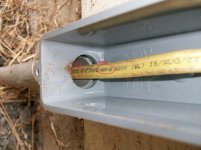
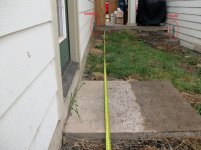
Quick note: It's a 5 year old home and already has a 1" conduit with 12/2 nm-b ran to the detached garage.
 

Aceman

Well-known member
Joined
Jan 28, 2007
Messages
2,513
Location
Eastern Oregon
Luv, you're in over your head. Everything about your plan is wrong.

1. You can't run NM-B in conduit underground.
2. You can't run multiple circuits to a seperate structure.

Run a decent sized feeder over there, set a panel, drive a couple rods and feed your equipment correctly. And pull a permit. You need it.

A lot of your questions can be answered by simply searching this forum...
 

Speedy Petey

Well-known member
Joined
Apr 22, 2012
Messages
1,430
Location
NY State
luv2diy, I'm not sure who advised you to buy all that wire, but they did you a serious disservice and wasted a good bit of your cash.

PLEASE listen to Aceman.
 

jkeyser14

Well-known member
Joined
Dec 19, 2008
Messages
1,823
Location
(rural) Maryland
Yes, there is something special about running wire in conduit. Although it's not just about the welder, its about all of the wiring in the vicinity of the welder.

Welders can put off some nasty high frequency EMI. The amount of EMI scales linearly with power, but drops off as a function of distance squared. Unprotected wires will act as antennas to pick up the high frequency from the welder and introduce that noise into your wiring, potentially damaging sensitive electronics.

I've been in a shop where we had all of the electrical run in EMT conduit with a computer 15' from a welder. If someone had the computer on at the same time the welder was in use the computer power supply would blow. Apparently the 3' cord between the outlet and computer was all that was needed to pick up enough EMI to do damage. Our shop was only 15' x 30' and we were never able to avoid the problem, so we just made sure not to use the computer and welder at the same time.

Just as a reference point, my welder is rated for 300A @ 60% duty cycle and the manual recommends running all of the buildings electrical wiring within 50' of the welder in metal conduit (no flex) as well as driving a ground rod within 10' of the welder.
 

Speedy Petey

Well-known member
Joined
Apr 22, 2012
Messages
1,430
Location
NY State
Yes, there is something special about running wire in conduit. Although it's not just about the welder, its about all of the wiring in the vicinity of the welder.

Welders can put off some nasty high frequency EMI. The amount of EMI scales linearly with power, but drops off as a function of distance squared. Unprotected wires will act as antennas to pick up the high frequency from the welder and introduce that noise into your wiring, potentially damaging sensitive electronics.

I've been in a shop where we had all of the electrical run in EMT conduit with a computer 15' from a welder. If someone had the computer on at the same time the welder was in use the computer power supply would blow. Apparently the 3' cord between the outlet and computer was all that was needed to pick up enough EMI to do damage. Our shop was only 15' x 30' and we were never able to avoid the problem, so we just made sure not to use the computer and welder at the same time.

Just as a reference point, my welder is rated for 300A @ 60% duty cycle and the manual recommends running all of the buildings electrical wiring within 50' of the welder in metal conduit (no flex) as well as driving a ground rod within 10' of the welder.
This is all well and good, but really does not apply to a residential application.
I have also work in a couple of serious welding/fabrication shops, and while most wiring is in metal conduit this is something I have never heard of.
 

luv2diy

Well-known member
Joined
Jun 13, 2011
Messages
79
Location
Ada county, ID
Thank you for the feedback guys. The guy at the local box store pointed my in the wrong direction.
Now, I think back.. my buddy that's an electrician that wired my shop at my old house did it this way. I had a permit pulled and remember the county stopping by and inspecting.

I will do a complete write up and take pictures/ videos of my future plans for you guys to give your yay or nay.
 

jkeyser14

Well-known member
Joined
Dec 19, 2008
Messages
1,823
Location
(rural) Maryland
This is all well and good, but really does not apply to a residential application.
I have also work in a couple of serious welding/fabrication shops, and while most wiring is in metal conduit this is something I have never heard of.

It applies anywhere you put the welder, regardless of commercial or residential. The EMI given off by the welder doesn't magically disappear because you're at home. Like I said though, the amount of EMI given off is proportional to the output power and drops off with the square of the distance. So if you have a smaller welder the recommended distance might drop to 10-15 ft. The only way to know for sure is to read what the manufacturer recommends.
 

jkeyser14

Well-known member
Joined
Dec 19, 2008
Messages
1,823
Location
(rural) Maryland
How would you handle this? This garage was constructed with the house, so who all would be at fault?:headscrat

The electrician would definitely be at fault, but the the inspector was supposed to catch that, I'm surprised they didn't. I would contact your electrician first and ask him to correct the problem.
 

jrsulo

Well-known member
Joined
Feb 23, 2010
Messages
754
Location
New Jersey
:thumbup:
Luv, you're in over your head. Everything about your plan is wrong.

1. You can't run NM-B in conduit underground.
2. You can't run multiple circuits to a seperate structure.

Run a decent sized feeder over there, set a panel, drive a couple rods and feed your equipment correctly. And pull a permit. You need it.

A lot of your questions can be answered by simply searching this forum...
 

Speedy Petey

Well-known member
Joined
Apr 22, 2012
Messages
1,430
Location
NY State
It applies anywhere you put the welder, regardless of commercial or residential. The EMI given off by the welder doesn't magically disappear because you're at home. Like I said though, the amount of EMI given off is proportional to the output power and drops off with the square of the distance. So if you have a smaller welder the recommended distance might drop to 10-15 ft. The only way to know for sure is to read what the manufacturer recommends.
Not really. Here are the instructions from my welder:http://www.millerwelds.com/om/o225311c_mil.pdf

Here is what I found about EMI:
ARC WELDING can cause interference.
- Electromagnetic energy can interfere with
sensitive electronic equipment such as
computers and computer-driven equipment
such as robots.
- Be sure all equipment in the welding area is
electromagnetically compatible.
 -To reduce possible interference, keep weld cables as short as
possible, close together, and down low, such as on the floor.
- Locate welding operation 100 meters from any sensitive electronic
equipment.

- Be sure this welding machine is installed and grounded
according to this manual.
- If interference still occurs, the user must take extra measures
such as moving the welding machine, using shielded cables,
using line filters, or shielding the work area.

Sorry, to me none of this applies in a residential setting. Unless of course your shop is >330' from your home computer.
It also says NOTHING about running the building wiring in conduit only.

I am not trying to create a big argument here, I'm just saying that in a typical residential application this is NOT much of an issue.
 
To avoid these ads, REGISTER NOW!

Speedy Petey

Well-known member
Joined
Apr 22, 2012
Messages
1,430
Location
NY State
How would you handle this? This garage was constructed with the house, so who all would be at fault?:headscrat
Regardless of who is to blame (1: Electrician, 2: Inspector) that is a SAD installation. That was NOT done by any kind of respectable electrician, for several reasons. That looks like handyman work to me.
 

theoldwizard1

Well-known member
Joined
Feb 22, 2011
Messages
43,432
Location
SE MI
How would you handle this? This garage was constructed with the house, so who all would be at fault?:headscrat

It doesn't really matter NOW who is wrong. What matters is to make it right.

Assuming there really is conduit between the house and garage, pulling out the NM-B (while pulling a new pull cord) should be easy. You want to put in 4 #8, or better yet #6, and then you can put in a 100A subpanel.
 

jkeyser14

Well-known member
Joined
Dec 19, 2008
Messages
1,823
Location
(rural) Maryland
Not really. Here are the instructions from my welder:http://www.millerwelds.com/om/o225311c_mil.pdf

Here is what I found about EMI:


Sorry, to me none of this applies in a residential setting. Unless of course your shop is >330' from your home computer.
It also says NOTHING about running the building wiring in conduit only.

I am not trying to create a big argument here, I'm just saying that in a typical residential application this is NOT much of an issue.

330' away can cover the better part of an acre, so I would say that it definitely applies to residential applications. That's also why I said it's important to read what the manufacturer suggests. I'm not trying to be argumentative either, I'm just trying to raise awareness that the welder can damage sensitive electronics. If someone puts a welder close (distance based on what the manufacturer states) to a computer or their nice new flat screen tv, they should be aware that there could be consequences.

Running all of the wiring in continuous metallic conduit will cut down on the effect that EMI has on those circuits.
 
Last edited:

Speedy Petey

Well-known member
Joined
Apr 22, 2012
Messages
1,430
Location
NY State
It may be, but I don't see how. :confused:
Per the neighborhood's CC&R every home must have a double garage and this is the only power source to the garage.
That's my point.
A single run of 12/2 romex; underground in conduit; feeding a two-car garage with ONE 20A circuit; equals HACK work. IMO of course. :cool:
 

Larwyn

Well-known member
Joined
Oct 10, 2011
Messages
378
Location
Texas
I tend to agree with Sberry (often a good choice). I also have a little real world experience with this matter being a non issue.

I have a Miller Matic 180 mig welder as well as a Miller Spectrum 375 Extreme plasma cutter in my garage. These two machines are normally up against the same wall that, on the living room side, supports my 55 inch flat screen TV. Approximately 20 feet beyond that lives my laptop computer. This arrangement has worked for me since we moved into this house 6 years ago. I realize that I am the only one doing any welding out there so I would not notice any interference. I just asked my wife if she ever noticed any interference on the tv or computer when I am welding out in the garage. Her answer is "no", so I have no plans to fix what aint broke.

I have a 240 volt 30 amp circuit for my welder and plasma cutter, the 10-2 with ground up in the attic runs directly over the top of the TV and down the garage side of the wall directly behind it. The two 6-50r receptacles are mounted on the same wall about a foot and half below the TV set. The 10-2 is in pvc conduit on the garage wall and there is no conduit in the attic. The wall is standard 1957 construction; 2x4 studs, drywall inside and 1x6 planks on the garage side, insulation was blown in.

I also have a Lincoln AC 225 out back at the shed. The shed is about 90 feet behind the house, has a 100 amp sub panel supplied from the home service panel by three 6 gauge thhn and a 10 gauge ground, it is on a 60 amp breaker and in pvc conduit, about half of it underground, out to the shed. This was put in by the electrician when he upgraded the home service panel and inspected by the city inspector. I, long ago, did all the wiring in the shed and it is all in EMT conduit just because that is the way I wanted to do it. The welder outlet (another 6-50r) is connected to a 50 amp breaker in the sub panel by two 6 gauge thhn and 10 gauge ground . There have been no reports of interference when I run this welder either.
 

jkeyser14

Well-known member
Joined
Dec 19, 2008
Messages
1,823
Location
(rural) Maryland
I don't recall any where does it say damage,,, it says interference.

EMI causes damage. It's stray voltage/current where it shouldn't be. If the electronics don't have some sort of protection built in they can be harmed.

Google "welding near computers" if you don't believe me.
 

sberry

Banned
Joined
Jun 18, 2005
Messages
35,747
Location
Brethren, Michigan
What would I get if I googled this,,,more opinions? Larwyn, yes I don't imagine you would have an issue, most of this centers around HF with tig welders. This is about like the disconnect battery discussion. Despite the real world experience of thousands, hundreds of thousands there is always someone just absolutely sure he saved his car because he unhooked the battery. I have heard of interference, never personally had it be an issue despite having the equipment and using it in same vicinity. (Have had it going on while in my office, don't recall it was a problem. I can't recall any reliable accounts of direct damage but,, I haven't read every forum either. I can add,,, it does seem that there is someone somewhere who's brothers cousins uncle's nephew has had these things happen. I remember a case involving welding on a pickup, was a Ranger as I recall,,, the guy says,,, he blew out every light bulb, fried every wire including the "computer",, light bulbs kinocked half the wall of garage over in the process, nearly caught the place on fire.

My 300 synch sits, maybe 35 ft or so from puter in may office, most of my wiring is piped but there are a few cords connected,, I am in a grounded steel building,,, not sure how much of a factor that is. This I tend to know,,, I haven't seen anyone follow all this to a T, some take no special precautions such as myself, I suspect its the case for most. If it was a real problem the welding forums would be full of it on a daily basis since this is a common scenario every day by the thousands.

As I mention on another forum,,, its about like being afraid to fly on commercial air liner but think nothing of throwing a leg over a Harley.
 
Last edited:

Charles (in GA)

Well-known member
Joined
Jan 11, 2006
Messages
12,489
Location
50 mi south of Atlanta
Since I think the OP's question was answered, luv2diy needs a little explanation of some of what has been said. The reason you cannot use NM-B underground, even in a conduit, is that any conduit in a slab or underground, is considered by the National Electric Code (aka "code" or "NEC") to be a WET location. Yes, you would think that a PVC conduit is dry down there, and even if it is, its still a "wet location" and NM-B can never be used in a "wet location". You would need to use either UF (flat underground, direct burial wire) that can be run in conduit but is very difficult to do this with an un-necessary, or you should use individual wires, THWN/THHN (its gotta have the W in it, meaning "wet") but almost all THHN is also rated as THWN. These wires must stay in conduit throughout their run, from end to end. You could, if you wanted, where you emerged in the garage, install a properly sized junction box and splice to Romex, or you could simply run the conduit on to its destination, a subpanel, you will need to install in the garage.

The reason you cannot run more than one circuit (two hots/neutral/ground) to the garage is that code does not all allow it. You are allowed only one circuit from one building to another, so you need to run something large enough to supply everything you intend to do, lights, welder, plasma cutter, air compressor, radio, etc, and run them all from the sub panel.

The best thing you can do is run three #6 THHN/THWN wires (red/black/white) plus a #10 green THHN/THWN) to the garage, install a small breaker panel (hopefully an 18 space or better, don't cut yourself short, more on this later) and then supply the garage with a 60 amp breaker from the house. If your garage panel has more than 6 breaker handles, or you expect to add enough breakers to exceed the 6 handles, you will have to have a main disconnect on or in the garage. This can simply be a backfed breaker in the panel, retained with a main breaker retainer kit designed for that brand of panel, and of an amperage equal to or better than what is being supplied by the main panel.

Many people buy a 6 space or 8 space panel thinking it will be all they ever need, when in reality, they need a 16 or 24 space panel, just to cover all the bases. It also allows the use of standard full size breakers which are cheaper than buying the small half sized breakers or the tandems (two 120v breakers in one housing). You also have to allow space for your main breaker in a panel also.

One last thing, is that you will need to drive a ground rod, or two, or more, depending on what your local code people say.

As Aceman said, it really sounds like you may be in over your head, you will at least need lots of guidance in doing this project right, or possibly even have an electrician do the work (hopefully one better than the one that ran the NM in the conduit).

Charles
 

luv2diy

Well-known member
Joined
Jun 13, 2011
Messages
79
Location
Ada county, ID
Mr. Charles,
Wow,:bowdown:
Thanks for so much detail! I appreciate it very much.

At first, I was pointed in the wrong direction, but now with all of your help, I know where to start and I will relentlessly read/research until I feel comfortable before moving forward. And of course, touching base w/ you guys along the way.:bounce::bounce:
 

Highbeam

Well-known member
Joined
Feb 15, 2011
Messages
2,292
Location
Mt Rainier foothills, WA
Don't forget about burial depth. If that conduit was put in for a 20 amp residential circuit it might only be 12" deep. Once you pull 6 gauge to the shop, that conduit is supposed to be 24" deep.
 
To avoid these ads, REGISTER NOW!
Top Bottom