To avoid these ads, REGISTER NOW!

Circuit trip?

DDLexus

Member
Joined
Dec 30, 2008
Messages
16
Location
Madison, Alabama
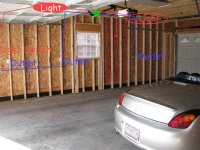
Need a little help in determining the potential cause of the interference in my electrical wiring. I have an image to help illustrate the situation. When I was in my attic installing insulation and sheetrock, 2 wire bundles (shielded with metal casing) contacted each other and threw the GFI switch on one of the outlets. The two wire bundles/conduit were kept apart and the GFI was reset. No problems. I moved the conduit so that they touch and the GFI tripped again. One conduit feeds the outlets and the other is tied to a light switch for the 2 ceiling mounted fluorescent fixtures. They are fed from the same circuit breaker in the breaker box... To keep them from touching and tripping the GFI, i nailed one of them down with a plastic wire naildown tap. Is this normal and if not, how can the problem be diagnosed?

Note, the star on the image show the location in the attic where the conduit touched and tripped the GFI outlet on the left side of the image.
 

Attachments

  • wires_garage3.jpg
    wires_garage3.jpg
    72.8 KB · Views: 62
To avoid these ads, REGISTER NOW!

ddawg16

Well-known member
Joined
Jul 11, 2008
Messages
21,005
Location
S. California
I concur with MAD.

I would be willing to bet that the shield of one of those bundles is connected to Common.

The ONLY place that ground and com connect is at the main panel. If your garage has a seperate sub panel, I believe that the ground and com in it should NOT be connected together.
 

rinny_tin_tin

Well-known member
Joined
Dec 20, 2008
Messages
636
Location
Northern Virginia
What makes this really strange is that both ckts are fed from the same breaker. GFCIs work by sensing any residual path to ground. Given your scenarios as you describe, and as surmised by Deputy & Mad you may have a neutral shorted to the metal conduit ON your ltg ckt, AND your ltg ckt conduit is not properly bonded to gnd (perhaps it is/is not?)

Check the above - however, if the neutral is not shorted to the gnd on both ckts -- try an experiment with the ltg ckt OFF - that is keep the fluorescent lights off and then try shorting together the two metal casings. Also - what exactly do you mean when you say "metal casing"?

Also, it would maybe help if you upload a simple pencil schematic of your wiring. Your pic, although descriptive, does not show desired wiring details
 
OP
D

DDLexus

Member
Joined
Dec 30, 2008
Messages
16
Location
Madison, Alabama
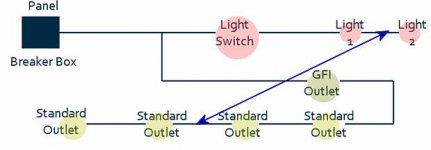
I'm guessing the schematic looks like this... There is a non-GFI breaker in the box that supplies power to both the lights and the outlets. The GFI is located at the start of the series for outlets indicated on the drawing. When the GFI tripped, the overhead lights remained on.

I paid a contractor to do the electrical, so my drawing is my best guess at where the 2 feeds are split.

The neutral is the bare copper wire, correct? This cannot touch any bare metal inside the metal outlet boxes, correct too? Since all my outlet boxes are metal, and so is the conduit (non romex), it is probably touching inside a box... agree?
 

Attachments

  • wires3.jpg
    wires3.jpg
    16.9 KB · Views: 21

rinny_tin_tin

Well-known member
Joined
Dec 20, 2008
Messages
636
Location
Northern Virginia
I'm guessing the schematic looks like this... There is a non-GFI breaker in the box that supplies power to both the lights and the outlets. The GFI is located at the start of the series for outlets indicated on the drawing. When the GFI tripped, the overhead lights remained on.

I paid a contractor to do the electrical, so my drawing is my best guess at where the 2 feeds are split.

The neutral is the bare copper wire, correct? This cannot touch any bare metal inside the metal outlet boxes, correct too? Since all my outlet boxes are metal, and so is the conduit (non romex), it is probably touching inside a box... agree?

The schematic itself looks fine. The Neutral is not the bare copper wire and is ground and must never touch (or serve) as the neutral (white), however, you want the bare copper (gnd) to indeed touch the metal box and the metal conduit body. Ok - next step - trace the conductors from the main panel noting color and what connections are being made. Make a sketch from junction to junction all the way to the load.
 
To avoid these ads, REGISTER NOW!
OP
D

DDLexus

Member
Joined
Dec 30, 2008
Messages
16
Location
Madison, Alabama
Ok - next step - trace the conductors from the main panel noting color and what connections are being made. Make a sketch from junction to junction all the way to the load.

If the GFI box trips, I'd expect there is a problem between the GFI and the other outlets. Right? The breaker at the box is not thrown, only the GFI at the wall outlet. Is there a tool that might help pin-point what box has the problem? A screwdriver-like tool with a light in it? I saw a home inspector using something like that...
 

rinny_tin_tin

Well-known member
Joined
Dec 20, 2008
Messages
636
Location
Northern Virginia
If the GFI box trips, I'd expect there is a problem between the GFI and the other outlets. Right? The breaker at the box is not thrown, only the GFI at the wall outlet. Is there a tool that might help pin-point what box has the problem? A screwdriver-like tool with a light in it? I saw a home inspector using something like that...

There are GFCI testers that will evaluate GFCI operation, I have one made by Ideal and another made by Greenlee. The Ideal is a POS while the Greenlee is good, but both are expensive. There are also cube devices for about $15.00 that will tell you about polarity, etc - and this might be something you may want to have in your toolbox and use in this case.

See here:

http://www.drillspot.com/products/76742/Hubbell_HBL5200_Receptacle_Gfci_Tester
 

Torque1st

MEMBER EMERITUS
Joined
Sep 14, 2008
Messages
5,668
Location
KC Metro, Kansas
Hmmm, a person could make a GFI tester with a 3-prong grounding plug and a resistor. I think I can find the trip current values and will calculate what resistor to use and post the value if anyone is interested. It may not be as accurate as the professionally made unit.

There are handy testers available that can be used to check outlets. They have three LEDs in them and are available with the electrical tools at any Home Box store. The problem may be in the lights also.

The outlet tester is like:
http://www.lowes.com/lowes/lkn?action=productDetail&productId=12370-1781-GRT-800&lpage=none
There are far cheaper models available tho that just do the wire polarity test. I have two of them around and I don't think I gave more than $5 for either of them. The unit above tests GFI outlets also.
 
Last edited:
OP
D

DDLexus

Member
Joined
Dec 30, 2008
Messages
16
Location
Madison, Alabama
The contractor will be alerted today. Since the issue only occurs when the 2 wires touch, i was not too concerns. However, it sounds like a faulty wiring setup and therefore needs to be addressed. I don't want my house and new garage to melt to the ground... is that even possible?
 
To avoid these ads, REGISTER NOW!
Top Bottom