To avoid these ads, REGISTER NOW!

Clark forklift ID and questions

dwlee6

Member
Joined
Jun 4, 2012
Messages
6
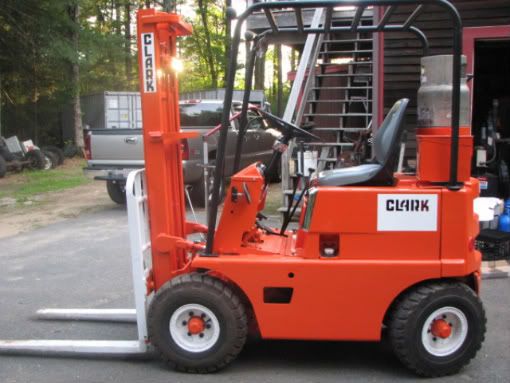
Took the plunge and bought an old Clark forklift. Need help with identification and a few questions. Photos attached. Looks like a “Carloader” from comparison to photos saw posted on web.
Has 4 cylinder flathead? gas engine looks like original paint on engine is medium blue. Seems to run well. Seller said it was 3500 lb capacity, but don’t think they knew anything about forklifts beyond what who they bought it from told them. I worked as a ASE certified auto tech for a few years back in the 70’s and have pretty good mechanical knowledge overhauling engines, transmissions, machinery, electric motors etc., but this is my first forklift.

Questions:

SERIAL NUMBER LOCATION FOR ID
I read somewhere serial number was on frame, someone posted was :”under battery” which looks to be in original carrier on right side inside the access door. Took out battery and took a quick look, did not find anything under the accumulated crud in that area. Before I scrape too much, am I looking in the correct place?

BRAKES
When I got it home, the brake pedal did nothing – went to floorboard with no resistance or braking action. Looked in master cylinder and it was about ½ full of fluid. That was yesterday. Today I went out in garage and pumped the brake pedal a bunch of times, and now it has resistance, firm not spongy near the top of it’s travel. Did not have room or time to start it up and move it, but I could hear something moving inside the right front wheel when I pressed on the brake pedal and I put the machine in neutral and rocked it fore and aft a little with a 2x4 and pressing the brake pedal stopped me being able to rock it, so maybe the brakes do work? I’m not one for fixing it if it ain’t broke so will add some brake fluid and try things out when I get some time. Any ideas on why no pedal yesterday, OK today?

HYDRAULIC OIL MILKY COLOR
The oil in the hydraulic tank which is in front of the motor, sort of under the front of the seat looks milky. Photo attached shows a bit of it running down the outside of the tank that dripped off a dipstick I stuck in to check the level. Any idea why it is this color? How high in the tank is the level supposed to be, and what oil to use? Can I get the 5 gallon pail of tractor hydraulic fluid/trans fluid and use that? How about automotive automatic transmission fluid? The lift seems to work OK and it has no major leaks, the lift cylinder area especially is dry. The little bit it does leak somewhere leaves a few drips on the floor at right front of the machine, maybe a few inches overnight. The radiator coolant looks clear light green like someone did use an antifreeze mix in it, so there does not appear to be comingling of coolant, though I don’t even think these systems are interconnected anywhere.

ENGINE OIL DIPSTICK
Where is the engine oil dipstick and any idea how much oil goes in the motor and oil filter part numbers?

STEERING
The unit has about 1/3 of a turn free play in the steering. Have not looked underneath to see where the play is – probably stack up of all linkages and box. Is this “normal” for a machine this age? Any suggestions where to look first?
 

Attachments

  • Clark right rear.jpg
    Clark right rear.jpg
    116.4 KB · Views: 217
  • Clark rt frt.jpg
    Clark rt frt.jpg
    129.2 KB · Views: 193
  • Clark steering.jpg
    Clark steering.jpg
    132.5 KB · Views: 175
  • Clark engine.jpg
    Clark engine.jpg
    123.6 KB · Views: 190
  • Clark hyd oil.jpg
    Clark hyd oil.jpg
    82.1 KB · Views: 177
  • forkclfrt.jpg
    forkclfrt.jpg
    38 KB · Views: 201
To avoid these ads, REGISTER NOW!

bgott

Well-known member
Joined
Oct 31, 2005
Messages
3,512
Location
Houston, TX.
I've never seen a forklift with really good brakes. I think they design 'em to be a little loose, if they locked up and you had a load up in the air you could flop the truck over pretty quickly. I would bleed them and fill with fresh fluid. The hydraulic fluid needs changed, it has a lot of water in it. Outside parking?
 

WWIIjeep

Well-known member
Joined
May 30, 2012
Messages
1,240
Location
Arizona
Took the plunge and bought an old Clark forklift. Need help with identification and a few questions. Photos attached. Looks like a “Carloader” from comparison to photos saw posted on web.
Has 4 cylinder flathead? gas engine looks like original paint on engine is medium blue. Seems to run well. Seller said it was 3500 lb capacity, but don’t think they knew anything about forklifts beyond what who they bought it from told them. I worked as a ASE certified auto tech for a few years back in the 70’s and have pretty good mechanical knowledge overhauling engines, transmissions, machinery, electric motors etc., but this is my first forklift.

I think it's a Model 20B or 25B or C. It's similar to a Clark Yardlift (Y-series), but Yardlifts had pnuematic tires as opposed to cushion tires (Carloaders or warehouse lifts). Otherwise, most of the rest of the lift should be the same as the Y20 or Y25. Probably mid-late-50s to early-60s vintage (I'm better at identifying the even older ones and the Yardlifts).

The engine should be a Continental Y-91.

3500 lbs is somewhat optimistic. It's likely 2000 lbs (on 24" center). It might be 2500 lbs, but let's be conservative for now. :)


SERIAL NUMBER LOCATION FOR ID
I read somewhere serial number was on frame, someone posted was :”under battery” which looks to be in original carrier on right side inside the access door. Took out battery and took a quick look, did not find anything under the accumulated crud in that area. Before I scrape too much, am I looking in the correct place?

There should be a nameplate on the left front of the motor housing (down and to the operator's right). I don't remember ever seeing anything on or under the battery boxes except corrosion. :) I vaguely remember seeing serial numbers on frames of Clarks I've had completely apart, but don't remember a particular location and might even be thinking of some other make.

BRAKES
When I got it home, the brake pedal did nothing – went to floorboard with no resistance or braking action. Looked in master cylinder and it was about ½ full of fluid. That was yesterday. Today I went out in garage and pumped the brake pedal a bunch of times, and now it has resistance, firm not spongy near the top of it’s travel. Did not have room or time to start it up and move it, but I could hear something moving inside the right front wheel when I pressed on the brake pedal and I put the machine in neutral and rocked it fore and aft a little with a 2x4 and pressing the brake pedal stopped me being able to rock it, so maybe the brakes do work? I’m not one for fixing it if it ain’t broke so will add some brake fluid and try things out when I get some time. Any ideas on why no pedal yesterday, OK today?

Air in the brake lines. There's not much brake line and a small master cylinder, so a little pumping usually gives you brake pedal as long as there's fluid in the system.

Forklift brakes are generally poorly maintained, especially on old lifts. You really should flush the master cylinder and the lines, check/rebuild the wheel cylinders, and check and adjust the shoes, but I also agree with the "if it works, don't fix it rule" so, assuming your parking brake works (in case of emergency) if you want to just run it for a while and see how the brakes act, that's probably OK, but I wouldn't try driving down a hill with a heavy load until you're sure of the brakes.

HYDRAULIC OIL MILKY COLOR
The oil in the hydraulic tank which is in front of the motor, sort of under the front of the seat looks milky. Photo attached shows a bit of it running down the outside of the tank that dripped off a dipstick I stuck in to check the level. Any idea why it is this color? How high in the tank is the level supposed to be, and what oil to use? Can I get the 5 gallon pail of tractor hydraulic fluid/trans fluid and use that? How about automotive automatic transmission fluid?

Probably some water or condensation in the hydraulics. Did you check it after it had been running? Sometimes hydraulic oil foams and looks milky and therefore contaminated, but isn't. DO NOT use automatic transmission fluid. Tractor hydraulic fluid is OK if you drain the contaminated stuff out first.

ENGINE OIL DIPSTICK
Where is the engine oil dipstick and any idea how much oil goes in the motor and oil filter part numbers?

Y-91 engine takes 4 quarts. Oil filter number depends on which type you have. Assuming it's a cartridge type and not a screw-on, just open the top of the filter canister and see which filter is inside, because more than one size has been used on those engines.

STEERING
The unit has about 1/3 of a turn free play in the steering. Have not looked underneath to see where the play is – probably stack up of all linkages and box. Is this “normal” for a machine this age? Any suggestions where to look first?

1/3 turn isn't bad at all for an old forklift, although you can probably get it tighter than that. I've managed to get really loose ones down to less than 1/4 turn of free play pretty easily usually. One common place where steering slop can develop is where the linkage pivots on the frame, and that's where I'd look first.

Welcome to the forklift club. :thumbup: Try not to let your friends, relatives and neighbors see it, or all your free time will be taken up with low-pay or no-pay lifting and moving jobs. :lol_hitti
 

Milton Shaw

Well-known member
Joined
Feb 11, 2011
Messages
4,845
The one I had the model number plate was on the left front of forklift between the tower and the cab. Those will take a special jack to pick it up. Northern tool has one its a very low profile strong jack for forklifts. I bought a lift not running and when I got into it, found enough stuff that I ended up selling the lift instead of fixing it. Had cracked block plus cylinder leak plus brake and clutch problems. Dip stick after I got it running and looked at it was four inches up from full and looked like a milk shake. Water went straight into oil pan from radiator, not worth a rebuild. The brakes are a little funky but you should be able to figure them out. Bleeders are a little hard to get too and are in an elbow from wheel cylinder at least they were on mine.
 
OP
D

dwlee6

Member
Joined
Jun 4, 2012
Messages
6
Thanks for info WWIIjeep. What part of Arizona? My sister in law lives in Scottsdale, used to go out there regularly. Ben Avery is one of the best (and certainly biggest) ranges I've been to.

I'll flush the lines and add new fluid and see what happens. There is no parking brake, at least that I have seen so far. I've seen pictures of some units that have a handle on the right with a grip release looking thing, but there is no such handle on mine, nor a hole in the floor board where it would have been that I remember seeing.

Regarding the hydraulic fluid, checked it after it sat for a day. Any idea how much fluid to change it all out, and any opinions on the completely flushing out process, or just drain tank and refill and live with what is left in lines, cylinders, and pump?

I bought this intending on using it to load all my shop tools on the ABF "you load we move" truck then selling or scrapping it. Looking around inside the engine bay and seeing how solid it is and the apparently good shape, I am tempted to keep it. Prior owner just put on a new starter, battery, coil and looks like voltage regulator. Now I have to buy a trailer to move it to Texas with, then sell the trailer . . .
 

Steevo

Well-known member
Joined
Aug 18, 2009
Messages
8,738
Location
43.49600, -112.04300
Rent U-haul flatbed car trailer to transport it on.
That is a sweet forklift. As long as the engine is sound, the rest is easy.
 

WWIIjeep

Well-known member
Joined
May 30, 2012
Messages
1,240
Location
Arizona
...I'll flush the lines and add new fluid and see what happens. There is no parking brake, at least that I have seen so far. I've seen pictures of some units that have a handle on the right with a grip release looking thing, but there is no such handle on mine, nor a hole in the floor board where it would have been that I remember seeing.

Some units have an electro-hydraulic parking brake mounted below the master cylinder. There will be a button on the instrument cluster to control it. If yours has that, press and hold the button on the instrument cluster, then press the brake pedal and release. To release the brake, press and hold the brake pedal, then press the button on the IC and release. Don't be surprised if you have that type and it doesn't work. :confused: :(

...Regarding the hydraulic fluid, checked it after it sat for a day. Any idea how much fluid to change it all out, and any opinions on the completely flushing out process, or just drain tank and refill and live with what is left in lines, cylinders, and pump?

There's a recommended flushing procedure when draining the hydraulic reservoir. I can probably find and scan a copy of it rather than trying to explain it, especially since I'm not sure I remember it exactly.

Clark recommended SAE 10 hydraulic oil or equivalent. Modern equivalent would be ISO 32.

A flush and fill will take somewhere between 8 and 12 quarts, depending on the diameter of your lift cylinder and upright lift height. 8' lift height, about 9 quarts, 10' lift height, about 11 quarts.

...I bought this intending on using it to load all my shop tools on the ABF "you load we move" truck then selling or scrapping it. Looking around inside the engine bay and seeing how solid it is and the apparently good shape, I am tempted to keep it. Prior owner just put on a new starter, battery, coil and looks like voltage regulator. Now I have to buy a trailer to move it to Texas with, then sell the trailer . . .

Since it sounds like it's in pretty good shape, I'd recommend keeping it, but I'm a notorious forklift enabler and codependent. :lol_hitti

Once you have one, you'll wonder how you ever got along without one, especially as you get older or develop back problems. :( If you do engine or body removals/installs, the forklift will pay for itself with one use. I hardly ever use the engine hoist or gantry crane anymore, just the forklift with a short fork extender and hook instead.

For moving it, assuming you can't just put it in the ABF container once you've finished loading everything else, I'd suggest finding a place where you can rent an elevating-platform or hydraulic-deck equipment trailer. You just lower it, drive on, raise it. They're made for moving forklifts and platform lifts and so on, and there are places that rent the trailers alone. You'll need a 3/4T or larger truck to tow those types of trailers.

Forklifts are generally too heavy and too concentrated of a load to be hauled on a regular car trailer. Figure yours weighs somewhere between 4000 and 5000 lbs, with the primary issue being the very small footprint for that weight.

This type of trailer is excellent (I've owned one for several years), and they can probably suggest a rental outlet to you:

http://air-tow.com/

Renting one of those will probably be an easier and cheaper option than buying a used trailer and then reselling it or whatever.

Lastly, I just noticed I forgot to answer your earlier question about where the engine oil dipstick is located. On the Y-91 engine, it should be on the driver's right side, between the starter and the hydraulic pump.
 

Ancient Iron

Well-known member
Joined
Mar 23, 2012
Messages
1,195
Location
Nobody Knows
You should go to a clark dealer and pick up a repair manual and a parts book, They will answer a lot of questions. Just a suggestion
 

Boomer343

Well-known member
Joined
Mar 19, 2012
Messages
519
I'll second the idea of once having one you'll wonder how you did without.

Brakes are easy to fix and the cylinders are probably leaking.

Just a word of caution when you go to lift it to do any work....the concentrated weight will tax even a good jack and if you are on any kind of angle things get interesting real quick.

The old Clarke I got to play with had lots of slop in the steering box so adjusting that took some of the play out of the steering.

Lastly if there is any kind of slick surface will you have no traction, I repeat no traction....if you are on a slick incline.....you will learn new ways to express yourself.
 

dwp99

Well-known member
Joined
Apr 18, 2012
Messages
167
Location
West Coast of Florida
The one I had the model number plate was on the left front of forklift between the tower and the cab. Those will take a special jack to pick it up. Northern tool has one its a very low profile strong jack for forklifts. I bought a lift not running and when I got into it, found enough stuff that I ended up selling the lift instead of fixing it. Had cracked block plus cylinder leak plus brake and clutch problems. Dip stick after I got it running and looked at it was four inches up from full and looked like a milk shake. Water went straight into oil pan from radiator, not worth a rebuild. The brakes are a little funky but you should be able to figure them out. Bleeders are a little hard to get too and are in an elbow from wheel cylinder at least they were on mine.

As far as jacking up the drive wheels I use to tilt the forks all the way back then pile up blocking under the ends of the upright. Second tilt the forks forward. This will raise the drive wheels off of the ground. set more blocks under frame behind drive wheels and tilt forks back. Now the drive wheels are off the ground and the fork lift is safely supported. You will need a heavy duty low profile jack for the steer wheels.
 
OP
D

dwlee6

Member
Joined
Jun 4, 2012
Messages
6
Thanks to all who responded with info on my forklift. I found the serial number which was stamped on the outside of the right side “frame”” the big ½” plate slab side of the machine near the floorboard intersection. I contacted Clark equipment and they sent me a brochure on the machine a 1955 model year Carloader 4024 it turns out to be. 4000 lift capacity with curb weight 6800 pounds. It is a 1 mb file so don’t think can attach but if anyone wants it PM me. They also sent the original build card with all the part numbers in the machine and the name of the original dealer and purchaser which was pretty neat. When I get time I am going to flush/change the brake fluid and the hydraulic oil. The Clark literature says there is an electric parking brake actuator/lock for the hydraulic brakes as one poster mentioned but that button if there was one is gone from my “instrument panel”. Will check that out someday when I get time.
 

Thruxton

Well-known member
Joined
Dec 30, 2010
Messages
767
Location
Virginia
I have no idea if it is, but if the steering is hydraulic, changing and refilling the hydraulic fluid to the right level may fix things right up.
 
To avoid these ads, REGISTER NOW!

cyamaha2007

Well-known member
Joined
Apr 20, 2009
Messages
2,001
Location
St.Charles MO
id be really surprised if it picked up 3000lbs. My forklift"very similar to yours" will be very tippy at 2100 ish. A few guys on the back and you could get pickup 2400 with no steering due to rears off the ground. Ive since poured a 700lb concrete weight to sit on the counter weight. She will lift until it stalls the motor now but i still cant pick 3000lbs.
 

WWIIjeep

Well-known member
Joined
May 30, 2012
Messages
1,240
Location
Arizona
id be really surprised if it picked up 3000lbs. My forklift"very similar to yours" will be very tippy at 2100 ish. A few guys on the back and you could get pickup 2400 with no steering due to rears off the ground. Ive since poured a 700lb concrete weight to sit on the counter weight. She will lift until it stalls the motor now but i still cant pick 3000lbs.

The photos are deceptive with no familiar size reference alongside. The OP sent me a copy of the Clark specs for it based on the serial number he finally found, and it is indeed the 4000 lb capacity 4024, not the 2000 lb capacity 2024 that it appears to be in the photos.
 

cyamaha2007

Well-known member
Joined
Apr 20, 2009
Messages
2,001
Location
St.Charles MO
Ive been deuped... You will love having one. I wish i has more concrete now. Im leery taking mine into the gravel as its all fresh, a sharp turn and she needs a shove to get moving again..... I would love a 4x4 case like we have at work. That would be a great asset.
 

454ragtop

Well-known member
Joined
Mar 24, 2008
Messages
5,011
Location
Carver, MA
Careful, these forklifts are a slippery slope. Once you've used this one for a while, you'll be looking for a yard lift, to go on dirt and gravel. Heres how i know, 2000 lb yard lift. Restored it a couple years ago.
050-1-1.jpg


As far as the brakes, they're not bad to fix, other than the weight of the wheels and drives that have to be removed to access them. I think I bought my brake stuff from Nash Lift, both wheel cylinders and a master cyl, were dirt cheap.
Good luck, Jim
 

1948

Well-known member
Joined
Oct 14, 2011
Messages
569
Location
IL WI border
ive used an old 50s one similar to that but with more chrome lol! it worked good, but sometimes it was hard to start and it felt real sketchy lifting stuff over the top of your head. because if anything fell off on you you were pretty much a goner....
 
OP
D

dwlee6

Member
Joined
Jun 4, 2012
Messages
6
Michigan, United States

New problem - the crankshaft pulley that drives the fan and generator is loose - rotates about 15 degrees to and fro. The big bolt in the center of it is hard to get to, but I managed about 1/4 turn on it, it was looser than a bolt that big should be, still probably looser than spec. Pulley still loose, rotates by hand.

I suspect is keyed and key slot in pulley worn out? Or worse crank keyway bad. Any suggestions? Looks like have to pull radiator to get to this area with any ease.

BTW it was a Clark carloader 4000 lb, 1955 model. Has a Continental F-163 motor, not the original per the spec sheet Clark sent me.
 

wounded7

New member
Joined
May 30, 2013
Messages
1
I have a Clark TM 20 3 wheeled forklift that stops moving when I turn left. the motor still runs, it just stops moving. It only dose it going forward and runs fine any other time.
Does anyone have any ideas about this? I thought it may be in the directional control but I'm not a real forklift mechanic. I'd appreciate any thoughts yall have.
 

IndyGarage

Well-known member
Joined
Apr 29, 2010
Messages
9,738
Location
Indy
That's a pretty old lift - I'd say late 50's or early 60's.. I had two late 60's clarks c20B and C25B and that's older than them.

In the mid 60's version clark put their 4 way lift lever on the steering column.

If the engine runs good, and it doesn't leak too bad, then it will be a great tool.

Be careful with it, though, it's easy to start lifting heavy stuff with a forklift and get into trouble. That safety cage looks like it was added on later and doesn't really look stout enough for a 4,000 lb lift.

From a safety standpoint it's good that it has a low lift mast - probably won't go above about 8 feet lift, however you'll find yourself wanting to lift higher. You'll also want power steering someday. The newer lifts are much more stable for higher lifts and in general much easier to use - the hydraulics are smoother to use, and the steering is such that they use less space, but those old ones will still do work.
 

shor2832

New member
Joined
Jul 28, 2014
Messages
2
1953 Clark Yardlift 60

I have a 1953 Clark Yardlift 60 that I use at my shop in Portsmouth, RI. Does anyone know where to get the seal for the lift cylinder? I had a local shop, Moy Works in Newport, replace it twice but it has failed both times. They had to have the seal fabricated at a different shop as it is made out of leather. The replacement, however, was thinner and different looking than the original. Has anyone run into this problem?
Also, does anyone have any insight on the transmission/clutch setup to these machines? I am starting to lose my clutch and its a damn shame because the engine starts right up every time and she is a big girl. I looked into replacing her and a used machine with high hours starts at about 14k.. yikes. Any info would be greatly appreciated.

Sean
 
To avoid these ads, REGISTER NOW!
Top Bottom