To avoid these ads, REGISTER NOW!

Clay Soil Southern VA - Sub Base/Base question

ddurrett896

Well-known member
Joined
Mar 29, 2015
Messages
995
Location
VA
I live in South Eastern VA with clay soil and planning my slab.

Plan is to to...

1) Excavate down 12"
2) Run plate compactor on soil
3) Add 3" gravel
4) Run plate compactor on gravel
5) Add 3" gravel
6) Run plate compactor on gravel
7) Add 2" sand
8) Run plate compactor on sand
9) Add Stegowrap + wire mesh
10) Pour 4" concrete slab

What do you think? only reason I added the sand was to make grading flat easier. Thanks!
 
To avoid these ads, REGISTER NOW!

Apeatwo

Well-known member
Joined
Apr 23, 2019
Messages
98
Location
Virginia Beach
I'm in VB as well and the soil seems to be different everywhere you go. It is probably worthwhile for you to get a soils engineer out after digging a test hole. I say this because we dug one down 2' and the hole had 2" of water in it within 30 minutes. Its farmland so the soil was holding a lot of water. Soil engineer came out and we ended up with 18" of compacted stone under 18" of footer. According to the engineer, "this thing ain't going anywhere".
 

Ray-CA

Well-known member
Joined
Jan 6, 2007
Messages
3,452
Location
San Diego CA
We're in the San Diego area and have clay soil as well. We had to excavate 48" and bring in base material in 12" layers, compact that to 8" until we built up enough to frame/pour the slab.

Our compaction rate ended up at 98%, almost as hard as the concrete.

That's what the city required soils engineer required us to do.

Best of luck

Ray
 
OP
D

ddurrett896

Well-known member
Joined
Mar 29, 2015
Messages
995
Location
VA
I'm in VB as well and the soil seems to be different everywhere you go. It is probably worthwhile for you to get a soils engineer out after digging a test hole. I say this because we dug one down 2' and the hole had 2" of water in it within 30 minutes. Its farmland so the soil was holding a lot of water. Soil engineer came out and we ended up with 18" of compacted stone under 18" of footer. According to the engineer, "this thing ain't going anywhere".

Who did you use? Thanks!
 

matt_i

Well-known member
Joined
Mar 14, 2008
Messages
10,741
Location
SE Michigan
Sand is OK but beware if using #57 - washed 3/4" nominal limestone. Despite initial compaction there are a lot of voids for the sand to settle into over time. I feel like your best job is to pour your slab directly on the compacted #57s. It is harder to level those though.
 

pcmeiners

Well-known member
Joined
Aug 13, 2009
Messages
7,949
Location
In the only town in Pennsylvania, Bloomsburg.
Agree with Matt, if your using large gravel the sand will migrate down through the gravel over time. Get some fine crush gravel for the top layer, or do as Matt suggests. Go 20 mil on the barrier. 8" of base is cutting it short, I would go 12" minimum . Keep the slab wet for at least a week, if mine I would go 2-3 weeks.
 
OP
D

ddurrett896

Well-known member
Joined
Mar 29, 2015
Messages
995
Location
VA
Agree with Matt, if your using large gravel the sand will migrate down through the gravel over time. Get some fine crush gravel for the top layer, or do as Matt suggests. Go 20 mil on the barrier. 8" of base is cutting it short, I would go 12" minimum . Keep the slab wet for at least a week, if mine I would go 2-3 weeks.

Just talked to the material guy and he recommended to skip #57 and just use #21 crush run. #21 was $100 less than #58 per load.

I only listed the sand because it’s easier to grade on the final pass and open to all suggestions. Got a buddy that did #57 under #21 and so far so good.
 
Last edited:
To avoid these ads, REGISTER NOW!

ConCretin

Well-known member
Joined
Jan 20, 2011
Messages
3,379
Location
Central Maine
It's a common misconception that a slab somehow benefits from removing and replacing the soil under it. Unless there is something deficient about the native soils there is no reason to remove them at all. The only benefit might come from replacing a few inches with a granular material to act as a capillary break and stand up to construction traffic without getting rutted and muddy.

A slab on grade doesn't require a huge amount of support, it requires uniform support. Native soils are going to have to support the load no matter how much material you place over them. As long as existing soils are free of organics, are stable and drain well, there is no need to over excavate and replace them.

As long as it's not expansive, there is nothing wrong with building on clay. Twelve inches of over excavation and backfill is not necessary. I'd just remove 4" and replace with stone to avoid having to work on it.
 
Last edited:
OP
D

ddurrett896

Well-known member
Joined
Mar 29, 2015
Messages
995
Location
VA
As long as it's not expansive, there is nothing wrong with building on clay. Twelve inches of over excavation and backfill is not necessary. I'd just remove 4" and replace with stone to avoid having to work on it.

What stone? #57, crush run or something different? Thanks!
 

FANTM58

Well-known member
Joined
Feb 21, 2015
Messages
575
Location
Brighton, Co
On my house build, the soil was horrible.
So my 4000 sq’ ranch and 2400 sq’ shop are sitting on a
Combined 54 caissons. 12” x a min 35-40’
$$$
 

ConCretin

Well-known member
Joined
Jan 20, 2011
Messages
3,379
Location
Central Maine
What stone? #57, crush run or something different? Thanks!

Up in this neck of the woods we spec stone by screen size i.e. 3/4", 1" etc. A quick google search indicates #57 is equivalent to 1", which would be fine although a slightly smaller stone would be a little easier to fine grade.

I concur with those who have suggested checking with local authorities to ensure you are doing it properly with regard to local conditions. I just wanted to point out the purpose of a slab base so you don't spend unnecessary time and money on a 12" base if you don't need it. Good luck with your build!
 
OP
D

ddurrett896

Well-known member
Joined
Mar 29, 2015
Messages
995
Location
VA
Got good news. The tester came out and said I have sandy clay and doesn't recommend any sub-base stone.

He did say I could put #57 under the footer to move water but not required.

Also the footer is going thru a part of the yard where a tree was just cut down. Still has roots underground and will need to be backfilled. He recommend sand over #57 or crush run because it drains better and easier to grade.

He also recommended covering the slab in sand to get a level grade. Sand = better drainage in the event water comes in.

Question:
1) Would you still put #57 under the footer?
2) Would you backfill the organic tree roots with sand?
3) Would you add sand to the slab area or just leave compacted soil + vapor barrier?
 

theoldwizard1

Well-known member
Joined
Feb 22, 2011
Messages
43,243
Location
SE MI
Got good news. The tester came out and said I have sandy clay and doesn't recommend any sub-base stone.
Worth the money for your peace of mind ! We have a lot of clay around here and usually they just through 4"-6" of sand on top and compact that. Sand is a must over the native soil (unless that is sand). Sand is used for all filing.

He did say I could put #57 under the footer to move water but not required.
Good suggestion, but probably not needed if the footers are more than 3' deep.

Also the footer is going thru a part of the yard where a tree was just cut down. Still has roots underground ...
All roots under the footer and slab MUST be removed ! They will eventually rot and cause a failure !
 

Falcon67

Well-known member
Joined
Jun 11, 2009
Messages
18,371
Location
Merkel, TX
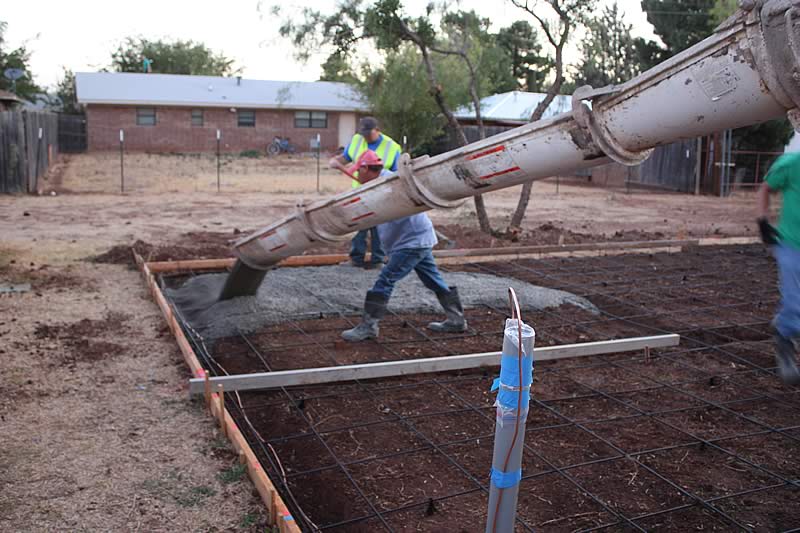
We have expansive clay soil here. Slab on grade, 12x12 footer with 12x12 grade beam longways and two across. Pour the concrete on the ground and get on with it.

Foundation11.jpg
 

ConCretin

Well-known member
Joined
Jan 20, 2011
Messages
3,379
Location
Central Maine
Got good news. The tester came out and said I have sandy clay and doesn't recommend any sub-base stone.

He did say I could put #57 under the footer to move water but not required.

Also the footer is going thru a part of the yard where a tree was just cut down. Still has roots underground and will need to be backfilled. He recommend sand over #57 or crush run because it drains better and easier to grade.

He also recommended covering the slab in sand to get a level grade. Sand = better drainage in the event water comes in.

Question:
1) Would you still put #57 under the footer?
2) Would you backfill the organic tree roots with sand?
3) Would you add sand to the slab area or just leave compacted soil + vapor barrier?

Question 1 - I'm not sure where the water is going to move to in the bottom of a trench dug in clay - don't bother with the stone.

Question 2 - So the plan is to excavate to remove the tree roots? Thats good. Sand is fine as a backfill material although I prefer a larger aggregate. I don't have an engineering justification - I just feel like sand displaces more easily than stone or gravel.

So up here, what we call gravel is a material that contains a range of aggregate sizes including fines that compacts without voids. I'm aware that the term has a different meaning elsewhere. I like using gravel because it eliminates the possibility of other materials migrating into it such as sand placed over crushed stone.

Question 3 - See previous comments. :lol_hitti I don't like sand because it can wash or subside into voids in adjacent materials. I'd prefer to use a smaller stone that is easier to fine grade rather then sand. If you use a 15 mil vapor barrier, it will hold up fine over stone.
 
To avoid these ads, REGISTER NOW!
Top Bottom