To avoid these ads, REGISTER NOW!

Clean sub-panel wiring question

brad d

Well-known member
Joined
Sep 2, 2007
Messages
361
Location
Winnipeg
some pin the wires like this..
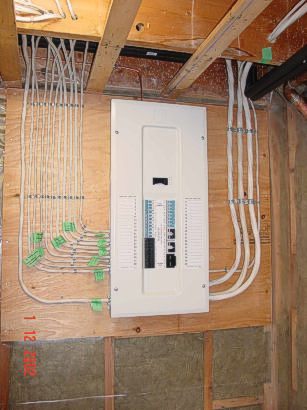
01_Main_Panel.jpg


others drill holes and feed the wire through and feed it into the side.

some come out the top
PANEL.jpg


What do you guys like? post up some pics...

it would be nice to have the wires all in the wall... but there will be alot of wires (its a 1400sq.ft welding/fab shop, 2x6 walls with dry wall)
 
To avoid these ads, REGISTER NOW!

Fast Orange

Well-known member
Joined
Aug 27, 2005
Messages
861
Location
Hightstown,N.J.
You're looking at two different situations in your pics-the first pic is a surface mounted panel in an unfinished area,the second is a flush mounted panel in an area to be sheetrocked.how are you mounting the panel?
If you are flush mounting it,the studs on each side keep you from using the side KOs-you only have the top and bottom of the can for entry.
 

tfi racing

Well-known member
Joined
Apr 19, 2008
Messages
2,907
Location
Cedar,BC
Depends on the panel and its location.Branch circuit wiring is generally not allowed in the"service entrance"area if the panel's main breaker is partitioned off from the rest of the breaker area.In Canada anyways the panel in the second photo would not be acceptable with the branch circuit wiring going through the top of the panel.Other than that,the workmanship appears to be top notch,done by people who take pride in their work.
 

dwilliams35

Well-known member
Joined
Sep 27, 2008
Messages
271
Location
Pattison, TX
No way that first one would pass an inspection in my area: all that exposed romex won't cut it. You want it really clean looking, run conduit to an attic junction box, and run all the wiring to it.
 

LoneGunman

Well-known member
Joined
Mar 27, 2007
Messages
2,081
Location
The Gunshine state
No way that first one would pass an inspection in my area: all that exposed romex won't cut it. You want it really clean looking, run conduit to an attic junction box, and run all the wiring to it.

That panel would pass inspection in most areas, it's in an unfinished basement, unless your town has some code above and beyond the NEC it would pass. In my area you'd get more strange looks from running everything to an attic J box than the pictured installation, why would you want more splices than needed, you are just creating more areas for a splice to go bad in the future. LOL, it must be those hot florida attics that makes me cringe over attic J boxes.

To the OP, you want a recessed panel, in a finished shop romex should not be running down the walls to the panel, if you insist on surface mount you should run conduit down the walls. You can always add a sub panel on the other side of the shop if you are concerned about getting everything into the one panel, it's nice to have a location on the otherside of the shop you can grab power from if needed in the future.

You could also run all your romex to a gutter and then come out of the bottom of the gutter with a few 2" pieces of EMT, run THHN down to the panel, you still have all of those splices but at least they are easy to get to.
 
Last edited:

hewl35

Member
Joined
Jan 24, 2006
Messages
13
Location
Merriam, KS
What I did looks like the second one but instead of having one 1 1/2" entry and several 1/2" stub outs I have three 1 1/2" stubouts to give easy access to future electrical runs and a cleaner look.
 

dwilliams35

Well-known member
Joined
Sep 27, 2008
Messages
271
Location
Pattison, TX
That panel would pass inspection in most areas, it's in an unfinished basement, unless your town has some code above and beyond the NEC it would pass. In my area you'd get more strange looks from running everything to an attic J box than the pictured installation, why would you want more splices than needed, you are just creating more areas for a splice to go bad in the future. LOL, it must be those hot florida attics that makes me cringe over attic J boxes.

.
There's "exposed" running through the studs and on the rafters, and then there's "surface-mount" exposed. It's the latter that doesn't generally cut it around here: that would have to be in MC cable or conduit with most of the inspectors I've run into. "Strange looks" are easy to take: it's still quite legal. The attics in FL aren't any hotter than ours in Houston, and back when I was wiring houses, I'd pretty much make a point of running some conduit into an attic J-box: even if it never had a wire in it, it makes future expansion a whole lot easier than fishing wire into a panel.
 

toadjammer

Well-known member
Joined
Apr 14, 2007
Messages
296
Location
WI
I don't think you want the romex exposed so the first picture is most likely out for a shop space.But you may want to consider surface mounting the panel and running conduit from there. It makes it easier to add to and alter later on. Also if you were to run wires into the cieling and decide to run more lights later you would have to get up in the insulation and add to existing lines or add new ones. As far as I know if you were to run it up into a junction box the box has to be exposed so it is easy to find/diagnose/alter later.
 

Steve in Mi

Well-known member
Joined
Mar 13, 2007
Messages
1,042
Location
Mid Michigan
I went with recessed in 2X6 studs and a couple of inches of foam insulation behind it for our Michigan cold temps.

If you need additional space an additional box can help [[ keep it within 6' of the main panel and you need not duplicate feed breakers, saving you 2 more slots in each panel]] also piggyback breakers help.

Shopelectricalpanels.jpg


As for the first illustration you give, the holes drilled in the floor/ceiling joist are located well below the neutral axis and weaken the structure unnecessarily - only a bonehead would be so wasteful.
 

LoneGunman

Well-known member
Joined
Mar 27, 2007
Messages
2,081
Location
The Gunshine state
"I'd pretty much make a point of running some conduit into an attic J-box: even if it never had a wire in it, it makes future expansion a whole lot easier than fishing wire into a panel."

I have yet to find one of those spare attic J Boxes you speak of, I mean you hear about them but nobody ever finds one :) thank God I do very little resi now. If I'm in an attic 6 times a year it's a lot. I get most of the motor control work where I work, the guys I work with hate it, I love it.
 

dwilliams35

Well-known member
Joined
Sep 27, 2008
Messages
271
Location
Pattison, TX
"I'd pretty much make a point of running some conduit into an attic J-box: even if it never had a wire in it, it makes future expansion a whole lot easier than fishing wire into a panel."

I have yet to find one of those spare attic J Boxes you speak of, I mean you hear about them but nobody ever finds one :) thank God I do very little resi now. If I'm in an attic 6 times a year it's a lot. I get most of the motor control work where I work, the guys I work with hate it, I love it.

It actually paid off three times as I remember: homeowners calling us back to add something they didn't think of originally: cut my attic time down considerably.
I pretty much won't do any more residential work unless it's got my name or one of my family's on the deed: just isn't worth it. I'm a maintenance manager in a large machine shop now, but I'm still the one that can pull the motor control out when no one can. Gives me a great excuse to get out of the office. I love it too.
 

wilbilt

Banned
Joined
Aug 17, 2006
Messages
5,602
Location
NorCal
That panel would pass inspection in most areas, it's in an unfinished basement, unless your town has some code above and beyond the NEC it would pass.

It would never pass here, either. All NM cabling must be protected from physical damage up to 8' from the floor. It would have to be behind sheetrock or plywood, or in conduit.
 

JCByrd24

Well-known member
Joined
Jul 21, 2005
Messages
493
Location
Bath, ME
I surface mounted my box but ran all of my "during construction" wiring in the wall cavity and came through the knock outs in the back of the box for a couple of reasons.

1) All wiring I had thought of before construction will be hidden and protected (romex).
2) Full insulation behind the box.
3) Expansion is easy and will be done in conduit at least to the ceiling.
 

MisterCMK

Well-known member
Joined
Nov 29, 2007
Messages
170
Location
USA
While the first one looks like it was dressed nicely, it is a huge waste of space and leaves the temptation to mount something on top of the romex or damage it in some way.
 

MisterCMK

Well-known member
Joined
Nov 29, 2007
Messages
170
Location
USA
There's "exposed" running through the studs and on the rafters, and then there's "surface-mount" exposed. It's the latter that doesn't generally cut it around here: that would have to be in MC cable or conduit with most of the inspectors I've run into. "Strange looks" are easy to take: it's still quite legal. The attics in FL aren't any hotter than ours in Houston, and back when I was wiring houses, I'd pretty much make a point of running some conduit into an attic J-box: even if it never had a wire in it, it makes future expansion a whole lot easier than fishing wire into a panel.

I wish more people would install some pipe to attics or garages when it is still a stick building. There really should be at least one conduit for line voltage and one for low voltage to the hard to reach parts of the house or to detached buildings.
 
To avoid these ads, REGISTER NOW!

BigChevy80

Well-known member
Joined
Jun 23, 2008
Messages
212
Location
Illinois
In that first pic, reguardless if it's up to code or not... why the hell did they run everything down to the bottom of the box? They should have run everything through the top. Then they wouldn't have to worry about putting in those 400 romex staples.
 

JOHNMAN

Well-known member
Joined
Aug 14, 2006
Messages
194
Location
Southwest Indiana
I like the recessed panel shown in the second picture. I am assuming that the wiring will be covered with at least drywall.

On surface mounted panels, I like to see the wiring running in conduit at least until it is out of harms way.


I know this may sound pretty ignorant, but I must ask none the less....

On a 100A panel, can the totals of all the breakers inside the panel exceed the 100A main feeding the panel?

My opinion is that the total for all the breakers in the panel can exceed the main breaker capacity.
 

tdkkart

Well-known member
Joined
Jun 17, 2006
Messages
6,887
Location
Eastern Iowa
I wish more people would install some pipe to attics or garages when it is still a stick building. There really should be at least one conduit for line voltage and one for low voltage to the hard to reach parts of the house or to detached buildings.

Years ago when I was temporarily "in the biz", we got tangled into an OLD 2-1/2 story farm house refurb. In addition to their remodeling of the downstairs they wanted us to add at least 2 outlets in each of 5 bedrooms on the 2nd floor, none of which any electric other than ceiling lights with pull chains.
After several hours of measuring the entire house we could not find a single space that we could feed any wires to the upstairs from the main panel in the basement, none of the walls lined up right.
Ended up running a conduit up the side of the house to a sub panel in the 1/2 story attic and then going down into each of the rooms.

Those outlets cost alot of money.

In that first pic, reguardless if it's up to code or not... why the hell did they run everything down to the bottom of the box? They should have run everything through the top. Then they wouldn't have to worry about putting in those 400 romex staples.

The stupid part is that by running them into the bottom they created a dog-knotted mess getting to the breakers in the bottom of the panel, very little slack wire to work with.
 

Junkman

Well-known member
Joined
Dec 18, 2006
Messages
6,597
Location
Northeastern CT
I don't know the answer, but I have a 40 breaker 200 amp panel, and there is about 1000 - 1200 total amp breakers. I have never tripped the main, nor do I experience any brown outs. I am guessing on the total by adding in my head what I remember. 2 100 amp sub panels, and 1 60 amp sub, plus the electric range, well pump, and all the domestic lighting.
 
Last edited:

StingRay

Well-known member
Joined
Jan 26, 2006
Messages
1,340
Location
Saskatoon,SK. Canada
I think that the panels with the wiring all cut exactly to length are very pretty and in some regions maybe even necessary to meet code but not here. My panel isn't nearly so pretty and I can reconfigure almost any circuit to anywhere in the panel because of the extra wire in the panel. I like neat and pretty too but not at the expense of future flexibility.
 

StingRay

Well-known member
Joined
Jan 26, 2006
Messages
1,340
Location
Saskatoon,SK. Canada
I have had to add sub panels and 220 breakers before and in order to get a breaker in the right spot sometimes a reconfigure is necessary to do it. I would have thought to do it all neat and cut to length in the beginning too. I have a buddy who is probably the most **** and neetest electrician you could ever meet. He taught me to leave as much wire as possible. It's easy to cut some off if you need it but it's alot harder to make it longer.
 

Charles (in GA)

Well-known member
Joined
Jan 11, 2006
Messages
12,489
Location
50 mi south of Atlanta
Mine:
attachment.php


200amp panel for 1500+ s.f. shop - 220V breakers for welders, plasma, compressor, and such at the bottom.

Ah, the "upside down" panel. Even though they are intended to be mounted this way if needed (and I now wished I had done my that way, as my main service wires come in the back at the bottom), some people will argue that this isn't right, or allowed, or whatever.

If it isn't right, then why is the writing on the label on the inside of the door printed both ways on most panels?

Charles
 

Charles (in GA)

Well-known member
Joined
Jan 11, 2006
Messages
12,489
Location
50 mi south of Atlanta
I have a buddy who is probably the most **** and neetest electrician you could ever meet. He taught me to leave as much wire as possible. It's easy to cut some off if you need it but it's alot harder to make it longer.

Thats why on my panel work, when the wires go out the top, they run to a breaker in the bottom, and if they go out the bottom, they run to the top. I too make them as long as possible, but mine are still neat.

Virtually all of my shop panelboard wires go out the top, so I started at the bottom with breakers and worked my way up. I used the largest panel I could reasonably get, a full sized 40 slot Siemens main lug panel with full length ground and neutral bars. No need for a main breaker when the 200 amp service disconnect is right outside. You can stand in the doorway and touch both panels.

Charles
 

PAToyota

Well-known member
Joined
Jan 20, 2006
Messages
4,366
Location
South Central Pennsylvania, USA
Ah, the "upside down" panel. Even though they are intended to be mounted this way if needed (and I now wished I had done my that way, as my main service wires come in the back at the bottom), some people will argue that this isn't right, or allowed, or whatever.

If it isn't right, then why is the writing on the label on the inside of the door printed both ways on most panels?

Charles

People get used to seeing overhead feed panels and get confused when they see an underground feed panel (such as this one). Makes no sense to take the feeds from the bottom of the panel all the way to the top (or vice versa) - just put the main where the feeds come in. Perfectly legal.

As for the label - that has more to do with whether you mount the door to open to the left or the right than whether the panel is a top or bottom feed.

I have had to add sub panels and 220 breakers before and in order to get a breaker in the right spot sometimes a reconfigure is necessary to do it. I would have thought to do it all neat and cut to length in the beginning too.

Re-balance the load between the 2 legs if you change around circuits or whatnot.

That makes sense now that I think about it. In my case, I'm pretty well set for any future expansion with the wiring that is there so it isn't going to be an issue.
 

kvom

Well-known member
Joined
Feb 1, 2008
Messages
820
Location
*******, GA
Reading the "upside down" panel posts makes sense; I know that bending the feeder cables up and over on mine took a bit of muscle, and some persuasion with a deadblow hammer. OTOH I'm just as happy not to have had a discussion with the inspector.
 

Terry Kennedy

Well-known member
Joined
Feb 4, 2008
Messages
80
Location
Northern NJ
Ah, the "upside down" panel. Even though they are intended to be mounted this way if needed (and I now wished I had done my that way, as my main service wires come in the back at the bottom), some people will argue that this isn't right, or allowed, or whatever.
Looks like a Square D "QO" panel. These are set up for mounting in either direction. Here's mine (re-done a few years ago - converted from Federal Pacific panels):

6F5S5674-l.jpg


The boxes below the center panel are EUM-2000 meters to keep an eye on the utility company - the utility once charged me for 7 MW/Hr one month...
 

PAToyota

Well-known member
Joined
Jan 20, 2006
Messages
4,366
Location
South Central Pennsylvania, USA
Yep, QO panel.

Hmmm... I had thought about something like those energy meters you are using but wasn't even sure how to start. Since I have C320 coming into the property and then split to the two 200amp panels I've wanted a way to monitor how much was going to the shop. Their website shows the EUM-2500 now, not sure if the 2000s can still be picked up for less money?
 

kbs2244

Well-known member
Joined
Nov 11, 2006
Messages
14,065
It sounds like he wants a neat looking shop.
That would mean wires in the walls.
That means a recessed box and, most likely, circuits out the top of the box.
To make it assessable for future modifications, cover the space between the studs above the box with screwed on plywood instead of drywall.
Paint it the same as the rest of the wall and it will hardly be noticeable.
But you can easily unscrew the wood for access if you ever need to.
 

Terry Kennedy

Well-known member
Joined
Feb 4, 2008
Messages
80
Location
Northern NJ
Yep, QO panel.

Hmmm... I had thought about something like those energy meters you are using but wasn't even sure how to start. Since I have C320 coming into the property and then split to the two 200amp panels I've wanted a way to monitor how much was going to the shop. Their website shows the EUM-2500 now, not sure if the 2000s can still be picked up for less money?

The 2000's dont register properly when using 2 legs of a 3-phase feed, so if you have that type of service, you'll want the newer units.

These are all actually made by a company called Brultech. If you order from Brultech the units are a bit less expensive, you can download software updates, etc.
 

PAToyota

Well-known member
Joined
Jan 20, 2006
Messages
4,366
Location
South Central Pennsylvania, USA
Hmmm... Looks like they are more expensive there - about $250 compared to $215 from www.energymonitor.com

Sort of funny that the Energy Monitor website makes it sounds like this was a device that they invented and produced when all it was is a home version of something they were likely using when they were "utility employees."

Thanks for the Brultech site, though. That gives you the individual components and software and all that the Energy Monitor site doesn't.
 

Charles (in GA)

Well-known member
Joined
Jan 11, 2006
Messages
12,489
Location
50 mi south of Atlanta
People get used to seeing overhead feed panels and get confused when they see an underground feed panel (such as this one). Makes no sense to take the feeds from the bottom of the panel all the way to the top (or vice versa) - just put the main where the feeds come in. Perfectly legal.

As for the label - that has more to do with whether you mount the door to open to the left or the right than whether the panel is a top or bottom feed.
.

Mine comes thru the back at the bottom, I ran the wires to the top, two on one side and two on the other, real tight against the sides of the panelboard, and arched them over to supply the lugs. Later, a couple of years later, I'm thinking "why did I not just invert the panel?" Too late now, but the supply cables are not really in the way anyhow.

My door is not reversible, its hinged on the left, only way to get it on the right is to invert the panel, but the label has writing printed sideways, and some of it is printed right side up and also upside down. Probably more of a universal label for whatever front they chose to install on the panelboard.

EDIT: Raising right hand and striking the forehead with the heel of the right hand and going, DUH!!! Why yes, it does!!! The insert in the cover, the spring loaded mask that surrounds the breaker faces is not symmetrical, however the outer part of the cover, and the door are symmetrical, so you would disassemble the inner part, floating screws, springs, etc, flip the inner part top to bottom, reassemble it and then install the whole thing, thus putting the door on the other way. Sometimes I'm just a little slow to figure stuff out.

Charles
 
Last edited:
To avoid these ads, REGISTER NOW!
Top Bottom