
I have a damaged Ken Tool 34549 dual wheel separator tool.
The tool uses a puller foot that travels along a forcing screw against a pusher foot.
At some point in the past, someone else (I swear!) must have used it without proper lubrication and the puller foot became seized to the forcing screw. Eventually, I tried to free it up by using a vise, an impact, lubrication, and heat to no avail. Failing to see any other way to get the components apart, I resorted to cutting off the puller as best I could, but i still knicked the threads in a few places. Once I had it apart, the damage to the steel forcing screw was greater than I anticipated, with a bunch of threads galled up.
I gave it to my buddy, who ran a thread cutter tool along it in his lathe to clean up any of the "mountains" that had balled up. With the damage now underneath the dimensional envelope of the correct threads, the puller foot moves up and down the forcing screw seemingly correctly.


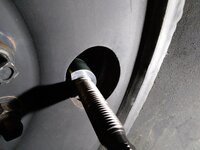
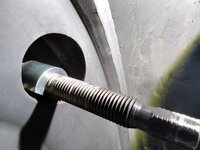
The puller is large enough that it contacts at least 3 threads of the forcing screw on both sides of the damaged area if centered over the damage. In my estimation, the vehicle I'll likely use this tool with has the "work" area before it gets to the damaged threads. The image shows the tool snug against both wheels - presumably, wheel separation should occur before the puller gets too much into the damaged area. The threads are 7 TPI.

So here is my question - Is there anything else I should do to the forcing screw before putting it back into cautious service?
Or, am I flirting with too much danger with a compromised part that gets loaded with energy during use?
I know what the Ken Tool liability answer is and I know what the answer would be if I were using this to make a living, but as a hobbyist, I've used this tool once before and it's quite possible that I may never use it again.
Is it better to be lucky or smart?
The tool uses a puller foot that travels along a forcing screw against a pusher foot.
At some point in the past, someone else (I swear!) must have used it without proper lubrication and the puller foot became seized to the forcing screw. Eventually, I tried to free it up by using a vise, an impact, lubrication, and heat to no avail. Failing to see any other way to get the components apart, I resorted to cutting off the puller as best I could, but i still knicked the threads in a few places. Once I had it apart, the damage to the steel forcing screw was greater than I anticipated, with a bunch of threads galled up.
I gave it to my buddy, who ran a thread cutter tool along it in his lathe to clean up any of the "mountains" that had balled up. With the damage now underneath the dimensional envelope of the correct threads, the puller foot moves up and down the forcing screw seemingly correctly.
The puller is large enough that it contacts at least 3 threads of the forcing screw on both sides of the damaged area if centered over the damage. In my estimation, the vehicle I'll likely use this tool with has the "work" area before it gets to the damaged threads. The image shows the tool snug against both wheels - presumably, wheel separation should occur before the puller gets too much into the damaged area. The threads are 7 TPI.
So here is my question - Is there anything else I should do to the forcing screw before putting it back into cautious service?
Or, am I flirting with too much danger with a compromised part that gets loaded with energy during use?
I know what the Ken Tool liability answer is and I know what the answer would be if I were using this to make a living, but as a hobbyist, I've used this tool once before and it's quite possible that I may never use it again.
Is it better to be lucky or smart?
Last edited: