To avoid these ads, REGISTER NOW!

Clogged underground pipes from downspouts - could use some suggestions

Skyman

Well-known member
Joined
Nov 9, 2021
Messages
1,296
Location
Central Maryland
Here's our situation:

Multiple downspouts from a complex roof, and from an under-the-deck drainage system, are all feeding into underground plumbing. All or nearly all of these are clogged, causing backwash geysers where the downspouts enter the below-ground stuff. I don't know, and haven't so far been able to figure out, where any of this plumbing is daylighted. I also know nothing about the composition of most of the underground plumbing - whether it's perforated flex tubing, or ??? I can only see the verticals that the downspouts feed into, and their composition varies. Worse, some of it is running under what I'm sure was a rather expensively-installed paver-type patio in the rear, and walkway in the front, plus one that might be running under our asphalt driveway (I don't know where it goes). All of this plumbing and hardscaping was done on the previous owners' watch. I've reached out to him with a few unrelated, simple queries but received no response, so helpful information is unlikely to be forthcoming from him about this mess if I bother to ask. And he wasn't a DIY guy, so I'm not confident he'd have much to offer about it anyway.

I burned all of this past Saturday morning trying to clear one of the clogs, sucking at least a gallon of top soil out, then hitting a lot of tree roots with a plumber's snake. No joy was gained, as the clog persists. I presume the roots from a nearby River Birch have infiltrated this pipe in a big way, and I think the sensible path forward will be to abandon most of this pipe, and probably do the same with all of the others that are clogged (or possibly collapsed) below ground. I can foresee excavation in my near-term future, to replace many segments of the blocked system, and abandoning the remainder.

The main question all of this leads to is how best to daylight the downhill side of these pipes, which I likely would be fabricating with PVC. There's no hard surface onto which to dump the outflow, so it's gonna have to exit onto the lawn somehow -- ideally in such a way that doesn't create an erosion problem, a tripping or mowing hazard, or an ankle-breaking crater. The entire lawn slopes gradually away from the house with not much grade to it, but with enough slope to prevent pooling. At my previous home, I piped all of the downspouts underground in PVC, but there I had a hard surface onto which to dump the outflow. No similar opportunity exists here.

Any and all suggestions and advice will be gratefully accepted.

TIA
 
To avoid these ads, REGISTER NOW!

Mikes61

Well-known member
Joined
Dec 25, 2023
Messages
265
I would try a plumber that deals with this issue. There are snakes that will cut through roots that have grown into the pipes. You can’t do any more damage and I’d rather try this than digging up the drain pipes.
 

MOS3522

Well-known member
Joined
Nov 6, 2022
Messages
1,830
Location
Colorado
Went through this at my house. You need a proper hydrojetting service to trace and clear the pipes. It's expensive and hard to DIY.

In my case I had to dig up and replace most of the system -- at great cost. Sometimes they can't be saved.


jblnut

ALLIANCE MEMBER
Joined
Jan 17, 2015
Messages
7,339
Location
In the Middle of MN
Where you at ? I can head over and put some pipes in your yard. The asphalt and pavers shouldn’t be an issue 😆
2023-11-14 15.16.46.jpeg

Seriously though if it’s roots a good hydrojet company should be able to clean them out unless the pipes are degraded too far. We hydro jet out a few tile lines each spring and it’s amazingly effective.
 

GRN96WS6

Well-known member
Joined
Dec 23, 2012
Messages
2,322
Location
SOMD
I'd bet it is perf pipe which will have roots grow in it, solid PVC is less of an issue (sure it can happen but not as common) and you can get it snaked and solve it for an unknown timeframe, or pay to get it done with solid pipe and hopefully never worry again.

Gate City Foundation on youtube does a lot of this stuff if you're curious.
 

thammel

Well-known member
Joined
Oct 3, 2005
Messages
2,268
Location
Maryland
As above - check out gates city on youtube. Definitely use hard pvc with glued joints. One of mine dumps out into the yard about 100 feet from the house. The land is sloped enough so that I mow right over it. Never had a problem.
 

DGersic

Well-known member
Joined
Mar 12, 2017
Messages
6,475
Location
DeKalb, IL
As much as I prefer a DIY approach to most problems, this one you will probably be best to hire out. A water jet should be able to clear out the lines, if they’re not totally destroyed. May need a camera to see what’s down there. And tracing where they run. A plumber will have the equipment to do this.

It would be helpful to know where it is supposed to drain to. It may not go to daylight. My house has downspouts and a sump pump plumbed to 4” pipe that runs to the nearest storm sewer, two houses away. Your system may be similar.
 

carlaisle

Well-known member
Joined
May 14, 2022
Messages
426
The first thing I would do is get a shovel and find out what kind of pipe you're dealing with. If it's that black corrugated stuff and it's plugged with roots you're already finished. If you have hard lines, those can be snaked or hydrojetted. One of these https://www.homedepot.com/p/JONES-S...od-with-Ball-Point-for-Pipes-P27003/313461380 can help you trace where those pipes go. If you do have hard lines and want to DIY it, rent a serious sewer machine from your local rental place. Anything small enough to easily move around isn't stout enough for cutting out roots.
 
Last edited:

rancherbill

Well-known member
Joined
Oct 18, 2007
Messages
5,338
Location
Foothills County, Alberta, Canada
I would get some sort of guy with a router or pipe locator or something. IF, you can find the end of the pipe they can pull in a new pipe inside the old one using pipe bursting. This will save the time and expense of repairing the stone patio.

OR, put on you designer hat, squint your eyes and look at it and answer the question how would I do it. Get a shovel and you'll probably hit the end of the pipe fairly quickly. There usually only one or two solutions to the location problem.
 

pcmeiners

Well-known member
Joined
Aug 13, 2009
Messages
8,104
Location
In the only town in Pennsylvania, Bloomsburg.
If you have roots, either it is shoe maker install (busted pipe or the piping joints are not sealed), or most likely perforated pipe , as mention. Either way even if you could clear the pipe, with roots it is a very temporary solution, a year or two at most, roots will come back thicker than before. Copper sulfate as a root poison might kill the roots, but odds are
you will kill the trees also.. a band-aid solution.
 
To avoid these ads, REGISTER NOW!
OP
S

Skyman

Well-known member
Joined
Nov 9, 2021
Messages
1,296
Location
Central Maryland
Many thanks everyone for the suggestions and advice. I've been swamped with other chores since posting this query, so I haven't had a chance to further investigate this or begin any remediation efforts. Some of these proposed solutions sound intriguing.
 

mreisner

Well-known member
Joined
Jun 25, 2019
Messages
949
Location
North of Detroit
Where you at ? I can head over and put some pipes in your yard. The asphalt and pavers shouldn’t be an issue 😆
2023-11-14 15.16.46.jpeg

Seriously though if it’s roots a good hydrojet company should be able to clean them out unless the pipes are degraded too far. We hydro jet out a few tile lines each spring and it’s amazingly effective.
Nice gold digger. How hard does it pull?
 

mreisner

Well-known member
Joined
Jun 25, 2019
Messages
949
Location
North of Detroit
Many thanks everyone for the suggestions and advice. I've been swamped with other chores since posting this query, so I haven't had a chance to further investigate this or begin any remediation efforts. Some of these proposed solutions sound intriguing.
You might be able to find out a lot of where it goes if you or a friend have a drone and go up a couple of hundred feet. You would be amazed what you can see that you can't see close up.
 

jblnut

ALLIANCE MEMBER
Joined
Jan 17, 2015
Messages
7,339
Location
In the Middle of MN
Nice gold digger. How hard does it pull?
The 9420 will pull it around 62” deep in hard ground with no pre-ripping. It doesn’t take that much power really it’s just weight and traction. The turbo whistles just a little bit pulling it that deep and is only around 30% power so it’s taking around 150hp. Big John weighs in around 44,000lbs so it can definitely put the power to the ground.
 

jblnut

ALLIANCE MEMBER
Joined
Jan 17, 2015
Messages
7,339
Location
In the Middle of MN
I was looking into one of those, but my baby Steiger has the power but not the weight.
I pulled it with an STX325 weighing around 32,000 and it’d do around 48” before spinning out. We also have a Deere 750 dozer we put on the front when it’s slimy.
 
Last edited:

Jackfre

Well-known member
Joined
Dec 26, 2010
Messages
4,440
Location
N CA
Miserable job ahead of you on this. I had a perimeter drain installed on our MA home years ago. As it was 7’ deep at the front and day lighted at the back of the sloped property I hired it out. He use the light sch 10 or 20 perfed PVC drain pipe. Worked great for a couple years and then the pipe collapsed fortunately out in the yard and not along the foundation. Definitely use Sch 40 pvc if you replace. Do check you local codes. Code told me I could daylight 20‘ from the property line.
 
OP
S

Skyman

Well-known member
Joined
Nov 9, 2021
Messages
1,296
Location
Central Maryland
Yeah, I'm not looking forward to getting further into this. As noted previously, I hand-dug and buried schedule 40 PVC to plumb the downspouts away from the house at my previous home, and that was 30 years ago. I had no problems thereafter, but it was a lot of manual labor, and I don't relish a similar task here.

As has been suggested above, more exploratory efforts are in my near-term future to see what can be learned, prior to formulating a plan forward. Coming up with a satisfactory solution at the outfall where any new plumbing will be daylighted remains an open question, as there is no hard surface onto which I can have it discharge.

Edited to add that I'm in central Maryland.
 
Last edited:

545_days

Well-known member
Joined
Oct 30, 2016
Messages
621
Location
Texas
Don't be surprised if they never see daylight and simply drain to sumps full of gravel where the water would supposedly filter into the earth.

If that is the case, after years of neglect and failing to clean the gutters, they are likely clogged and no longer drain very well at all. Once the open area between the gravel fills with sediment, drainage sumps didn't work anymore.
 
OP
S

Skyman

Well-known member
Joined
Nov 9, 2021
Messages
1,296
Location
Central Maryland
I think that is a distinct possibility. I can easily foresee abandonment of significant portions of the existing underground segments of this system, and replacement with individual segments that see daylight a much shorter distances from the structure. The worst of this is likely to be dealing with the six downspouts that are presently plumbed beneath the stone hardscaping.
 

BombShelter

Well-known member
Joined
Nov 16, 2015
Messages
569
Location
State of Hockey
There are some interesting underground "systems" popping up these days like the one 545_days mentioned. In our state they really want you to keep your rain water on your property so when these guys put in the mid-size condo buildings filling up most of the lot, they run into a ton of water issues, sometimes a few months after completion. The underground rocky perculation system fills up very quickly and everything backs up, the engineer/designer got paid, he's long gone plus it might have been "experimental."

If you can daylight the system, use at least 6" diameter smooth pipe (even for homeowners), do not use DWV pipe, it falls apart after a few years from the weight of the dirt. I'd put a rock garden at the discharge, 4" and larger rocks depending on the flow, sometimes they can look like a fire hydrant. Install cleanouts with runs longer than 20', these systems always fill with debris or critters.

Sometimes just running a hose through the discharge with a fireman's style nozzle will dilute the dirt and clear them out. I think I've seen nozzles for pressure washers that do the same but don't own one.
 
OP
S

Skyman

Well-known member
Joined
Nov 9, 2021
Messages
1,296
Location
Central Maryland
Keeping the outflow such that it will daylight on this property would not be a problem, although surface runoff would depend on variables.

I used 3-inch schedule 40 PVC with glued joints underground at my previous residence, with turn-ups visible above ground. Thirty years later, I'd still never had a problem. Their discharge did resemble a fire-hose during an intense rainstorm, but never did I have any backwash with any of them. They all continued to flow freely until the day I sold the property. I did include cleanouts above ground level on them, but never had to use them. I'm sure gutter covers helped a lot to that end. Given this history, I'm surprised to hear it suggested that this material would fail underground in a short period of time. Care to elaborate on this?

TIA.
 

Fav Onefour

Well-known member
Joined
Jul 14, 2022
Messages
786
Location
MN cold and hot
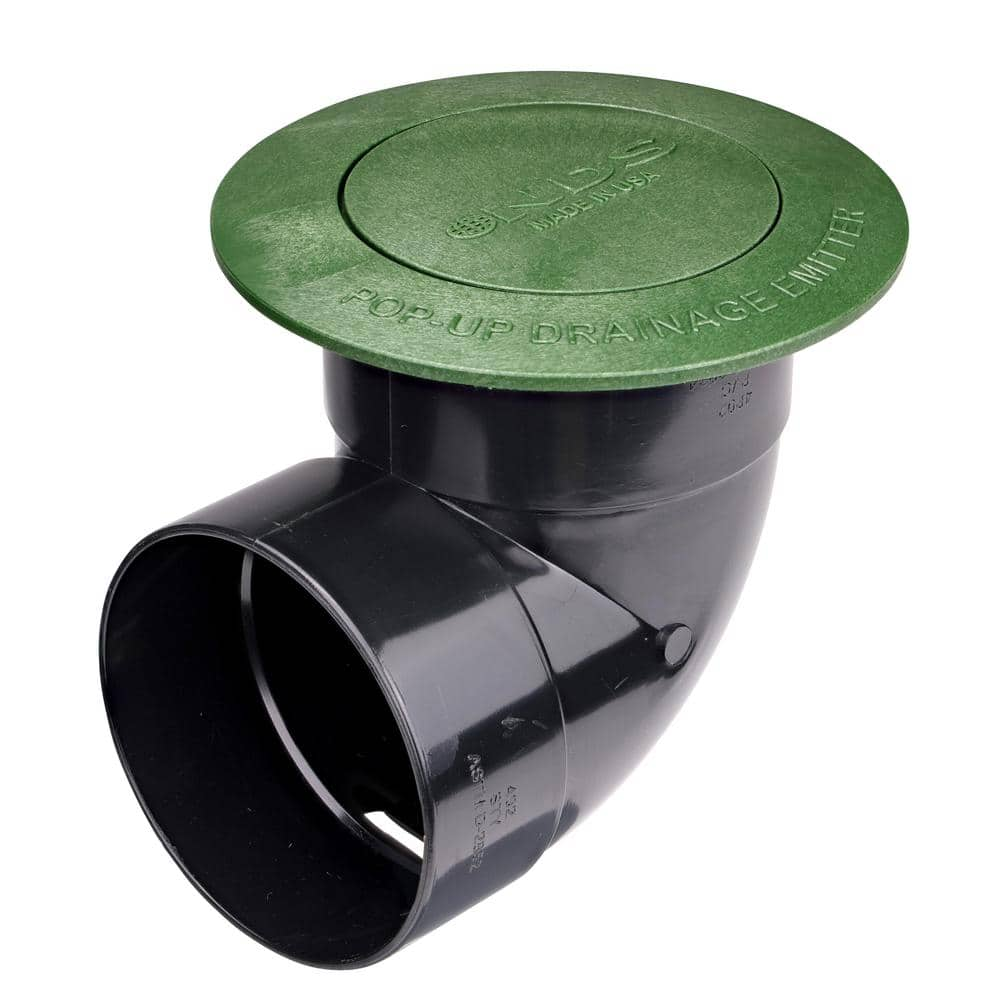
Daylighting that much flow is a challenge. I have 4" PVC and initially used multiple pop ups on a side hill. I didn't want to restrict the outlet which was my reasoning for multiple outlets. The water pressure blew the main one off in the first big storm. Friction fit wasn't enough.
The pop ups were nice for mowing and looks. They don't let out the kind of flow needed for the pipe size. They also collected debris and sediment with that elbow being the lowest point.
I eventually went to regular PVC and a long angle cut for the outlet. I cut the angle to be almost flat to ground contour. That setup seemed to fan out the water a little bit with high flow storms. Plain dirt still wouldn't have a chance staying put, but established sod held fairly well.

I do agree that hardscape would be the best option. I eventually extended mine to the curb. I'm in a cold climate and the outlet needed to be clear to deal with icing. Moving it to the curb made it easier to maintain.

There is no simple short answer for the clogged piping. If it's clogged now, cleaning out the pipes will only be a short term solution. Those R.B. tree roots will even grow faster and thicker inside a perf pipe. They do well with water and room to grow fast. Dirt is part of life with perf tile. If you can keep water flowing through, it helps some.
I did smooth wall pipe for my main line. Downspouts and surface drains go directly into smooth wall. I did the perf in short sections and did Y tee tie ins to the smooth wall. @jblnut , can tell you that method is used a lot with pattern tile systems. Another advantage is that the main line will still flow even if a section of perf is plugging.
 
OP
S

Skyman

Well-known member
Joined
Nov 9, 2021
Messages
1,296
Location
Central Maryland
At the previous place, I was able to dump the outflow onto the sidewalk in front of the house, where I had angle-cut the ends of the 3-inch PVC pipes to match the contour of the terrain. That all worked well for 30 years, with zero issues ever. Here the majority of the pipes will be discharged onto the lawn in the rear of the property, which is a field of roughly two acres with no downhill hard surface anywhere near the property. The front will discharge onto the front lawn, which slopes around the house and then down to the rear. I'm thinking that small rock gardens of stone as previously suggested above might be the most effective solution, but I might try letting it flow onto the established lawn first to see how that goes. Pop-ups don't seem to me to be the solution in this application, given that it'll be subjected to freezing temperatures, and I really don't want to have any standing water anywhere in the plumbing.

I've ordered one of the T-handled ball-end soil probes from HD that was mentioned above (thanks for that tip, Carlaisle), and I have a borescope camera that has a very long leader on it, so I'll be putting that to work as well. The immediate goal now seems to be to figure out as much as I can about the routing of what's under the hardscaping. If I'm lucky, those portions might still be clear of roots, and not collapsed, in which case they should be salvageable. Dealing with the remainder will be less problematic, as I'll have the option to abandon it and adapt to smooth-wall PVC from the edges of the hardscaping until I daylight it. The portions that aren't running beneath hardscaping will only require simple excavations and replacements, etc. Those will be comparatively simple to resolve.

Many thanks to all who've contributed suggestions, and to any who might still chime in. This isn't what I'd been hoping to spend my free time doing this summer, but such are the joys of home-ownership.
 
To avoid these ads, REGISTER NOW!
Top Bottom