To avoid these ads, REGISTER NOW!

Code for 230v outlets

vavet

Well-known member
Joined
Mar 6, 2012
Messages
5,360
Location
Ashland, VA
Trying not to threadjack the other thread about using the same circuit for a lift and a compressor...
NEC prohibits multiple outlets on a circuit greater than 20 amps. Or is it 230V?

Either way...why? Why is it not ok on those circuits but it’s fine on 120v 15 amp circuits?
The breaker should protect the wiring and prevent overloads.
 
To avoid these ads, REGISTER NOW!

theoldwizard1

Well-known member
Joined
Feb 22, 2011
Messages
43,587
Location
SE MI
Trying not to threadjack the other thread about using the same circuit for a lift and a compressor...
NEC prohibits multiple outlets on a circuit greater than 20 amps. Or is it 230V?
240V circuits

A 120V circuit over 20A is VERY unusual ! I have seen L5-30 receptacles and plugs but only in locking and only in industrial application.
 

wyliesdiesels

Well-known member
Joined
Aug 14, 2012
Messages
20,241
Location
Modesto, CA
Trying not to threadjack the other thread about using the same circuit for a lift and a compressor...
NEC prohibits multiple outlets on a circuit greater than 20 amps. Or is it 230V?

Either way...why? Why is it not ok on those circuits but it’s fine on 120v 15 amp circuits?
The breaker should protect the wiring and prevent overloads.

The NEC has no such prohibition for 240v circuits with outlets.

The code youre thinking of is in the IRBC- international residential building code.

What is the HP rating on the compressor and lift motors?
 
Last edited:

pattenp

Well-known member
Joined
Jun 4, 2008
Messages
10,175
Location
Virginia - USA
There is no NEC code that prohibits multiple outlets greater than 20A. It's the IRC that prohibits multiple recepticals on a single circuit greater than 20A. The voltage doesn't matter.

I was one step behind wylie.
 
Last edited:

PhysicsDude

Well-known member
Joined
Jan 28, 2013
Messages
805
Location
Dallas, TX
15 and 20 amp circuits are designed for any device that uses 15/20A or LESS. Thus you can have 5-10 things plugged into the same 15A circuit, each of which probably draw a lot less than 15A.

The game changes when you have a 30A and up circuit. If you're plugging something into a 30A circuit, then obviously that device draws more than 20A, otherwise you'd be plugging it into a 20A circuit. Likewise something with a 50A plug probably draws more than 30A, otherwise it would have a 30A plug on it! Thus, you should never use more than 1 device on a 30A+ circuit, because it will draw more than 30A+. (I'm ignoring a lot of particulars, de-ratings, peak draw, 80% rule, etc. for the sake of brevity)

Now, in the real world there's a lot of grey area. If you have an air compressor that draws 10A @ 240v, and a lift that draws 10A @ 240v, can you put them both on a 30A circuit? Or have your lift on the same circuit as your welder plug? I mean I think realistically its fairly safe to do so, but it technically wouldn't be to code in most cases.
 
Last edited:

Radix2

Well-known member
Joined
May 28, 2014
Messages
1,853
Location
the thumb!, MI
15 and 20 amp circuits are designed for any device that uses 15/20A or LESS. Thus you can have 5-10 things plugged into the same 15A circuit, each of which probably draw a lot less than 15A.

The game changes when you have a 30A and up circuit. If you're plugging something into a 30A circuit, then obviously that device draws more than 20A, otherwise you'd be plugging it into a 20A circuit. Likewise something with a 50A plug probably draws more than 30A, otherwise it would have a 30A plug on it! Thus, you should never use more than 1 device on a 30A+ circuit, because it will draw more than 30A+. (I'm ignoring a lot of particulars, de-ratings, peak draw, 80% rule, etc. for the sake of brevity)

Now, in the real world there's a lot of grey area. If you have an air compressor that draws 10A @ 240v, and a lift that draws 10A @ 240v, can you put them both on a 30A circuit? Or have your lift on the same circuit as your welder plug? I mean I think realistically its fairly safe to do so, but it technically wouldn't be to code in most cases.


You can have as many 20A 240v outlets on a 20A circuit as you want.

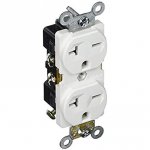
You can use 20A 240 duplex outlets too. (Easier to find covers for than the singles).
 

Attachments

  • IMG_7594.JPG
    IMG_7594.JPG
    21.6 KB · Views: 23
To avoid these ads, REGISTER NOW!

FordTruckWench

Well-known member
Joined
Jan 8, 2015
Messages
539
Location
California
If you have an air compressor that draws 10A @ 240v, and a lift that draws 10A @ 240v, can you put them both on a 30A circuit? Or have your lift on the same circuit as your welder plug?

What happens when one of those 10A devices develops a short? It is possible the short circuit current would have tripped a 20A breaker, but won't trip a larger breaker. At the same time, the device wiring isn't safe conducting more than 20A.

In other words, it is reasonable to design appliances/equipment to trip 15A/20A circuits. But not reasonable to make everything handle higher currents. Example: Does your internet router really need an 18ga power cord? No - but that 18ga is enough to trip a 20A breaker. However, on a 50A circuit, it might just become an electric heater.
 

wyliesdiesels

Well-known member
Joined
Aug 14, 2012
Messages
20,241
Location
Modesto, CA
What happens when one of those 10A devices develops a short? It is possible the short circuit current would have tripped a 20A breaker, but won't trip a larger breaker. At the same time, the device wiring isn't safe conducting more than 20A.

In other words, it is reasonable to design appliances/equipment to trip 15A/20A circuits. But not reasonable to make everything handle higher currents. Example: Does your internet router really need an 18ga power cord? No - but that 18ga is enough to trip a 20A breaker. However, on a 50A circuit, it might just become an electric heater.

Youre confusing overcurrent with short circuit.

Theres 2 separate components in a circuit breaker- one that deals with overcurrent and one that deals with short circuits.

There was a thread awhile back on here about this. I will see if i can find it later.
 

FordTruckWench

Well-known member
Joined
Jan 8, 2015
Messages
539
Location
California
Youre confusing overcurrent with short circuit.

Am I? I didn't specify the failure mode.

Lets create a scenario: Someone has a welding rig with a 50A cord. They've added an unprotected 120V 15A "convenience" receptacle on the welding rig. One day they need to charge a car battery way down the driveway. They unroll 200 feet of cheap 18ga extension cord, and plug it into the "convenience" receptacle. Unfortunately, the cord gets pinched and shorts at 187.5'.

18ga wire has a resistance of 0.0064 ohms/foot. 187.5' times two (out and back) means a total resistance of 2.4 ohms. 120V across 2.4 ohms pulls 50A. Thus, the welding breaker doesn't trip. However, 6000W is being dumped into the wire. That's 32W/foot. How long until the insulation melts and the wire glows?

A more realistic scenario: PhysicsDude's 10A compressor develops an internal short, stalls, and starts drawing 30A. This would trip the breaker of a 240V-20A circuit. But it won't trip the 30A breaker. The compressor designers may have designed it assuming it will be on a 20A circuit: Faults that draw less than 20A can be handled by the compressor wiring. Faults that draw more, that could set the compressor on fire, are assumed to trip a breaker.

Back to the extension cord scenario. This time it is in a receptacle protected by a 15A breaker. Now the short needs to be 625' down the cord to not trip the breaker. This results in 2.88W/foot of heating. No problem, i.e. the cord is inherently safe when used on a properly protected circuit.
 

Showkey

"MEMBER EMERITUS"
Joined
Aug 9, 2014
Messages
8,638
Location
Wausau WI
^^^^^^^ you should unplug and kill the power to every outlet when leave the house....... because..........you scenario can happen to any circuit and any device in the home.

Just change the numbers slightly..........shorts or over current with no breaker trip can and do happen. This is the dehumidifier or coffee maker or worn extension cord fire.
 

TRWham

Well-known member
Joined
Aug 11, 2017
Messages
2,007
Location
East Cobb County, Georgia
From the point of view of a circuit breaker, the distinction between an electrical load and a short circuit is only that the load normally has enough impedance to restrict the current to an acceptable level. A thermal-magnetic breaker reacts differently to a sustained overload than a short circuit only because the short, given its low or zero impedance, normally draws enough current to trip the magnetic mechanism first. Even then, a typical breaker will hold anywhere from 10 to 30 times its rated load briefly. If the short circuit current is restricted to a level below the trip current of the breaker, it will remain closed because it cannot sense that anything is wrong.
 
Last edited:

alfredeneuman

Well-known member
Joined
Mar 3, 2011
Messages
4,596
Location
Fullerton, CA
Lets create a scenario: Someone has a welding rig with a 50A cord. They've added an unprotected 120V 15A "convenience" receptacle on the welding rig.

They'd have have a neutral wire in the cord. Most (if not all) 'welding rigs' only use 3 wire cords, and they would have to have a 4 wire cord.
 
Last edited:

sberry

Banned
Joined
Jun 18, 2005
Messages
35,747
Location
Brethren, Michigan
They should but don't. This was a published suggestion in farm show. I think there must have been 3 or 4 guys wrote or called in about that and said it want such a good idea. .
 
To avoid these ads, REGISTER NOW!
Top Bottom