
I am moving into a new shop soon and am planning the compressed air setup and piping.
My current setup in the existing shop utilizes two 60 gallon 3.7hp single-stage Husky air compressors (155 psi; about 11 cfm each). They are installed in a closet with 1/2" copper pipe running about 50' to my finishing area. I have one drop that runs into a filter/regulator then up to a hose reel which we use for a blow gun. I have another drop that runs to a small refrigerated air dryer that is rated for 10cfm at 100psi at 100° inlet temperature. My spray gun, which I run directly off the RAD, is rated for 13.5 cfm.
We sometimes have long painting marathons which uses a lot of air. With two guys, it's an almost constant use of air; we're either spraying paint or using the blow gun from the hose reel to dust off the next piece prior to spraying it. I didn't connect the hose reel to the RAD because I was worried about it being too much demand. The filter to the hose reel seems to be capturing all the water and I don't notice any moisture coming out the blow gun except when I fail to drain it.
I've been using this setup for about 5 years and it has worked really well. I get no moisture out of the gun, the hi-temp warning light has never lit up, and I haven't noticed any issue between the mismatch of cfm ratings between the RAD and the spray gun.
In the new shop I bought a larger RAD which is rated at 25cfm at 100psi at 140° inlet temperature to dry the entire compressed air system, not just the spray gun drop. The RAD will be installed in an equipment room with the same two 60 gallon compressors. I also acquired a 60 gallon tank that I plan on plumbing in after the RAD to use as a dry tank reserve.
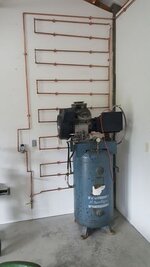
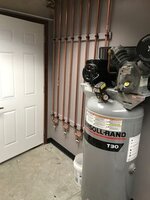
I believe that my success with the RAD in the current shop is due to the fact that there is more than 50' of pipe after the compressors. So, to replicate that, my original plan was to install a manifold/radiator (not sure what these things are called) between the compressors and RAD consisting of about 40' of copper pipe either in a left to right or up and down configuration. Similar to these that I found on the web:
However, I recently came across the option to add an aftercooler between the compressor and tank, similar to this (another pic found on the web):
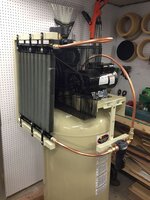
The aftercooler would eliminate the need for the extra copper pipe and would be more compact. I think the difference in cost would be insignificant.
My questions are:
It appears that the aftercoolers are primarily marketed and sold for use on larger two-stage compressors. Are there any issues or concerns with installing aftercoolers on smaller single-stage compressors?
What are the pros and cons of each system and which would offer the best results?
Thanks in advance,
Mike
My current setup in the existing shop utilizes two 60 gallon 3.7hp single-stage Husky air compressors (155 psi; about 11 cfm each). They are installed in a closet with 1/2" copper pipe running about 50' to my finishing area. I have one drop that runs into a filter/regulator then up to a hose reel which we use for a blow gun. I have another drop that runs to a small refrigerated air dryer that is rated for 10cfm at 100psi at 100° inlet temperature. My spray gun, which I run directly off the RAD, is rated for 13.5 cfm.
We sometimes have long painting marathons which uses a lot of air. With two guys, it's an almost constant use of air; we're either spraying paint or using the blow gun from the hose reel to dust off the next piece prior to spraying it. I didn't connect the hose reel to the RAD because I was worried about it being too much demand. The filter to the hose reel seems to be capturing all the water and I don't notice any moisture coming out the blow gun except when I fail to drain it.
I've been using this setup for about 5 years and it has worked really well. I get no moisture out of the gun, the hi-temp warning light has never lit up, and I haven't noticed any issue between the mismatch of cfm ratings between the RAD and the spray gun.
In the new shop I bought a larger RAD which is rated at 25cfm at 100psi at 140° inlet temperature to dry the entire compressed air system, not just the spray gun drop. The RAD will be installed in an equipment room with the same two 60 gallon compressors. I also acquired a 60 gallon tank that I plan on plumbing in after the RAD to use as a dry tank reserve.
I believe that my success with the RAD in the current shop is due to the fact that there is more than 50' of pipe after the compressors. So, to replicate that, my original plan was to install a manifold/radiator (not sure what these things are called) between the compressors and RAD consisting of about 40' of copper pipe either in a left to right or up and down configuration. Similar to these that I found on the web:
However, I recently came across the option to add an aftercooler between the compressor and tank, similar to this (another pic found on the web):
The aftercooler would eliminate the need for the extra copper pipe and would be more compact. I think the difference in cost would be insignificant.
My questions are:
It appears that the aftercoolers are primarily marketed and sold for use on larger two-stage compressors. Are there any issues or concerns with installing aftercoolers on smaller single-stage compressors?
What are the pros and cons of each system and which would offer the best results?
Thanks in advance,
Mike