To avoid these ads, REGISTER NOW!

Compression - Flush Trim Router bit leaving step? Am I the problem?

HoosierBuddy

Well-known member
Joined
May 9, 2006
Messages
2,963
Location
Southern Indiana
Hey guys,

I'm building a set of card catalog drawers and the drawer sides feature a curved cutout area that was best made (at least with equipment I own) by cutting to rough shape in the band saw and then finishing using a template and flush-trim router bit.

I ordered a Spetool Compression Router bit with guide bearings on the top and bottom from a ultra-large vendor of all things named after a river in South America. Looks like this:
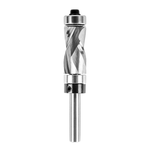
1727707935394.png

In using this bit, with a template, and my vintage Craftsman router/router table, to cut 1/2" hard maple drawer sides, I'm getting a step about mid-line on the routed edge. This is causing me to have to sand every one to remove the step and (as it's on a curve) and I have to make tons of these drawer sides, it's pretty annoying.

Questions:

Is there something I could be doing incorrectly that is causing this?

If "no", is this just the way "compression" router bits are?

If "no" and "no", should I send the router bit back and ask for a replacement?

Thanks guys, I appreciate any wisdom you can supply!
 
To avoid these ads, REGISTER NOW!

cgrutt

Well-known member
Joined
Mar 4, 2016
Messages
8,488
Not sure but will a second pass with bit raised (or lowered) resolve problem?
 

jar944

Well-known member
Joined
Jul 26, 2010
Messages
6,043
Location
Northern VA
If its in the middle of the cut, and not towards either bearing its the bit. Get a different/ better bit. You don't need a compression bit for solid wood.
 

cgrutt

Well-known member
Joined
Mar 4, 2016
Messages
8,488
Could it be caused by interference from chip ejection? The chips will accumulate in center of cut with upspiral sending chips up and downspiral portion of bit sending them down concurrently. Shouldn't be issue on outside cut but you may be getting some interference with inside cut if chips have no room to eject. Did you try moving more slowly? Do you have any dust collection attached to router to help pull chips away from the cut?
 
OP
H

HoosierBuddy

Well-known member
Joined
May 9, 2006
Messages
2,963
Location
Southern Indiana
Could it be caused by interference from chip ejection?

I don't think so? This router/table is the most basic setup you can imagine. There is no dust collection, but I didn't leave much stock on there to remove after the band saw.

My technique has been to use double-sided tape to fasten the template to the rough cut piece. Then gently route along the top of the drawer side (the other 3 sides are square, and were cut on the table saw) taking most of the 1/8" to 3/16" wood away, then make a final pass by pressing the template firmly into the bearing on the compression bit (the top bearing as I have the template taped to the top of the workpiece). The final cut is just a very light skim....maybe 10 to 20 thousandths of an inch.

The step I'm complaining about is uniform on the entire cut and appears to be exactly the same on every piece I've finished.

Reviewing the responses above, I think my next move is to adjust the bit slightly (probably have to go a little higher) and see if the step moves from the center-line the same amount as the bit was adjusted.

That would be definitive.

I guess no one is saying "that's the way these bits are SUPPOSED to be"?
 

MoonRise

Well-known member
Joined
Nov 5, 2010
Messages
4,046
Location
NJ
If the step/ridge is right at the location of the cutter edge helix 'shift', it's most likely a problem with the bit. Do you have a picture of the step/ridge on your workpiece?

Shifting the bit location a little should enable the bit to shave off the wood that it missed the first time if the step/ridge is just a 'bump' and not a 'ledge'.

Unless the 'step' is not a line and is instead an offset from the two cutter diameters being slightly different between the up-cut and the down-cut helix sections. In which case send the bit back and get a replacement.
 
To avoid these ads, REGISTER NOW!
OP
H

HoosierBuddy

Well-known member
Joined
May 9, 2006
Messages
2,963
Location
Southern Indiana
If the step/ridge is right at the location of the cutter edge helix 'shift', it's most likely a problem with the bit. Do you have a picture of the step/ridge on your workpiece?

Shifting the bit location a little should enable the bit to shave off the wood that it missed the first time if the step/ridge is just a 'bump' and not a 'ledge'.

Unless the 'step' is not a line and is instead an offset from the two cutter diameters being slightly different between the up-cut and the down-cut helix sections. In which case send the bit back and get a replacement.

Good info. I will check diameters (top vs bottom) of the bit with my digital micrometer.
 

MoonRise

Well-known member
Joined
Nov 5, 2010
Messages
4,046
Location
NJ
For a problem with the bit, it could be a diameter difference between the two helix sections or it could be an axis offset between the two helix sections (effectively giving you a cut diameter difference even though the two helix diameters could be the same).

Is the cut problem a 'ridge' at the location of junction of the two cuter helixes, or is it a 'step' at that location?

Got a pic of the problem cut?
 
OP
H

HoosierBuddy

Well-known member
Joined
May 9, 2006
Messages
2,963
Location
Southern Indiana
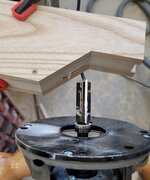
Thanks for all the info guys. Here is a pic of a sample piece of 1/2” hard maple I just cut.


IMG_8082.jpeg

So, based on ideas tossed around above I did some measuring with a digital micrometer. I measure the step at -.007 on the router table side. I measured the max OD of the cutter near the top bearing and near the table. I measure the diameter as 0.004 larger on the router table end of the bit.

So my measurements don’t exactly add up, but it’s possible there is also an eccentricity issue. I could check for it with a dial indicator, but I’m confident my problem is the cutter was made wrong…so I’m just going to send it back.
 
Last edited:

PCustoms

Well-known member
Joined
Jul 23, 2011
Messages
23,684
Location
VT
Thanks for all the info guys. Here is a pic of a sample piece of 1/2” hard maple I just cut.


IMG_8082.jpeg

So, based on ideas tossed around above I did some measuring with a digital micrometer. I measure the step at -.007 on the router table side. I measured the max OD of the cutter near the top bearing and near the table. I measure the diameter as 0.004 larger on the router table end of the bit.
IMG_8082.jpeg
So my measurements don’t exactly add up, but it’s possible there is also an eccentricity issue. I could check for it with a dial indicator, but I’m confident my problem is the cutter was made wrong…so I’m just going to send it back.
A flush trim would clean that right up!
 

jar944

Well-known member
Joined
Jul 26, 2010
Messages
6,043
Location
Northern VA
Thanks for all the info guys. Here is a pic of a sample piece of 1/2” hard maple I just cut.


IMG_8082.jpeg

So, based on ideas tossed around above I did some measuring with a digital micrometer. I measure the step at -.007 on the router table side. I measured the max OD of the cutter near the top bearing and near the table. I measure the diameter as 0.004 larger on the router table end of the bit.
IMG_8082.jpeg
So my measurements don’t exactly add up, but it’s possible there is also an eccentricity issue. I could check for it with a dial indicator, but I’m confident my problem is the cutter was made wrong…so I’m just going to send it back.

That surface finish is awful.

This is a single knife carbide insert bit.
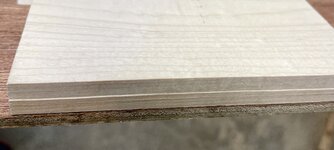
Screenshot_20240930_192953_Gallery.jpg
If you plan on much pattern work, insert bits are the way to go.
 

MoonRise

Well-known member
Joined
Nov 5, 2010
Messages
4,046
Location
NJ
Yeah, bad bit. 4 thou diameter difference and a 1.5 thou axis offset/mismatch (×2 for the diameter) and you have the 7 thou rabbet.

That's not a line bump, that's an offset between the two helixes.

You didn't order a ledge bit or mini-rabbet bit by accident? :lol_hitti

Send it back.

And that surface finish is horrible.

Skip the fancy compression double-bearing bit and just get a single bearing pattern trim bit. You pick top or bottom bearing, whatever works for your setup.

I've usually been satisfied with Freud or Bosch bits, but I also have some other brands too that have been fine.
 
To avoid these ads, REGISTER NOW!
Top Bottom