To avoid these ads, REGISTER NOW!

Compressor after cooler

motoguy

Well-known member
Joined
Dec 8, 2010
Messages
157
Location
MO
Ok. I'm ready to assemble my air line run. I've got the HF air cooler, a Hayden 1290, and plan on having a large vertical grid of copper as well. All copper will be 3/4". Right now, I'm focusing on the route from the compressor, out through the cooling/water removal components (above), and back into the tank. Then I'll run the feed line out of the tank. I'd like to have most of my moisture removed before the air gets back to the tank, though I'll have filters on the feed lines as well.

Would it matter if I run the line from the compressor head into the copper run first, and then through the Hayden? Or should I go through the hayden first? Will one way condense out more water than another? Heat issues? I'm planning on having about 50" of copper in up/down runs, with drains at the bottom of each run. Basically, 50" of copper in something like this:

aircompressor001.jpg


I plan on being able to bypass the refrigerated cooler. I'll likely only run it for the blaster or plasma table, and bypass it for most everything else, using just the passive elements (Hayden, copper run, in-line filters) for moisture removal. I'm going to build a shroud for the Hayden, and probably have a household fan pulling air, with power from a garage outlet tripped with a relay from the compressor switch.
 
To avoid these ads, REGISTER NOW!

njccmd2002

Active member
Joined
Apr 30, 2013
Messages
39
i used that same kind of setup, i made 2 years ago.


i used black pipe, and get a lot of debris trapped, assuming from the pipes rusting inside, and wondering if copper would be better, of course the expense....

im tired of the bad air quality, because of the rust...
 
Last edited:

bnred777

Member
Joined
Apr 28, 2016
Messages
6
Hi guys, I was hoping someone might be able to tell me how many BTU's a heat exchanger needs to be (transmission cooler or the like) for my compressor. I have a Kobalt 80 gal 2 cycle. I'd really like to add the aftercooler to help with water because I'm getting a lot here in Arkansas (imagine that :) I've been looking at a B&M 70274 that has a BTU rating of 29200 but I really want to make sure it's big enough before I buy it...
I've tried to figure it out but a few there are a couple things I don't understand. Firstly, why these companies size the tank in gallons! I guess that part is not as important as the following.

I'm assuming to get the answer to the BTU questions, first I would need to know the flow rate of the compressor itself. I really don't know how to get that answer. Is that the rating that is on the side of the tank (16.5 SCFM)? Also, is that number normally overrated like everything else?

Once I get that figured out the next question would be, how much temperature drop do I want. Since the outlet of the compressor is going to be around 330F to 350F. I'm guessing I want it to come down as far as I can get it (room temp).

Once I know those things, does anyone know the math to calculate the BTU rating needed for a specific temperature drop at a certain flow?

Then again I may be completely off or missing stuff... Any help would be greatly appreciated!

Thanks,
Brandon
 

Burgerkong

Well-known member
Joined
Apr 17, 2010
Messages
2,501
Location
Markham, Ontario, Canada
Hi guys, I was hoping someone might be able to tell me how many BTU's a heat exchanger needs to be (transmission cooler or the like) for my compressor. I have a Kobalt 80 gal 2 cycle. I'd really like to add the aftercooler to help with water because I'm getting a lot here in Arkansas (imagine that :) I've been looking at a B&M 70274 that has a BTU rating of 29200 but I really want to make sure it's big enough before I buy it...

I've tried to figure it out but a few there are a couple things I don't understand. Firstly, why these companies size the tank in gallons! I guess that part is not as important as the following.

I'm assuming to get the answer to the BTU questions, first I would need to know the flow rate of the compressor itself. I really don't know how to get that answer. Is that the rating that is on the side of the tank (16.5 SCFM)? Also, is that number normally overrated like everything else?

Once I get that figured out the next question would be, how much temperature drop do I want. Since the outlet of the compressor is going to be around 330F to 350F. I'm guessing I want it to come down as far as I can get it (room temp).

Once I know those things, does anyone know the math to calculate the BTU rating needed for a specific temperature drop at a certain flow?

Then again I may be completely off or missing stuff... Any help would be greatly appreciated!

Thanks,
Brandon

If you don't trust the rated specs, just empty your tank and time how long it takes to fill it up to the cut off pressure and math it out to get 'true' CFM's.
 

bnred777

Member
Joined
Apr 28, 2016
Messages
6
If you don't trust the rated specs, just empty your tank and time how long it takes to fill it up to the cut off pressure and math it out to get 'true' CFM's.

That's a great tip, thank you very much!

As for the math, is this right?

Convert gallons (tank size) to cubic feet | 80gal / 7.4805 = 10.69 Cubic Feet

My Compressor say it can do 16.5 scfm but I know it can't fill the tank in under a minute. Is there something I'm supposed to do to get the tank pressure involved?
 

sld961

Well-known member
Joined
Oct 28, 2015
Messages
395
That's a great tip, thank you very much!

As for the math, is this right?

Convert gallons (tank size) to cubic feet | 80gal / 7.4805 = 10.69 Cubic Feet

My Compressor say it can do 16.5 scfm but I know it can't fill the tank in under a minute. Is there something I'm supposed to do to get the tank pressure involved?
TANK GALLONS x 0.536 x Change in PSI divided by SECONDS
 

InterpreDemon

Active member
Joined
May 12, 2015
Messages
27
I wouldn't worry about it, just mount the biggest most durable cooler you can. You can always add a fan. As to those unnecessary BTU calculations, if you wanted to estimate it you could take the run time for a compression cycle, measure the electrical load (or use the motor nameplate rating), calculate the difference in stored energy between the low and high pressure setting for your tank volume, then subtract the stored (net) from the input and attribute the remainder to heat, which you divide by time to get your cooler rating. That would be very conservative (robust) for an after cooler since the compressor itself absorbs and then rejects much of that heat, but it would at least give you the "more than this makes no sense" number.

Meanwhile the rest of us will just mount any cooler that is easy to connect and can handle the heat, pressure and vibration, knowing that something is better than nothing. . . In most cases.
 

lametec

Well-known member
Joined
May 5, 2008
Messages
2,099
Location
Michigan
I wouldn't worry about it either.

I use a B&M 70266 on mine (which is smaller that what you're looking at), and only the first 20% or so of the cooler actually gets warm. This is with a fan pushing air through it, of course.

I measured the intake temperature (on the outside surface of the inlet of the cooler) to be over 310°F using an infrared thermometer. The outlet temperature measured the same way never went above 96°F. That's a drop of 214°F. Ambient temperature was about 86°F.

Come to think of it, I have an IR camera now, so I could actually take a picture of the cooler in operation, which will show the temperature drop across it. I'll make a mental note to get that done.. maybe this weekend.
 

bnred777

Member
Joined
Apr 28, 2016
Messages
6
I wouldn't worry about it, just mount the biggest most durable cooler you can. You can always add a fan. As to those unnecessary BTU calculations, if you wanted to estimate it you could take the run time for a compression cycle, measure the electrical load (or use the motor nameplate rating), calculate the difference in stored energy between the low and high pressure setting for your tank volume, then subtract the stored (net) from the input and attribute the remainder to heat, which you divide by time to get your cooler rating. That would be very conservative (robust) for an after cooler since the compressor itself absorbs and then rejects much of that heat, but it would at least give you the "more than this makes no sense" number.

Meanwhile the rest of us will just mount any cooler that is easy to connect and can handle the heat, pressure and vibration, knowing that something is better than nothing. . . In most cases.

That's a good point, I was afraid I was not getting a big enough cooler but after reading this post and the next post I decided to just go for it. I have all the main hardware on the way. I appreciate your input! Thanks!
 

bnred777

Member
Joined
Apr 28, 2016
Messages
6
I wouldn't worry about it either.

I use a B&M 70266 on mine (which is smaller that what you're looking at), and only the first 20% or so of the cooler actually gets warm. This is with a fan pushing air through it, of course.

I measured the intake temperature (on the outside surface of the inlet of the cooler) to be over 310°F using an infrared thermometer. The outlet temperature measured the same way never went above 96°F. That's a drop of 214°F. Ambient temperature was about 86°F.

Come to think of it, I have an IR camera now, so I could actually take a picture of the cooler in operation, which will show the temperature drop across it. I'll make a mental note to get that done.. maybe this weekend.

Thanks for the input, I have the one I was talking about on the way. I plan to use this fan (Papst W2E250-HJ52-06). I'll likely build a shroud as well. I'll be using a B&M 70274 SuperCooler and I wanted to add a Parker WS010CNFX/US water separator just out of the cooler. I'm hoping that type of water separator will work for this application. Any thoughts on the water separator?

Here's some links to the hardware:

Cooler

Water Separator

Fan
 

bnred777

Member
Joined
Apr 28, 2016
Messages
6
I wouldn't worry about it either.

I use a B&M 70266 on mine (which is smaller that what you're looking at), and only the first 20% or so of the cooler actually gets warm. This is with a fan pushing air through it, of course.

I measured the intake temperature (on the outside surface of the inlet of the cooler) to be over 310°F using an infrared thermometer. The outlet temperature measured the same way never went above 96°F. That's a drop of 214°F. Ambient temperature was about 86°F.

Come to think of it, I have an IR camera now, so I could actually take a picture of the cooler in operation, which will show the temperature drop across it. I'll make a mental note to get that done.. maybe this weekend.
By the way, I'd love to see those images! That would be really cool.

Thanks again!
 

devildog93

Member
Joined
Apr 20, 2016
Messages
19
Location
Oklahoma City
Ok TNToy, couple of questions about your setup. 1 - I saw you used hydraulic hose for both sides of the cooler. Where did you get this and how much does it run? 2 - do you think the water trap after the aftercooler is necessary? I was planning on using my tank as a water trap, then having a couple others down the line. I am wondering why you decided to go prior to the tank. The initial water trap is a witty solution by the way, i am just wondering if i need to reassess the plan for my belt guard cooler after seeing it.

One last question, i have seen guys with blow off valves prior to the aftercooler. How important do you guys think that might be? I guess it depends on how often the aftercooler is going to get plugged/gummed up. Maybe not so important if your access point is hydraulic hose. Pretty easy to disassemble i would think.
 
Last edited:

lametec

Well-known member
Joined
May 5, 2008
Messages
2,099
Location
Michigan
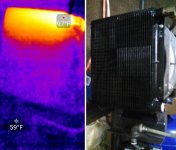
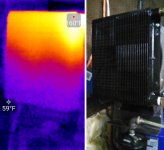
Thermal pictures attached.

Thermal and regular pictures combined to show you what you're looking at. Angles aren't exactly the same, but you should be able to figure it out, I hope.

The temperatures shown are min/max, and I the min temps I think are the wall in the background, so ignore those. Ambient temperature was 59°F, as you can see.

Thermal 1,2 and 4. Taken one after the other. You can see how the cooler heats up. Thermal 4 was taken after the compressor shut off, and as you can see, only about 1/2 the cooler has really warmed up. You can easily put your hand on anything but the very top 3 or 4 inches of the cooler without it being too warm to touch.
 

Attachments

  • Thermal 1.jpg
    Thermal 1.jpg
    142.8 KB · Views: 191
  • Thermal 2.jpg
    Thermal 2.jpg
    136.9 KB · Views: 178
  • Thermal 4.jpg
    Thermal 4.jpg
    142 KB · Views: 222

nine4gmc

Well-known member
Joined
Mar 24, 2012
Messages
14,357
Location
Dallas
Lametec, thats awesome, thanks for sharing! It also looks like your return pipe from the cooler is too close to the feeder pipe in the 4th thermal pic, right above the motor. Looks like the feed is heating the return.

Sent from my SM-T230NU using Tapatalk
 

lametec

Well-known member
Joined
May 5, 2008
Messages
2,099
Location
Michigan
You're right, it does look like it. I doubt the air temperature changes much from passing through the pipe, though, so I can't be bothered to fix that. :)
 

StangStang

Well-known member
Joined
Aug 22, 2016
Messages
50
Hello all!

I am new to the site and am wondering how to setup my compressor with an after cooler. I have a big problem with water coming out of my air tools and I eventually want to paint my car. I have a Kobalt 3.7-HP 60-Gallon 155-PSI 230-Volt, 11.5 SCFM at 90 PSI Vertical Stationary Electric Air Compressor. I would like to build an after cooler for it.

I was looking at the Air Cooled After Cooler, Max HP 15, 60 CFM built by AKG and my plan was to purchase a 220 volt fan to go with it and then plumb it in after the discharge of the compressor and then back into the tank with a water separator prior to the tank and a drain. I would like the fan to run when the compressor runs which shouldn't be hard to wire up.

What do you guys think?

Thanks!
 

devildog93

Member
Joined
Apr 20, 2016
Messages
19
Location
Oklahoma City
I think that sounds like a good plan. I bought an aftercooler that has air drawn over it by the compressor pulley so i could forgo the electric fan, but plenty have gone with the electric fan and wired it to run when the compressor is running.
 

md21722

Well-known member
Joined
Nov 30, 2015
Messages
1,840
Location
Mt Juliet, TN
Hello all!

I am new to the site and am wondering how to setup my compressor with an after cooler. I have a big problem with water coming out of my air tools and I eventually want to paint my car. I have a Kobalt 3.7-HP 60-Gallon 155-PSI 230-Volt, 11.5 SCFM at 90 PSI Vertical Stationary Electric Air Compressor. I would like to build an after cooler for it.

I was looking at the Air Cooled After Cooler, Max HP 15, 60 CFM built by AKG and my plan was to purchase a 220 volt fan to go with it and then plumb it in after the discharge of the compressor and then back into the tank with a water separator prior to the tank and a drain. I would like the fan to run when the compressor runs which shouldn't be hard to wire up.

What do you guys think?

Thanks!

If you are getting that much water out of your tools, it makes me think you have the filter/regulator right on the tank. The cooler the air, the more water the filter can catch. An after cooler will help significantly. Many industrial compressors have it as a factory option bolted to the belt guard in front of the pump flywheel and do not use an auxiliary fan. While a float type filter/drain as part of that plumbing is nice, it's also another leak point. With just the cooler, it will go into the tank as liquid where you can drain it with the tank drain. You will want to see what the temperature of the air after the cooler is. Your target is ambient or +20 of ambient.
 

pcmeiners

Well-known member
Joined
Aug 13, 2009
Messages
7,825
Location
In the only town in Pennsylvania, Bloomsburg.
Any thoughts on the water separator?

Larger the better, even if you need to adapt down to the pipe size. Separators swirl the air, with small units the air velocity is very high, not conducive for water to drop out. Ebay is your best bet, but you need to be patient for a good deal. Search coalescing filter or water trap
Avoid plastic bowls!

http://www.ebay.com/itm/NEW-Parker-...499025?hash=item21156eba91:g:wk0AAOSw9eVXWw3z

http://www.ebay.com/itm/Watts-Fluid...849615?hash=item4af64d6e8f:g:5BoAAOSw3KFWgB10

http://www.ebay.com/itm/NEW-ATLAS-C...460234?hash=item58e1906b0a:g:VDAAAOSwoMZXEUNt
 
To avoid these ads, REGISTER NOW!

StangStang

Well-known member
Joined
Aug 22, 2016
Messages
50
Any thoughts on the water separator?

Larger the better, even if you need to adapt down to the pipe size. Separators swirl the air, with small units the air velocity is very high, not conducive for water to drop out. Ebay is your best bet, but you need to be patient for a good deal. Search coalescing filter or water trap
Avoid plastic bowls!

http://www.ebay.com/itm/NEW-Parker-...499025?hash=item21156eba91:g:wk0AAOSw9eVXWw3z

http://www.ebay.com/itm/Watts-Fluid...849615?hash=item4af64d6e8f:g:5BoAAOSw3KFWgB10

http://www.ebay.com/itm/NEW-ATLAS-C...460234?hash=item58e1906b0a:g:VDAAAOSwoMZXEUNt

I will keep an eye. I have a Husky water separator on my current setup. It has a clear bowl. Is that bad?

I was looking at this: http://www.ebay.com/itm/1-2-NPT-Aut...er-F-R-L-Air-Control-Unit-D704A-/121037468199

Any advice on the auto drains?
 

StangStang

Well-known member
Joined
Aug 22, 2016
Messages
50
Once I build the After Cooler, how should I have the unloader valve setup? Do you want to drain the air out of the entire After Cooler once the motor shuts off?
 

MacMcMacmac

Well-known member
Joined
Oct 21, 2014
Messages
1,573
Location
canada
Anyone ever think of hitting the junkyard for a Volkswagen TDI or Mazda Millennia intercooler for these projects?
 

StangStang

Well-known member
Joined
Aug 22, 2016
Messages
50
Yep, leave the check valve at the tank.

Awesome, thanks! I will post some pictures when stuff gets in. I don't have the room to mount mine on the side so I will be doing it a bit different. Should be interesting!

Thanks for the help!
 

volaredon

Well-known member
Joined
Oct 7, 2012
Messages
1,608
Location
IL
the unit from Grainger comes up discontinued and their "alternate" current product is over $1000!!!!
 

pcmeiners

Well-known member
Joined
Aug 13, 2009
Messages
7,825
Location
In the only town in Pennsylvania, Bloomsburg.
"Any advice on the auto drains? "

What you have linked i your last post is a water trap, not bad but not a coalescing filter. Trap just gathers water in your lines, coalescing filter swirl the air within the filters bowl, causing moisture to form droplets and drop out. Remember whatever filter or trap, bigger the better.

As to auto drains, sure beats manually remembering to drain filters. On the other hand they can malfunction. Basically I have purchased all my filters with auto drains on Ebay, did not cost any more. If you purchase them separately they can be pricey.

Issue with clear bowls....the only reason to create a clear plastic bowl is cost cutting, they can blow up..no reason to buy one as Ebay has many quality aluminum bowl units.

one of my compressor setups ....
Allison cooler

http://s852.photobucket.com/user/pcmeiners/media/DSC_00640001.jpg.html?sort=3&o=3
 
Last edited:

brianpgriset

Well-known member
Joined
Sep 29, 2006
Messages
1,036
Location
Beaumont, TX
This thread never fails to come back up

But my CX Racing oil cooler still is holding in. Close to 70 hours on the compressor since install and still works great.
 

mct75

Active member
Joined
Aug 19, 2016
Messages
39
Hi everyone. I am wanting to add an aftercooler to a 5 gallon man-portable compressor. I know this is about 55 gallons less than what most of you have.

I was looking at this PS oil cooler as it's small and cheap: https://www.amazon.com/dp/B0049ESKAU/

I know these are not designed for pressure, but often they are pressure tested to 300 PSI or more. My compressor is only 125 PSI.

Has anyone tried these smaller coolers, and do they remove any heat at all?
 

Ferrino

Well-known member
Joined
Mar 30, 2011
Messages
254
Location
San Diego, CA
Inspired by this great thread, I have been meaning to install my aftercooler+fan+trap for a long time, but have not got around to it. Although I ultimately want to position it between the compressor and the tank, for various reasons I may have to temporarily place it after the tank (compressor -> tank -> regulator -> aftercooler -> water trap).

Does anyone see a problem with this? I understand the benefits of eliminating moisture before the tank, but I am willing to sacrifice that temporarily and drain regularly, if it means I can paint moisture-free in the short term.

I'm using this B&M transmission cooler, which is "pressure tested to 200 PSI".

Thanks!
 
Last edited:

InterpreDemon

Active member
Joined
May 12, 2015
Messages
27
Depending upon the size of your tank and continuous flow rate during spraying, it probably will do squat unless it is a tiny tank with high flow rate, like an engine-powered portable. The maximum water vapor condensation and entrapment occurs when you have the greatest temperature drop, which of course is "hot from the press" so to speak, where the compressor outlet temp can easily exceed 250 degrees. The tank itself will trap most of the moisture at low or intermittent flow rates, and if your regulator has a trap it will get some more due to the cooling of the pressure drop across the regulator. The only way you can squeeze more out after that would be with a refrigerated dryer, which is what the pro painter will use regardless what he's got for wringers upstream. If I were you, I would just wait until you can install your cooler between the compressor and the tank, otherwise it is a waste of money, time and effort.
 

cadunkle

Well-known member
Joined
Feb 13, 2011
Messages
472
Location
NJ
Did this last winter...

20160228_173430.jpg


Used a Hayden cooler with a roughly 12"x20" core, Norgren filters. It'll pull temps from 300*+ down to a few degrees above ambient, though in summer if using it heavily (blasting) I see as high as 130* into the tank if it's running continuous. Need to put a fan on it to be ideal but it pulls a LOT of water out.
 

Ferrino

Well-known member
Joined
Mar 30, 2011
Messages
254
Location
San Diego, CA
Did this last winter...

20160228_173430.jpg


Used a Hayden cooler with a roughly 12"x20" core, Norgren filters. It'll pull temps from 300*+ down to a few degrees above ambient, though in summer if using it heavily (blasting) I see as high as 130* into the tank if it's running continuous. Need to put a fan on it to be ideal but it pulls a LOT of water out.

Neat. Do you have any photos showing how you attached the cooler to the compressor frame? Also, what type of copper fittings are you using to connect to the cooler and the compressor/tank - are these compression fittings or flared? Thanks!
 

BCreekDave

Well-known member
Joined
Dec 17, 2015
Messages
206
Location
Dayton, OH
Just got mine done a week or so ago.

The compressor is a Eaton Polar Air 5HP. Bought it on CL for 800.

The cooler itself is a Thermal Transfer Systems DH-205. Got it from work in the scrap bin. It was a hydraulic pump cooler that got a tiny hole punched in the side tank. 10 minutes braze time fixed that.

The fan is the ever popular EBM-Pabst 220V muffin fan from eBay for 40. It is the 160 watt version and 1200CFM.

The water filter is also from eBay and is from UPE Group (Asian) 3/4" with auto-drain for 50 bucks: http://www.ebay.com/itm/201449479155?_trksid=p2057872.m2749.l2649&ssPageName=STRK:MEBIDX:IT

In my installation, I couldn't go wider or deeper on the compressor. The width is limited due to being between two garage doors and the depth is due to being all the way back against the wall. I toyed wit the idea of a fan guard mounted cooler but many compressors are purposely slow running and therefore move relatively little air. Saylor-Beall recognizes this and therefore mounts a fan on the motor shaft to power air across its guard mounted cooler:

So with all this, I made a couple of angle iron mounts and mounted it to the top of the fan guard above the motor. The fan guard on the Eaton Compressor is pretty heavy duty so mounting it was easy. I also had to make a custom aluminum manifold block on the exit port of the compressor. The fan is wired in parallel with the motor. bent some copper pipe and added ~25 in fittings and it was done. Total investment was ~125.00.

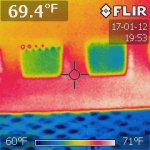
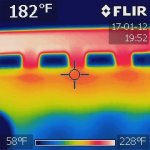
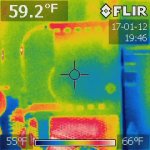
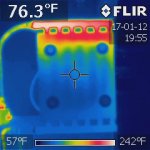
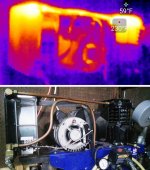
To verify effectiveness, I took some thermographic images using a FLIR camera. It seems to work really well. The temp of the entry pipe into the tank never goes above +5 ambient. The first picture is at startup with an ambient garage temp of 57F. The last is at 10 minutes with ~250F into the cooler and 76 midpoint and 60F at the exit. i think the performance may drop some in the summer at 90F, but we'll see. In about an hours run time at ~50% humidity it produced about a cup of water.
 

Attachments

  • Aftercooler Exit piping 7 minutes.jpg
    Aftercooler Exit piping 7 minutes.jpg
    39.3 KB · Views: 136
  • Aftercooler Entry piping 7 minutes.jpg
    Aftercooler Entry piping 7 minutes.jpg
    40.4 KB · Views: 143
  • Aftercooler 7 minutes.jpg
    Aftercooler 7 minutes.jpg
    40.6 KB · Views: 141
  • Aftercooler FLIR startup.jpg
    Aftercooler FLIR startup.jpg
    42 KB · Views: 167
  • IMG_1638.JPG
    IMG_1638.JPG
    107.1 KB · Views: 261
  • IMG_1636.JPG
    IMG_1636.JPG
    111.5 KB · Views: 267
  • Aftercooler FLIR 10 minutes.jpg
    Aftercooler FLIR 10 minutes.jpg
    40 KB · Views: 143
Last edited:

sberry

Banned
Joined
Jun 18, 2005
Messages
35,747
Location
Brethren, Michigan
Something else to consider with these systems is that bigger isn't always better. Fine for the cooler but not the filter. If the air goes too slow they don't work correctly, it needs the velocity to cyclone it.
 

AJ1978

Well-known member
Joined
Apr 27, 2010
Messages
239
Location
Jamestown, PA
I installed the Saylor Beall Kit on my Vt 735-80 It had IMPRESSIVE results, the fan moves a lot of air, and it sure drops the temp of the air entering the tank. Agree when I am running hard or the ambient temp is up I have elevated temps but I could hold onto the supply line entering the tank. The line coming from the head is another story.
 
To avoid these ads, REGISTER NOW!
Top Bottom