To avoid these ads, REGISTER NOW!

Compressor air math

Don1357

Well-known member
Joined
Apr 15, 2019
Messages
948
Location
Palmer, AK
I just sold my Husky 30-gallon 175PSI compressor, This Monday I'm picking a Campbell Hausfeld 60-gallon 140 PSI unit! I wanted more CFM to get into sand blasting and I got to sell mine for a good price and pick the other one for the same amount.

Considering that the smaller tank had a higher PSI rating, how much extra air does the 60-gallon tank actually holds?
 
To avoid these ads, REGISTER NOW!

Lwel9226

Well-known member
Joined
Jun 7, 2014
Messages
764
Location
So Oregon
Sounds like your old compressor was a two stage unit... The new one is single stage...
You probably did not gain much if any....
You could have added an extra tank for more storage to the old one...

LynnW
 

metlmunchr

Well-known member
Joined
Sep 10, 2011
Messages
1,278
You're going to be blasting at some specific pressure, so the amount of air available is the difference between the starting pressure and the blasting pressure.

Let's say you're blasting at 80 psi. The 30 gal/175 psi would deliver 25.84 cu ft of air while the 60 gal/140 psi will deliver 32.64 cu ft.

These numbers ignore whatever additional air is available as a function of the compressor cycling on and delivering X additional cu ft as you didn't specify the scfm rating of either compressor.

In reality, for blasting, the tank size is largely irrelevant and the compressor output is pretty much the sole factor in determining how long you can blast before having to stop and let the compressor catch up. The only place where tank size comes into play is in determining how long you can run prior to the pump coming on. Past that point, a compressor delivering more air than the blast gun is using will allow continuous non-stop blasting while a compressor with less capacity than the blast gun is using will require stopping every so often to allow the compressor to catch up.

Depending on nozzle size, the typical cabinet blaster will use 10 to 15 CFM. Pot type blasters like you'd use to blast larger items will use more air unless you're happy with blasting at a painfully slow rate.

My bead blast cabinet will run on my 5hp compressor but just barely. If I'm going to blast something that's going to take more than 2-3 minutes then I turn on my 10hp compressor. If I only had the 5 horse compressor then I'd put a bit smaller nozzle on the gun and it would run just fine for extended times.

For larger stuff, I've got a Clemco pressure pot blaster. With a 3/8" nozzle, it will use about 250 cfm when blasting something made from fairly heavy material like a car trailer at 100 psi, or around 175 cfm when blasting thinner stuff at 60-70 psi. For the Clemco we typically run a 400 cfm diesel compressor.

As with most anything, what you need to do determines the equipment needed to do it efficiently. Personally, I prefer dealing with things I can carry in one hand and pop in the bead blaster. Stuff that needs the Clemco is way too much like work :(
 
OP
D

Don1357

Well-known member
Joined
Apr 15, 2019
Messages
948
Location
Palmer, AK
The husky was a single stage.

Don't let the higher PSI rating fool you. Regardless of the higher pressure it was rated at 5.1 SCFM, the new one is rated at 13.5 SCFM which should cover my hobby blasting. I don't think that I'm going to outgrow the 7HP engine on it anytime soon.
 

Sleeper

Well-known member
Joined
Feb 27, 2009
Messages
73
Your numbers are very confusing maybe you could post the actual model numbers of these compressors. It sounds like you are saying that the 30 gal 175 psi Husky was a single stage compressor. I don’t think that’s possible as single stage units generally can’t produce those high pressures because they only have one stage of compression to raise the pressure from atmospheric to their maximum working pressure.
Your new unit sounds like it’s probably a single stage and if it is putting out 13.5 CFM you should figure it’s probably got a true 3 HP motor on it. The general rule of thumb is about 3 CFM per true horsepower for a single stage unit and maybe 4 CFM per HP for a two stage compressor.
Post up the specifics and I bet someone here will be able to help you work out what your set up should look like if you want to blast with it.

The husky was a single stage.

Don't let the higher PSI rating fool you. Regardless of the higher pressure it was rated at 5.1 SCFM, the new one is rated at 13.5 SCFM which should cover my hobby blasting. I don't think that I'm going to outgrow the 7HP engine on it anytime soon.
 

bob15

Well-known member
Joined
Dec 8, 2011
Messages
6,863
Location
Northeasten, CT

zkling

Well-known member
Joined
Jan 23, 2007
Messages
16,939
I just sold my Husky 30-gallon 175PSI compressor, This Monday I'm picking a Campbell Hausfeld 60-gallon 140 PSI unit! I wanted more CFM to get into sand blasting and I got to sell mine for a good price and pick the other one for the same amount.

Considering that the smaller tank had a higher PSI rating, how much extra air does the 60-gallon tank actually holds?

P1V1=P2V2....Highschool physics. Will get you close enough.

Running a compressor off of tank volume is foolish though. Tanks and pumps are matched for duty cycle.

single stage at 175psi is very unlikely.

maybe you are confusing that with single phase?

No. It's one of the piece of ****, oil less, direct drive single stage units.
 

welder4956

Well-known member
Joined
Apr 8, 2010
Messages
3,063
Location
Birmingham, AL USA
If you are just asking about tank capacity at different pressures,use the combined gas law:
P1 x V1 = P2 x V2

So, you want to know what the volume of air (V1) is at 14.7 psi (atmospheric pressure) (P1) for a 30 gallon tank (V2) at 175 psi (P2). 30 gallons converted to cubic feet is 4.01 cu.ft.

V1 = (175 x 4) ÷ 14.7 = 47.62 cu. ft.

For the 60 gal. tank @ 140 psi:

V1 = (140 x 8) ÷ 14.7 = 76.2 cu. ft.

So, even though the larger tank is rated at lower pressure, it is capable of holding more volume at that pressure. The cutoff pressures will govern the actual volumes though.
 
Last edited:

joe_padavano

Well-known member
Joined
Feb 26, 2011
Messages
1,788
Location
Northern VA
The HP rating (which is usually bogus) and the tank size are irrelevant. What matters is the SCFM rating of the pump. Few compressor manufacturers publish this info because usually it's dismal. Personally, don't even bother looking at anything by Husky or CH. Buy a real compressor for media blasting. I struggled with too-small a compressor for years. The 23 SCFM I have now makes blasting a joy (well as much as getting grit in various bodily cavities can be considered a joy... :lol2:).
 
OP
D

Don1357

Well-known member
Joined
Apr 15, 2019
Messages
948
Location
Palmer, AK
Your numbers are very confusing maybe you could post the actual model numbers of these compressors. It sounds like you are saying that the 30 gal 175 psi Husky was a single stage compressor. I don’t think that’s possible as single stage units generally can’t produce those high pressures because they only have one stage of compression to raise the pressure from atmospheric to their maximum working pressure.
Your new unit sounds like it’s probably a single stage and if it is putting out 13.5 CFM you should figure it’s probably got a true 3 HP motor on it. The general rule of thumb is about 3 CFM per true horsepower for a single stage unit and maybe 4 CFM per HP for a two stage compressor.
Post up the specifics and I bet someone here will be able to help you work out what your set up should look like if you want to blast with it.

What's confusing about the numbers?

The Husky is a single stage compressor:

https://www.homedepot.com/p/Husky-3...table-Electric-Air-Compressor-C303H/206532808

As per the vendor 175PSI, 5.1 SCFM at 90, 1.7HP engine.

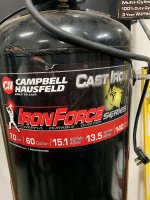
The Campbell Hausfeld is their older Cast IronForce series, 140PSI, 13.5 SCFM at 90, 7HP engine. The motor is also rated for 100% cycle.
 
OP
D

Don1357

Well-known member
Joined
Apr 15, 2019
Messages
948
Location
Palmer, AK
If you are just asking about tank capacity at different pressures,use the combined gas law:
P1 x V1 = P2 x V2

So, you want to know what the volume of air (V1) is at 14.7 psi (atmospheric pressure) (P1) for a 30 gallon tank (V2) at 175 psi (P2). 30 gallons converted to cubic feet is 4.01 cu.ft.

V1 = (175 x 4) ÷ 14.7 = 47.62 cu. ft.

For the 60 gal. tank @ 140 psi:

V1 = (140 x 8) ÷ 14.7 = 76.2 cu. ft.

So, even though the larger tank is rated at lower pressure, it is capable of holding more volume at that pressure. The cutoff pressures will govern the actual volumes though.

Yeah, basically this was what I wanted to know, for no other purpose than to satisfy my curiosity. Basically I have 62% more tank capacity; 76.2 divided by 47.62 pretty much flexes all of my math capacity :D

The HP rating (which is usually bogus) and the tank size are irrelevant. What matters is the SCFM rating of the pump. Few compressor manufacturers publish this info because usually it's dismal. Personally, don't even bother looking at anything by Husky or CH. Buy a real compressor for media blasting. I struggled with too-small a compressor for years. The 23 SCFM I have now makes blasting a joy (well as much as getting grit in various bodily cavities can be considered a joy... :lol2:).

Yeah, but if one vendor is lying about their 1.7HP engine and another vendor is lying about their 7HP engine, one it still much much much larger than the other ;)

Heck this upgrade is not costing me a penny so no matter what I gain (which should be significant) is still free.
 
To avoid these ads, REGISTER NOW!

Citation

Well-known member
Joined
Jan 20, 2016
Messages
3,212
Location
Indy
I do something like this compressor math but don't use the full tank pressure. The pressure in question is the pressure above your minimum pressure. So if 90 psi is your minimum usable pressure then the math looks like this:

(140-90)psi*60gal=3000psi*gal
(175-90)psi*30gal=2550psi*gal

So if 90 psi is your minimum then the 60 gallon tank only has 18% more usable air*. Psi*gal is a not a common unit. You could convert it into standard cubic feet but since we are just comparing why bother.

*This ignores some thermodynamics where big pressure drops will result in drops in temperatures etc. I no longer have (or recall how to read) my air tables so I can't tell how how much that will impact the real numbers. My math says a 1psi*1000gal is the same as 1000psi*1gal. It's not that's kind of an extreme case that doesn't matter here.
 

ducksface

Banned
Joined
Oct 25, 2012
Messages
2,477
I'll complicate it for you.
Factory cfm ratings are made on the INTAKE side with zero tank pressure at about 73°f.
No back pressure just a pump pumping at equal intake and exhaust.
No restrictions on either side.
Add any compression and you lose...dramatically.
 
OP
D

Don1357

Well-known member
Joined
Apr 15, 2019
Messages
948
Location
Palmer, AK
I'll complicate it for you.
Factory cfm ratings are made on the INTAKE side with zero tank pressure at about 73°f.
No back pressure just a pump pumping at equal intake and exhaust.
No restrictions on either side.
Add any compression and you lose...dramatically.

Yeah, but this is the only way you can get an apples to apples comparison between two pumps, by removing the external variables that would require long winded explanations better had over single malt.
 

welder4956

Well-known member
Joined
Apr 8, 2010
Messages
3,063
Location
Birmingham, AL USA
I do something like this compressor math but don't use the full tank pressure. The pressure in question is the pressure above your minimum pressure. So if 90 psi is your minimum usable pressure then the math looks like this:

(140-90)psi*60gal=3000psi*gal
(175-90)psi*30gal=2550psi*gal

This is what I come up with if the cutoff pressure is 90 psi for both tanks. For the 30 gal. tank @ 90 psi:

V1 = (90 x 4) ÷ 14.7 = 24.5 cu. ft.

For the 60 gal. tank @ 90 psi:

V1 = (90 x 8) ÷ 14.7 = 49 cu. ft

So the storage capacity is twice as much (surprise, surprise - 30 gal vs. 60 gal.) But like others have said, the important number is the flow rate of the compressor. A 60 gal. tank just means it won't be starting/stopping as often with the larger storage capacity.
 

Citation

Well-known member
Joined
Jan 20, 2016
Messages
3,212
Location
Indy
This is what I come up with if the cutoff pressure is 90 psi for both tanks. For the 30 gal. tank @ 90 psi:

V1 = (90 x 4) ÷ 14.7 = 24.5 cu. ft.

For the 60 gal. tank @ 90 psi:

V1 = (90 x 8) ÷ 14.7 = 49 cu. ft

So the storage capacity is twice as much (surprise, surprise - 30 gal vs. 60 gal.) But like others have said, the important number is the flow rate of the compressor. A 60 gal. tank just means it won't be starting/stopping as often with the larger storage capacity.

I think you missed something I was getting at. I use 90 psi as the minimum pressure, not the max. Of course the actual minimum usable pressure varies but I figure 90 is a good number. So a 140psi fill pressure means you have 50 psi of usable air * how ever many gallons or cf. A 175psi fill pressure means you have 85 psi * how ever many gallons.

To illustrate the point consider comparing a 120 gallon tank filled to 95 psi vs a 10 gallon tank filled to 200 psi. Which will let my 90 psi minimum die grinder last long on just the tank?

Big tank, (95-90)psi*120 gallons = 600 psi*gallons
Little tank, (200-90)psi*10 gallons = 1,100 psi*gallons

So in my extreme hypothetical a 10 gallon tank has more usable air above my 90 psi minimum than a 120 gallon tank due to the difference in pressure.

If we ran the same calculation but were trying to fill up 30 psi car tires then our minimum pressure is 30 psi. Now the math looks like this

Big tank, (95-30)psi*120 gallons = 7800 psi*gallons
Little tank, (200-90)psi*10 gallons = 1,700 psi*gallons

As you mentioned, this is just looking at tank volume, not the pump. This sort of calculation can matter if you have a tool which simply outruns any 120V compressor so should you get the smaller tank with higher PSI or the larger tank with lower max psi? For example, how much more useful air is in a 6 gallon, 150 psi Porter Cable pancake compressor vs an 8 gallon, 120 psi CAT compressor. The PC has about 50% more usable air thanks to the higher pressure.

In the OP's case it just shows that thanks to the higher tank pressure, the 30 gallon tank isn't that far off the 60 gallon tank in terms of usable stored air. However, that ignores that the 60 gallon's pump flows 2x or more what the other compressor does.
 

gnpenning

Well-known member
Joined
Jan 25, 2015
Messages
2,754
Location
I have more questions than answers.
Yeah, but if one vendor is lying about their 1.7HP engine and another vendor is lying about their 7HP engine, one it still much much much larger than the other ;)

Heck this upgrade is not costing me a penny so no matter what I gain (which should be significant) is still free.

2 very important facts. All math aside, I'm impressed you could sell the old one, let alone for enough to pay for an upgrade. You could sell sand to Saudis or swimsuit to Eskimos. I'm impressed.

Can't wait to see what your next upgrade will be.
 

csp

Well-known member
Joined
Mar 23, 2010
Messages
5,719
Location
Franktown, CO
2 very important facts. All math aside, I'm impressed you could sell the old one, let alone for enough to pay for an upgrade. You could sell sand to Saudis or swimsuit to Eskimos. I'm impressed.

Can't wait to see what your next upgrade will be.

There are all kinds of people out there that have no clue about compressors. They see a 30 gallon tank and think it must be a really good one. Many don't need double digit CFM.

They're slightly smarter than the people who buy these same types of compressors new. At least they look for a bargain.

I sold a 30 gallon "5hp" oilless Craftsman 2hours after listing it for sale. Paid $120 24 years ago and sold it for $160 and the guy didn't even care to hear it run.
 
Last edited:
OP
D

Don1357

Well-known member
Joined
Apr 15, 2019
Messages
948
Location
Palmer, AK
2 very important facts. All math aside, I'm impressed you could sell the old one, let alone for enough to pay for an upgrade. You could sell sand to Saudis or swimsuit to Eskimos. I'm impressed.

Can't wait to see what your next upgrade will be.

Dumb luck had a lot to do with it. A few days after I sold the Husky Home Depot put it on sale...

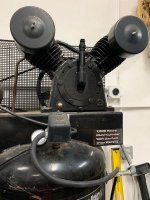
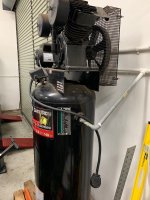
Well I got this ******* home. It is still in the truck because I tricked my wrist loading it in... no pain no gain. Attached are a few stock pictures from the net of the same unit I got.

What I like is that this was the last 60-gallon compressor CH made right before discontinuing it around 2008. When you compare it to the current 60-gallon the new one is quite inferior: smaller motor, smaller max PSI, smaller pumps, 75% duty cycle as opposed to this one's 100%, basically it looks like in order to compete in the 60-gallon capacity they decided to go for price point and not quality.
 

Attachments

  • b5a38987176246c39427466abd63bed0.jpg
    b5a38987176246c39427466abd63bed0.jpg
    94.3 KB · Views: 32
  • 7a484a83ef4840e3824a9b986a634ff4.jpg
    7a484a83ef4840e3824a9b986a634ff4.jpg
    89.2 KB · Views: 31
  • d9224ae553a54a8198a2039f8d3c76c0.jpg
    d9224ae553a54a8198a2039f8d3c76c0.jpg
    82.9 KB · Views: 30

Ermac

New member
Joined
Oct 12, 2020
Messages
2
Location
texas
If you are just asking about tank capacity at different pressures,use the combined gas law:
P1 x V1 = P2 x V2

So, you want to know what the volume of air (V1) is at 14.7 psi (atmospheric pressure) (P1) for a 30 gallon tank (V2) at 175 psi (P2). 30 gallons converted to cubic feet is 4.01 cu.ft.

V1 = (175 x 4) ÷ 14.7 = 47.62 cu. ft.

For the 60 gal. tank @ 140 psi:

V1 = (140 x 8) ÷ 14.7 = 76.2 cu. ft.

So, even though the larger tank is rated at lower pressure, it is capable of holding more volume at that pressure. The cutoff pressures will govern the actual volumes though.

Thanks for this formula. but I'm still lost on where did that "4" and "8" came from?
 
To avoid these ads, REGISTER NOW!
Top Bottom