To avoid these ads, REGISTER NOW!

Compressor safety. What can be done?

87jeepwrangler

Well-known member
Joined
May 23, 2013
Messages
195
Every few months another story of a compressor that exploded shows up. I don't care how old or new your tank is, this should, and does scare the **** out of me.

So what can be done to make an air compressor safer?

Obvious preventative measures include frequent tank draining, newer equipment including blow off valves and tanks, etc. While those are obviously good ideas, nothing is 100%. So what about safety measures to protect in the event a tank does let go?

Short of burying your tank and encasing it in a concrete shelter, what can you do? Wrap it in a few layers of chain link fencing? Wrap it in steel cable? Anchor the entire assembly to the ground so it can't launch? Can you even reasonably hold back that much energy and the release of shrapnel?

And what about the sudden release of all that air? Obviously that can be just as dangerous, and could cause serious damage as well, but short of keeping a large no-entry safety zone around the compressor, how close can you reasonably be to a charged compressor?

What are some safety measures that can be put in place on an existing household compressor?

Is this an over protective conversation? Probably, but I feel it's at least worth a conversation.
 
To avoid these ads, REGISTER NOW!

MScott

Well-known member
Joined
Jun 30, 2009
Messages
1,616
Location
Eastern Ontario
Mine is in a shed outside of the garage. Piping will be copper. That should take care of any safety concerns.
 

Prototyper

Well-known member
Joined
Oct 31, 2009
Messages
77
Location
Kalispell, Montana
Hydrostatic testing the receiver is a good way to ensure its sound. I did the 80 gal on my Quincy when I rebuilt it. Rated for 200 psi, I tested it to 250. Filled it with water, pumped it up with a hand pump, held for 5 minutes. I set my pressure switch at 150 psi, and have a new ASME relief valve at 175 psi. Auto drain for condensate. It lives in an outdoor enclosure. I sleep well at night!
 

Prototyper

Well-known member
Joined
Oct 31, 2009
Messages
77
Location
Kalispell, Montana
Something tells me that is worse than leaving it pressurized. If it's full all the time the tank isn't undergoing constant cycles from 0psi to 125pis..


That is likely true (fatigue cycling), as well as very wasteful. Compressed air is very expensive to produce. Fix your leaks, shutoff supply from receiver when not in use, and leave receiver charged. Sure is nice to always have air on tap!
 

ddawg16

Well-known member
Joined
Jul 11, 2008
Messages
21,005
Location
S. California
If you look at aircraft....it's not really the number of flying hours that does them in...but rather the 'cycles'.....each take off and landing.....and resulting change in pressure. The real wear and tear on aircraft is the pressure/depressurization....(excluding war birds)
 

rlitman

Well-known member
Joined
Oct 18, 2010
Messages
24,591
Location
Long Island
If you look at aircraft....it's not really the number of flying hours that does them in...but rather the 'cycles'.....each take off and landing.....and resulting change in pressure. The real wear and tear on aircraft is the pressure/depressurization....(excluding war birds)


That is an issue with aluminum, but not really with steel.
 

tdkkart

Well-known member
Joined
Jun 17, 2006
Messages
6,887
Location
Eastern Iowa
Over pressuring is your biggest issue, and that only happens if the pressure switch sticks while the pump is running.
Been discussed here before, I made up a control box with a contactor controlled by one of the shops lighting circuits. Contactor switches the power leads to the motor. Power to the pressure switch comes from the lighting circuit, power from the pressure switch feeds the contactor coil. The pressure switch contacts only see the current draw from the contactor coil so the switch will last forever, and the compressor can only run when the shop lights are on.
I will never again find my compressor running continuously with the pressure relief valve blowing off.......


I think your fear is a bit mis-guided. While I've seen pictures of blown up compressors, it's really not all that common or we would hear alot more about it, and compressors would be under much more control by the safety police.
What I have seen several times, were rusted out tanks that were leaking. Really not all that dangerous, rusting is a slow process that ends up making a few pin-hole leaks in the tank which(should) serve as your warning that it's time to retire the tank. I once sawa a small portable compressor with a tan that had bondo smeared all over the bottom trying to control a leak. It was leaking so much that it wouldn't even fully pressurize and ran continuously.
 
Last edited:

owenst7

Well-known member
Joined
Oct 19, 2011
Messages
632
Location
Anchorage/Reno
That is an issue with aluminum, but not really with steel.

I would be reluctant to make that statement without verifying where the stress is in relation to endurance limit. It is true that ferrous and titanium alloys can be used under conditions with effectively no fatigue limit, but the mechanics of work hardening in the crystal structure absolutely apply to all metals, not just aluminum.
 

sloppy

Well-known member
Joined
Mar 3, 2013
Messages
481
Location
Ohio
A ruff guess we have around 200 compressors and miles of pressurized lines at work. I would say your fear is extremely misguided..

Unless you own or have somehow bypassed all the safety's on a compressor its pretty unlikely to happen. Even a rusted and bad tank is more likely to just leak then exploded..
 

The mean fish

Well-known member
Joined
Aug 31, 2010
Messages
323
A lot of compressor pressure switches are 4 port switches and usually you've got a plug or 2 in unused ports. On my 80 gallon Champion I had to replace the pressure switch and when I did instead of replacing one of the plugs I installed a second pressure relief valve rated at 190 psi. There is a 175psi relief valve on one side of the switch which is the factory installed valve, I replaced it with a new OEM unit but added a 190psi unit as well. This way if the 175psi unit ever fails to open when it should or if it can't keep up against the pump building pressure the 190psi should open and help bleed down the tank before anything blows up. It's a simple $10 piece of mind. I figure by the time the second valve pops it'll be so loud in the shop that someone will know something is wrong, if not the motor will eventually overheat and shut down.

I also regularly check the relief valves by manually cycling them when the compressor is at 40 or 50 psi just to make sure they're still smooth and working.

You can see the 4 ports on the bottom of this generic switch.

414yvQK1MlL.jpg
 

Mattlt

Well-known member
Joined
Nov 30, 2005
Messages
1,382
Location
MN
I'm personally more worried about it running away and starting on fire than the tank exploding. That said, I throw the breaker when I'm not in the shop.
 

vonhef

Well-known member
Joined
Apr 4, 2011
Messages
454
Location
Southern, Ok
I haven't been watching the post of failed air tanks that long... but, what I have observed is that most of the violent failures seem to be of the smaller, lighter portable type compressors. If this observation is correct, I can surmize that this is because these small tanks may have have lighter-thinner metal, which makes them more likely to tear once the metal fails under pressure.

I could be wrong and please feel free to debate. ;)
 

Falcon67

Well-known member
Joined
Jun 11, 2009
Messages
18,371
Location
Merkel, TX
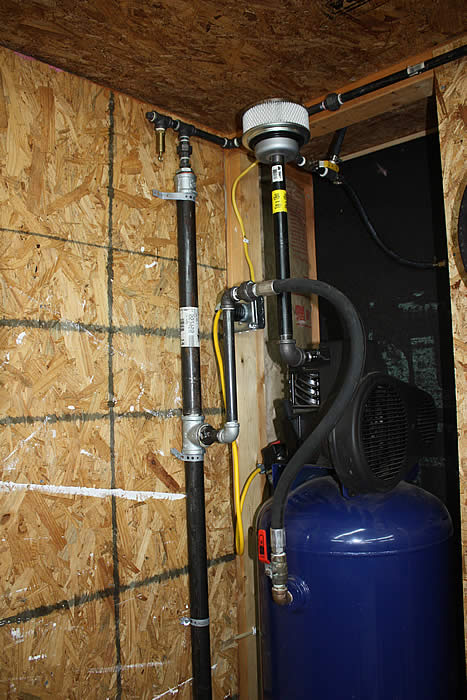
Right off the top of my dryer column I have a 175 PSI pop off. Gold thing on the left hand leg.
Air7.jpg
 
To avoid these ads, REGISTER NOW!

Durka

Well-known member
Joined
Mar 20, 2014
Messages
341
Location
Howell, MI
Same here with the 190 psi releases. I use 3 , 2 at the compressor, 1 on the header. Just in case I leave the system valve open.

Takes 6 minutes to fill my 80 gallon from 0. That would add up at the end of the month. So, I NEVER drain the air, but I keep the water drained....Religiously. :thumbup:
 

Durka

Well-known member
Joined
Mar 20, 2014
Messages
341
Location
Howell, MI
If this is by chance referring to the most recent thread of a the tank blowing on someone. There's way to much info missing to determine what actually happened IMO.

http://www.garagejournal.com/forum/showthread.php?t=242662

____________

Personally, I joined GJ just recently and this is the first tank I've seen that blew. I've always heard they can though, -in the past anyway. First time seeing.

I do wonder how that actually happened.
 

shooting4life

Well-known member
Joined
Nov 19, 2012
Messages
334
I test my pressure relief valve pretty regularly, maybe once a month, my compressor probably cycles 5-10 times a month at most. I have been meaning to add a secondary PRV just in case.
 

b-body-bob

Well-known member
Joined
Oct 10, 2011
Messages
1,621
Location
Almost Heaven
most of the violent failures seem to be of the smaller, lighter portable type compressors.

I doubt those small cheap tanks have the same safety certification standards that big tanks have. I know for sure that my portable tank has no certification on it.
 

wnstwolf

Well-known member
Joined
Nov 7, 2007
Messages
837
Location
New York and PA
This post has been up for a few hours and no one has even hinted at it...

Thisis why you use the forbidden PVC pipe...... Path of least resistance!

Ok not a solution but as with a few of the other posts I see this as the least likely thing in my barn that will hurt me. Taking myself out of the equation as that is the most dangerous tool in my garage I am more fearful of the paint and cleaners I have inflicted on my 45 year old soul as well as the fumes from welding. I know I am not alone when I say many, not all, of us do not wear any type of breathing mask when welding?
 

EOC_Jason

Well-known member
Joined
Jun 25, 2012
Messages
11,388
Location
Bentonville, AR
Extra pop-offs never hurt anything... I always like to check mine every now and then too...

I'm wondering though, there is a cheap piece of aluminum pipe that goes from the pump to the tank... I wonder what the burst strength of that is? I had to replace one on a friend's that cracked (replaced with copper and added a loop before going in the tank)...

From those horizontal pics of ones that burst, I would guess that the bottom just developed a rust line which eventually lead to failure. I'm just glad my old tank didn't do that... the pinhole leaks were enough of a wakeup call to stop using it.
 

Vegaman_Dan

Well-known member
Joined
Jun 1, 2012
Messages
2,453
Location
Pacific, WA
I see advice and concerns over pressure levels and tank integrity, but nobody has mentioned physical stabilization of the tank itself.

If you have a catastrophic event, a tall vertical tank is a very heavy object now pressurized and wanting to go someplace. I'd recommend a couple of chain tethers- one to a foot and one to the compressor head mounting brackets that then connect to the wall. You can use quick link disconnects if you need to move the compressor- mine is on casters so I can get easier access around it. If it does go off, a short length of chain top and bottom will keep it from tipping over or going crazy- assuming it doesn't rip out of the wall, at which point all bets are off.

Plus it looks cool. :)
 

big.jim

Well-known member
Joined
May 11, 2011
Messages
1,011
Location
derbyshire uk
just a thought but why the high pressures arent power tools rated at 90 psi normally , i run at 95-120 my cut in out pressures and my prv is set at 130
 

b-body-bob

Well-known member
Joined
Oct 10, 2011
Messages
1,621
Location
Almost Heaven
If you have a catastrophic event, a tall vertical tank is a very heavy object now pressurized and wanting to go someplace. I'd recommend a couple of chain tethers- one to a foot and one to the compressor head mounting brackets that then connect to the wall. You can use quick link disconnects if you need to move the compressor- mine is on casters so I can get easier access around it. If it does go off, a short length of chain top and bottom will keep it from tipping over or going crazy- assuming it doesn't rip out of the wall, at which point all bets are off.

Plus it looks cool. :)

If I had a compressor on wheels I'd tether it down too. I think mine would run away just from the vibration. :lol_hitti

There's a point where it just becomes paranoid behavior, and IMO chaining the tank to the wall is approaching that. If it blows to the extent that tethering it down is going to help, that wall doesn't stand a chance to begin with.

A friend of mine lost all his front teeth top and bottom when he was standing too close to the cage when inflating a split-ring wheel/tire that blew the ring off, and that was less than 90 psi and not a huge volume. Now imagine what's going to happen if an 80 gallon tank lets go at 150 or 175 psi.
 

teamextreme

Well-known member
Joined
Aug 10, 2013
Messages
867
Location
Lakewood, CO
I test my pressure relief valve pretty regularly, maybe once a month, my compressor probably cycles 5-10 times a month at most. I have been meaning to add a secondary PRV just in case.

How do you test the PRV? The only way to truly test one is to bring the pressure above the trip point and confirm it opens. Pulling the relief valve ring is not a test, if that's what you're doing. I don't know how you would pressurize the system to those levels to properly test.

As far as all the concerns about tanks exploding, I'm with the apparently small minority that have said this safety threat is so low I wouldn't even think once about it, nevermind twice. There are SOOOO many other things FAR more dangerous and worthy of addressing than the minute chance of a compressor exploding. As was already mentioned, you're statiscally way more apt to be killed driving to the store to buy parts to fix this hazard, than having the hazard harm you. Doesn't make sense to me :dunno:
 

Bsj04

Well-known member
Joined
May 28, 2012
Messages
194
Location
Aledo, TX
What's the best way(least messy) to drain the water from the tank when it's pressurized?

I have a 90* on the bottom of the tank, then short pipe to a ball valve but if you crack it open under pressure it blows nasty water all over the place. How are you guys going about it and catching the water rather then let it blow all over the wall and floor?
 

LS6 Tommy

Well-known member
Joined
Dec 27, 2013
Messages
26,162
Location
Northern NJ
What's the best way(least messy) to drain the water from the tank when it's pressurized?

I have a 90* on the bottom of the tank, then short pipe to a ball valve but if you crack it open under pressure it blows nasty water all over the place. How are you guys going about it and catching the water rather then let it blow all over the wall and floor?

I drilled a 1/4" hole in the center of the cap of a 1 gallon plastic washer fluid bottle and a bunch of smaller holes around it, pulled the "seal" out of it & put in a piece of thin cloth in & replaced the seal. The line from my blow down goes into the 1/4" hole. When I crack the blow down line ball valve it discharges into the bottle, but vents the air out through the holes...

Tommy
 

Durka

Well-known member
Joined
Mar 20, 2014
Messages
341
Location
Howell, MI
just a thought but why the high pressures arent power tools rated at 90 psi normally , i run at 95-120 my cut in out pressures and my prv is set at 130

More air, less cycles, less heat , is a +++ . Always keep the tank/header maxed, regulate at the station. When using anyway.

It's been said a few times, - this rarely happens.
 

sberry

Banned
Joined
Jun 18, 2005
Messages
35,747
Location
Brethren, Michigan
Both my units are plumbed together, makes for 2 valves. It cant hurt to pop them open to make sure they are not outright stuck for some reason, dirt dauber etc.
 

sberry

Banned
Joined
Jun 18, 2005
Messages
35,747
Location
Brethren, Michigan
What's the best way(least messy) to drain the water from the tank when it's pressurized?

I have a 90* on the bottom of the tank, then short pipe to a ball valve but if you crack it open under pressure it blows nasty water all over the place. How are you guys going about it and catching the water rather then let it blow all over the wall and floor?
I have some old rolled copper tubing, ran it thru the wall.
 

rlitman

Well-known member
Joined
Oct 18, 2010
Messages
24,591
Location
Long Island
I doubt those small cheap tanks have the same safety certification standards that big tanks have. I know for sure that my portable tank has no certification on it.


The big tanks have ASME certs, the small ones don't.

The end bells are the thickest part of the tank. The bottom is the part that rusts fastest (that's where the water is). So a horizontal tank corrodes on the thinnest part first (which would be any weld under cut on a seam near the bottom).

That's why I feel a lot safer with my big vertical tank.
 

rlitman

Well-known member
Joined
Oct 18, 2010
Messages
24,591
Location
Long Island
I would be reluctant to make that statement without verifying where the stress is in relation to endurance limit. It is true that ferrous and titanium alloys can be used under conditions with effectively no fatigue limit, but the mechanics of work hardening in the crystal structure absolutely apply to all metals, not just aluminum.


Not what I was saying. Aluminum fatigues under all dynamic conditions. I'm sure that if an airplane was skinned in steel of the right alloy, fatigue would be an issue. But compressor tanks are not built light enough to fly. They're mild steel, and quite overbuilt (even the cheap ones). Fatigue is NOT a problem. Feel free to prove me wrong. Good luck with that.
 
To avoid these ads, REGISTER NOW!
Top Bottom