To avoid these ads, REGISTER NOW!

Compressor - to drain or not drain?

For infrequent use... Purge empty and leave open OR keep filled and auto drain?


  • Total voters
    42
  • Poll closed .

Chris_Hamilton

Well-known member
Joined
Dec 2, 2012
Messages
1,023
Why in the world would you drain your tank of air if not using it for a period of days? What are you accomplishing? Drain (the water) it once a day when using it, if it will be some time before being in use again, drain it the following day after the last use and forget about it.
 
Last edited:
To avoid these ads, REGISTER NOW!

nadogail

Well-known member
Joined
Jan 23, 2009
Messages
31,894
Location
Coronado, CA
I try to remember to crack the drain valve and blow out any condensation after every day I use my compressor. If several days have passed since the last usage and there is pressure in the tank I will blow the condensation out of the tank before I charge the tank and again when I finish for the day.

My goal is to keep the tank as dry as possible while not spending a lot of electricity to recharge the system.
 

The Cobbler

Super Moderator
Staff member
Joined
Oct 24, 2013
Messages
25,802
Location
Niagara Region, Ontario, Canada
allow the tank to stay at atmospheric pressure during non-use, it will eventually be as dry inside as anything else in the shop - and I run a dehumidifier
I doubt your compressor will dry out very quickly by leaving it open to atmosphere . water vapour would evaporate, but it ( vapour) rises and would then condense again . no doubt eventually it would be at relative humidity , but I suspect it's a bit of a wait .
 

mikedodge

Well-known member
Joined
Jun 27, 2017
Messages
2,749
If I'm in the middle of a project and using the compressor daily I open the drain to let water out, shut it off and leave the air. If it won't be used for a while I drain it completely.
 
OP
I

Irondrgntp

Member
Joined
Jan 29, 2024
Messages
7
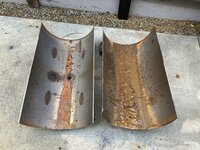
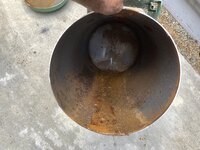
IMG_1585.jpegIMG_1584.jpegIMG_1583.jpegIMG_1582.jpegI have posted these before…20 yo Speedaire tank that got a pinhole. I drained this tank at the end of the day every time I charged it. Left some air and thought I was taking good care of it…
What are you saying then? It seems mostly everyone here with experience agrees that it makes no sense to purge the air every day. What was your procedure after use? Perhaps you charging it back up again each day created more moisture than if it was left filled the air would have been cooler and moisture easily purged once in awhile. I've definitely changed my perspective now.
 

MichaelP

Well-known member
Joined
Jul 27, 2009
Messages
904
Location
IL/WI border
Quincy 60 gal 5HP 2-stage compressor here. I have an auto drain that opens for 3-4 seconds a few times a day to keep the tank free of water. There is a 1/4" tubing that directs water outside.

I also installed a motorized ball valve at the compressor output and close it at the end of work session to prevent air leaks in lines. The compressor stays full for weeks if I don't use it (home workshop).

I also prefer to switch compressor power off if I'm going to be away for a while or don't need air next few days. This way if a major air leak happens (I don't know how, but I'm a "belt a suspenders" kind) , the motor is not going to run till it dies. The power switch is in my shop (actually, it's a quick disconnect, but it has no problem working in this capacity for the last 15 years or so. I just never switch it off while the motor is running to prevent contacts arcing).

The compressor is located in a garage next to my shop to make my environment less noisy. The motorized ball valve switch is installed in the workshop next to the quick disconnect for the motor, so I don't need to visit my compressor at all until it needs an oil change.

My shop is in a pretty humid wooded area. Since I need bone dry air for my plasma cutter, sandblasting, etc., I made a DIY air cooler run and draining lines arrangement described here: https://www.garagejournal.com/forum/threads/setting-up-air-dryer-filters.73032/#post-1040181. It works like a charm, and I never had a drop of water at the outlets or even in the filter-regulator located right after the cooling run.
 
Last edited:
OP
I

Irondrgntp

Member
Joined
Jan 29, 2024
Messages
7
I want you sincerely thank every single person here that has contributed and commented on my thread. The vast majority, and overwhelmingly positive response that favors leaving the tank filled and draining the water once in awhile, seems to be the consensus. I think I will forego the auto drain method and opt to just empty the water out when convenient. I was in fear of destroying my tank from the inside out, but it seems like I won't. Now, is the steel the same as it was years ago? Not sure. It's an Eaton / Polar Air which seems to be a pretty solid beast though. I think I will look into an air dryer/cooler for in between the tank and crankcase though... Even though it is overkill I'm sure. FYI, this is DIY garage stuff but I plan to do a lot of big cfm jobs and love the continuous air it provides. Also, to whoever it was that asked about my silicone heating pads on the crankcase underside.... Yes it gets below freezing in my uninsulated garage unfortunately during the winter and even fall/early spring sometimes. I'm up Northeast in the US.

Thanks so much everyone! Sincerely, I appreciate it.
 

johnre

Well-known member
Joined
Dec 1, 2016
Messages
1,040
Location
Portland, OR
I doubt your compressor will dry out very quickly by leaving it open to atmosphere . water vapour would evaporate, but it ( vapour) rises and would then condense again . no doubt eventually it would be at relative humidity , but I suspect it's a bit of a wait .
Agreed, drying out isn't that fast a process - but then closing off the petcock will guarantee that none escapes!

And the drain petcock is actually mounted on this panel, with a 3' whip leading up to the bottom drain point of the horizontal tank roughly 24" higher (you've seen this image over in the other thread where you helped me to get better situated on the switch ratings used for the motor starter). I made sure that no point of the hose forms a trap and the petcock is at the low point. It's therefore not as challenging, I think, to get it to evaporate compared to if were still on the bottom of the tank, oriented downward:

1713856570302.jpeg
 
Last edited:

larry4406

Well-known member
Joined
Jan 27, 2006
Messages
18,942
Location
Northern Virginia
I leave my 7.5HP 80 gallon vertical tank full charged, outlet valve closed, and unit turned off. I manually drain it periodically.

One day I want to install the tsunami moisture minder drain system.
 

demarpaint

Well-known member
Joined
Sep 17, 2010
Messages
1,237
Location
Long Island
Yes it gets below freezing in my uninsulated garage unfortunately during the winter and even fall/early spring sometimes. I'm up Northeast in the US.
That is precisely the reason I drain my 60 gallon tank during the winter months. If I lived where it didn't get to freezing I'd leave it charged all year. In any event I manually purge the water as I mentioned earlier. Having a second smaller compressor helps too, if I need to air up tires in the winter or use an air tool, the small compressor fits the bill. I use it, release the air and put it back during the winter. My wife asked why I don't sell the small compressor. My reply was for what I'd get for it, it pays to keep.
 

fomocoforrester

Well-known member
Joined
Jun 13, 2008
Messages
3,061
As tarmys post #36 above shows - the drain stub and weld extends into the tank so it can't completely drain anyway.

My solution was to buy a tank with an inspection plug (approx. 3") so I can check visualy every few years.
 

JradM

Well-known member
Joined
Sep 4, 2019
Messages
1,811
Location
Alberta
IMG_1585.jpegIMG_1584.jpegIMG_1583.jpegIMG_1582.jpegI have posted these before…20 yo Speedaire tank that got a pinhole. I drained this tank at the end of the day every time I charged it. Left some air and thought I was taking good care of it…

Is this bad? The cylinder walls though look pretty thick and I would have thought some surface rust inside a 20 year old tank would be normal.

Don't get me wrong - I appreciate that you had a pinhole leak and it was time to remove it from service. I'm wondering though whether most people wouldn't find their tanks looking visually very similar even after a few years of use, albeit without rust concentrating enough in one spot to cause a leak.

There's still lots of shiny un-rusted metal showing inside your tank after all, meaning some parts hadn't even begun to rust.
 

tarmy

Well-known member
Joined
May 28, 2014
Messages
4,645
Location
Nor Cal
What are you saying then? It seems mostly everyone here with experience agrees that it makes no sense to purge the air every day. What was your procedure after use? Perhaps you charging it back up again each day created more moisture than if it was left filled the air would have been cooler and moisture easily purged once in awhile. I've definitely changed my perspective now.
When done using I would drain it until it was not dribbling any more water drops/splatter. I assumed, correctly, that there was some (not a lot) moisture left in the remaining charge. Usually, there was about 30-40 psi left so I would close the valve. I did not restart the pressurization process, just left the residual. I cut that tank up outa curiosity mostly. After reading many threads, like this one, on numerous sites I had always wondered what the best solution was. I figured after 20 plus years my technique was as good as any.
 
Last edited:

tarmy

Well-known member
Joined
May 28, 2014
Messages
4,645
Location
Nor Cal
Is this bad? The cylinder walls though look pretty thick and I would have thought some surface rust inside a 20 year old tank would be normal.

Don't get me wrong - I appreciate that you had a pinhole leak and it was time to remove it from service. I'm wondering though whether most people wouldn't find their tanks looking visually very similar even after a few years of use, albeit without rust concentrating enough in one spot to cause a leak.

There's still lots of shiny un-rusted metal showing inside your tank after all, meaning some parts hadn't even begun to rust.
The pin hole, which I found was on the bottom in that muck. I cleaned up the area around it to see if the metal had deteriorated as a small hole or a larger area. I was not going to try to fix it…just was curious. As many have commented before, you could probably weld the hole but the area around the hole was compromised and the bomb affect would be achieved.
 

Chris_Hamilton

Well-known member
Joined
Dec 2, 2012
Messages
1,023
Current compressor in my home shop I've had for 9 years. For 5 of those years I worked a regular job and used the compressor in the evenings working on side jobs or my projects. I drained the water every day (when I used it). Last 4 years I have been working for myself out of my home shop. Drain the water every day. Never do I evac the air. Water that comes out is still crystal clear. So no sign of rust.

Previous place of employment was a Shop that I had originally started 20+ years ago. I purchased an IR 7.5 hp compressor for the Shop in 2001. When I closed up, another guy took over the Shop and the compressor stayed there. It was in hard use for 16 years. Day in, day out, running thousands of hours. I eventually ended up working at this Shop for yet another guy. We replaced the compressor I bought in 2001, in 2017. At the time of replacement condensated water still came out clear. If you drain the water regularly it's really a non issue IMO. And evac'ing the air each time only creates more condensated water when you turn it on and the air builds back up. The act of going from zero to 125 or 150 psi creates a lot of heat and a lot of water when it cools. It's really a case of taking two steps back trying to take a step forward.

If it's 6 months between use then evac'ing makes a little more sense. If it's a few days or a week then it really doesn't.
 

metalmagpie

Well-known member
Joined
Nov 1, 2011
Messages
796
Location
Seattle
I haven't noticed anyone commenting on the relatively new practice of building bucket high drain valves into vertical air tanks. By "bucket high" I mean you can comfortably slide a 5 gallon bucket under the valve. Behind the valve is a rubber dip tube that runs down to the floor of the tank. In the end of that dip tube is a pickup fitting that lies on the floor sideways. It has enough weight so it doesn't go anywhere.

The point is, for many of us it is much much easier to open a drain about knee high than it is to get down on the floor and open a valve at the bottom of the tank. (Yes, I know about extending the pipe and fitting a 1/4 turn ball valve you can flick open with your toe. I have nothing bad to say about that at all.)

Auto condensate drains are much cheaper today than they were 25 years ago. Bit fiddly to install but then they do a great job. I like the idea of routing the output from such a drain up the side of the tank and then over and down again for a short leg, so you can put a bucket underneath it. I have noticed that most of the time water that is ejected evaporates before the next water is ejected so I rarely have to empty the bucket.
 

Bmw4life

Well-known member
Joined
Apr 17, 2020
Messages
207
Location
Canada
I leave my 7.5HP 80 gallon vertical tank full charged, outlet valve closed, and unit turned off. I manually drain it periodically.

One day I want to install the tsunami moisture minder drain system.
I wonder if anyone tried these? Doesn't seem very expensive.
This seems similar


I don't have an outlet where my compressor is, so a drain that doesn't require electricity would be great!
 
To avoid these ads, REGISTER NOW!

WMichelsen

Well-known member
Joined
Nov 24, 2012
Messages
64
Just adding my behavior to the statistics:
I'm a home futzer with a vertical 80g. It has a copper drain pipe extension that probably holds 1-oz of water.
On average I use my air once a week, but it fluctuates wildly. It's always pressurized.
I'll purge the drain when I think the copper is 1/2 full, or more often if I'm in high use mode.
 

Bmw4life

Well-known member
Joined
Apr 17, 2020
Messages
207
Location
Canada
Do you just open it for a few seconds to let the water drain, and then close it back up?
 

Beerhippie

Well-known member
Joined
Oct 13, 2023
Messages
9,606
Location
Far NE Oregon
I understand the pneumatic drains, but I don't understand the other one you linked to .

1732511129521.png
It's float-operated, like a condensate trap in a steam system. In fact, it looks like it's repurposed from just that.

Problem with things like that, to me, are that they startle the holy F out of me when they go off at the wrong time. I lust use a ball vale on a 90 and kick it partially open every now and then during the day.
 

ER70S-2

Well-known member
Joined
Jan 2, 2015
Messages
796
Depressurizing the tank after use makes no sense at all. The inside of the tank is not going to magically dry just because there is no pressure in it. All you're doing is putting more wear and tear on everything and wasting time waiting for it to charge up. Leave that **** pressurized so it's ready to go when you need it. Drain the standing water in the tank at whatever frequency makes you feel good. There is always going to be moisture in the tank no matter what you do.
 

cannuck

Well-known member
Joined
Nov 30, 2021
Messages
4,590
Location
Rural SK
The pin hole, which I found was on the bottom in that muck. I cleaned up the area around it to see if the metal had deteriorated as a small hole or a larger area. I was not going to try to fix it…just was curious. As many have commented before, you could probably weld the hole but the area around the hole was compromised and the bomb affect would be achieved.
Corrosion is only as predictable as the metal it is working within. When you see a pinhole surrounded by relatively sound steel is suggests to me a slag inclusion from rolling at the mill (as opposed to roll forming at the manufacturing stage). "perfect" material would allow one to calculate lifespan vs. thickness, but realistically NO material is perfect.
 

dnschmidt

Well-known member
Joined
Oct 3, 2014
Messages
7,260
Location
Phoenix, AZ
I live in a desert so what do I know. I keep my Quincy filled 24/7 and I blow out whatever small amount of moisture is in it about once a week. I get about a couple of teaspoons out in less than 5 seconds when I do this. When you live in an area with 20% relative humidity where 40 degrees is about as low of a temperature as you'll ever see I think this is entirely adequate.
 

danielbuck

Well-known member
Joined
Apr 15, 2014
Messages
916
Depressurizing the tank after use makes no sense at all. The inside of the tank is not going to magically dry just because there is no pressure in it. All you're doing is putting more wear and tear on everything and wasting time waiting for it to charge up. Leave that **** pressurized so it's ready to go when you need it. Drain the standing water in the tank at whatever frequency makes you feel good. There is always going to be moisture in the tank no matter what you do.
that's what I've always done, leave it compressed.
 

rlitman

Well-known member
Joined
Oct 18, 2010
Messages
24,576
Location
Long Island
IMG_1583.jpegI have posted these before…20 yo Speedaire tank that got a pinhole. I drained this tank at the end of the day every time I charged it. Left some air and thought I was taking good care of it…

That exact scenario is what scares me about horizontal tank compressors. For aesthetics, the longitudinal weld is placed along the bottom, which is perpetually wet AND the weld itself has the likelihood of contributing to galvanic corrosion. That's how these tanks unzip and fail catastrophically. It's much less of an issue on vertical tanks.
 

Chris_Hamilton

Well-known member
Joined
Dec 2, 2012
Messages
1,023
Buy quality stuff. Make sure the tank has an ASME rating (or whatever it's called...been a long day) welded to it. Use it like normal. After "X" amount of years consider replacing the tank if your compressor is still going strong. Don't try to repair an old tank. Common sense type stuff. Draining the tank might make sense if you were using it only a few times a year, otherwise it doesn't. Like was said above, if you drain the tank because you are concerned about rust, how are you drying the inside of the tank? Because the residual moisture is what is going to cause the rust. If you are using and draining the tank daily or semi weekly, you are accomplishing nothing. The tank is going to have plenty of moisture inside it, the rust will continue to form. If one is that paranoid about a tank blowing then perhaps reconsider using compressed air.

Not trying to be an a-hole, but it's silly to me. The amount of compressed air tanks blowing up has got to be infinitesimal and I would hazard a guess that nearly every one has something that points to a clear defect that was noticeable well before they exploded. There was a video linked here several times showing a cheap portable compressor that blew. That compressor had poor prior repairs done to it. Pretty obvious that was going to be an issue at some point. Just seems silly to obsess over something that might happen that in reality almost never does.
 

Bmw4life

Well-known member
Joined
Apr 17, 2020
Messages
207
Location
Canada
I don't really see how a compressor can blow, unless you weld the pressure relieve valve shut...
Don't all these compressors come with a pressure release valve, where if pressure gets past a certain point, for example 150 psi, this emergency valve just opens?
Those videos on YouTube, do we know the pressure it took for them to explode?
 

ching0n

Well-known member
Joined
Jul 21, 2016
Messages
1,496
if you're in the desert or have an aluminum tank, don't bother. Otherwise drain. The rust will plug the autodrain eventually if you don't.
 
To avoid these ads, REGISTER NOW!
Top Bottom