dhill001
Member
Last fall I bought a compressor at auction.
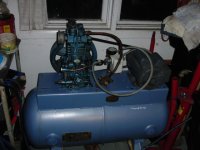
The pump is a Quincy 306 and the receiver was built in 1948 by the Pressed Steel Tank Company. This fall, I got working on it. I tried to hydrotest the receiver with a grease gun. No luck. But while struggling with that, I flashed on a plan to plumb in my pressure washer. That worked and the test started at 300 psig which leaked down overnight to about 260 psig. In a separate test the overpressure relief valve actuated at 175 psig.
I had to rewire the (1hp) motor from 240 VAC to 120 VAC. With no pressure in the tank, it pulls ~13 Amps. As the pressure and load increase, the current draw goes up to something over 20 amps with the receiver at 120psi when the pressure switch shuts off the motor power. Sometimes the branch circuit breaker opens first.
I think the pump has Quincy's control version "S". After some rework, it appears to function. There is a speed detection valve that cuts receiver pressure to the unloader towers when the pump is up to speed. There is a spring loaded check valve which applies receiver pressure over a certain value to the unloaders to shut down compression without shutting off the motor.
By fiddling with the continuous run check valve spring adjustment and the motor shutoff pressure switch, I can keep the current draw down to about 19.5 Amps. This is at the price of only pumping the receiver up to about 95 psig.
My questions are these:
1) how long should I trust this receiver before hydrotesting again?
2) my branch circuit breaker is 20 Amp. The house is 1960s construction and probably hasn't had electrical upgrades since. If I run this compressor hard and long, am I risking fire by overheating my house wiring? The line cord to the compressor gets warm but not hot. I know the National Electrical Code rules aren't arbitrary. They came about by people burning their buildings down. Should I trust that a 20 Amp breaker somebody installed in my panel means that I can pull 20 Amps through it forever? I don't want to burn my house, but I can't really see a $300 wiring upgrade to run a $50 compressor.
Before and after pictures:
The pump is a Quincy 306 and the receiver was built in 1948 by the Pressed Steel Tank Company. This fall, I got working on it. I tried to hydrotest the receiver with a grease gun. No luck. But while struggling with that, I flashed on a plan to plumb in my pressure washer. That worked and the test started at 300 psig which leaked down overnight to about 260 psig. In a separate test the overpressure relief valve actuated at 175 psig.
I had to rewire the (1hp) motor from 240 VAC to 120 VAC. With no pressure in the tank, it pulls ~13 Amps. As the pressure and load increase, the current draw goes up to something over 20 amps with the receiver at 120psi when the pressure switch shuts off the motor power. Sometimes the branch circuit breaker opens first.
I think the pump has Quincy's control version "S". After some rework, it appears to function. There is a speed detection valve that cuts receiver pressure to the unloader towers when the pump is up to speed. There is a spring loaded check valve which applies receiver pressure over a certain value to the unloaders to shut down compression without shutting off the motor.
By fiddling with the continuous run check valve spring adjustment and the motor shutoff pressure switch, I can keep the current draw down to about 19.5 Amps. This is at the price of only pumping the receiver up to about 95 psig.
My questions are these:
1) how long should I trust this receiver before hydrotesting again?
2) my branch circuit breaker is 20 Amp. The house is 1960s construction and probably hasn't had electrical upgrades since. If I run this compressor hard and long, am I risking fire by overheating my house wiring? The line cord to the compressor gets warm but not hot. I know the National Electrical Code rules aren't arbitrary. They came about by people burning their buildings down. Should I trust that a 20 Amp breaker somebody installed in my panel means that I can pull 20 Amps through it forever? I don't want to burn my house, but I can't really see a $300 wiring upgrade to run a $50 compressor.
Before and after pictures: