To avoid these ads, REGISTER NOW!

Compressors in series

Iridium rand

Well-known member
Joined
Sep 23, 2021
Messages
218
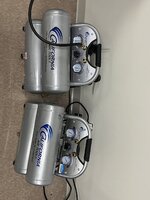
77B2E7EA-D8D6-400D-8422-03FCF3C1CF14.jpeg

looking for advice on what extra I can do with these besides using one alone as I have been. I have these two ultra quiet compessors working great, and a third that needs a small repair (different model numbers i know, only difference is two are 1.5hp, one is 2hp). they’ve stacked up to this point due to being treated as a part for one of our machines and are relatively often replaced for whatever reason, small repair etc. still functional or not

I have heard of connecting two tanks together in series but that it came with difficulty synchronizing the motors, wouldn’t the tank pressure drop evenly across all three pressure switches with all being the same model set to the same kick-on pressure and thus all of them would trigger at the same time? And are there any safety systems i have to worry to avoid bypassing in doing this? In any case would love to hear from anyone that has combined compressors or components and achieved a stronger and/ or higher capacity system from it’s components.
 
To avoid these ads, REGISTER NOW!

Firebrick43

Well-known member
Joined
May 12, 2015
Messages
13,971
Location
West central Indiana
You don't run them in series, you run them in parallel. Hook up the outputs to a Wye or Tee connections. If you do it in series, the second one is likely not to do much work

In industry, they run compressors in parallel all the time, never seen one in series
 

The Cobbler

Super Moderator
Staff member
Joined
Oct 24, 2013
Messages
25,802
Location
Niagara Region, Ontario, Canada
the issue you may have is some of the regulators may bleed air trying to adjust the pressure it's set to. it's best to use only 1 regulator & hook all the compressors before the regs.
 

Lucid Moments

Well-known member
Joined
Aug 9, 2015
Messages
1,775
Location
Gainesville, Ga
I saw a video on youtube a while back where a young girl (with her fathers help) ran a bunch of pancake compressors together. One thing I remember is that she had to change the settings on the pressure switches so that they didn't come on and off all together. That may have been to allow for electrical issues, I can't remember.
 
To avoid these ads, REGISTER NOW!

Firebrick43

Well-known member
Joined
May 12, 2015
Messages
13,971
Location
West central Indiana
I saw a video on youtube a while back where a young girl (with her fathers help) ran a bunch of pancake compressors together. One thing I remember is that she had to change the settings on the pressure switches so that they didn't come on and off all together. That may have been to allow for electrical issues, I can't remember.
Yea, in industry they have controllers set to start in an order. They won't start at the same time or the insurge amperage can trip main breakers.
 

Citation

Well-known member
Joined
Jan 20, 2016
Messages
3,209
Location
Indy
I would try simple first. I made a male-ball valve-male connector to connect two compressors together using a standard hose. Those CAT compressors peak at something like 120 psi so I would just turn the regulators up all the way. With my roofing compressor the regulator doesn't vent when I do that. Since those compressors have two sets of couplers, just run a hose from one to the other with the ball valve thing. That valve is just so you can disconnect the hose without venting a lot of air.

It would be best if the pressure switches are just a bit off each other so the motors come on at slightly different times. That will avoid all the motors starting at once causing a momentary voltage drop on the lines. Still, these aren't huge motors and all the compressors will be run on separate circuits (they will be right?).

This is easy enough to check. Fill the units then unplug them. Connect them. Drain the air slowly enough that you can tell when each compressor's pressure switch clicks. So long as the clicks are a few PSI apart that should be OK. Note that under light load this may mean that one pump fills both tanks. Under heavier loads, presumably, the first pump will turn on but still not quite keep up with the load and pressure will still drop. Then the second one kicks in. Something similar could happen when the tanks are about full. The first motor turns off. The second one needs to get a few PSI more to shut off. If the load is more than 1 pump can handle (but less than 2 can handle) then the shutting off of one pump will result in the second pump trying to do all the work. It won't keep up and will run continuously as pressure drops enough for the other pump to kick in. This is the sort of thing that would only happen if you ran a near continuous load that was right in the middle of what your two pumps could do (say your pumps are 4 cfm each, 8 cfm as a pair, and you run a 6 cfm load). In practice this seams really unlikely and typically you could avoid this issue by pausing to let the pressure rise so both pumps turn off.
 
To avoid these ads, REGISTER NOW!
Top Bottom