

subarctic_moose
Member
- Joined
- Sep 25, 2023
- Messages
- 11
Disclaimer: I take full responsibility for my current situation and the contractor did exactly what I was asking him to do.
After a few rough winters here in the Sierras and no garage on the property my wife and I are finally pulling the trigger on a 30x40x12 metal frame shop. It's being built to our snow load spec of 80psf and will have studs/trusses 24" OC to accommodate the loads. For the foundation, the plan was to first do a 8"x16" footer below frost depth of 18" and have a 24" stem wall on the perimeter, 6" above grade, with the exception of 18"/grade level at the doors. I was hoping to get this part done in the next month so the building could be constructed on a foundation when it's delivered end of October. The building will be delivered with the frame and roof and our plan is to mill up the siding and frame in the ends with vehicle/man doors next year and tie in a slab as well. My understanding is that this foundation type is typical in our area.
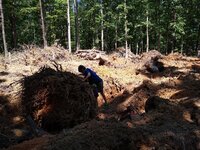
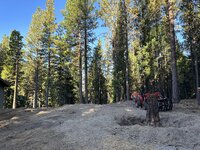
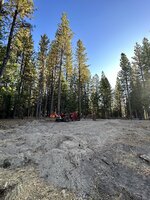
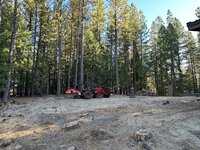
The shop will be in a flat area behind our house in a zone where I've had to drop a number of small and large pines to make room. I hired a local (and recommended) excavator to come out and handle the earth work. My very naive instructions were that we needed the stumps removed and a building pad leveled and graded for a shop. I also explained that because of this was for a foundation the stumps had to be completely dug out and not just ground down below grade. Using a medium sized tractor/backhoe they made pretty quick work of some of the smaller stumps but there were a few larger ones where they dug down about 24" and then cut the taproot below the root ball. There's also a 28" stump that's still standing as of now due to a massive taproot. It's one of the trees I cut down just a few weeks ago and is pretty fresh.
So here's where things have gone off the rails. After talking more with a neighbor, I realized I was woefully unaware of compaction requirements with organic material removal. I also did not think to have that conversation with the contractor to gauge his level of understanding of earth work specifically for foundation requirements. After removing each stump, they backfilled the holes with the surrounding dirt and graded over it. No base gravel, no compaction layers, nothing. I now have a nice looking pad with no way to tell where stumps were previously and what dirt is original or filled. I don't know if this is a big problem for the footers as those would be at a total depth of at least 24" and there were no stumps in their path. But in terms of a future slab, my understanding is that the whole area is now compromised.
Edit: Originally we were not going the permitted route as we have an ag exception in our zoning laws. But since we're already planning on having everything engineered and will be building to code regardless, we might as well (and maybe avoid these kinds of situations).
After a few rough winters here in the Sierras and no garage on the property my wife and I are finally pulling the trigger on a 30x40x12 metal frame shop. It's being built to our snow load spec of 80psf and will have studs/trusses 24" OC to accommodate the loads. For the foundation, the plan was to first do a 8"x16" footer below frost depth of 18" and have a 24" stem wall on the perimeter, 6" above grade, with the exception of 18"/grade level at the doors. I was hoping to get this part done in the next month so the building could be constructed on a foundation when it's delivered end of October. The building will be delivered with the frame and roof and our plan is to mill up the siding and frame in the ends with vehicle/man doors next year and tie in a slab as well. My understanding is that this foundation type is typical in our area.
The shop will be in a flat area behind our house in a zone where I've had to drop a number of small and large pines to make room. I hired a local (and recommended) excavator to come out and handle the earth work. My very naive instructions were that we needed the stumps removed and a building pad leveled and graded for a shop. I also explained that because of this was for a foundation the stumps had to be completely dug out and not just ground down below grade. Using a medium sized tractor/backhoe they made pretty quick work of some of the smaller stumps but there were a few larger ones where they dug down about 24" and then cut the taproot below the root ball. There's also a 28" stump that's still standing as of now due to a massive taproot. It's one of the trees I cut down just a few weeks ago and is pretty fresh.
So here's where things have gone off the rails. After talking more with a neighbor, I realized I was woefully unaware of compaction requirements with organic material removal. I also did not think to have that conversation with the contractor to gauge his level of understanding of earth work specifically for foundation requirements. After removing each stump, they backfilled the holes with the surrounding dirt and graded over it. No base gravel, no compaction layers, nothing. I now have a nice looking pad with no way to tell where stumps were previously and what dirt is original or filled. I don't know if this is a big problem for the footers as those would be at a total depth of at least 24" and there were no stumps in their path. But in terms of a future slab, my understanding is that the whole area is now compromised.
- What are our options at this point?
- How much dirt will have to be excavated and replaced now that fill dirt has been introduced?
- How much of a problem are we looking at if part of a tap root still exists below 24"?
- I'm thinking we'll need to delay delivery of our building to Spring and gut it out one more winter. Even if we can do the footers now, I'm guessing it would be horrendous to then have to try and remove large quantities of material inside the perimeter at a later time?
Edit: Originally we were not going the permitted route as we have an ag exception in our zoning laws. But since we're already planning on having everything engineered and will be building to code regardless, we might as well (and maybe avoid these kinds of situations).


 ) a ****, but….