To avoid these ads, REGISTER NOW!

Concrete alterations for lift

Dutch106

Well-known member
Joined
Apr 23, 2020
Messages
49
Location
North Carolina
Hey guys

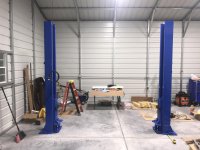
I’ve got a 2 post 10k lbs capacity lift that I’m going to be installing in my shop. Originally I had two 3ftx3ft squares poured deeper In my pad for this purpose, but unfortunately I cannot place the lift there as it will not give me the work room needed. I will be cutting two 4ftx4ft (manufacturer’s recommendation) squares where the lift posts will be going, and they will be 12in deep. I’ve got the general idea of it down but I’m still unsure of the details.

My current slab is 4in thick at 4000psi. Where the lift will be going I will use concrete that is 12in thick at a higher psi rating. Should I also use fiber reinforced concrete?

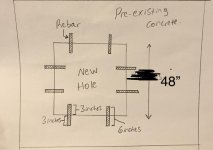
I have been advised to drill into the sides of the existing concrete and place rebar in the configuration shown in the attached picture. I am worried that drilling into the 4in concrete sideways may compromise the strength of it and may crack it.

Would it be a good idea to dig out under the existing concrete prior to pouring the new sections? I think this is known as underpinning.

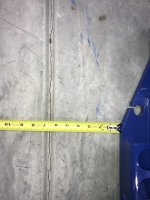
Where I will be pouring these sections is near a pre-existing control joint. In the attached pictures you will see where the final lift post positions will be. Should I bring the edge of the new sections to the control joint or overlap the control joint with the new sections thus eliminating a portion of the control joint?

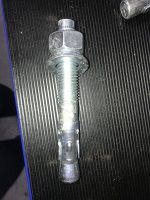
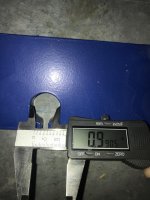
The lift comes with 5.5in Long by 3/4in wedge anchors. The holes in the baseplate of the lift columns measure closer to 1in. I’m think of using 1in diameter wedge anchors instead.

Thanks
 

Attachments

  • 0C12FE40-3622-464A-90DF-4DCCEF7C8F3C.jpg
    0C12FE40-3622-464A-90DF-4DCCEF7C8F3C.jpg
    71.8 KB · Views: 101
  • 2683A178-8735-4B1F-96C1-73FDE8FB5ACF.jpg
    2683A178-8735-4B1F-96C1-73FDE8FB5ACF.jpg
    103 KB · Views: 93
  • 296C46EF-0999-4A06-844E-948C1E91941A.jpg
    296C46EF-0999-4A06-844E-948C1E91941A.jpg
    96.7 KB · Views: 109
  • 7ECBD170-4876-43A7-B568-48E1D1FE27A8.jpg
    7ECBD170-4876-43A7-B568-48E1D1FE27A8.jpg
    147.2 KB · Views: 89
  • 9EFBAE50-CC3E-4A0B-9BB7-49383D948BE8.jpg
    9EFBAE50-CC3E-4A0B-9BB7-49383D948BE8.jpg
    88.9 KB · Views: 83
  • 1A9B4861-0052-4D1C-AAC9-BD9D184251C2.jpg
    1A9B4861-0052-4D1C-AAC9-BD9D184251C2.jpg
    90.3 KB · Views: 87
  • B2FDE1F2-1B53-4471-B8B9-06FC629C8781.jpg
    B2FDE1F2-1B53-4471-B8B9-06FC629C8781.jpg
    149.1 KB · Views: 109
To avoid these ads, REGISTER NOW!

kaymccampbell

Well-known member
Joined
Feb 27, 2015
Messages
29,481
Location
Upstate New York
Considering that you only have a 4" slab, which is basically a nice blanket to keep the dirt down, and although the manufacturer says that 4x4 is a big enough pad for the lift. Think of this. Would you set that lift on 2 4x4 pads in the open, and expect it to stay standing up with your biggest vehicle at full height? No. And pinning into a 4" slab won't get you much stability with a large vehicle, if you have it a bit off center, or pull the motor, or whatever unbalanced thing you do to it.
If it were me, I'd want the lift on a single pad a few feet wider than the lift, and at least half as long as the longest vehicle that will be on it. Big enough to resist tipping on its own.
 

CraigStu

Well-known member
Joined
May 22, 2014
Messages
4,023
Location
Blacksburg, Va
Rather than the rebar pins, a couple of friends just scooped out some of the gravel from under the existing slab all around the newly cut hole. This way the new concrete flowed under the edges of the old floor for 6-8 inches so it locked itself to the old floor. One laid some rebar that also went under the old floor for reinforcement. No one thought the rebar was needed, and he had to be careful of placement so it wouldn't interfere w/ bolts. But he already had it so he used it.
 

sjvicker

Well-known member
Joined
Aug 9, 2014
Messages
602
Location
SW Washington
There's no need to upsize your wedge anchors to 1". If you're looking for a better anchoring method, consider using threaded rod held in with epoxy.

Another note with the wedge anchors. Drill your holes through the slab until you hit dirt. This way in the future you can always drive them down into the ground if you want to remove your lift.

Sent from my SM-T560NU using The Garage Journal mobile app
 

StormcrowAz

Well-known member
Joined
Nov 3, 2011
Messages
750
Location
Phoenix, AZ
I had a lift put in after-the-fact and followed Mohawk recommendations of a singular section removed, spanning both columns. Dug down 12 inches below ground level, and rebar dowels epoxied in all around. I undercut the existing for good measure. I don’t think it was required but I didn’t think it would hurt, either. I did not have any issues with the dowel holes cracking out and my existing concrete was also about 4” thick. If I remember right, they also recommended the 4k psi concrete. I cut through a control joint, so didn’t have to worry about that.
mowhawk 1

mowhawk 2

mowhawk 3

20200517_090310
 

Tntundra13

Active member
Joined
May 2, 2015
Messages
34
Please see my comments below in red.

Hey guys

I’ve got a 2 post 10k lbs capacity lift that I’m going to be installing in my shop. Originally I had two 3ftx3ft squares poured deeper In my pad for this purpose, but unfortunately I cannot place the lift there as it will not give me the work room needed. I will be cutting two 4ftx4ft (manufacturer’s recommendation) squares where the lift posts will be going, and they will be 12in deep. I’ve got the general idea of it down but I’m still unsure of the details.

My current slab is 4in thick at 4000psi. Where the lift will be going I will use concrete that is 12in thick at a higher psi rating. Should I also use fiber reinforced concrete? 12" should be okay, but if you could do 18" that would be great. Also make sure to compact the soil, and if you could over excavate some and replace it with compacted 57 stone or ABC that would be great. Also I would recommend the use of rebar in lieu of fiber. In theory fiber is great if it is mixed 100% into your concrete, but that is not always the case.

I have been advised to drill into the sides of the existing concrete and place rebar in the configuration shown in the attached picture. I am worried that drilling into the 4in concrete sideways may compromise the strength of it and may crack it. If you were poring back another portion of slab I would recommend a similar method to what you have shown in your sketch. However what you are doing is placing a foundation for a piece of equipment that will take concentrated loads of both the lift and a vehicle. I would recommend not connecting your foundation in this case. I would actually recommend making a bond break between your slab and foundation by using expansion joint material.

Would it be a good idea to dig out under the existing concrete prior to pouring the new sections? I think this is known as underpinning. You can, but ideally you would leave the soil under the slab undisturbed as much as possible.

Where I will be pouring these sections is near a pre-existing control joint. In the attached pictures you will see where the final lift post positions will be. Should I bring the edge of the new sections to the control joint or overlap the control joint with the new sections thus eliminating a portion of the control joint? I would recommend cutting back to that tooled control joint. If not you will be left with a small portion of concrete between your footing and your control joint what will more than likely fail over time. Also if you could put in saw joints at the corners of your of you new footing that would help control cracking as well. Concrete loves to crack at sharp corners.

The lift comes with 5.5in Long by 3/4in wedge anchors. The holes in the baseplate of the lift columns measure closer to 1in. I’m think of using 1in diameter wedge anchors instead. I would think the 3/4" anchors would be fine. Since you are pouring your own foundation you could make a template out of wood that mirrors the base plate then cast all thread rods into your footing for anchoring.

Thanks
 
OP
D

Dutch106

Well-known member
Joined
Apr 23, 2020
Messages
49
Location
North Carolina
I had a lift put in after-the-fact and followed Mohawk recommendations of a singular section removed, spanning both columns. Dug down 12 inches below ground level, and rebar dowels epoxied in all around. I undercut the existing for good measure. I don’t think it was required but I didn’t think it would hurt, either. I did not have any issues with the dowel holes cracking out and my existing concrete was also about 4” thick. If I remember right, they also recommended the 4k psi concrete. I cut through a control joint, so didn’t have to worry about that.
mowhawk 1

mowhawk 2

mowhawk 3

20200517_090310

What diameter rebar did you use to insert into the pre-existing concrete? It looks as though I may also need to cut through a control joint. There is no issue in doing this correct?
 
OP
D

Dutch106

Well-known member
Joined
Apr 23, 2020
Messages
49
Location
North Carolina
Considering that you only have a 4" slab, which is basically a nice blanket to keep the dirt down, and although the manufacturer says that 4x4 is a big enough pad for the lift. Think of this. Would you set that lift on 2 4x4 pads in the open, and expect it to stay standing up with your biggest vehicle at full height? No. And pinning into a 4" slab won't get you much stability with a large vehicle, if you have it a bit off center, or pull the motor, or whatever unbalanced thing you do to it.
If it were me, I'd want the lift on a single pad a few feet wider than the lift, and at least half as long as the longest vehicle that will be on it. Big enough to resist tipping on its own.

The total width of the lift outside column to outside column is 137.5” so the slab would have to be a few feet wider on each side than that? Largest vehicle would be 21ft in length so the slab itself would have to be 10.5ft long? This seems like a lot
 
OP
D

Dutch106

Well-known member
Joined
Apr 23, 2020
Messages
49
Location
North Carolina
There's no need to upsize your wedge anchors to 1". If you're looking for a better anchoring method, consider using threaded rod held in with epoxy.

Another note with the wedge anchors. Drill your holes through the slab until you hit dirt. This way in the future you can always drive them down into the ground if you want to remove your lift.

Sent from my SM-T560NU using The Garage Journal mobile app

Will drilling all the way through the concrete into the dirt below (or gravel since my slab is over thick gravel) allow moisture to come in contact with the bottom of the wedge?
 
OP
D

Dutch106

Well-known member
Joined
Apr 23, 2020
Messages
49
Location
North Carolina
Please see my comments below in red.

18” below the 4”? Giving me a total of 22”of concrete? Or 18” concrete depth all together?

I would be inserting rebar vertically into the hole rather than horizontal so that I am not connecting the new concrete the existing slab? And insert the rebar deep enough so that it does not occupy the same depth as the anchors?

Would I essentially be making control cuts around the perimeter of the new pads so that they would be “separate” from the existing slab?

Would the saw cuts at each corner promote cracking that could eventually crack the surface of the slab?
 
Last edited:

matt_i

Well-known member
Joined
Mar 14, 2008
Messages
10,725
Location
SE Michigan
I would pin with something like #3 = 3/8" dia rebars. Its basically just to keep the top surfaces aligned.

Where there was no-load on the slab then it would be just fine without it, but were you to load it up with trucks, forklifts, (a vehicle lift), then the pins are a good idea in my opinion.

I would use the 3/4" or epoxy in some Grade B7 studs of 3/4" dia after repeatedly blowing and brushing out the hole. The move to 1" likely will cost you the ability to tweak the alignment ever so slightly, and then the choices are to start slotting the baseplate for the lift with a file or torch or tear out the concrete and start over.

A key thing would be letting the concrete cure for the ~28 days before you load the lift with a vehicle. if you apply curing sealer after the pour, you can expect even higher strength.

It might be good to saw at the control joint, the little piece could get chipped or broken and would be a very weak link in the pinning.

I'm not a fan of undercutting, concrete shrinks ever so slightly as it cures and so there's now a gap somewhere that previously had solid support. I have a 4 ft cube dug out of my shop floor currently, and it tapers from 48" at the top down to around ~42" at the bottom.
 
OP
D

Dutch106

Well-known member
Joined
Apr 23, 2020
Messages
49
Location
North Carolina
I would pin with something like #3 = 3/8" dia rebars. Its basically just to keep the top surfaces aligned.

Where there was no-load on the slab then it would be just fine without it, but were you to load it up with trucks, forklifts, (a vehicle lift), then the pins are a good idea in my opinion.

I would use the 3/4" or epoxy in some Grade B7 studs of 3/4" dia after repeatedly blowing and brushing out the hole. The move to 1" likely will cost you the ability to tweak the alignment ever so slightly, and then the choices are to start slotting the baseplate for the lift with a file or torch or tear out the concrete and start over.

A key thing would be letting the concrete cure for the ~28 days before you load the lift with a vehicle. if you apply curing sealer after the pour, you can expect even higher strength.

It might be good to saw at the control joint, the little piece could get chipped or broken and would be a very weak link in the pinning.

I'm not a fan of undercutting, concrete shrinks ever so slightly as it cures and so there's now a gap somewhere that previously had solid support. I have a 4 ft cube dug out of my shop floor currently, and it tapers from 48" at the top down to around ~42" at the bottom.

If I were to use the 3/4” wedge anchors, should they be longer than 5 1/2”?
Would it be a good idea to go around the perimeter of the new pads with a concrete edging tool? Wouldn’t this essentially give me small control joints surrounding the pads?
 

Attachments

  • 2EF5C3DF-6385-4397-B63E-7EA04FE0F928.jpg
    2EF5C3DF-6385-4397-B63E-7EA04FE0F928.jpg
    51.4 KB · Views: 41

kaymccampbell

Well-known member
Joined
Feb 27, 2015
Messages
29,481
Location
Upstate New York
The total width of the lift outside column to outside column is 137.5” so the slab would have to be a few feet wider on each side than that? Largest vehicle would be 21ft in length so the slab itself would have to be 10.5ft long? This seems like a lot

My in-floor , mid-rise, scissor lift slab is 5000 lb concrete and is just shy of the size you mentioned. It's not gonna twitch. I put full size pickups on it with impunity.
If you consider a couple extra yards of concrete a lot, what do you consider losing a vehicle, the lift and the floor the lift tears up, plus any ancillary building damage it does?
 

Walter_TA

Well-known member
Joined
Mar 11, 2017
Messages
191
I thought that the requirement for a lift was 4 inches of 3000 PSI concrete. Am I wrong?
 

firebirdparts

Well-known member
Joined
Jun 8, 2016
Messages
10,594
Location
Kingsport, TN
The total width of the lift outside column to outside column is 137.5” so the slab would have to be a few feet wider on each side than that? Largest vehicle would be 21ft in length so the slab itself would have to be 10.5ft long? This seems like a lot

Kay's right. Personally, I wouldn't want to pick up a 20 foot long vehicle with a 4 foot long shoe under it (I guess you were comfortable with 3, right?). However, it's not my lift. It's easy to for me to talk about how the lift actually works when mine is bolted to an entire building that weighs 100,000 pounds. I never had to deal with the temptation of putting it on two 4 x 4 slabs.
 
Last edited:

StormcrowAz

Well-known member
Joined
Nov 3, 2011
Messages
750
Location
Phoenix, AZ
What diameter rebar did you use to insert into the pre-existing concrete? It looks as though I may also need to cut through a control joint. There is no issue in doing this correct?

I followed the Mohawk instructions, looks like the same thing Road King linked above.

"#4 x 18 in long anchorage dowels spaced every 18" around perimeter of slab and/or use alternative key-ins"
 
To avoid these ads, REGISTER NOW!
OP
D

Dutch106

Well-known member
Joined
Apr 23, 2020
Messages
49
Location
North Carolina
I thought that the requirement for a lift was 4 inches of 3000 PSI concrete. Am I wrong?

These are the specs that the manufacturer says is the minimum requirement. Personally I do not trust this. And I’d rather not take the chance. If I’m not mistaken, when you drill into concrete the last 1/2” or so of concrete will break off? If the anchor grabs at 4” deep it will not have anything to grab correct?
 
Last edited:
OP
D

Dutch106

Well-known member
Joined
Apr 23, 2020
Messages
49
Location
North Carolina
My in-floor , mid-rise, scissor lift slab is 5000 lb concrete and is just shy of the size you mentioned. It's not gonna twitch. I put full size pickups on it with impunity.
If you consider a couple extra yards of concrete a lot, what do you consider losing a vehicle, the lift and the floor the lift tears up, plus any ancillary building damage it does?

How deep would this larger slab need to be? Surely not as deep as two individual footers since it spans such a large area
 

matt_i

Well-known member
Joined
Mar 14, 2008
Messages
10,725
Location
SE Michigan
If I were to use the 3/4” wedge anchors, should they be longer than 5 1/2”?
Would it be a good idea to go around the perimeter of the new pads with a concrete edging tool? Wouldn’t this essentially give me small control joints surrounding the pads?

I am not sure what's specified. I would use that unless you intend to use epoxied rods.

Also I would steel- trowel the concrete flush. The "control joints" are going to be there automatically due to the "cold joint".
 

matt_i

Well-known member
Joined
Mar 14, 2008
Messages
10,725
Location
SE Michigan
If I were to use the 3/4” wedge anchors, should they be longer than 5 1/2”?
Would it be a good idea to go around the perimeter of the new pads with a concrete edging tool? Wouldn’t this essentially give me small control joints surrounding the pads?

I would use the length recommended unless you are going with epoxied studs.

I don't think you will need to create control joints. it will be there already because of the "cold joint" with the old concrete. I would just steel trowel it flush.
 

WNYflyer

Well-known member
Joined
Sep 13, 2009
Messages
2,119
Location
Lockport, NY
Personally if I am cutting up the floor anyways I would be doing it similar to how Mohawk shows it on a single monolithic concrete foundations. Assuming the 2 lift columns see equal vertical loading then the overturning/tipping forces at the 2 lift column bases are essentially equal but in opposite directions. When the the column bases are connected on a common foundation those overturning/tipping forces can travel through the common foundation and basically cancel each other out and make for a quite stable foundation.

From my review of Mohawks recommendations it looks like they really know what they are talking about. Of course their recommendations look like the expensive versions but I am a do it once the right way and then not worry about it kind of guy. Keep in mind that I believe 2 post lifts with no structural bar across the top of the columns behave differently at the base than those with a structural bar across the top of the columns. I believe Mohawk lifts have no bar across the top and thus their foundation recommendations are based upon that type of lift. Regardless, both of those lift types have overturning/tipping forces at each of the 2 column bases that are essentially equal and opposite to each so mounting them on a common foundation allows for those forces to essentially counteract each other.
 

kaymccampbell

Well-known member
Joined
Feb 27, 2015
Messages
29,481
Location
Upstate New York
How deep would this larger slab need to be? Surely not as deep as two individual footers since it spans such a large area

Mine is about 7" thick with one layer of rebar. But it's under compressive load only. I would say if you did 8" of 4-5K lb concrete with a layer of #4 rebar, 8-12" on center, running through the middle of it, the thing should never fail. At least not in our lifetimes.
 

Jking24

Well-known member
Joined
Feb 27, 2018
Messages
258
These are the specs that the manufacturer says is the minimum requirement. Personally I do not trust this. And I’d rather not take the chance. If I’m not mistaken, when you drill into concrete the last 1/2” or so of concrete will break off? If the anchor grabs at 4” deep it will not have anything to grab correct?

I'm pretty sure the manufacture knew about that last half inch when they came up with the minimum standards. And no the anchor doesent grab at exactly 4" Your putting in a ton of effort and expense for basically no reason lifts are installed every day on four inch slabs with zero issues
 

mike93lx

ALLIANCE MEMBER
Joined
Dec 9, 2013
Messages
37,467
Location
Richmond, VA
I'm pretty sure the manufacture knew about that last half inch when they came up with the minimum standards. And no the anchor doesent grab at exactly 4" Your putting in a ton of effort and expense for basically no reason lifts are installed every day on four inch slabs with zero issues

I love people that think they can re-engineer engineered work based on hunches
 
OP
D

Dutch106

Well-known member
Joined
Apr 23, 2020
Messages
49
Location
North Carolina
I love people that think they can re-engineer engineered work based on hunches

Are you saying you feel confident in mounting a 2 post lift on 4inches of concrete? At this point I don’t know what to believe I’ve read all different kinds of opinions
 

Handyandy23

Well-known member
Joined
Nov 8, 2017
Messages
1,523
Location
Ontario, Canada
My 2 post 9000 lb lift has been mounted in 4" of concrete for 3 years now. It lifts my half ton truck regularly, had my Trans Am in the air for most of the winter, and I've had zero issues.

Even the "minimum" requirements for something like this have a pretty large safety factor calculated in. If the lags reach the proper torque then they have the proper grab, period. The instructions for mine say to check the torque periodically to make sure they are still holding properly.

Go nuts on going above and beyond if it makes you feel better, but if lifts were falling over after following the installation requirements set out in the manual, there would be a lot of lawsuits.
 
OP
D

Dutch106

Well-known member
Joined
Apr 23, 2020
Messages
49
Location
North Carolina
My 2 post 9000 lb lift has been mounted in 4" of concrete for 3 years now. It lifts my half ton truck regularly, had my Trans Am in the air for most of the winter, and I've had zero issues.

Even the "minimum" requirements for something like this have a pretty large safety factor calculated in. If the lags reach the proper torque then they have the proper grab, period. The instructions for mine say to check the torque periodically to make sure they are still holding properly.

Go nuts on going above and beyond if it makes you feel better, but if lifts were falling over after following the installation requirements set out in the manual, there would be a lot of lawsuits.

4in of concrete wouldn’t bother me so much if I only planned on lifting my cars and 1/2 ton trucks. But I do plan on lifting heavier vehicles such as 3/4 ton and 1ton trucks.
 

mike93lx

ALLIANCE MEMBER
Joined
Dec 9, 2013
Messages
37,467
Location
Richmond, VA
Are you saying you feel confident in mounting a 2 post lift on 4inches of concrete? At this point I don’t know what to believe I’ve read all different kinds of opinions

If that is what the manufacturer spec'd, yes I would be. If you trust them enough to stand under their lift with 6000 lbs above your head, you should trust their specs on the concrete
 

Handyandy23

Well-known member
Joined
Nov 8, 2017
Messages
1,523
Location
Ontario, Canada
4in of concrete wouldn’t bother me so much if I only planned on lifting my cars and 1/2 ton trucks. But I do plan on lifting heavier vehicles such as 3/4 ton and 1ton trucks.

It's still the manufacturer saying you only need 4" with anything up to the 10,000 lb it's rated for. The manual doesn't say "4 inches is fine, unless you lift a 3,/4 ton truck".

You can do more if it makes you feel better, but without doing or understanding any of the engineering that goes into that recommendation, you're just arbitrarily deciding a half ton 'seems fine with 4 inches' and a larger truck doesn't.

If that is what the manufacturer spec'd, yes I would be. If you trust them enough to stand under their lift with 6000 lbs above your head, you should trust their specs on the concrete

Exactly this. If the manufacturer isn't competent in their minimum concrete spec, then how can one feel confident using the lift at all? Seems strange to pick and choose what parts of the owner's manual you trust and which parts you don't.

I'm not trying to sound like a smart-@$$, but it's difficult to decide on what kind of base is "good enough" when the manual tells you, but you don't believe it. Aside from people relaying what minimum requirements their particular lifts had, the answers from anyone else is a complete guess as much as just pulling a number out of the air.
 

Jking24

Well-known member
Joined
Feb 27, 2018
Messages
258
4in of concrete wouldn’t bother me so much if I only planned on lifting my cars and 1/2 ton trucks. But I do plan on lifting heavier vehicles such as 3/4 ton and 1ton trucks.

I have a 8000 pound lift on a 3.5 inch slab that if i had to guess was framed with a 2x3. The lift manufacture recommended a minimum of 3" i have had every bit of that 8000 on the lift and some very unbalanced loads with no issues whatsoever. I frequently lift crew cab Longbed 4x4 ford powerstrokes. People completely talk out of their *** on these forums with their 8 and 12" recommendations. 4" is perfectly fine and done every day the manufacture came up with their minimum requirements using a buffer or safety margin. The bottom line is if you put your anchors in and they torque up to spec your good to go
 

wondo

Active member
Joined
Nov 20, 2010
Messages
28
Location
Fowlerville, MI
Totally unnecessary. Unless you cut out a section much later than you plan and pin it to the existing slab it will be less stable than using what you already have.
 

Mowerpan

Well-known member
Joined
Jun 21, 2005
Messages
116
Location
Sarasota, FL
I worked at a large Chevrolet dealership and all of lifts were installed on 4" concrete and only a few lifts needed a new section re-poured due to cracking around where the lifts mounted but the original floor was over 25 years old as well. We lifted 3/4 and 1 ton trucks regularly on these 10K lifts. I would have no concerns about mounting a lift to 4" floor especially in a homeowner garage that sees little use.
 

ericm

Well-known member
Joined
Apr 17, 2016
Messages
1,963
Location
Southern Oregon
I'm having a hard time seeing how a lift manufacturer can be competent to build a lift but not to specify the concrete under it.
 
To avoid these ads, REGISTER NOW!
Top Bottom