To avoid these ads, REGISTER NOW!

concrete block wall grout

inphx

Well-known member
Joined
Feb 23, 2012
Messages
1,273
Location
Phoenix/Scottsdale AZ
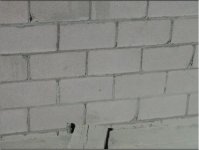
I had a retaining wall built. There are portions of the wall which will be exposed at the top of the stem. The contractor did a poor job an aesthetics and detail on grout. They defend the work as structurally to spec and it passes inspections.

Anyway - so i am wanting to find something like an auto body file to clean up the work. And maybe topically regrout a few courses.

Is there any "right" tool that i can use to sand off excess and get some uniformity that has a chance of durability lasting 80 linear feet by 8' high?

Thanks in advance!

attachment.php
 

Attachments

  • 11-4-2013 1-36-13 AM.jpg
    11-4-2013 1-36-13 AM.jpg
    12 KB · Views: 233
To avoid these ads, REGISTER NOW!

brickG-man

Well-known member
Joined
Jul 31, 2011
Messages
134
Location
Chicagoland
It's mortar, not grout.

Hammer & Chisel.

Mason's hammer (Skutch Hammer)

This is true, it is mortar not grout. As a third generation and 40 year Bricklayer/Stonemason I can tell you that is very poor quality work. First of all, any exposed work should be tooled or struck. Typically a concave joint but there are various types of joints that can be used for the finished product. That aside, all joints should be free of voids of which this work certainly is not. I have seen the inside of elevator shafts or walls that were going to be covered with ceramic tile look better than this. It does not take that long to strike or tool the work if exposure is in question.

Now as far as a remedy if they are not coming back to fix this. Yes, you could use a hammer and chisel however a grinder would be easier and faster. If the wall is fairly new the joints should grind out easily. A 4" angle grinder will work just fine but be careful that it doesn't wander on you or you will cut into the block and end up with a bigger mess than you have now. Carborundum blades should work on this so no need to spend the money on a diamond blade if you don't have one. You only need to grind it back to a depth of about 3/8" to 1/2". Then repoint the joint using a trowel or hawk and a 3/8" or 1/2" backfilling trowel or sometimes called a Tuckpointer. Not to be confused with a pointing trowel. If you really don't feel like grinding a pointing (or don't feel like you should be fixing somebody else's work) another alternative might be to get a piece of 1/2" threaded rod or "all thread" cut it off to maybe 24" to 28", bend a small hook or handle on each end and run it through the joints kind of like a file. This will give you a concave joint but certainly won't fill in any voids. That you will still have to point in with mortar. If you go with the threaded rod route, ideally painting the wall with some block filler could hide some of the sins. I would only try any of these options after I called the contractor to come and fix it or tear it down and rebuild it, that is if you haven't paid him yet.
Good luck.
 
To avoid these ads, REGISTER NOW!

Jagmandave

Well-known member
Joined
Nov 6, 2011
Messages
6,299
Location
Overland Park, Ks.
How about a nice couple of coats of stucco? As long as the wall is structurally sound, it will look nice and last a very long time.

I agree with brickG-man tho, that's terrible workmanship....I built a short block retaining wall that I was going to coat with stucco and even then I did a better job on the joints than they did.
 
OP
I

inphx

Well-known member
Joined
Feb 23, 2012
Messages
1,273
Location
Phoenix/Scottsdale AZ
brickG - thank you so much for taking the time to give your assessment and corrective options. I shared the body of your message with my architecht who recommended the mason and it found its way intact to that individual. It was "cosmetically" corrected by a team who did some scraping / gouging and then packed mortor into all the joints so it visually looks clean. Unsure of the bond or longevity - but it hid that messy work.

I do also have a follow up question - the retaining wall seems to be filled with "mortor" while some older pre-existing retaining walls seem to be filled with Concrete. When i drilled for a utility it was easier to do here verses a wall in place for 10 years.

The wall was inspected by an engineer 2x and the city 3x and passess. Any concerns about the fill being mortar vs concrete?
 

Milton Shaw

Well-known member
Joined
Feb 11, 2011
Messages
4,835
Concrete is a lot stronger than mortar and should have been what was used. Even concrete needs to have rebar in the cores and either rebar or zigzag wire in the layers as the wall comes up to keep it together over the years. Sounds like you will be in for problems in the future with the way that wall was built. How tall and did the wall get back filled with gravel or dirt and did they put drainage in that fill to keep water pressure down. To late to get anything from the original contractor but watch that wall and be especially careful when you have a heavy downpour for a day or so.
 
To avoid these ads, REGISTER NOW!
Top Bottom