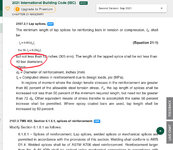
You sure about that? 5 diameters for #6 rebar is less than 4”.
That's what the inspector said he wanted, so he got that as a minimum.
Not one inspector I have spoken with will provide clarity on how a single piece of rebar, that is 20' or less, can be 20' continuous in the footing, then turned up thru the footing and future slab (not part of the 20'), all while still being continuous, and somehow actually becoming longer than 20', to enable the acorn nut (a junction) to be accessible. Can't be done unless the bars are spliced (lapped/welded, ?)
Embedding the acorn nut (a junction) in the concrete makes it non-accessible.
We have to provide a mud ring in the drywall covered framed wall to provide access to the acorn nut junction of copper to rebar.
This is why I think the rebar method is flawed and the AHJ's just look the other way.
I prefer the copper wire method given a choice with enough extra length to run fully to the panel (no splice) and therefore no mud ring needed since the junction is inside the panel and is accessible.
@cliffcharb - take and retain detailed pictures of your copper wire ground installation with tape measure in field of view prior to your pour. I did for my barn and at final the inspector was asking where the rebar and acorn nut were and I had posted my pictures of the copper wire installation. The inspector had to call his supervisor to accept the copper wire (he was used to seeing the rebar method).