To avoid these ads, REGISTER NOW!

Concrete Experts - Give Me Your Opinion

GlennSullivan

Well-known member
Joined
Mar 15, 2006
Messages
342
Location
Yorktown, NY
A few years back we bought a second home in a warm winter climate. The garage is a plain old 2 car attached type with an uncoated floor. In this warm climate it gets fairly hot in there in the summer and warm in the winter.

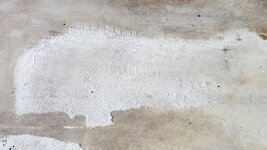
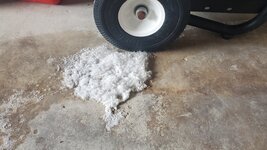
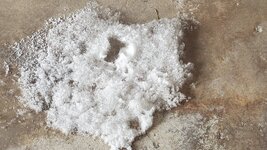
Last winter I noticed a white powder on the floor, didn't think much of it, swept it up and moved on. Recently when we went there, more powder and when cleaning it up it appears the concrete is turning to powder.

What is happening to this concrete, why is it happening and how do I stop it? Thanks in advance!

20241023_110806.jpg

20241023_110822.jpg

20241023_110829.jpg
 
To avoid these ads, REGISTER NOW!

lmg

Well-known member
Joined
Mar 17, 2023
Messages
97
Based on where you are, this appears to be from deicing products dripping from your car. They are usually or always containing salts. If allowed to soak into the concrete, the water will evaporate, allowing the salts to again form crystals. When the crystals reform, they create pressure internal to the concrete, and the top of the slab is likely to spall off. What you are seeing is the salt which did not penetrate. Perhaps none penetrated due to a sealer previously installed.

You may want to consider installing a sealer on the slab.

There are threads here on concrete sealers, including boiled linseed oil. Myself, I am partial to the boiled linseed oil. It definitely has to be boiled, and applied correctly.
 

ConCretin

Well-known member
Joined
Jan 20, 2011
Messages
3,379
Location
Central Maine
You indicated that this garage is in a warm winter climate, correct? if so, it's not probably not related to de-icing products, which generally result in spalling rather than dust.

Normally a slab that produces dust is exhibiting a condition know not surprisingly as 'dusting'. This results from excessive water in the surface layer during placement, which lowers the water cement ration and decreases concrete strength to a point that the surface abrades under normal use producing dust.

Your pics would suggest an extreme case and I'm not sure that's what your are experiencing. How old is the slab? Is there water present or some other condition that is causing the dust to collect?
 
Last edited:

Treeman

Well-known member
Joined
Jan 4, 2008
Messages
548
Location
Michigan
To me, it looks like concrete efflorescence. Google it. "https://www.nitterhousemasonry.com/blog/what-is-efflorescence/

"Efflorescence is a crystalline deposit of salts that can form when water is present in or on brick, concrete, stone, stucco or other building surfaces. It has a white or greyish tint and consists of salt deposits that remain on the surface after water evaporates. In addition, efflorescence can appear as a powdery substance on floors and walls and requires special care to treat."
 

ConCretin

Well-known member
Joined
Jan 20, 2011
Messages
3,379
Location
Central Maine
To me, it looks like concrete efflorescence.
Good call Treeman. You could be right. It does look more like salt than powdered concrete. If so, it's a serious case of it. Something seems to be causing the powder to collect in specific areas. If there's a lot of water present in the garage that could bolster your case. Maybe the OP can provide more info.
 
OP
G

GlennSullivan

Well-known member
Joined
Mar 15, 2006
Messages
342
Location
Yorktown, NY
To provide some additional info and answer your questions above.

House is in South East Florida. Hot, humid environment 7 months a year. No concern of winter environment.

The house is not used much in the May - Oct period, so "fresh air" is introduced during that period.

It is built in 1994 by others, so I don't know and can't find out the history of the pour.

The "dust is definitely coming up out of the slab as I can see where the surface is pot marking at these points.

Another thing I just noticed based on LMG's comment, it the problem seems to be only happening in one of the 2 bays, the one where a vehicle is usually parked.

We have owned the house for a number of years, and don't remember seeing this, or at least it was not as big of an issue as it is now.
 
Last edited:

ConCretin

Well-known member
Joined
Jan 20, 2011
Messages
3,379
Location
Central Maine
Can moisture under or behind concrete "push" the salts to the surface?
Yea, that's basically how it works. Dissolved minerals in the concrete are dragged to the surface as water passes through and are left there when the moisture evaporates. From the pics it sure looks like there is water pooling on the top of the slab as well.

Solving the problem is pretty diificult. Obviously it's too late to install an under slab vapor barrier. It might be possible to reduce the moisture under the slab if there are external sources that can be diverted with improved drainage. Otherwise the only option I know of is a chemical vapor barrier applied to the slab surface.

The good news is that either dusting or efflorescence are a nuisance but shouldn't affect the long term serviceability of the floor. The only slight concern I have is the OP's comment about pock marking. If it's dusting caused by excessive water, the weak concrete could go deeper than just the surface paste. In any case, there's not much to be done about it but wait and see what happens.
 
Last edited:

ConCretin

Well-known member
Joined
Jan 20, 2011
Messages
3,379
Location
Central Maine
Another thing I just noticed based on LMG's comment, it the problem seems to be only happening in one of the 2 bays, the one where a vehicle is usually parked.
Presumably the car is parked after being outside in the rain on occasion? This could explain how the powder is being collected up in specific areas. Is there any chance this material is being tracked in by the car?

Another reason for the issue being localized in one bay might just be that this concrete sees more wear by being driven on, which would suggest dusting although if I'm honest, it doesn't look like concrete dust to me.

I'm not sure if you could visually tell the difference between powdered cement paste and dissolved salts but that would provide your answer and a start on how to proceed.
 
OP
G

GlennSullivan

Well-known member
Joined
Mar 15, 2006
Messages
342
Location
Yorktown, NY
Presumably the car is parked after being outside in the rain on occasion? This could explain how the powder is being collected up in specific areas? This bay would also have more wear on the surface from being driven on as well.

I'm not sure if you could visually tell the difference between powdered cement paste and dissolved salts but that would provide your answer and a start on how to proceed.
Well for sure the vehicle is parked in there after being driven in the rain - it is the tropics and it rains a lot. Possibly the wet combined with the underside heat generated from the cars hot exhaust and drivetrain is contributing?

The staining on the floor which looks like liquid stains, is from an issue when we first purchased the house of the HVAC air handler - located in the garage behind the vehicle - bay not draining properly (condensate pipe clogging). That was resolved years ago and any remaining stains are just that, stains, not wet. I do not remember seeing the floor dust problem during the period of the problem.

I'll take some closeup pics today and post later.
 
OP
G

GlennSullivan

Well-known member
Joined
Mar 15, 2006
Messages
342
Location
Yorktown, NY
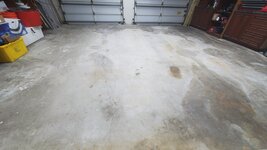
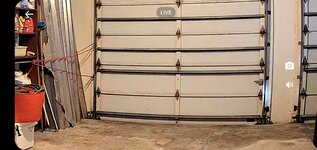
Here is a pic of both sides. The left - in the camera view which is actually right garage bay has no dusting issue. As you can also see, this was not installed well and has no expansion joint, so it made its own.

Another thought I had after it was mentioned above, is the previous owner was a fisherman and when we were looking at the house his boat sitting on its trailer was parked in the bay with the issues. Maybe he was lazy a few times or few dozen times and put the boat in the garage right after it came out of the salt water without washing it off and letting it dry. The community we are in has a boat ramp about 50' from our house.

But again, this problem did not exist when we bought the house. Maybe the salt impregnated in the floor was reactivated by me pulling in a wet hot truck or by leaving the doors closed for months at a time in the FL summer.

In any case, anyone have an idea how I can arrest the deterioration now? Long term plan (sometime next year) would be to gut the garage, redo the floor and install new cabinets - all the existing are used stuff he pulled out of peoples houses.

Thanks again for your time and input.

20241108_135031.jpg

Here are closeups of the worst areas.

20241108_135102.jpg

20241108_135215.jpg
 
Last edited:

Fav Onefour

Well-known member
Joined
Jul 14, 2022
Messages
725
Location
MN cold and hot
I wish I could say wow.
Unfortunately, I saw similar damage on a relatively young slab. It is a radiant slab over vapor barrier. My damage was from winter street salt coming off the cars. My wife's car dropped buckets of slop and the marks were most pronounced under that car.
The powder looks similar, and the concrete skin damage looks virtually identical. In may case, I could see the drop and run flow pattern of salt slop and melting. Washing down the floor helped slow down the powder until the next winter. The surface peeling was another story. The worst areas were right around the slop drop areas and the open surface skin seemed to let more into the concrete.
In my case, I also knew the damage source.
Salt is brutal.

@GlennSullivan , You mention being 50' from a ramp. Is it salt water? With the right conditions, there is a lot of salt in the air. Is it possible that the vehicles are bringing in more salt with light rains?
It may be helpful to at least confirm or rule out salt. How about testing the powder with one of those salt water pool test kits?

BTW, is the first picture in post #11 looks like the door thresholds are well below your pad. Am I seeing it correctly? It would be an odd configuration. I'm wondering if there is a reason?
 
OP
G

GlennSullivan

Well-known member
Joined
Mar 15, 2006
Messages
342
Location
Yorktown, NY
I wish I could say wow.
Unfortunately, I saw similar damage on a relatively young slab. It is a radiant slab over vapor barrier. My damage was from winter street salt coming off the cars. My wife's car dropped buckets of slop and the marks were most pronounced under that car.
The powder looks similar, and the concrete skin damage looks virtually identical. In may case, I could see the drop and run flow pattern of salt slop and melting. Washing down the floor helped slow down the powder until the next winter. The surface peeling was another story. The worst areas were right around the slop drop areas and the open surface skin seemed to let more into the concrete.
In my case, I also knew the damage source.
Salt is brutal.

@GlennSullivan , You mention being 50' from a ramp. Is it salt water? With the right conditions, there is a lot of salt in the air. Is it possible that the vehicles are bringing in more salt with light rains?
It may be helpful to at least confirm or rule out salt. How about testing the powder with one of those salt water pool test kits?

BTW, is the first picture in post #11 looks like the door thresholds are well below your pad. Am I seeing it correctly? It would be an odd configuration. I'm wondering if there is a reason?
Excellent idea of taking some of the powder, mixing with fresh water and using the pool test kit to do a saline test. This will tell a lot!!

Yes, the boat ramp is on a salt water creek, leading to a section of Loxahatchee River which empties into the Atlantic. Total distance from ramp to ocean inlet by water is approx 3.5 miles. I do not have a boat so my vehicles do not use the ramp and I don't drive past it, however, neighbors that use must drive by my house so their vehicles, trailers and boats can be leaving salt water on the road in front of my house. Not sure how much accumulates as the ramp is not heavily used and it rains alot in south Florida. The road is pitched toward the ramp, so rain will wash the road into the ramp.

The garage door thresholds have about a 1.25" 1.5" step in them which transitions the driveway to the garage door floor. The doors close onto the outer / lower section and provide a good / tight water and animal seal, I wish I had this in my big garage.

What are you doing or did you do to resolve your problem.

I have a disk style surface washer attachment that I can use to do the garage floor without getting the entire garage and everything in it soaked. Will prolly do that as a first step, unless someone can suggest a chemical that can be rolled or squeegeed on and washed off that will treat it better.


Garage Floor Door Closed.jpg

1732909503547.png
 

48windsor

Well-known member
Joined
Jan 24, 2013
Messages
407
Location
Olympia ,Wa.
You indicated that this garage is in a warm winter climate, correct? if so, it's not probably not related to de-icing products, which generally result in spalling rather than dust.

Normally a slab that produces dust is exhibiting a condition know not surprisingly as 'dusting'. This results from excessive water in the surface layer during placement, which lowers the water cement ration and decreases concrete strength to a point that the surface abrades under normal use producing dust.

Your pics would suggest an extreme case and I'm not sure that's what your are experiencing. How old is the slab? Is there water present or some other condition that is causing the dust to collect?
Expert- ex that is a has been
spurt - that is a drip under pressure
 
To avoid these ads, REGISTER NOW!

Fav Onefour

Well-known member
Joined
Jul 14, 2022
Messages
725
Location
MN cold and hot
I mentioned the proximity to salt water because of how much is in the air near water. Machinery etc. rust faster and you can feel the film on items sitting in the salt air. You may be seeing some wash down off vehicles with light rain. That could be adding to whatever came off the previous owners boat?

High concentration salt buildup does some goofy stuff. Throw softener salt crystals on a concrete floor in high humidity. Drops will form around the salt. I keep some partial bags in plastic pails during the summer. It's common to have quite a bit of liquid brine in the pail during high humidity. Your floor may even be doing cycles of condensation - drying and creating crystals during the drying process. If you have salt concentration, the floor may feel slimy when it's wet.

Maybe you are lucky and it is just salt built up over the years. It may be a lot and well into the concrete.

In my case, it was a only few years worth of salt buildup. I vacuumed the pad and did a few scrubbing rounds. I used a shop vac to **** up the last bit of moisture and anything else each round. I let it dry completely in between scrubbing rounds to verify there was no residue coming up. I honestly thought it was good after the second round until it dried completely. I still had some crystals so I kept going.

I may have been over diligent but my long term plan was to use a good sealer. I didn't want to seal anything into the concrete.
In the end, I found a guy that did coatings as a side gig. His main job was resurfacing parking ramps in our climate. I figured his advice was worth a shot.
I ended up with a heavy grind on the entire pad and top coated using a high solid epoxy and al. oxide for abrasion. I'm not a huge fan of the top coat, but it is fantastic at preventing salt and slop from seeping through. I'm a big fan of that aspect. I'm able to rinse the floor during the season and do not see residual crystal formation.
 

john.k

Well-known member
Joined
Jun 4, 2024
Messages
1,200
Location
Brisbane Qld Australia
Is the land reclaimed coastal swamp/pumped marine sand? ...there may be a high salt content in the soil ,and its being lifted by a raised water table
 

KenC

Well-known member
Joined
Dec 20, 2009
Messages
2,598
Location
oklahoma
I would first examine the exterior water drainage and flow directions. Because it appears to me to be water born salts from below as others have stated. When that happens, about the only cure is to mitigate the water. Stop runoff from pooling next to the foundation, install exterior drains, route gutter runoff far away from the house etc.
 
OP
G

GlennSullivan

Well-known member
Joined
Mar 15, 2006
Messages
342
Location
Yorktown, NY
Is the land reclaimed coastal swamp/pumped marine sand? ...there may be a high salt content in the soil ,and its being lifted by a raised water table
The land wasn’t created / reclaimed, but from what I’ve learned owning property in FL for 10 years, a) the entire state was at the bottom of the ocean at some point in the past and b) every development in FL starts as some level / type of beach or swamp.
 
OP
G

GlennSullivan

Well-known member
Joined
Mar 15, 2006
Messages
342
Location
Yorktown, NY
I would first examine the exterior water drainage and flow directions. Because it appears to me to be water born salts from below as others have stated. When that happens, about the only cure is to mitigate the water. Stop runoff from pooling next to the foundation, install exterior drains, route gutter runoff far away from the house etc.
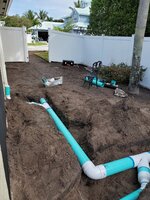
2 Years ago, I redid all of the drainage around the house. New 7” gutters with toppers and 8 oversized downspouts each feeding into individual 4” underground drainage pipes collecting into a 6” main pipe. I’m certain the current drainage around the house is good. What damage might have been caused in the past by all downspouts dumping next to the slab I can’t say.


1732928876741.jpeg
 
OP
G

GlennSullivan

Well-known member
Joined
Mar 15, 2006
Messages
342
Location
Yorktown, NY
**UPDATE**
Finally got back to this house and we vacuumed and then pressure washed the entire garage floor, vacuuming up any residual water when done. No vehicles have been in the garage since the cleaning.

48 Hours later the pictures below are what we saw. this is not powder, but very light fibrous material - like cotton candy, but lighter and not sticky. Any thoughts of what this is, considering the additional information?

20241217_133454.jpg

20241217_133448.jpg

20241217_133642.jpg

20241217_133525.jpg

20241217_133602.jpg
 

Attachments

  • 20241217_133548.jpg
    20241217_133548.jpg
    160.2 KB · Views: 1
Last edited:

Fav Onefour

Well-known member
Joined
Jul 14, 2022
Messages
725
Location
MN cold and hot
Oh wow, that does not look like any type of salt formation that I've had. Bummer deal, I had hopes to help narrow down the culprit.
I'm off the answer path but sure interested to see where it goes.
 
OP
G

GlennSullivan

Well-known member
Joined
Mar 15, 2006
Messages
342
Location
Yorktown, NY
Well, after doing some research, it appears this is, in fact effloresce as some of you indicated above. It does appear to not be as widespread after the pressure washing with the surface washer yesterday.

In searching this subject on search engines, there are dozens of different approaches to tackling / resolving this, what say you guys?
 

JohnC1957

Well-known member
Joined
Mar 19, 2022
Messages
84
It’s efflorescence caused by water in the concrete leaving deposits on the surface as it pushes up and dries. That’s as bad as I’ve seen it and I’m a GC. My experience is that any film product just disintegrates as it has nothing to stick to. It’s not from vehicle salt as that degrades the surface and dusts. Something is pushing water through that slab.
 
OP
G

GlennSullivan

Well-known member
Joined
Mar 15, 2006
Messages
342
Location
Yorktown, NY
It’s efflorescence caused by water in the concrete leaving deposits on the surface as it pushes up and dries. That’s as bad as I’ve seen it and I’m a GC. My experience is that any film product just disintegrates as it has nothing to stick to. It’s not from vehicle salt as that degrades the surface and dusts. Something is pushing water through that slab.
Being that it is near the water and in a very high water table area, that's certainly possible. What can I do about it, other than hammering up the garage floor slab, putting down a moisture barrier and re-pouring it?
 

JohnC1957

Well-known member
Joined
Mar 19, 2022
Messages
84
Being that it is near the water and in a very high water table area, that's certainly possible. What can I do about it, other than hammering up the garage floor slab, putting down a moisture barrier and re-pouring it?
My experience for residential that It happened primarily on substandard or damaged concrete on a floor slab. It would come through a patched trench that had been cut for utility repair and repoured, while the surrounding existing concrete was okay. Walls are a different story. It seems like the PSI of the poured concrete has an effect as someone once told me 4000 and above was immune. That was only hearsay so I can't stand behind it but it seems logical.
Someone who knows more than I do about coatings may have a better idea than I do. I would wet mop it , vacuum and stiff brush, and try one of the products that sinks in and supposedly waterproofs the concrete. They' I've used it on brick work etc, but never on a slab. Might be worth a shot. Xypex is one product. I have never had this happen on any concrete that I poured so it was always an existing problem and the options were replace or live with it.
 

Treeman

Well-known member
Joined
Jan 4, 2008
Messages
548
Location
Michigan
It’s efflorescence caused by water in the concrete leaving deposits on the surface as it pushes up and dries. That’s as bad as I’ve seen it and I’m a GC. My experience is that any film product just disintegrates as it has nothing to stick to. It’s not from vehicle salt as that degrades the surface and dusts. Something is pushing water through that slab.
My VERY quick and dirty internet search seems to lead to your conclusion. You have to eliminate the source of water pushing the sulfates up to the surface. One site suggests that only sealing the surface can cause the efflorescence to continue forming underneath the surface and cause spalling.

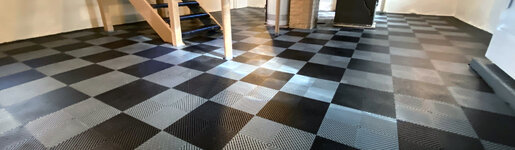
What about putting the flow thru garage floor tiles down and rinse away the efflorescence several times a year?
1734568285504.jpeg1734568378661.jpeg
 
Last edited:

1949 caddyman

Well-known member
Joined
Oct 5, 2010
Messages
1,778
Location
Arizona
In arid Arizona we had this problem on a patio covered with a cool deck product that was painted & sealed the concrete. The efflorescence lifted the cool deck in spots. The fix for us was to put travertine pavers over the patio.
 

C-S-H

Well-known member
Joined
Jan 18, 2024
Messages
145
What is happening to this concrete, why is it happening and how do I stop it?
I would guess that water dripping off your cars is drawing efflorescence to the surface. (Mostly calcium hydroxide. Test it with some vinegar)

It is happening because your concrete did not have a pozzolan in the mix, and had high water/cement ratio.

It is too late for some fly ash or slag, but the silicate densifiers will react with the Ca(OH)2 near the surface. See post #12 above.
 
To avoid these ads, REGISTER NOW!
Top Bottom