You are using an out of date browser. It may not display this or other websites correctly.
You should upgrade or use an alternative browser.
You should upgrade or use an alternative browser.
concrete floor issues
- Thread starter davey25
- Start date


LegacyIndustrial
ALLIANCE MEMBER
Did that water start bubbling out of the hole or did you wet it?
LegacyIndustrial
ALLIANCE MEMBER
Ok. Not sure why they are popping like that. We have the material to repair but before you get busy, may want to tap the floor a bit and see if it's anywhere else.
Tap around with a hammer, lightly. If there is more weakness, you will hear it. Will sound hollow.
Tap around with a hammer, lightly. If there is more weakness, you will hear it. Will sound hollow.
possibly spalling from de-icing salt / freeze thaw damage.
If you live in the rust belt you are bringing the salt into the garage on the undercarriage, wheelwells etc. which then drip off and soak into the floor the water freeze then pops the surface.. this is common if you don't heat the space or exterior walks & driveway exposed to de-icing agents.
Air entrained concrete helps control this sort of damage
the next best thing is a quality concrete curing / sealing compound that dries to clear matte or gloss finish. This film protects the surface from water intrusion / salt damage.
If you live in the rust belt you are bringing the salt into the garage on the undercarriage, wheelwells etc. which then drip off and soak into the floor the water freeze then pops the surface.. this is common if you don't heat the space or exterior walks & driveway exposed to de-icing agents.
Air entrained concrete helps control this sort of damage
the next best thing is a quality concrete curing / sealing compound that dries to clear matte or gloss finish. This film protects the surface from water intrusion / salt damage.
Last edited:
The first winter it was heated occasionally. . The second it was heated full time. . No vehicles in or out during winter.. my other garage though is unheated and the vehicle are parked in there with salt and such of the roads. . Floors are excellent except right where the overhead door opens there is large very shallow pieces broken. . Probably Spalling if I had to guess
LegacyIndustrial
ALLIANCE MEMBER
Davey:
If you need help with products to patch and help protect for the future, here you go...
Repair: http://www.legacyindustrial.net/products/concrete-repair/hd-110-epoxy-concrete-patch.html
Seal: http://www.legacyindustrial.net/products/concrete-sealers/hd6600-mma-concrete-sealer.html
If you need help with products to patch and help protect for the future, here you go...
Repair: http://www.legacyindustrial.net/products/concrete-repair/hd-110-epoxy-concrete-patch.html
Seal: http://www.legacyindustrial.net/products/concrete-sealers/hd6600-mma-concrete-sealer.html
LegacyIndustrial
ALLIANCE MEMBER
Good article!
FRITZ OHIO
Well-known member
Sometimes the slag used in a concrete mix can cause such problems. Best mix contains limestone, but in some parts of the country, mill slag is used. For some reason, mill slag tends to come to the surface later. We have neighbors in our area of NE Ohio that have driveways that have so many popups that they have to sweep the slag off the surface, leaving a rough surface. When I built my last home, I had a blacktop drive set low and placed interlocking paver bricks on top of the black top. Pavers are made of high pressure concentration and seldom if ever give a problem. If a paver should fail, you just pull it up and replace it! Unfortunately such a driveway is very expensive but sure looks good!
For indoors, you do not often see concrete pop, but it can do so, especially in an unheated garage. I do a lot of construction and always specify at least a 6-sack or 6.5 sack mix and order it air entrained and pour it 6" in depth, along with rebar reinforcement. I also pay extra to add micro fibers to help hold it together. Some try to save money and buy 5-sack cement and in my opinion this is a bad move. I recommend paying a little more with a quality supplier when it comes to cement.
If you look closely at the pop-ups can you see any small stone (some times blue or black) or evidence of something like that? That might indicate mill slag or other impurities in the mix. Also, sometimes too much water is added when pouring the cement to get it to level out faster. This is also a bad move, as the cement will be stronger if excess water is not added. After the concrete is finished, we usually apply a liquid sealer to keep the surface smooth and clean.
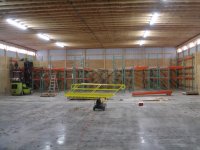
Attached picture shows one of our buildings where the floor was sealed. We recently completed this 60' x 96' garage and added speed racks at one end for more storage. So far, have not yet finished organizing our warehouse, but will be doing so soon. We use a numbering system with metal signs around the perimeter of most of our buildings, and later develop an index (by location number) in alphabetical order. This helps us locate whatever is stored in our buildings.
My accountant once told me that "there is nothing like a clean and well-organized warehouse for proper inventory control". I find this to be very true.
Fred
For indoors, you do not often see concrete pop, but it can do so, especially in an unheated garage. I do a lot of construction and always specify at least a 6-sack or 6.5 sack mix and order it air entrained and pour it 6" in depth, along with rebar reinforcement. I also pay extra to add micro fibers to help hold it together. Some try to save money and buy 5-sack cement and in my opinion this is a bad move. I recommend paying a little more with a quality supplier when it comes to cement.
If you look closely at the pop-ups can you see any small stone (some times blue or black) or evidence of something like that? That might indicate mill slag or other impurities in the mix. Also, sometimes too much water is added when pouring the cement to get it to level out faster. This is also a bad move, as the cement will be stronger if excess water is not added. After the concrete is finished, we usually apply a liquid sealer to keep the surface smooth and clean.
Attached picture shows one of our buildings where the floor was sealed. We recently completed this 60' x 96' garage and added speed racks at one end for more storage. So far, have not yet finished organizing our warehouse, but will be doing so soon. We use a numbering system with metal signs around the perimeter of most of our buildings, and later develop an index (by location number) in alphabetical order. This helps us locate whatever is stored in our buildings.
My accountant once told me that "there is nothing like a clean and well-organized warehouse for proper inventory control". I find this to be very true.
Fred
Attachments
ConCretin
Well-known member
You don't say where you are from, but there are various materials around the country that can cause the pop ups you are experiencing. Lignite coal often finds it's way into the fine aggregates used to make concrete in some parts of the country.
Ask your concrete supplier about this.
Ask your concrete supplier about this.
FRITZ OHIO
Well-known member
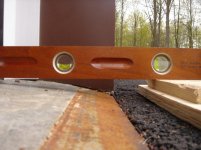
Here are some pictures showing how we handle the overhead door openings, with concrete poured first and finished floor level at the inside edge of overhead jamb, with concrete sloping from that point to the outside edge of overhead door jamb. The drop in this example is about 1.5" in the 12" width of the door jamb.
As mentioned previously, we use a heavy angle iron across the outside edge of the concrete to minimize damage to the edge of the concrete. In the photo, our blacktop butts up to this angle iron and then continues to slope so that water is directed away from the building. We never install our overhead doors until concrete has been poured and cured for a few days. We always have a tight fit across the bottom and never any leakage. We also set certain "ground rules" for our door installers to accomplish this.
Another thing that we use on our overhead doors that are often not suggested by the door companies are "high rise tracks". Normally the tracks turn at a 90 degree angle just above the top of the door opening. We run our overhead door tracks up just under the bar joists where they turn. Reason: Forklifts can easily catch these tracks if installed in conventional way. The difference in cost is minimal.
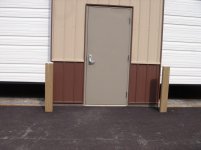
Another picture shows our man door with the heavy metal posts at each corner of the overhead doors (saves a lot of damage). Last picture shows our water detention pond that was required by the EPA. Water from both buildings drains into this pond and slowly goes into a catch basin where the water flow is reduced from an 8" pipe to a 3" opening. This allows the water to flow slowly out of the pond to the property line so as not to flood neighbor's land. Lots of these are required in our area and engineering drawings are required.
Fred
As mentioned previously, we use a heavy angle iron across the outside edge of the concrete to minimize damage to the edge of the concrete. In the photo, our blacktop butts up to this angle iron and then continues to slope so that water is directed away from the building. We never install our overhead doors until concrete has been poured and cured for a few days. We always have a tight fit across the bottom and never any leakage. We also set certain "ground rules" for our door installers to accomplish this.
Another thing that we use on our overhead doors that are often not suggested by the door companies are "high rise tracks". Normally the tracks turn at a 90 degree angle just above the top of the door opening. We run our overhead door tracks up just under the bar joists where they turn. Reason: Forklifts can easily catch these tracks if installed in conventional way. The difference in cost is minimal.
Another picture shows our man door with the heavy metal posts at each corner of the overhead doors (saves a lot of damage). Last picture shows our water detention pond that was required by the EPA. Water from both buildings drains into this pond and slowly goes into a catch basin where the water flow is reduced from an 8" pipe to a 3" opening. This allows the water to flow slowly out of the pond to the property line so as not to flood neighbor's land. Lots of these are required in our area and engineering drawings are required.
Fred