To avoid these ads, REGISTER NOW!

Concrete Pad for 2 Post Lift Question

moparkid440

Active member
Joined
Jul 29, 2012
Messages
35
Location
Bowie, MD
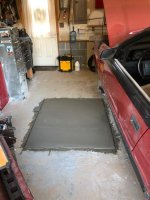
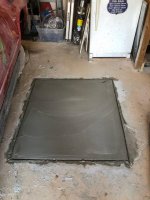
I'm installing a MoHawk 9klb 2 post lift, using the exact anchors the company says to use and above minimum requirments.

Mohawk requires minimum of 3000 psi concrete (I used 4000 psi) at least 12" deep (Mine is 16") and enough space around the pad that the Anchors are at least 6" away from the edge of the pad (mine are 10" away)

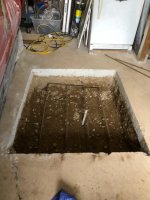
I did put 1/2" Rebar in there ( welded to a large 1" or 1.25" thick piece of rebar pounded about 3 feet into the ground (pic below). Mohawk does "recommend" to attach that rebar to the existing foundation which I didn't do (realized it afterwards). I did everything above Mohawk minimum except their rebar "recommendation" into the foundation. A very experienced concrete guy said it won't make a difference as far as safety (since the pads are much larger and deeper than required anyway). Most lift manufacturers don't REQUIRE rebar in the concrete anyway . My existing pad is 5" thick. I've heard of people NOT tieing real thick pads into much thinner existing concrete anyway because the surrounding existing pad is much thinner.

Anyway...Yes I know that it would have been BETTER to tie in the rebar to existing........yes I know it would have been stronger. Yes I know all that but it's too late obviously. All I'm looking for is opinions on if anyone thinks that's a major safety issue when the lift is installed on the pads that I have. Thanks alot.
 

Attachments

  • 18248.jpeg
    18248.jpeg
    84.3 KB · Views: 91
  • 18249.jpeg
    18249.jpeg
    58.2 KB · Views: 91
  • 18269.jpg
    18269.jpg
    87.3 KB · Views: 86
  • 18270.jpg
    18270.jpg
    88.5 KB · Views: 71
To avoid these ads, REGISTER NOW!

rattle_snake

Well-known member
Joined
Jun 25, 2015
Messages
5,181
Location
Chandler, AZ
5" slab left alone would have been enough. Mohawk has highest requirements compared to all others.
What you don't want is your new pad to tilt when lift loads it to the center of vehicle, hence tying it into the existing slab with rebar. Another option is to dig out under existing a few inches to allow the new pour to interlock better.

IMO, I'd be concerned with the new pour. I think it is worse than before. But that is just my opinion. See what others have to say.

If new pad(s) are big and heavy enough not to need any other support, tie-in is not needed.
 

WNYflyer

Well-known member
Joined
Sep 13, 2009
Messages
2,119
Location
Lockport, NY
Is this a new Mohawk lift ? Reason I ask I do not see a 9000# capacity unit in there line-up, at least showing up online.

Looks like their current foundation recommendations for their current two-post lifts when the existing concrete floor slab is inadequate is cutting out the existing floor slab and pouring one new foundation that is continuous across from post to post. From your photos it looks like you have poured foundations at each individual post. Where did the recommendation for the size of the individual foundations come from ? Mohawk installation manual or something similar?

If you purchased a used lift then I would contact Mohawk and clarify with them all the new foundation requirements for you particular lift.

Oh, and don't trust what your experienced concrete guy has to say about the size of the foundations.
 

WNYflyer

Well-known member
Joined
Sep 13, 2009
Messages
2,119
Location
Lockport, NY
I'm sorry. My error. It is the A7 7k lb capacity not 9k. Sorry

For the A-7 It looks like if the existing slab is inadequate and therefore you need to cut it out for one new foundation then it is supposed to be 4'x 12'x a minimum of 12" thick per the Mohawk table in the attached link, see pages 3, 4 & 5. Page 5 in particular gives you the lay-out for two-post lifts. Of course that foundation should be centered in both directions on the entire assembled two-post lift.

From you photos is doesn't look like you have that big a foundation poured. With the correct 4' x 12' foundation I doubt keying or doweling into the existing slab is taken into account by the Mohawk engineers when they calculated the required foundation size. Perhaps they did it for other reasons such belt and suspenders, hiding visible movement at the foundation/slab joint, etc. Who knows, regardless call Mohawk directly with any questions, clarifications or doubts you have on the new foundation requirements.

https://mohawklifts.com/library/specs/Slab_Requirements.pdf
 
Last edited:
OP
M

moparkid440

Active member
Joined
Jul 29, 2012
Messages
35
Location
Bowie, MD
Yes you're right. It is inadequate. I should have poured a long slab. I will be digging out and pouring new concrete in the middle of the two slabs I poured, essentially connecting the two slabs, making one long slab.
 
To avoid these ads, REGISTER NOW!

WNYflyer

Well-known member
Joined
Sep 13, 2009
Messages
2,119
Location
Lockport, NY
Yes you're right. It is inadequate. I should have poured a long slab. I will be digging out and pouring new concrete in the middle of the two slabs I poured, essentially connecting the two slabs, making one long slab.

The Mohawk foundation requirement is one continuous monolithic concrete foundation. Re-reusing the foundations you already poured and pouring a new foundation between those two and doweling/connecting everything together is most likely not going to give the same strength as one continuous monolithic foundation.

Yes an engineer maybe able to figure out the required doweling/connecting to replicate a continuous monolithic foundation but that would be more effort than it is worth for something like this.

Mohawk wants a continuous monolithic foundation which means no joints (construction, control, etc.) of any kind in the 4'x12' ? foundation.
 

ConCretin

Well-known member
Joined
Jan 20, 2011
Messages
3,378
Location
Central Maine
Good grief. Do not remove what you have already placed just to install a new 'monolithic' footing. I wouldn't even bother connecting the two footings you have already placed but if you must, just drill and epoxy a few bars top and bottom to connect everything together and place some concrete. A construction joint won't make any difference at all.
 
To avoid these ads, REGISTER NOW!
Top Bottom