To avoid these ads, REGISTER NOW!

Concrete prep for ts210

happyj

Well-known member
Joined
Aug 22, 2013
Messages
56
Location
Belfair, Wa
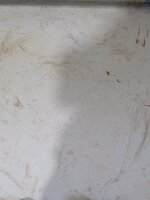
I am planning to put down TS210, the concrete was poured three months before the building was installed. So it has what I assume are stains from leaves sitting on the surface. I pressure washed it, tried scrubbing with vinegar, hydrogen peroxide, dawn, simple green and other cleaners. That may have lightened some of them up a little. So before I apply over the top of them I thought I'd ask if I should rent a machine to scrub it. Two pictures add one which shows one of the spots and the second one which shows the spot after scrapping with a putty knife.
Any thoughts would be appreciated.
I don't really mind the look so could just cover over them.
Thanks in advance
 
To avoid these ads, REGISTER NOW!
OP
H

happyj

Well-known member
Joined
Aug 22, 2013
Messages
56
Location
Belfair, Wa
I forgot to mention when scrapping the spot a fine white powder come up as the stain is scrapped. I suspect that is Efflorescence

?
 

ericm

Well-known member
Joined
Apr 17, 2016
Messages
1,963
Location
Southern Oregon
Your pics didn't show up.

I'd suggest calling Concrete Sealers USA's support line but I had a poor experience with that. I got the worst sort of know it all who lectured me on how burnished concrete doesn't exist (their web site mentions it in a number of places and it's become a common term even if that guy doesn't like it) and then read me the information they have on line that I'd already read. Maybe there's more than one person who answers the phone there but I'm really hesitant to call them again.
 
OP
H

happyj

Well-known member
Joined
Aug 22, 2013
Messages
56
Location
Belfair, Wa
I am planning to put down TS210, the concrete was poured three months before the building was installed. So it has what I assume are stains from leaves sitting on the surface. I pressure washed it, tried scrubbing with vinegar, hydrogen peroxide, dawn, simple green and other cleaners. That may have lightened some of them up a little. So before I apply over the top of them I thought I'd ask if I should rent a machine to scrub it. Two pictures add one which shows one of the spots and the second one which shows the spot after scrapping with a putty knife.
Any thoughts would be appreciated.
I don't really mind the look so could just cover over them.
Thanks in advance

Your pics didn't show up.

I'd suggest calling Concrete Sealers USA's support line but I had a poor experience with that. I got the worst sort of know it all who lectured me on how burnished concrete doesn't exist (their web site mentions it in a number of places and it's become a common term even if that guy doesn't like it) and then read me the information they have on line that I'd already read. Maybe there's more than one person who answers the phone there but I'm really hesitant to call them again.
Thanks, I had the same experience, I was basically told to read all the stuff I had already been through as well as informed they deal with LARGE jobs > 1 million square feet multiple times during a single conversation. I had already ordered the product and think it will do what I need but if I had not already purchased I would have found a different company.
Files attached now also
 

Attachments

  • markup_1000001568.jpg
    markup_1000001568.jpg
    907.5 KB · Views: 12
  • markup_1000001569.jpg
    markup_1000001569.jpg
    742 KB · Views: 9

Shea

Well-known member
Joined
Sep 19, 2012
Messages
2,866
Location
California
I am planning to put down TS210, the concrete was poured three months before the building was installed. So it has what I assume are stains from leaves sitting on the surface. I pressure washed it, tried scrubbing with vinegar, hydrogen peroxide, dawn, simple green and other cleaners. That may have lightened some of them up a little. So before I apply over the top of them I thought I'd ask if I should rent a machine to scrub it. Two pictures add one which shows one of the spots and the second one which shows the spot after scrapping with a putty knife.
Any thoughts would be appreciated.
I don't really mind the look so could just cover over them.
Thanks in advance
The pics almost look like the surface is painted (I know it's not). Particularly with all the brown marks, lines, and smudges. I can't tell if that's dirt or something else. Is the surface showing signs of efflorescence only where you cleaned, or can you scrape up white powder in other areas?
 

ConCretin

Well-known member
Joined
Jan 20, 2011
Messages
3,378
Location
Central Maine
I forgot to mention when scrapping the spot a fine white powder come up as the stain is scrapped. I suspect that is Efflorescence?
I agree with Shea in that the surface appears off but I doubt it's efflorescence, which is dissolved salts being deposited on the surface by moisture moving through the concrete. and then evaporating.

The surface of the slab looks chalky and there seem to be a lot of scratches and abrasions. if a fine white powder came up when you scraped it, that also suggests a slab that is 'dusting'. This occurs when too much water is worked into the surface during finishing, which leads to a weak surface layer. The water can come from excess bleed water from too high of a slump or water added to the surface to facilitate.finishing.

This is unfortunate in that there is no real solution other than grinding away the weak surface layer to sound concrete. A sealer/densifier might help somewhat with the actual dust but won't really fix the problem. I'm not familiar with TS210 so I can't offer much in that regard,

Edit; A quick google machine review of TS210 seems to indicate that it forms a surface membrane to prevent stains as opposed to a penetrating sealer/densifier. Hopefully the real experts will weigh in but if your slab is dusting, you might reconsider your product choice. A surface applied sealer depends on adhesion to the slab surface, which may be an issue in your case.
 
Last edited:

Treeman

Well-known member
Joined
Jan 4, 2008
Messages
545
Location
Michigan
Your pics didn't show up.

I'd suggest calling Concrete Sealers USA's support line but I had a poor experience with that. I got the worst sort of know it all who lectured me on how burnished concrete doesn't exist (their web site mentions it in a number of places and it's become a common term even if that guy doesn't like it) and then read me the information they have on line that I'd already read. Maybe there's more than one person who answers the phone there but I'm really hesitant to call them again.
I used TS210 about a year ago and I also had a unique experience with my phone call to them. The person I talked to was somewhat overly helpful, if that makes any sense. He seemed to be ultra diligent to give advice that would guarantee no failure. I had mixed feelings. In one sense, he demonstrated ultra concern that I use their product in such a way to not have any failures. But the advice also left me a bit perplexed. He admitted that he tends to provide more advice than someone might want.

My project turned out awesome and so far is holding up well. Time will tell.
 
OP
H

happyj

Well-known member
Joined
Aug 22, 2013
Messages
56
Location
Belfair, Wa
I am planning to try it this weekend will let y'all know how it turns out. In my 26x26 garage which has been the shop for almost 30 years I had never sealed it and it has been fine. I struggle with sweeping it so am hoping the sealer helps with that as well as some protection against stains.
 
OP
H

happyj

Well-known member
Joined
Aug 22, 2013
Messages
56
Location
Belfair, Wa
I agree with Shea in that the surface appears off but I doubt it's efflorescence, which is dissolved salts being deposited on the surface by moisture moving through the concrete. and then evaporating.

The surface of the slab looks chalky and there seem to be a lot of scratches and abrasions. if a fine white powder came up when you scraped it, that also suggests a slab that is 'dusting'. This occurs when too much water is worked into the surface during finishing, which leads to a weak surface layer. The water can come from excess bleed water from too high of a slump or water added to the surface to facilitate.finishing.

This is unfortunate in that there is no real solution other than grinding away the weak surface layer to sound concrete. A sealer/densifier might help somewhat with the actual dust but won't really fix the problem. I'm not familiar with TS210 so I can't offer much in that regard,

Edit; A quick google machine review of TS210 seems to indicate that it forms a surface membrane to prevent stains as opposed to a penetrating sealer/densifier. Hopefully the real experts will weigh in but if your slab is dusting, you might reconsider your product choice. A surface applied sealer depends on adhesion to the slab surface, which may be an issue in your case.
Sorry meant to answer this, it does bring up a fine powder. Can I scrub it with a buffer and black pad to know that off? Thanks in advance
 
To avoid these ads, REGISTER NOW!

CSUSA

New member
Joined
Sep 15, 2022
Messages
3
My name is Christopher and I am the owner of Concrete Sealers USA based in Green Bay, WI. Based on some recent feedback left in this thread about customer support experiences, I thought I would weigh in if that would be OK. First, we thank all customers for their feedback. It is great when we receive positive feedback as everyone likes praise. However, we do appreciate the constructive feedback we receive when it comes in as well as it helps us learn and grow as a company and ultimately makes our company stronger for it. For any support experiences that fell short of the high expectations that we hold ourselves to, please accept my sincerest apologies and please also know we are committed to doing better. We are not a perfect company nor do we have perfect products. When we do make mistakes, we try to own them, learn from them, and make things right by our customers. Should customers ever run into any issues with our products, we are also committed to resolving any and all issues quickly, expeditiously, and hopefully to the customer's satisfaction.

If I can perhaps add some perspective if for no other reason for DIYers to better understand the challenges we face attempting to sell professional grade concrete sealing products to the DIY market. The majority of our business is selling to professionals like contractors, architects, and engineers for large scale projects. It makes up about 80% of our business with the DIY segment making up a much smaller 20%. The DIY market is, admittedly, not an easy market for companies like us to sell into. It is for that reason that our direct competitors for the contractor market do not generally sell their products to the DIY market and almost exclusively sell their products to contractors through concrete supply houses (ex. White Cap).

What makes the DIY market particularly challenging for us is 1) we are not local to most of our customers and troubleshooting issues after the fact is sometimes challenging from afar as we are not right around the corner and fixing failed projects by communicating over the phone or via email is time consuming and not always easy for us or our DIY customers. 2) There is an extremely wide diversity in capabilities of DIYers out there. Some are as skilled as Pros but most are not. Also, many DYIers know nothing about concrete sealers. They are coming to concrete sealing projects for the very first time and require a fair amount of guidance and direction as a result to achieve a successful result with their projects. 3) While we believe we have well written and detailed documentation, they are written more for our main contractor customers as they represent the majority of our business. Certain information not explicitly included is implied or inferred based on their level of knowledge and experience. As a result, at times, there are nuances or subtleties to using certain products of ours which may not always be 100% evident to DIYers but would be generally understood by our contractor customers. For instance, it may be possible for a particular product of ours to be used on different types of surfaces but depending on certain considerations or factors that contractors are usually aware of, a given product may end up being more of a "go to" product for certain projects but for others there may be even better or more suitable products. Also, a product may otherwise be a good candidate for a project on the face of things but due to certain factors, the product may be disqualified for the project as a result.

Fortunately, as mainly a concrete sealer company vs a topical coating outfit, most of our products are fairly easy and straightforward to use such as our penetrating line of concrete sealers. They normally just require DIYers to take a quick glance at our tech data sheets, watch a short video, or drop us a quick email or call, etc. and most DIYers are generally good to go at that point. The TS210 which is the product referenced in this thread is a little bit different though as it is technically a topical coating (just a micro thin one) and further a 2 component one which adds to its complexity and safety concerns. When compared to other topical coating systems like traditional epoxies, urethanes, polyureas, and polyaspartics, it is quite a bit easier to use which is the appeal of the product for both contractors and DIYers alike. However, when compared to our penetrating line of concrete sealers, there is a bit more of a learning curve involved and much more risk of something not going as intended if a DIYer is not careful or they do not have a full understanding of the product, its applicability to one's specific application, or process for surface prep and application.

Please know it pains us greatly when a project does not go well for a DIY customer as it generally results in a loss of both time and money to the customer and it can also result in much frustration. When problems arise, It also typically results in much time commitment on our part to fully troubleshoot on our end in order to gets things back on track for the DIYer. As a small company, with limited resources, this can admittedly become a pain point for us which is why we spend so much time with our DIY customers on the front end pre-sale helping customers (especially first time users of certain products) to double check that they in fact are purchasing the correct product, the product is indeed suitable for their application, the product is going to meet their expectations, and, most importantly, the DIY customer is up to the task. If we believe that another product may be a better fit for the DIY customer from our line of products or from other companies in our industry, we generally always make a Good Faith attempt to share those recommendations with the customer. In the end, we believe that we truly do have our customers best interests at heart whether a customer uses one of our products or one from a competitor.

We fully understand this approach is rare for any company and certainly very different than that of others companies in our space who DIYers may also find online. In most cases, this is what normally sets us apart from our competition in a positive way. However, admittedly, calls with our company may go a little longer and of course calls with our company are a lot more detailed and thorough than that of other companies in our space especially ones selling more retail grade products. But, please know this is done by design because we do truly care about all of our customers (large or small, contractor or DIYer) having a successful outcome with their projects when using our products. We totally understand this type of approach requires a little bit more patience by our DIY customers and we do fully realize the process may seem a bit tedious at times. We can certainly make efforts to streamline things where possible but in the end our approach will likely always end up taking more time and be more detailed. We believe that people work very hard for their money and they also place a significant value on their time. In the end, we just don’t want to squander either of these things for our customers especially with issues that could have been easily avoided upfront through a DIYer having a better or more complete understanding of our products and their use.

Good luck to all with the successful completion of your concrete sealing projects. If anyone at anytime has any issues or concerns, they certainly are welcome to call into our 800 number and ask for me by name. Thank you for your time and for your understanding!

Cheers,

Christopher
 
OP
H

happyj

Well-known member
Joined
Aug 22, 2013
Messages
56
Location
Belfair, Wa
My name is Christopher and I am the owner of Concrete Sealers USA based in Green Bay, WI. Based on some recent feedback left in this thread about customer support experiences, I thought I would weigh in if that would be OK. First, we thank all customers for their feedback. It is great when we receive positive feedback as everyone likes praise. However, we do appreciate the constructive feedback we receive when it comes in as well as it helps us learn and grow as a company and ultimately makes our company stronger for it. For any support experiences that fell short of the high expectations that we hold ourselves to, please accept my sincerest apologies and please also know we are committed to doing better. We are not a perfect company nor do we have perfect products. When we do make mistakes, we try to own them, learn from them, and make things right by our customers. Should customers ever run into any issues with our products, we are also committed to resolving any and all issues quickly, expeditiously, and hopefully to the customer's satisfaction.

If I can perhaps add some perspective if for no other reason for DIYers to better understand the challenges we face attempting to sell professional grade concrete sealing products to the DIY market. The majority of our business is selling to professionals like contractors, architects, and engineers for large scale projects. It makes up about 80% of our business with the DIY segment making up a much smaller 20%. The DIY market is, admittedly, not an easy market for companies like us to sell into. It is for that reason that our direct competitors for the contractor market do not generally sell their products to the DIY market and almost exclusively sell their products to contractors through concrete supply houses (ex. White Cap).

What makes the DIY market particularly challenging for us is 1) we are not local to most of our customers and troubleshooting issues after the fact is sometimes challenging from afar as we are not right around the corner and fixing failed projects by communicating over the phone or via email is time consuming and not always easy for us or our DIY customers. 2) There is an extremely wide diversity in capabilities of DIYers out there. Some are as skilled as Pros but most are not. Also, many DYIers know nothing about concrete sealers. They are coming to concrete sealing projects for the very first time and require a fair amount of guidance and direction as a result to achieve a successful result with their projects. 3) While we believe we have well written and detailed documentation, they are written more for our main contractor customers as they represent the majority of our business. Certain information not explicitly included is implied or inferred based on their level of knowledge and experience. As a result, at times, there are nuances or subtleties to using certain products of ours which may not always be 100% evident to DIYers but would be generally understood by our contractor customers. For instance, it may be possible for a particular product of ours to be used on different types of surfaces but depending on certain considerations or factors that contractors are usually aware of, a given product may end up being more of a "go to" product for certain projects but for others there may be even better or more suitable products. Also, a product may otherwise be a good candidate for a project on the face of things but due to certain factors, the product may be disqualified for the project as a result.

Fortunately, as mainly a concrete sealer company vs a topical coating outfit, most of our products are fairly easy and straightforward to use such as our penetrating line of concrete sealers. They normally just require DIYers to take a quick glance at our tech data sheets, watch a short video, or drop us a quick email or call, etc. and most DIYers are generally good to go at that point. The TS210 which is the product referenced in this thread is a little bit different though as it is technically a topical coating (just a micro thin one) and further a 2 component one which adds to its complexity and safety concerns. When compared to other topical coating systems like traditional epoxies, urethanes, polyureas, and polyaspartics, it is quite a bit easier to use which is the appeal of the product for both contractors and DIYers alike. However, when compared to our penetrating line of concrete sealers, there is a bit more of a learning curve involved and much more risk of something not going as intended if a DIYer is not careful or they do not have a full understanding of the product, its applicability to one's specific application, or process for surface prep and application.

Please know it pains us greatly when a project does not go well for a DIY customer as it generally results in a loss of both time and money to the customer and it can also result in much frustration. When problems arise, It also typically results in much time commitment on our part to fully troubleshoot on our end in order to gets things back on track for the DIYer. As a small company, with limited resources, this can admittedly become a pain point for us which is why we spend so much time with our DIY customers on the front end pre-sale helping customers (especially first time users of certain products) to double check that they in fact are purchasing the correct product, the product is indeed suitable for their application, the product is going to meet their expectations, and, most importantly, the DIY customer is up to the task. If we believe that another product may be a better fit for the DIY customer from our line of products or from other companies in our industry, we generally always make a Good Faith attempt to share those recommendations with the customer. In the end, we believe that we truly do have our customers best interests at heart whether a customer uses one of our products or one from a competitor.

We fully understand this approach is rare for any company and certainly very different than that of others companies in our space who DIYers may also find online. In most cases, this is what normally sets us apart from our competition in a positive way. However, admittedly, calls with our company may go a little longer and of course calls with our company are a lot more detailed and thorough than that of other companies in our space especially ones selling more retail grade products. But, please know this is done by design because we do truly care about all of our customers (large or small, contractor or DIYer) having a successful outcome with their projects when using our products. We totally understand this type of approach requires a little bit more patience by our DIY customers and we do fully realize the process may seem a bit tedious at times. We can certainly make efforts to streamline things where possible but in the end our approach will likely always end up taking more time and be more detailed. We believe that people work very hard for their money and they also place a significant value on their time. In the end, we just don’t want to squander either of these things for our customers especially with issues that could have been easily avoided upfront through a DIYer having a better or more complete understanding of our products and their use.

Good luck to all with the successful completion of your concrete sealing projects. If anyone at anytime has any issues or concerns, they certainly are welcome to call into our 800 number and ask for me by name. Thank you for your time and for your understanding!

Cheers,

Christopher
Thank you Christopher,
I really appreciate the detailed response and I truly understand the position you are in. I as you can probably see from my question have no knowledge of concrete so understand the position that leaves y'all in. I just had researched and planned for almost a year. I was initially sold on the ps100 penetrating sealer until I saw the write-up on all garage floors and thought that would be more on my skill level. I really don't mind the floor as it sits and as I stated in the thread above my current garage which I have used for wrenching and woodwork for almost 30 years is fine and doesn't have any type of sealer on it. From my reading it looked like sealer of some type might help withy biggest complaint. Which is the difficulty when sweeping it, not the cleaning from fluids. I suspect the product will be better than what I have currently and I won't be disappointed. I am just trying to ensure I have the best chance for success.
I do realize how little I know and this forum has been pretty helpful.
Thanks again for taking the time to provide an explanation I do appreciate it.
Have a great day.
Happyj
 

CSUSA

New member
Joined
Sep 15, 2022
Messages
3
Thank you for your response and for your understanding about our approach to customer service and support for the DIY market. The issue you are experiencing is in some respects illustrative of why we spend so much time on the front end in our pre-sale phone calls with our DIY customers. There is an old saying that “an ounce of prevention is worth a pound of cure”. When customers are in a hurry and are stretched for time, the method to our madness is not always apparent. But, when problems crop up during surface prep, application or final result, then our DIY customers generally see the value of our approach but by then sometimes it is too late. In your case, you caught it in time before applying the product so we should consider that a “win”! And, I’ll takes “wins” over “losses” any day of the week and twice on Sunday!

This issue you are experiencing would fall into the category of certain “subtleties or nuances” that I referenced in my earlier response that might not always be evident to DIYers but would generally be understood by our contractor customers. If your issue is a dusting one, there is a reference to “surface being free of surface laitance” in the Surface Preparation section of the Technical Data Sheet for the product. Surface laitance is essentially a weak and punky layer on the top level of the surface that sluffs off and is prone to dusting or chalking. Below is an excellent article from the National Ready Mixed Concrete Association on the topic. The article identifies common causes especially on new slabs and also offers some potential fixes. Another possible fix besides the ones identified in the article is taking a sanding screen to the area using an orbital floor machine if dusting is in fact the problem. This would be more user friendly than the more aggressive fixes mentioned in the NRMCA article. Sanding screens can be gotten at Home Depot and are inexpensive enough…$15 or so per screen (ex. 80 grit, 100 grit, 200 grit). Small orbital Clark Floor machines are also available for rent at most Home Depots for not a lot of money. I believe $35 or so in 4-hour increments.


If the issue is not dusting related but instead an efflorescence issue that would fall under “surface being free of other contaminants” or the reference to requiring the surface to “having a low moisture vapor transmission rate”….also in Surface Preparation section of the Technical Data Sheet. Most efflorescence issues are caused by moisture vapor drive which pushes up calcium deposits or salt deposits resulting in “ant hill” like clumps of mineral deposits on the surface.


While it is difficult to fully troubleshoot from afar as I alluded to in my initial response, can you tell me if a contractor was involved in placing the concrete for you? If so, is it possible for the local contractor who is boots on the ground to come out and evaluate the problem areas for you and make an official determination of what the actual problem is.

A lot of times, one can troubleshoot an efflorescence issue by measuring the moisture vapor drive in a floor using a moisture meter or calcium chloride test. You may also try to gauge whether it is a moisture issue by taping a 12”x12” piece of clear plastic sheeting on the floor and seeing if condensation forms underneath the plastic after a period of, say, 5-7 days. If you see visible signs of moisture days later after removing the plastic, this means moisture is being emitted from the floor which is the root cause of efflorescence. Another consideration is whether the white material is in small clumps on the floor in localized areas. This could be further evidence of efflorescence as that is how it usually manifests itself.

If instead the white material is a thin fine what layer of a dry powdery substance this might instead suggest your issue is more of a dusting or chalking problem caused by surface laitance. While not always the case, a dusting or chalking issue often times affects the entire surface or certainly large portions of it instead of it just showing up in localized areas or small spots.

In either case, whether through your own troubleshooting or with the help of the local contractor who placed the concrete, both could cause issues with application of the TS210. If issue is efflorescence and moisture related, depending on the rate of moisture vapor drive, it could cause the material to pop off or delaminate in the affected areas. The TS210 being micro thin and somewhat breathable has twice the tolerance to moisture vapor drive than full blown coatings but nonetheless it has its tolerances too. If it is a dusting issue in the affected areas, depending on wear and tear in the areas where there is dusting, as the top layer eventually sluffs off so too will the TS210 in those areas.

Our recommendation would be to attempt to remediate the areas first to mitigate risk and maximize the chances for success with your project. That would certainly be the case with either our TS210 or PS100. You would have a little bit more latitude with the PS100 over the TS210 if the issue is moisture/ efflorescence related as the PS100 is still breathable and there is no film, membrane, or coating on the surface like the TS210 that could possibly pop off or delaminate. If the issue is in fact dusting or chalking related, it would be advisable to address the issue in the affected areas before proceeding with either the PS100 or TS210.

In any event, I hope this response is of some help to you and gives you some things to think about as you plot a path forward. I think once the issue is identified and remediated, you will definitely have some options at that point using either the TS210 or the PS100 assuming there are no other issues we have not discussed.

If you have any other questions, please let me know.

Cheers,

Christopher


P.S. If the whitish material is in just a small area, could it possibly have been caused by the vinegar you scrubbed with? Vinegar is acidic and can etch concrete depending on the concentration and could weaken the top layer of the surface in the affected area resulting in the top layer of concrete in that area being softer causing dusting or chalking in that area. My only other last thought….could the white material be residue left behind by all the cleaners you used? In addition to vinegar, you also made reference to using “hydrogen peroxide, dawn, simple green and other cleaners”. Perhaps residue from one or more of the cleaners is the cause of the issue. It could be possible all those materials absorbed into the surface and are now just being purged out of the surface with all the rinsing you have been doing with water.
 
OP
H

happyj

Well-known member
Joined
Aug 22, 2013
Messages
56
Location
Belfair, Wa
That all makes sense thank you.
I did use all those cleaners including vinegar in just test areas. I have pressure washed the whole floor a couple of times since then also. I was not aware of the sanding I had asked in the garage journal forum if the black pad and buffer would cut it. (Typical user trying to find stuff with no experience. Lol)
Anyway as you point out with your training for me I was unaware of dusting/chalking or efflorescence until I was reading about sealers over the past year and until today I thought they were all the same thing. (Once again lack of understanding from the user. me)
I reached out to the contractor to ask him if he could assist that was a good idea. I would think (guess) that it is probably not efflorescence. I just guess that since I have a French drain in and down spots drained to daylight in my pasture down the hill also have slopes all around the building. (Still a guess on my part though so I will test.
Thank you so much I know your time is more valuable than what I have invested so I truly, truly appreciate your going so far to help.
Very refreshing for me.
Thanks again
Happyj
 

ConCretin

Well-known member
Joined
Jan 20, 2011
Messages
3,378
Location
Central Maine
Sorry meant to answer this, it does bring up a fine powder. Can I scrub it with a buffer and black pad to know that off? Thanks in advance
When a slab has a weak surface layer, dust is created from abrasion during normal use including simple foot traffic. A buffer might remove a bit of the surface but the slab will continue to produce dust until the weak cap is worn away, which could take years.

Let us know what your contractor has to say.
 
OP
H

happyj

Well-known member
Joined
Aug 22, 2013
Messages
56
Location
Belfair, Wa
Reading some more
When a slab has a weak surface layer, dust is created from abrasion during normal use including simple foot traffic. A buffer might remove a bit of the surface but the slab will continue to produce dust until the weak cap is worn away, which could take years.

Let us know what your contractor has to say.
Will do thanks, I can say I don't find the dust unless I scrape it with the putty knife. That was the initial discovery trying to scrape off tannin from leaves on the concrete before the building was put up
 

ericm

Well-known member
Joined
Apr 17, 2016
Messages
1,963
Location
Southern Oregon
Christopher-

Thanks for checking out this thread and posting. I'm not going to reiterate my post and everything I wrote still stands. My experience was such that I've spent the last few weeks looking for another product with the same performance at a similar price point. Unfortunately I have come up empty. I have read your documentation a couple times and I have to say that it's pretty good. It does leave out some things that someone doing this for the first time would need. I'm hoping you can answer those.


For background: 3200 sq ft shop in two rooms, one heated. It's in Oregon. The slab was poured a few months ago, after the building was done. The finish on the slab is smooth troweled, just short of burnished (actually there's a couple spots where it's got the characteristic darkened look of burnished, but only a couple).

A few drops of water is absorbed in about 5 minutes. A shot glass worth takes about 8. I think that means that I need a primer coat, does that sound right?

The stated coverage rates are for a single coat, correct? And the second coat after the primer and first coat will get better coverage?

I know this is a total newbie question, but if it's got a 2 hour pot life and I use a sprayer, does that mean that I have to clean out the sprayer before the 2 hours are up to keep it from clogging?

It's going to be a while before I can get it done. I can leave the heated side for later but I need to get the unheated side of the shop done before it gets too cold. Is the recommended temperature the air temp or the slab temp? How long a time do I need above the minimum temp to get a cure? What happens if it's not warm enough? Does it just take longer, or does it completely fail?


Thanks!
 

CSUSA

New member
Joined
Sep 15, 2022
Messages
3
Thank you for your follow-up post and response. Again, we are sorry if your original phone call with us did not go as smoothly as it perhaps could have. I also apologize the technical data sheet for the product may leave out some things for a DIYer doing a project for the very first time. As mentioned before in an earlier post, our documentation is written more for our main contractor customers as they represent 80% of our business. This would underscore another challenge we have in selling the TS210 product into the DIY market. Certain information not explicitly included in the data sheet is implied or inferred based on our contractor customers level of knowledge and experience. Perhaps this would be an area of improvement for us and is something we can possibly look into further. We just don't want to have multiple sets of data sheets as that would not be practical for us. We also don't want to have data sheets that are 10-12 pages long and certain info depending on the customer or application may still be left out. So, we try to keep to the industry standard of 2-4 pages long and write them in a manner that serves the needs for our main audience which is our contractor customers. Another option we have considered is just abandoning the DIY market altogether for our TS210 product and just make it available to the contractor market.

Perhaps part of the issue in your situation is definitional. In the world we operate in at least, we normally wouldn't use the term burnished to describe a smooth troweled concrete surface whether done by hand or by machine...not even a really slick finish that would come from a process in the industry called "burn" troweling where a contractor, more typically on a commercial floor, would use a very beefy power trowel and sometimes with weights placed on it. This technique uses multiple, aggressive passes with the machine trowel, often with a high blade pitch, to create a very smooth and hard surface. The end result with "burn" troweling still generally falls far short of a typical true burnished or polished surface in terms of smoothness, hardness, light reflectivity, etc.

In our parlance or jargon, burnished concrete is very different than standard machine troweled concrete and has a very specific meaning. This technique is not done as a final finishing technique like machine troweling is done when a slab is first installed. It is typically done at a later time and the starting point for the process is typically a standard machine troweled surface. This technique is not very common for residential or homeowner applications though. This technique is most commonly used on large industrial floors where a much smoother, denser, and harder surface with significant light reflectivity is desired. This technique is commonly specified by architects, design engineers, and specifiers for these floor applications. Burnishing is typically done with a very different piece of equipment than a standard machine trowel. The equipment involved calls for a very large high speed floor burnisher that is either propane powered or requires 3 phase power. They also generate a lot of heat and often times special guard like products formulated for burnished floors are then subsequently applied to the surface and then the material is burnished and buffed into the surface. Burnishing usually yields more of a true polished surface in a 1 step process compared to the more common multi step grind/ polish process (ex. 50 grit, 100 grit, 200 grit, 400 grit, 800 grit, 1500 grit, 3000 grit) that is used to a achieve a more traditional polished floor through grinding disks and resin polymer pads. For large industrial floors, floor burnishing is generally more practical, cost effective, and takes less time to achieve a "polished" floor result compared to the standard floor polishing process.

There is a lot of misinformation out on the internet about the differences between machine troweled, burnished, and polished concrete. Sometimes people, including smaller residential contractors, use information interchangeably which just adds to the confusion. The reason that the distinction on the type of surface is important is that while the TS210 is definitely a "go to" product for most machine troweled concrete surfaces and can often times be used on some light to mid burnished surfaces (ex. 400 to 800 grit). The TS210 may not always be the best option for highly burnished or highly polished surfaces though. The reason is that those types of floors just don't have the required absorbency that is needed for the TS210. Another constraint for highly burnished or highly polished floors is that the product is a matte finish and that undermines the light reflectivity and sheen customers appreciate with true burnished/ polished concrete. For these reasons, the special guard products referenced above or very low solids (10%-15%) polish guard type products that preserve or even add sheen might be more suitable. Examples of such are noted below:

https://prosoco.com/Content/Documents/Product/CD_LSGuard_PDS.pdf

https://prosoco.com/Content/Documents/Product/CD_PolishGuard_PDS.pdf

With your clarification in your response about actually having smooth troweled concrete and not what we would consider "true" burnished concrete as outlined above, here is a possible path forward for you...

1) Since you mentioned water did absorb into your surface in about 5 minutes and presumably darkened in color, your floor would likely be a candidate as is for the TS210 assuming there are not any other disqualifying issues that we are not aware of. The fact that all water didn't absorb into your surface until 8 minutes vs 5 minutes is not necessarily a huge cause for concern in our opinion.

2) When you do your water tests, we would recommend doing them in several different areas if you haven't already as different areas of your floor may have different absorbency rates. Perhaps conduct the water tests in 5-7 representative spots on the floor especially the ones that you believe are denser and smoother than other areas.

3) Primer coats referenced in the technical data sheet for the product, in our experience, are typically only really needed for light to mid burnished or polished surfaces (using definitions above) that are greater than the equivalent of 150-220 grit resin bond diamonds...for example, a floor that is the equivalent of 400 to 800 grit or so. However, for greater peace of mind, you could certainly do a primer coat even if not required. There really is no downside to doing one other than more product will be needed and more time will be involved on your part in completing your project.

4) If your water tests don't yield positive results or you still have some level of concern, etching your floor with a chemical etching agent might be an option to consider. This is normally not required for most standard smooth troweled concrete but we have had customers do this to minimize risk of any possible adhesion issues and to give themselves the best shot for success with their project. You would just need to rinse and neutralize the surface thoroughly before application of the TS210.

5) Because of your concerns, we would probably also recommend just buying a small quart size sample to test and evaluate the product before placing an order for material you would need for your full project. This is what our contractor customers almost always do for commercial applications. It helps them confirm adhesion, appearance, performance, and overall suitability of the product prior to proceeding with application of the product on their entire surface.

Yes, our stated coverage rates are 800 to 1000 sq ft per gallon for a single application and 400 to 500 sq ft per gallon for two applications which is what we require for best results. Yes, the primer coat could reduce absorbency of the surface leading to a better coverage on the first full application. However, there are too many variables involved to say exactly by how much.

With being a Newbie as you mentioned, we would not recommend that you use a sprayer. Our experience with the DIY market is that most DIYers do not have a good enough quality sprayer and usually don't have the spray technique of contractors which typically only comes through experience. Instead, we would recommend you working out of a roller tray and using a 1/4" thin nap roller for best results.

We would recommend that for best results that the air and slab temp be 70 degrees F or above. At that temp, we know the product will usually dry in the normal timeframes referenced on the tech data sheet. Temps below that like 60 degrees F for example can triple the dry times which is not advisable if it can be avoided. For best results, we would also recommend the applications being done the same day approximately 5 hours or so apart and once you have confirmed the previous application is dry to touch and tack free. If you feel that the 70 degrees F temp is not achievable or cannot be maintained for a period of time, we would highly recommend renting a space heater. People that do this generally keep the space heater going for 3 days....the day before, the day of, and the day after.

I hope this response answers all your questions and provides the necessary clarity you were looking for. I hope some of the additional detail I provided you on surface types is also helpful to you. I tried to be as detailed and thorough as possible. But, if you have any other questions, please let me know.

Cheers,

Christopher
 
OP
H

happyj

Well-known member
Joined
Aug 22, 2013
Messages
56
Location
Belfair, Wa
Hey Christopher,
The info you replied against was actually from Ericm. I am still waiting on my contractors to schedule swinging by
Thanks though, every industry has its own language and I have seen the misuse of words commonly lead to misunderstandings. Lol
 
To avoid these ads, REGISTER NOW!
Top Bottom