To avoid these ads, REGISTER NOW!

Concrete Questions After Winter Pour

lovetap

Well-known member
Joined
Sep 23, 2021
Messages
249
Location
the last frontier
Hello,
Just about 20 days ago we poured a 4" floating slab inside our 30x16 garage. 2" insulation bottom and sides, well compacted gravel, 6 mil vapor barrier, and 1/2" pex tied to wire mesh on dobies. 4000psi mix with fiber, no accelerators. We got the last concrete truck of the season, it was -12F ambient when we poured into a heated, insulated space. This was a DIY job and overall did a decent job given the conditions and experience. I think the issues we encountered were
  • Concrete was very slow to come out of the chute and the operator was adding hot water to keep it flowing
  • The cold outside temps and hot concrete created a thick cloud inside, which limited my use of the laser for shooting grade. We got some 1/2" highs and lows, but I can live with that.
  • I was more concerned with keeping the slab warm than keeping it wet. Was able to keep the garage around 50-55F using the oil monitor stove in the attached boiler room, but we ran a propane torpedo heater while we were working to stay warm.
  • I probably finish troweled a smidge too early, and probably brought up a bit of the cream
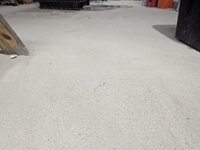
20 days later my major issue is the dusting, or efflorescence(?). Foot traffic kicks up dust, and we've eroded down to the more sandy, gritty layer. From reading the concrete threads and ConCretin's great post, this is probably from too much water, carbonation from the unvented heater, early finishing, or all of the above. I tried the "screwdriver test" and I can pullverise the top layer, more so or less so in different areas. It seems from reading that I can wait until its totally cured and powerwash, grind and apply a densifier and see if that helps.

My question is: although I have kept the garage temps at 50-55F since the pour, would the cold gravel temps below the slab make curing prolonged? Should I wait another few weeks and maybe the issue gets better? It seems it has hardened a bit over the last week, especially getting down the gritty parts.
And if curing is slowed by the cold underlying gravel, when would it be safe to drive a truck into the garage? Worried mostly about cracking it.

Photos attached of the floor.PXL_20250106_210550101.jpgPXL_20250106_210614917.jpg
 
To avoid these ads, REGISTER NOW!

ConCretin

Well-known member
Joined
Jan 20, 2011
Messages
3,379
Location
Central Maine
Without getting into the causes of the soft surface (although we can if you'd like), I'll start be addressing your question about curing. If you've maintained the space at 50 degrees for 20 days, the slab should have reached pretty close to design strength. It's safe to drive on the slab and also to expose the slab to freezing temps although it's best to ease the temps down gradually.

You're on the right track with regard to 'repairs'. About all you can do is grind away the soft cap and apply a densifier/sealer.
 
OP
L

lovetap

Well-known member
Joined
Sep 23, 2021
Messages
249
Location
the last frontier
Thank you for the response ConCretin. Good to know about strength, truck has been overdue for an oil change waiting on the garage.

Re: the chalky floor, thanks for confirming my suspicions. I'll give it another week or two and wash it real good to see where things are at. Would a rental EDCO be the style of grinder I would be looking for to remove the soft cap?
 
To avoid these ads, REGISTER NOW!

C-S-H

Well-known member
Joined
Jan 18, 2024
Messages
145
Your concrete will love the 50-55deg F curing temps (and hopefully initial set temperature). Cooler (above freezing) is better for final strength. But as you know it will hate the added water, and will also hate being dried out during curing. Do not add water to the concrete surface and let it freeze at this time. The time for moist curing has likely passed, and you are way late for covering. You are better off paying for water reducing admixture than densifier, but now your bed is made.
 
OP
L

lovetap

Well-known member
Joined
Sep 23, 2021
Messages
249
Location
the last frontier
I noticed when I wet swept the floor yesterday that tiny air bubbles were popping up in places, like water was infiltrating the slab. No cracks seen yet. Maybe just absorbing into the soft chalky layer? I'll look into the water reducing admixture.
 

C-S-H

Well-known member
Joined
Jan 18, 2024
Messages
145
If you have air entrained concrete it will be about 6% air, and about 1.5% of that will be entrapped air bubbles that you can see. If the air was migrating up and became trapped under your wet surface layer, that is another problem.

Water reducing admixture is added at the batch plant to give your requested slump, say 4oz of WRA per hundred weight of cement to get 5" slump. If slump is lost in transport due to evaporation of water or absorption of water into dry aggregates, then the truck driver can add WRA at the jobsite to get the slump back.

You never said what your concrete temperatures were, or batch time to end of casting time, but my biggest worry is that they retempered the concrete after it started setting instead of rejecting the load. It is easy for them to calculate how much hydration control admixture to use to make sure that the concrete does not start to set in the truck.
 
To avoid these ads, REGISTER NOW!
Top Bottom