To avoid these ads, REGISTER NOW!

Concrete Relief Cuts?

karoc

Well-known member
Joined
Dec 19, 2017
Messages
1,991
Location
Hemphill Tx
Guys wanting to build myself a Pole Barn with a concrete slab which will be about 4" thick. As I watch some Youtubes on building a pole barn they talk about relief cuts which is to prevent cracks in slab. But how deep does the relief cuts need to be and how many relief cuts does a slab that is 30'x 70' need?
 
To avoid these ads, REGISTER NOW!

mike93lx

ALLIANCE MEMBER
Joined
Dec 9, 2013
Messages
37,386
Location
Richmond, VA
The control cuts don't prevent cracks, they control where the cracks show up, hopefully in the bottom of the cut instead of across the slab.

There are some great resources here on pouring slabs. A little searching should get you tons of info
 

nadogail

Well-known member
Joined
Jan 23, 2009
Messages
31,907
Location
Coronado, CA
IMHO, A concrete slab comes with two guarantees. 1, There will be surface cracks, hopefully they will be in the control joints. 2, Nobody will steal it.
 

ConCretin

Well-known member
Joined
Jan 20, 2011
Messages
3,378
Location
Central Maine
From my Guide to Floor Slabs (saves some typing lol)

Crack control - The most common cause of cracking is shrinkage. Concrete shrinks as it 'drys' - as much as 1/2" in 100'. As your slab contracts, it is restrained by the sub grade, obstructions, reinforcing etc, which causes tension. Since this occurs when the concrete's inherent tensile strength is very low cracks often result.

There are things you can do to control shrinkage. The most important is to limit slump. More water means more volume will be lost when the concrete dries and the more it will shrink. Placing in cooler temps, fibermesh, increasing aggregate size and proper curing will help but there is a practical limit to how big a slab can be built before shrinkage cracks become inevitable

Control joints (CJs) prevent ugly cracks you can see by creating a weak spot for the slab to crack where it will be hidden. CJ's can be tooled into the slab while the concrete is plastic or saw cut after it hardens. Both should be cut at least 1/4 of the slab depth.

By definition, tooled joints are done early in the placement but it's vital that saw cuts be done in a timely manner too. Tension starts growing in your slab quickly as drying shrinkage occurs. If you don’t relieve that tension with CJs, the slab will do it for you in the form of ugly random cracks.

If your finisher will be tooling the joints, make sure his groover is deep enough. He'll have to cut the joints with a pole mounted groover while the concrete is still plastic to move the aggregate aside and re-groove to ensure the joint doesn't fill back in.

If you are cutting your joints, use an early entry or Soff-Cut saw and make your cuts immediately after finishing. These saws have a thin blade that turns into the floor and a plate that presses down on the concrete, which keeps the blade from pulling up the surface.

Plan your CJ layout and provide a sketch to your finisher. Recommendations for CJ spacing start at 8-12' but with some attention to overall crack control, you can spread them out to 15' or more. Keep the panels created by the CJs as square as possible with a maximum ratio of length to width of 1.5 to 1. If you are going to install a lift, most manufactures require a min distance from CJ's to the posts so take this into account.
 

larry_g

Well-known member
Joined
Apr 28, 2007
Messages
16,869
Location
oregon

WNYflyer

Well-known member
Joined
Sep 13, 2009
Messages
2,117
Location
Lockport, NY
Plan your CJ layout and provide a sketch to your finisher. Recommendations for CJ spacing start at 8-12' but with some attention to overall crack control, you can spread them out to 15' or more. Keep the panels created by the CJs as square as possible with a maximum ratio of length to width of 1.5 to 1. If you are going to install a lift, most manufactures require a min distance from CJ's to the posts so take this into account.

^^^

Assuming it is a pole barn with columns/post buried in the ground and the concrete floor is just a floating temperature/shrinkage steel reinforced S.O.G (slab-on-grade) then if you have any inclination of every installing a two-post lift then as LLWillysfan said you have to be very careful on the control joint (C.J.) locations. As he noted you really need to work the locations with the lift manufacturers recommendations otherwise potential of bad news.
 

Verdugo

Well-known member
Joined
Mar 31, 2014
Messages
98
I see in a related post where there is a great concrete contractor in Duluth who may be able to opine about this...
 

pmiranda

Well-known member
Joined
Jul 15, 2008
Messages
1,504
Location
Austin, TX
I think my contractor cut them too shallow and/or too late since cracks formed anyway. Luckily none where I care about. Maybe they'll never grow past the hairline cosmetic cracks they appear to be now?
 

mike93lx

ALLIANCE MEMBER
Joined
Dec 9, 2013
Messages
37,386
Location
Richmond, VA
I think my contractor cut them too shallow and/or too late since cracks formed anyway. Luckily none where I care about. Maybe they'll never grow past the hairline cosmetic cracks they appear to be now?

If it is cured, the small cracks are done. Further cracking would be from settling,
 

Kaizen

Well-known member
Joined
Jan 9, 2015
Messages
6,938
Location
New England
1/3 of the depth of slab, so about 1 1/4". 15' maximum. So, I'd split the 30', and then do 5 cuts at about 12' spacing down the 70'. If there's better places to put the cuts, they don't have to be equal distance.


This is what I did and now have perfect cracks in the joints in my 30x36. I spaced them so a lift will not be near the lines. Cut them myself with a circular saw and diamond blade as I wanted thin cuts.
I’m a little concerned about others’ comments on Texas specifically so get some local expertise as I’m in snow country.


Sent from my iPhone using Tapatalk
 

dutchgray

Well-known member
Joined
Sep 28, 2014
Messages
6,461
Location
Dorset. England.
I think my contractor cut them too shallow and/or too late since cracks formed anyway. Luckily none where I care about. Maybe they'll never grow past the hairline cosmetic cracks they appear to be now?

It needs to cut as soon as practicable but definitely within 24 hours of the pour if you want to beat the cracks.
 

Retroman

Well-known member
Joined
Jan 21, 2018
Messages
1,364
Location
Mojave Desert
25% of the slab thickness is what is called for on most of the jobs we cut. You need to cut the ends a bit deeper say 1.50" to gets the crack started in the joint. if you have any inside corners or diamonds for columns you need to come off those corners with joints. Cut them as early as possible without spalling the edge of the joint. The concrete guy or the guy cutting the joints will know when its ready to be cut.
 

eastbaysubaru

Well-known member
Joined
Dec 6, 2009
Messages
340
Location
NorCal
IMHO, A concrete slab comes with two guarantees. 1, There will be surface cracks, hopefully they will be in the control joints. 2, Nobody will steal it.

QFT...at least about the cracking part. It's going to crack. Even though the cuts were made it's going to crack, and likely not in the control joint. I've dealt with many different concrete contractors and GCs and they'll all tell you the same thing.

-Brian
 

ConCretin

Well-known member
Joined
Jan 20, 2011
Messages
3,378
Location
Central Maine
Let’s see. Where to start. Well first off, shrinkage cracks aren’t surface cracks. They usually go all the way through. Surface cracks are usually referred to as crazing and are a separate issue. Secondly, control joints are very effective at eliminating visible cracks if done properly. People who claim otherwise lack knowledge and/or skills. You need to find a better class of contractors and GC’s Brian.
 

eastbaysubaru

Well-known member
Joined
Dec 6, 2009
Messages
340
Location
NorCal
Let’s see. Where to start. Well first off, shrinkage cracks aren’t surface cracks. They usually go all the way through. Surface cracks are usually referred to as crazing and are a separate issue. Secondly, control joints are very effective at eliminating visible cracks if done properly. People who claim otherwise lack knowledge and/or skills. You need to find a better class of contractors and GC’s Brian.

I suppose so but anecdotally I've worked with over 20 different GCs and subs (4 different concrete contractors) over the past 15 years on six high end custom homes and I've not yet seen a concrete slab that hasn't cracked somewhere. Maybe someday I'll find this mythical concrete god who can pour a slab that will never crack, but in my limited experience, it's fairly unavoidable.

-Brian
 
To avoid these ads, REGISTER NOW!

Shovelhead

Well-known member
Joined
Dec 22, 2018
Messages
397
Location
DEEP EAST TEXAS
I rarely see relief cuts made in concrete in the OP's location

That is correct.
Never, ever have I seen saw cuts in concrete slabs in our area. Never.

Was just talking about this with my BIL couple days ago. He didn't even know what I was talking about. LOL

I told him I seen it on here that people in other areas act like it's as big a deal as having a roof that don't leak.

I'd really like to know why this seems so important in some area of this Country and why I've never seen it in my area. ?????
 

ConCretin

Well-known member
Joined
Jan 20, 2011
Messages
3,378
Location
Central Maine
I suppose so but anecdotally I've worked with over 20 different GCs and subs (4 different concrete contractors) over the past 15 years on six high end custom homes and I've not yet seen a concrete slab that hasn't cracked somewhere. Maybe someday I'll find this mythical concrete god who can pour a slab that will never crack, but in my limited experience, it's fairly unavoidable.

-Brian

Sorry for the snarky response Brian. :beer: Wasn't really directed at you. There are just so many hacks out there. There is absolutely no reason to have uncontrolled cracking in a slab. A modest amount of attention to shrinkage control i.e. not placing at a 7 slump and some properly spaced and timed control joints is all that is needed. We all get an occasional random crack but if it's a common occurrence, you ain't doing it right.
 

joes169

Well-known member
Joined
Sep 19, 2011
Messages
663
Location
WI
Guys wanting to build myself a Pole Barn with a concrete slab which will be about 4" thick. As I watch some Youtubes on building a pole barn they talk about relief cuts which is to prevent cracks in slab. But how deep does the relief cuts need to be and how many relief cuts does a slab that is 30'x 70' need?

The general "rule of thumb" is 8' x 8' max. squares for 4" thick concrete, 10' x 10' squares for 5" thick concrete. FOr pole barns, I like to wrap the poles in 1/2" insulation to avoid any possible restraint as the concrete is shrinking. I still run control joints to the center of every post, as they are re-entrant corners which are known to cause cracking. There's a ton of factors that can allow you to stretch control joints out, but the easiest, cheapest, and most proven way is to keep your control joints within the "rule of thumb".

Control joints should be 1/4 of the depth of the concrete and placed as early as possible. Using the Soff-Cut system, which has become the industry norm for years now, you can go shallower typically (1/6 to 1/7 of depth) due to the ability to saw them so much earlier.
 

pmiranda

Well-known member
Joined
Jul 15, 2008
Messages
1,504
Location
Austin, TX
Would you install a 2-post lift on a crack? For me, that's pretty much to only reason I cared about control joints in my build. I know where I want to put the lift, and I know where cracks are not a problem, so my contractor cut control joints away from that area (he'd always planned to, I just confirmed that the location worked). The slab has fine cracks near the control joints but nothing near the location for the lift columns so I'm happy. Once the floor gets polyurea coating, I'm guessing I'll never see those fine cracks ever again.
 

Shovelhead

Well-known member
Joined
Dec 22, 2018
Messages
397
Location
DEEP EAST TEXAS
My own 36x48 floor slab, has one crack running from the center overhead door more or less straight towards the back. It angles a bit, and isn't straight. So what? It's less than 1/16" wide. I think I saw a crack developing in the back half also, wasn't prominent enough to even really notice.

Maybe Texans are just a bit more laid back about this stuff?

Thanks, I feel about the same, but I don't know much about cement or concrete, except it's guaranteed to do two things, get hard and crack.

I've yet to lose a small child or puppy in any. I'm pretty sure I'd have a hard time even finding any of cracks in my 30x50 shed anymore. Prolly upset me a bit when I first saw one, but my pickup, boat and motorcycles never did seem to care.
 
OP
K

karoc

Well-known member
Joined
Dec 19, 2017
Messages
1,991
Location
Hemphill Tx
The general "rule of thumb" is 8' x 8' max. squares for 4" thick concrete, 10' x 10' squares for 5" thick concrete. FOr pole barns, I like to wrap the poles in 1/2" insulation to avoid any possible restraint as the concrete is shrinking.
I be dang,I was thinking about the same thing in putting piece of ridgid foam around the poles.But never heard or read about this till now awesome thanks. Guys thanks for all the response about relief cuts in slab.
 
OP
K

karoc

Well-known member
Joined
Dec 19, 2017
Messages
1,991
Location
Hemphill Tx
Thanks, I feel about the same, but I don't know much about cement or concrete, except it's guaranteed to do two things, get hard and crack.

I've yet to lose a small child or puppy in any. I'm pretty sure I'd have a hard time even finding any of cracks in my 30x50 shed anymore. Prolly upset me a bit when I first saw one, but my pickup, boat and motorcycles never did seem to care.

Thats funny, Shovelhead how is your project going?
 

Jason B

Well-known member
Joined
Apr 16, 2007
Messages
353
Location
PA
I have over 550 ft of concrete most poured by the same guy who’s been doing it for 35 years. In the one section of the driveway I did expansion joints every 10 feet. Not one crack anywhere in 15 years. I told him I didn’t earn cracks and that was the key.

Now just did a 14x50 inside a building and since not that wide did the saw cuts which also works out well for other portions of the driveway that he did 15 years ago. The key is finding someone with a good reputation, so you don't have to do the worrying and look at their existing work that’s many years old.

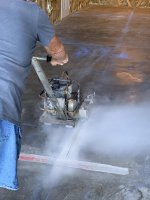
Here's the new one getting cut.

attachment.php
 

Attachments

  • EED5546D-378E-4872-A568-35A1B2AD486D.jpg
    EED5546D-378E-4872-A568-35A1B2AD486D.jpg
    92.5 KB · Views: 151

ConCretin

Well-known member
Joined
Jan 20, 2011
Messages
3,378
Location
Central Maine
It's an odd phenomena. I'm in the no joints formed or cut belief for my own stuff. So, it cracks, I seal the cracks, and that's the end of it. I prefer that to tooled or cut joints, which are wider and harder to seal. But, the obsession of over controlling every facet of how things look makes a lot of people cut the slab up into squares, so that you have straight lines instead of random cracks.

That is a perfectly reasonable position. Just comes whether you'd rather see a few ragged but tight cracks or a grid of saw-cut or tooled joints. Once people understand they'll have cracks either way, they can make a more informed decision.

With all the silica rules, the going rate up here for cutting control joints is $3 lf. I never understood an architect or engineer spending many thousands of dollars to cut an elaborate series of control joints in a floor that will be covered with carpet.

Old habits die hard I guess and cracks tend to freak people out.
 

Fatboy148

Well-known member
Joined
Feb 15, 2017
Messages
999
I have over 550 ft of concrete most poured by the same guy who’s been doing it for 35 years.
attachment.php

Just looking at him, you can tell he's done a day or two's work in his life BUT where are that man's legs?
 

eastbaysubaru

Well-known member
Joined
Dec 6, 2009
Messages
340
Location
NorCal
Sorry for the snarky response Brian. :beer: Wasn't really directed at you. There are just so many hacks out there. There is absolutely no reason to have uncontrolled cracking in a slab. A modest amount of attention to shrinkage control i.e. not placing at a 7 slump and some properly spaced and timed control joints is all that is needed. We all get an occasional random crack but if it's a common occurrence, you ain't doing it right.

All good. Just sharing my experiences. Pouring a lot of concrete in the next 12 months. Fingers crossed that we'll be crack free.

-Brian
 
To avoid these ads, REGISTER NOW!
Top Bottom