To avoid these ads, REGISTER NOW!

Concrete Slab Cracks - Should I Worry?

cory58

Well-known member
Joined
Dec 23, 2015
Messages
234
Location
Charlotte, NC
I'm in the process of building my dream garage, and just noticed cracks in the new slab. I know about the "2 types of concrete" and have read several other threads here about the same issue, but wanted to post some pics and details, and see what the collective Garage Journal wisdom thinks of my situation. Here are the details.

1. Slab (30 x 30) poured approx. 5 weeks ago. I looked at the slab close on Thurs for the first time in 2 weeks and noticed the cracks.

2. 4" monolithic slab with footers around the perimeter. One 15 x 6 area is 6" deep, for future 2-post auto lift.

3. 3000 psi concrete with fiber. No other reinforcement.

4. All fill was compacted.

5. Control joints were cut the morning after the pour.

6. Did not know about keeping the slab wet for days while curing, so that did not happen.

7. Prefab metal garage from capitolbuildings.net is scheduled to be erected the week of June 7.

Here are the pictures. I have 2 main concerns. First is the widest crack that seems to go all the way through the slab (at least all the way to grade as seen in the first photo). The other cracks all radiate from this crack. Second, one of the smaller radiating cracks is in the 6" thick area where the lift will be mounted. The pics are in a specific order, beginning with the widest crack and progressing to the smaller cracks that radiate from the large crack.

All opinions and feedback will be greatly appreciated! Cory


To avoid these ads, REGISTER NOW!

matt_i

Well-known member
Joined
Mar 14, 2008
Messages
10,730
Location
SE Michigan
Unless planning to tear out and repour, I would just live with it. Looks like standard shrinkage cracks. If the fill was compacted, I would think it OK.
 

Chaznsc

Well-known member
Joined
Apr 9, 2013
Messages
6,536
Location
SC
Really need more photos of larger scale. The shrinkage cracks are clearly sawed thru so they waited too long it looks like. Also, the saw joints have to be 1/3 depth of the concrete or they wont work as intended.
 

GSRinmyCRX

Well-known member
Joined
Jun 10, 2014
Messages
201
Location
Western, NY
concrete will crack every 10 ft on average. my guess is you waited too long to put in the control joints.

Levi
 

Jess

Well-known member
Joined
Oct 22, 2006
Messages
430
Location
Vancouver Island, BC Canada
As long as there isn't any displacement due to settling, I wouldn't worry about it now. If it was left to dry out in the sun without being kept wet, you could expect those type of cracks. Was a curing sealer applied?
 

CNGsaves

Well-known member
Joined
Sep 26, 2012
Messages
13,233
Location
KS and OK
^ ^ Tend to agree with this?? Spider cracks are common, but you appear to have settling crack in that first picture. Is that vertical pic so crack goes right through whole slab ??

WHERE are you located . . . and what was weather when you poured ??

If 110 degree day in Phoenix and you never watered concrete, that's bad.

UPDATE GJ Profile with a Location.
 
OP
C

cory58

Well-known member
Joined
Dec 23, 2015
Messages
234
Location
Charlotte, NC
Thank for all the feedback! I'll try to answer questions.

Control joints were definitely cut the morning after the pour. I personally saw them at lunch time that day. Cracks definitely happened weeks after the control joints were cut.

Yes - first pic is a vertical crack showing the side of the slab. This is what worries me the most. None of the other cracks that radiate from the main one extend to the edge of the slab (yet).

I am in Charlotte, NC. The weather was typical early spring during the pour and after - highs in mid 60s. Wish I would have known about keeping the slab wet. The concrete sub I used should have known.

No curing sealer was used.

Jess - what do you mean by "displacement due to settling"?

Thanks again, Cory
 

Falcon67

Well-known member
Joined
Jun 11, 2009
Messages
18,371
Location
Merkel, TX
What size footers? How much rebar/size in the footer?

The surface cracks look normal, I had several and didn't cut any control joints. Same for the slab next door that has nothing on it - no joints, plenty of shrinkage cracks. You don't cut "control joints" in slab-on-grade house foundations either, so the whole "must have control joints" deal is kinda lost on me.

However, the #1 pic looks a bit much, like something settled under that section to the left of the picture. Corner or close to?

In my case, I painted the floor and just remembered the locations of about 3 of the larger shrinkage cracks. Actually used the roller to kinda "caulk" the cracks with paint. Then - waited. After 5 years, no movement or change. So good to go here.
 

LXCam

ALLIANCE MEMBER
Joined
Apr 23, 2013
Messages
19,169
Location
AZ
Ya well concrete cracks. I'm not seeing anything out of the ordinary.

But either my eyes are totally shot today (good chance btw) or I'm not seeing any evidence of the fiber. I've poured a bunch of that through the years and never had an instance where I didn't have some exposed strands.
 

Jess

Well-known member
Joined
Oct 22, 2006
Messages
430
Location
Vancouver Island, BC Canada
Thank for all the feedback! I'll try to answer questions.


Jess - what do you mean by "displacement due to settling"?

Thanks again, Cory

I meant that if its only cracks, and not shifting or settling, you will likely be ok, given that the other alternative removal. A properly compacted base is a must.

Jess
 

NUTTSGT

Super Moderator
Staff member
Joined
Sep 14, 2009
Messages
51,041
Location
Northern Central Ohio
You mentioned the fill was compacted. How much fill was put in and did they compact it once it was all in or did they add fill, compact, add fill and compact once again repeating until the proper height was gained ?
 

Dhagan887

Well-known member
Joined
Dec 17, 2015
Messages
90
My first garage (monolithic, 4" slab, 24" deep Undisturbed soil, 2 #4's in footer) did the same thing as the first 2 pics. Crack straight up the face 6" away from the control joint and ran to the first perpendicular control joint 10' away. I was pissed.
 

barks

Well-known member
Joined
Jul 2, 2010
Messages
324
Yes, it will keep you from worrying about your 401(K), your daughter's tatted up, dope smoking boyfriend and the crazy neighbor with the target range out back.
 

Slednut

Well-known member
Joined
Dec 20, 2012
Messages
2,550
Location
Washington state
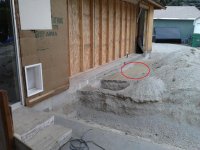
All the concrete at my house has cracks except for my garage addition. I had the excavator dig two feet down then use the whacker on the back hole every six inches of fill gravel. When he was done you would swear it was a concrete pad. It's now been 4 years and no cracks. This picture shows what it looked like (red circle).
 

Attachments

  • circle.jpg
    circle.jpg
    144.8 KB · Views: 237

wssix99

Well-known member
Joined
Mar 2, 2011
Messages
5,161
Location
Chicago, IL
It's hard to say if you should worry unless we can see wider angle pictures of the slab. If your lift legs will be too close to those cracks, per the manufacturer spec, then that would be a problem.

The cracks look to me like normal shrinkage cracks and I'd echo the comments above that its curious that they formed so close to the control joints, especially with them done on-time.

I wonder if any accelerators were used to cure the slab?

Having details on the reinforcement, the location of your 4" to 6" transition, and the location of that transition would also be helpful. The control joints create a weakness (at the surface) which entices the shrinkage cracks (a normal thing) to occur at those points. If you have an abrupt transition of thicknesses in the slab, then that will also create a weakness in the slab (where you can't see it from the surface) that could entice the cracks to form where you don't want them.
 

Cyberbear

Well-known member
Joined
Nov 23, 2013
Messages
1,524
Location
California
Well, judging from your pictures, it's far too late to do anything but live with what you have. Hindsight is always 20/20, but in the future I personally strongly believe in lots of steel no matter how thick the pour is, even with "control" cuts that seem to control very little and actually weaken everything. I also believe fiber in the concrete is a waste of money and how can those little fibers do what steel cannot? Using low quality concrete is simply getting what you paid for. Without proper curing, bad things often happen and cracks occur. From what I read on GJ, I must be very lucky not having any cracks in my last three pours, or my local concrete supplier knows what they are doing.
 

ishiboo

Well-known member
Joined
Oct 27, 2010
Messages
9,481
Location
Oshkosh, WI
I don't see how this is possible, unless I am missing something.. Some of those saw cuts clearly cut through existing cracks..

The saw cuts are only 25% or so of the slab depth. So as a crack transverses the slab it can easily continue under the control joint and continue on the other side.
 
To avoid these ads, REGISTER NOW!

Dhagan887

Well-known member
Joined
Dec 17, 2015
Messages
90
It's hard to say if you should worry unless we can see wider angle pictures of the slab. If your lift legs will be too close to those cracks, per the manufacturer spec, then that would be a problem.

The cracks look to me like normal shrinkage cracks and I'd echo the comments above that its curious that they formed so close to the control joints, especially with them done on-time.

I wonder if any accelerators were used to cure the slab?

Having details on the reinforcement, the location of your 4" to 6" transition, and the location of that transition would also be helpful. The control joints create a weakness (at the surface) which entices the shrinkage cracks (a normal thing) to occur at those points. If you have an abrupt transition of thicknesses in the slab, then that will also create a weakness in the slab (where you can't see it from the surface) that could entice the cracks to form where you don't want them.

I believe it's from the monolithic pour. Going from 4" to 2' thick. I buried the saw once I got over the footer area and mine still cracked 6" from it.
 
OP
C

cory58

Well-known member
Joined
Dec 23, 2015
Messages
234
Location
Charlotte, NC
Thanks again for all the feedback! This whole garage project has been a learning experience for me, and I'm still just beginning. Like everyone, I don't like to learn "expensive lessons", so the "just live with the cracks for now" feedback is what I was hoping for. Even up to this point, Garage Journal has been invaluable.

I'll try to answer a few more questions.

The footer is a minimum of 16" deep and 12" wide at the bottom. Below is a picture of the rebar in the footer.

No accelerators were used in the concrete.

I have copies of the delivery tickets from the concrete supplier, and they list the fiber mesh. I've read that you may not be able to see the fibers on a machine trowelled surface, but I agree that the fiber should be clearly visible on the edge of the pad. Makes me wonder....

The main crack that goes through the side of the slab is in the middle of the slab on the front, where the 2 roll up doors will be. From what I can tell of the building framing, I think the sides will bear most all of the load.

I will take some wider angle pictures and post them.


Cory
 

willymakeit

Well-known member
Joined
Apr 27, 2009
Messages
1,243
Location
Springfield Mo.
1. Do the control joints run both directions on slab?
2. What was mix design? Temp of concrete when installed [hot load]?
3. Was water added at site affecting slump?
All of these go back to supplier of concrete and subcontractor placement.
If you have the load tickets they should say mix design. time when truck left site, and when it was unloaded plus added water. Drivers are known to add water as the drum turns easier and sub adds water to make placement easier.
I deal with this a lot.
 

wssix99

Well-known member
Joined
Mar 2, 2011
Messages
5,161
Location
Chicago, IL
so the "just live with the cracks for now" feedback is what I was hoping for.

That's pretty much it unless you want to go through the pain of convincing your contractor that this is their fault and that they should pay for a new slab.

No worries on structural concerns or the foundation. If you had a base or a structural problem, it wouldn't show up like this - before you even put a real load on the slab. This is clearly from shrinkage stress/the curing process. (And the nature of this particular batch of concrete and slab design.)

If you don't like the look, a good commercial epoxy company can grind the cracks, fill them and then coat the whole thing so it looks perfect. (I had this done with my floor's control joints and contraction joints and it looks amazing.) The only worry is how close these cracks will be to your lift and if you are out of spec there.


I've read that you may not be able to see the fibers on a machine trowelled surface, but I agree that the fiber should be clearly visible on the edge of the pad. Makes me wonder....

Fibermesh only stops this type of plastic shrinkage cracking, which you don't have - so fiber isn't your worry here:

plastic-shrinkage-cracking-sm.jpg
 

DougWil

Well-known member
Joined
Dec 29, 2015
Messages
545
Location
NW Montana
Fibermesh only stops this type of plastic shrinkage cracking, which you don't have - so fiber isn't your worry here:


Yep, and now that it has cracked there is no primary reinforcement to stop the cracks from getting bigger or the cracked slabs from heaving, shifting,, etc.

Fibermesh is no substitute for rebar!

If you want to add fibermesh to reduce shrinkage cracking that is OK, but you don't want to leave the rebar out.
 

JerryB

Well-known member
Joined
Mar 22, 2007
Messages
132
Location
North Coast, CA
All concrete will crack.

Your first mistake was not putting any reinforcing steel in the pad. That probably wouldn't have kept it from cracking, but would have prevented vertical displacement of the parts of the slab that have parted ways with the adjacent parts. My preference is generally a double band of reinforcing steel around the outside edges of the slab and 6x6 or 8x8 10-10 mesh set to be half way up in the poured slab. This can vary, but is what works around here.

As DougWil wrote above, fibermesh is no substitute for steel.

Next, be aware that cracks generally develop over time, not in the first 24 or 48 hours. Your slab looks to have a serious problem, especially when you consider that it should have a useful life well in excess of 25 to 35 years. Now there is nothing to prevent vertical displacement of the individual pieces of concrete. Even more so considering your wet freeze / thaw climate zone. Water gets in the cracks, then freezes, expanding the cracks and raising the underlayment. Repeat this a few times and you have several slabs! Assuming the base material and compaction was of the same quality as the finished surface, you wind up with a slab with lots of vertical displacements.

I would definitely take your problem to the concrete supplier, the contractor, and the finisher. It appears to be a poorly done job, but maybe that is what is expected and accepted in your location.
 
Last edited:

SDBOB1

Member
Joined
Apr 5, 2016
Messages
23
I'm going to say from experience approx 30 yrs ago.We were pouring new home basement.Yrs before concrete when curing would pull away from block walls. This job didnt,it cracked like a checker board,not as many lines as board. But what I learned some cos. on 'second round jobs' if they have concrete left over from first round will load on top,YES.This then can create hot loads that cure quicker when placing in places,where other spots are curing slower ,a crack. Not saying but depends on co.Also 'some' finishers add additives to set up concrete quicker so they can get on to finish.Some have a job in am.,then job in pm. Not saying.just other ideas. I poured my old garage floor on stone wacker and mesh,4000psi (I use exclusively ),I had cracks afterwards where we stopped wheeling to start another section when pouring.There was no form or control joint there just we stopped to start filling in more of the floor as we worked to the doors.So these are my experiences.We use to have a saying,don't take this wrong,there is a crack in every truck' .Temperature, humidity, dampness of raw aggregates all plays a part in curing. I'm old school ,after pouring,slow curing,cool water. But today things are faster pace, $$$.
 

DougWil

Well-known member
Joined
Dec 29, 2015
Messages
545
Location
NW Montana
Your slab looks to have a serious problem, especially when you consider that it should have a useful life well in excess of 25 to 35 years.

Agreed.

Properly placed, reinforced, finished concrete with an appropriate mix and base prep should have a useful service life of hundreds of years.

I really don't get the economy of saving a few bucks on reinforcement and reducing the life to only a small fraction of what it could be.
 

wssix99

Well-known member
Joined
Mar 2, 2011
Messages
5,161
Location
Chicago, IL
^ There is no evidence here of a "serious" problem. So, I don't think we should be jumping to conclusions.

Your first mistake was not putting any reinforcing steel in the pad. That probably wouldn't have kept it from cracking, but would have prevented vertical displacement of the parts of the slab that have parted ways with the adjacent parts.

Reinforcing is nice, but it is not a "normal" thing and it isn't required. (It would have kept the cracks thinner, though.)

There is no evidence of and the OP has not mentioned vertical displacement. With a proper base, this will NEVER happen.


Next, be aware that cracks generally develop over time, not in the first 24 or 48 hours.

Shrinkage cracks like this do develop that quickly, which is why it's so important to do the saw cut joints so quickly. More could develop over time, but they will be small in comparison to what has already happened.


Even more so considering your wet freeze / thaw climate zone. Water gets in the cracks, then freezes, expanding the cracks and raising the underlayment. Repeat this a few times and you have several slabs!

If this were true, everyone with saw cut control joints in their slabs should run for the hills! Everyone has these cracks - they just usually form inside the control joint troughs and stay out of site when those cuts fill up with dirt and crud. Contraction cracks alone are no cause for alarm.
 

Falcon67

Well-known member
Joined
Jun 11, 2009
Messages
18,371
Location
Merkel, TX
Here, the minimum is #3 bar 24" OC, #4 bars in the footer - like you show. ERROR - minimum here is #3 18" OC in a garage/outbuilding, I managed to use 24" OC because my city doesn't use the inspector's city's amendments.

My footers are 12x12 with beams cut across the pour. We have expansive clay here and as I noted, since the slab was laid in 2011 there's been no movement. That includes 2-3 years of drought and this year where we are 6" over normal in the first 5 months and all the lakes are full. So I'd think with your footings everything should sit still. You could get some grey concrete caulk and putty those cracks to keep water from getting in there are freezing, then just keep an eye on things. It is what it is, if it doesn't change then it'll just be there. The key is that if things take a set and don't move, you're good to go.

>Expensive lesson
Well - I've not had the best luck here. The last shop was 20x24, that slab cracked diagonally after a couple of years due to poor ground prep (I could not be present at the pour). It was a big crack, could stick a decent screwdriver in it. Once it did it, it stayed that way. Ugly, but not a show stopper and didn't hurt the building.

The current shop had a few issues - truck #2 was late, so the first load was setting up and it left a bit of some ruff spots. The SE corner is down 2" or so, I think truck #3 hit forms and nobody - me included - didn't catch it. And the fun one - slab is 6" out of square. I should have double checked the forms they laid, but did not. You can not tell by looking anyway. We've owned lots of old houses where "plumb" and "square" were abstract concepts, so no problem - just adapt and go. It warm, dry, nice place to work, kids like it, cool in the summer with AC - no regrets. Until I parked my new 235" dragster in there, now I need another 3-4 feet of depth LOL :)

Also, the lanes on our drag strip - poured in 2003 - are 12" x 25' x 900'. Each lane poured on one continuous pour. Deep saw cuts done every 20', filled with backer and caulked. Concrete mix and the rock used are hard as hell according to Penhall (drag strip grinder). Ground was packed so hard you could shoot a 16 penny nail in it and had to get a pry bar to get it out. The lanes cracked about every 10' on their own. It's been ground twice and though the left lane has a bit of a dip where it crosses a gas pipeline, the surface has been pretty stable for the last 8-10 years or so.
 
Last edited:

DougWil

Well-known member
Joined
Dec 29, 2015
Messages
545
Location
NW Montana
^ There is no evidence here of a "serious" problem. So, I don't think we should be jumping to conclusions.

Life threatening, no.
But that slab will have a seriously shorter life than if it had primary reinforcement.


There is no evidence of and the OP has not mentioned vertical displacement. With a proper base, this will NEVER happen.

Not true.
Building settlement, water infiltration, expansive soils, etc all can and do happen regardless of how well those last 4-5" of base are compacted.

DSC04516_zpslvu3jhtp.jpg


^ Besides gravity there is little to keep slivers like that in place or from chipping out with time and use.
 

lakeroadster

Well-known member
Joined
Jan 19, 2015
Messages
5,166
Location
Central Colorado
Seems like every concrete slab thread turns into a ******* match.

OP... was there any vehicles or significant weight applied to the slab before you took the photo's?
 

DougWil

Well-known member
Joined
Dec 29, 2015
Messages
545
Location
NW Montana
No, but most fresh concrete slab threads are about problems with that slab.

And it always comes down to the same things.
Ill prepared soil and base.
Watery, high slump, low strength concrete.
Lack of primary reinforcement,,,, talked into fibermesh.
Not sawing the joints soon enough or not sawing any joints.
Not curing the concrete properly.
Poor surface finishing from weather or workmanship.

And most old existing concrete slab threads are about problems with that cracked up, heaving, falling apart slab.

And it always comes down to the same things.
Ill prepared site, soil and base.
Watery, high slump, low strength concrete.
Lack of primary reinforcement,,,, used fibermesh or thin wire mesh that has rusted away.
Not sawing the joints soon enough or not sawing any joints.
Not curing the concrete properly.
Poor surface finishing from weather or workmanship.

Almost like there is some kind of connection. LOL
 
OP
C

cory58

Well-known member
Joined
Dec 23, 2015
Messages
234
Location
Charlotte, NC
OP... was there any vehicles or significant weight applied to the slab before you took the photo's?

No - no weight on the slab yet. Metal building is scheduled to be delivered / erected in approx. 10 days. I'm meeting the concrete sub at the job site on Sunday, to look at the cracks.
 

JerryB

Well-known member
Joined
Mar 22, 2007
Messages
132
Location
North Coast, CA
No, but most fresh concrete slab threads are about problems with that slab.

And it always comes down to the same things.
Ill prepared soil and base.
Watery, high slump, low strength concrete.
Lack of primary reinforcement,,,, talked into fibermesh.
Not sawing the joints soon enough or not sawing any joints.
Not curing the concrete properly.
Poor surface finishing from weather or workmanship.

And most old existing concrete slab threads are about problems with that cracked up, heaving, falling apart slab.

And it always comes down to the same things.
Ill prepared site, soil and base.
Watery, high slump, low strength concrete.
Lack of primary reinforcement,,,, used fibermesh or thin wire mesh that has rusted away.
Not sawing the joints soon enough or not sawing any joints.
Not curing the concrete properly.
Poor surface finishing from weather or workmanship.

Almost like there is some kind of connection. LOL

An excellent summation!

I just wonder if anyone looks at these forums before starting construction. With something as basic and permanent as a slab, there should be a high degree of interest in getting it right the first time.
 

pmiranda

Well-known member
Joined
Jul 15, 2008
Messages
1,504
Location
Austin, TX
So, if he wants to put a 2-post lift where one of those cracks is located, is OP SOL?

For best practice, should you always put rebar where you want to place a lift? Seems like you could end up drilling holes and hitting steel and then WTF do you do?
 

JerryB

Well-known member
Joined
Mar 22, 2007
Messages
132
Location
North Coast, CA
I've never installed a lift, so don't know what the requirements are, but good planning and supervision will prevent most problems. When we poured my hanger and ramp (~3500 Sq Ft.) in a single pour, we carefully planned the locations for the openings for the electrical conduits and water pipes, where we would drill for the door tracks, and where the deep parts of the foundation were to be located. We provided simple dimensioned drawings to both the steel setter and the concrete finishing contractor and closely supervised the placement of everything. We also got a mix plant certification and did slump tests on the concrete actually delivered to make certain we were getting what we specified and were paying for.

The hanger is 48' clear span, with no side wall returns on the front opening. There is a 7' deep foundation under the side wall at one front corner, with a half dozen 3" pipes going from the bottom of that foundation to the top of the 14' tall building walls. This construction takes the place of the shear resistance that would come from return walls, thus allowing a maximum opening. Those pipes are full enclosed in the 2x6 framed and sheet rocked wall, with no room for any kind of error.

As the work progressed, my builder and I carefully measured everything and recorded the information for possible future use. Although built in 1989, I can still drill into the concrete with virtually no chance of hitting rebar.

Just one example is that the bottom door track has around 30 drilled in redhead anchors. We did not hit a single piece of rebar or mesh when it came time to put the tracks down. That wasn't luck: It was because we planned the locations.

Good construction with positive outcomes requires good planning and competent supervision. Putting a 2x4 form around a somewhat level patch of dirt, then calling a concrete delivery service to bring some mud of their choice is NOT my idea of good planning!
 

wssix99

Well-known member
Joined
Mar 2, 2011
Messages
5,161
Location
Chicago, IL
So, if he wants to put a 2-post lift where one of those cracks is located, is OP SOL?

In those situations, a hole would need to be cut in the slab and then a new retrofit slab would need to be poured in its place and then keyed and/or pinned in to the larger, older slab.


For best practice, should you always put rebar where you want to place a lift?

No. Only reinforcing a portion of a slab can cause cracks, as can changing the depth abruptly within the slab. (that could have been a contributing factor here) For a new slab, the proper installation of a lift is on a continuous flat slab. (The manufacturers will give specs for thickness, strength, and distance from cracks/joints.)

The proper thing to do with the pour is to keep the cross section consistent. (Same dimensions and same reinforcement across the entire slab.) In areas where the cross section needs to change, the slab sections should be isolated with expansion joints.

^ An exception to this is thickened edges. Since the edges are unconstrained, things can change at the edge of the slab. Specially engineered slabs, like post-tensioned slabs/etc. also live by different rules/rules of thumb.


Seems like you could end up drilling holes and hitting steel and then WTF do you do?

You'd never notice this with a proper hammer drill and bit. (against a #4 rebar - larger rebar is a little harder to get through, but still not a big deal with the proper tools)
 
To avoid these ads, REGISTER NOW!
Top Bottom