To avoid these ads, REGISTER NOW!

Concrete spider webbing and dark splotches

kolky

Active member
Joined
Dec 30, 2013
Messages
36
Location
St. Louis, MO
Hi all,

My garage was finally built back in April. They originally poured the foundation and floor back in December so it sat uncovered for a couple of months during the winter. I'm a little concerned about the floor because it is very splotchy and has hairline spider webbing over a lot of it. This is particularly evident around the stem walls. Does this look normal to you or should I be concerned? It has also already chipped in a couple of spots and a crack in one corner. Some of the white haze in the first pick is residual drywall mud but the spots in the second two pics are not.
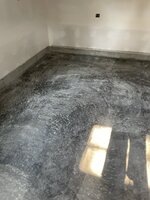

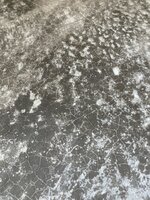
IMG_4911.jpgIMG_4910.jpgIMG_4912.jpg.
 
To avoid these ads, REGISTER NOW!

ConCretin

Well-known member
Joined
Jan 20, 2011
Messages
3,379
Location
Central Maine
The hairline cracks are called crazing, which are shrinkage cracks in the cement paste on the surface of the slab. By themselves, they're primarily cosmetic and not cause for concern. It's not uncommon to have a white appearance on a slab immediately after placement but it usually dissipates within a short period of time. It's basically efflorescence, which is dissolved solids being brought to the surface by moisture within. This moisture could have resulted from being exposed to the weather.

its also possible that the crazing combined with the persistent efflorescence resulted from too much mix water in the concrete at time of placement, which isn't good but isn't necessarily a death sentence either. Only time will tell at this point.
 
Last edited:
To avoid these ads, REGISTER NOW!

ConCretin

Well-known member
Joined
Jan 20, 2011
Messages
3,379
Location
Central Maine
Isn't overworking the trowel also a cause for crazing? Bringing to ok much water to the surface?

Yes and no. The amount of water on the surface of the concrete is primarily a factor of the amount of water in the concrete. As the fines settle in freshly placed concrete, excess mix water is squeezed out and makes it's way to the surface. This is called bleed water. The amount of bleed water depends on many factors but the amount of mix water i.e. slump is the biggest contributor.

Floating the concrete pushes the course aggregate down thereby bringing paste to the surface and is usually followed by the appearance of bleed water so you could say floating brings water to the surface.

It's important to float the concrete and then leave it alone until the bleed water dissipates. Floating too long will work the extra water back into the paste, increase the water cement ratio and weaken the surface. Troweling too early or too much can seal and densify the surface, which will trap bleed water and lead to a range of surface defects. Floating too long and troweling to early are generally referred to as overworking the concrete.
 
Last edited:

FMB4

Well-known member
Joined
Jan 19, 2017
Messages
2,926
its also possible that the crazing combined with the persistent efflorescence resulted from too much mix water in the concrete at time of placement, which isn't good but isn't necessarily a death sentence either. Only time will tell at this point.
This ^. Efflorescence will, unfortunately, only get worse (in many cases). And those spider webbing cracks are not good. My guess is that you can't have the pour redone (by the same contractors anyway). That said, the only thing to do might be to paint it with a name brand, and well reviewed, breathable (latex) garage floor paint.
 
Last edited:
To avoid these ads, REGISTER NOW!
Top Bottom