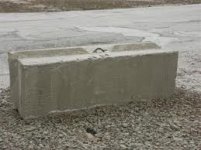
I'm new here and found my way by trying to get answers about concrete block. Specifically the 2'x2'x4' blocks, used to make material bins. Sometimes referred to as "mafia block". They weigh roughly 2000 lbs or more and are generally 3500 to 4000psi. I've read you can stack them 6 high for retaining walls. What I was thinking was stacking two rows of them three high (6ft) and five long (20ft) to use instead of a lift. They are only $25 a block and some times free on Craigslist. So that's $750 or less for the two rows. A little more for the poured ram and I would pour a proper footing. But I'm confused about the compressive strength. If the block is rated at 3500psi and each block weighs 2000 lbs should'nt the bottom block fail when a third block is stacked. 2000 +2000=4000. If not why, and can I drive a 7000lb. F250 or a 6000lb. New Holland skid steer on top of three stacked blocks without failure and death. I know the full load of the vehicle is spread out and not concentrated on one square inch. Anyway just wondering if anyone has ever used the block for a lift, or kind of like an "above ground pit". There's an oxymoron for you. Oh well.


You are using an out of date browser. It may not display this or other websites correctly.
You should upgrade or use an alternative browser.
You should upgrade or use an alternative browser.
Concrete
- Thread starter Rayhat
- Start date
Lx460
Well-known member
PSI = pounds per square inch. So a 2' x 2' block has 576 square inches, or about 4 lbs per square inch.
That's not exactly how that works...
Lx460
Well-known member
These bin blocks are typically made from leftover concrete in trucks after coming back to the plant. They aren't always poured at the same time either. They are usually used for creating bins for holding raw aggregates such as sand and rock. I believe the OSHA regulation for these is maximum 3 high. They are not really structural but would likely hold the weight of anything you could drive on it but for safety reasons I wouldn't do it for a few reasons.
They are not permanently mounted and can move or tip over if jarred hard enough.
The machinery could slip off the side of the block and then you'd be hurt and or screwed.
They are not permanently mounted and can move or tip over if jarred hard enough.
The machinery could slip off the side of the block and then you'd be hurt and or screwed.
Lx460
Well-known member
A 3500 psi concrete mix means that when cured at 28 days the concrete will withstand at a minimum 3500 psi of compressive force. Or in other words, one inch of concrete can support a compressive load of 3500 pounds without failure. This is measured by casting test cylinders, usually 4" x 8" and typically testing them at 3 days, 7 days, 14 days and 28 days. The cylinders are placed in a machine that applies a compressive load to the cylinder until it fails. You take the failure pressure and divide it by the surface area. That's the psi rating.
So how much pressure does a 2'x2' 2000lb pound block exert? 2000/576 = 3.472. Its been 33 years since high school science class, but I thought it was this simple. I googled a bit and I guess one must compensate for atmospheric pressure perhaps???
Last edited:
Ok so I asked around and found that yes they would probably work.
If I ran a steel plate along the top I would be spreading out the load.
The load would be the four points of contact the wheels make with the blocks and that divides the full load of the vehicle in four.
Each course would spread its load over the entire surface area of the lower course or courses.
And a proper footing incorporating rebar would be best.
The whole idea was for a low cost no maintanece non-electrical work platform. With the footing rebar and formed and floated ramp, this is getting a little up ther. A two post lift with the right footing might cost the same. But a lift will not fit in my garage.
Thanks for the replies we,lol see how it goes. I,m a cheapo. If free blocks appear that changes a lot. And they do appear. Error on the side of safety though.
If I ran a steel plate along the top I would be spreading out the load.
The load would be the four points of contact the wheels make with the blocks and that divides the full load of the vehicle in four.
Each course would spread its load over the entire surface area of the lower course or courses.
And a proper footing incorporating rebar would be best.
The whole idea was for a low cost no maintanece non-electrical work platform. With the footing rebar and formed and floated ramp, this is getting a little up ther. A two post lift with the right footing might cost the same. But a lift will not fit in my garage.
Thanks for the replies we,lol see how it goes. I,m a cheapo. If free blocks appear that changes a lot. And they do appear. Error on the side of safety though.
I'll stick with Lx460 on the PSI formula. So if one inch can hold 3500 lbs can two hold 7000. Or does each inch hold 3500. But now I am spreading the load over two inches sharing the compressive load. So as to say for simplicity. If the load is 8000 lbs and has four contact points of 2000 lbs each, and that 2000 lbs is spread over say a 6 inch by 8 inch tire footprint equalling 48 square inches, 2000 /48=41.6. So each sq.in. Is supporting 41.6 ponds and each square inch of block can hold 3500 lbs so I have 3458lbs of support left for each square inch. I know I have to take in account the weight of each successive block above in the 48 sq in tire footprint but it seems like plenty of support and spreading the load with a steel plate decreases the direct compressive load also. So not such a terrible idea. And I know safety safety safety safety.
wssix99
Well-known member
The compressive force on the blocks and ground is nothing. The load will generally spread out at 45 degrees from the point where the load is applied at the top, so:
If you have a 7000 lb F250, with four wheels and a 16 square inch contact patch on each tire, (your contact patch is probably larger than that - this is just conservative) the top of the concrete surface would see 7000 / 4 / 16 = 110 psi. That force, as you go down through the concrete will radiate out at 45 degree angles, so at 12" down in the first block, the force would be spread out to an area of 256 square inches. So, the force just 12" down would be 7000 / 4 /256 = 7 psi. You can imagine that as the forces are spread out more, (further down) they literally become almost nothing. Those concrete cubes won't even "know" the truck is there. Nor will the ground underneath them. (The weight of the truck will pale in comparison to the weight of all that concrete sitting there.)
The only thing I'd be worried about is the stability of the stacked cubes. The higher you go up, the more likely they will be to topple over and having a vehicle parked on top will make them more apt so sway.
Are you planning on having anything up against the sides, like fill or will they be free standing?
You also shouldn't have to worry about foundations. If you want to keep these things from heaving, just dig down to bellow the frost line, compact some gravel, and then start setting blocks. That being said, foundation or no foundation, the weight of these things could cause the ground to compress and the whole thing to sink. It all depends on the strength of your soil.
If you have a 7000 lb F250, with four wheels and a 16 square inch contact patch on each tire, (your contact patch is probably larger than that - this is just conservative) the top of the concrete surface would see 7000 / 4 / 16 = 110 psi. That force, as you go down through the concrete will radiate out at 45 degree angles, so at 12" down in the first block, the force would be spread out to an area of 256 square inches. So, the force just 12" down would be 7000 / 4 /256 = 7 psi. You can imagine that as the forces are spread out more, (further down) they literally become almost nothing. Those concrete cubes won't even "know" the truck is there. Nor will the ground underneath them. (The weight of the truck will pale in comparison to the weight of all that concrete sitting there.)
The only thing I'd be worried about is the stability of the stacked cubes. The higher you go up, the more likely they will be to topple over and having a vehicle parked on top will make them more apt so sway.
Are you planning on having anything up against the sides, like fill or will they be free standing?
You also shouldn't have to worry about foundations. If you want to keep these things from heaving, just dig down to bellow the frost line, compact some gravel, and then start setting blocks. That being said, foundation or no foundation, the weight of these things could cause the ground to compress and the whole thing to sink. It all depends on the strength of your soil.
d3ad1ysp0rk
Well-known member
In terms of stability, I would be inclined to use some level of shoring for the inside, and fill on the outside. This is a layman's perspective BTW, it may be safe without, but I wouldn't feel good about it.
Lx460
Well-known member
Have you looked at these in person? They are NOT flat on top like you may think. They have a tongue and groove setup for added stability.
They will certainly not break under the load of a truck or bobcat. Your concern will be stability and traction. It will be like trying to balance on an ice skate blade. Also there's usually a steel loop (bent rebar commonly) embedded to help in placement.
Please be careful in moving these also. There have been several deaths from these. If it falls on a person, they are dead. Many bigger companies that have used these no longer do because of past deaths. Some smaller companies still do though. Not sure what kind of equipment you have but a bobcat will not be enough to safely move these, as there's not enough counter weight, you'll need a full size loader.
Also, how do you plan on making the ramp to get the equipment up there?
They will certainly not break under the load of a truck or bobcat. Your concern will be stability and traction. It will be like trying to balance on an ice skate blade. Also there's usually a steel loop (bent rebar commonly) embedded to help in placement.
Please be careful in moving these also. There have been several deaths from these. If it falls on a person, they are dead. Many bigger companies that have used these no longer do because of past deaths. Some smaller companies still do though. Not sure what kind of equipment you have but a bobcat will not be enough to safely move these, as there's not enough counter weight, you'll need a full size loader.
Also, how do you plan on making the ramp to get the equipment up there?
Attachments
Pitt Grease Monkey
Member
- Joined
- May 23, 2013
- Messages
- 8
I'd be quite hesitant to work under something supported by just one level of these blocks, let alone three. Lx460 hit the nail on the head:
I'll add that these are also commonly made in the field at construction sites by concrete contractors to get a little more money out of the job. They often have at least one cold joint and very little reinforcing steel. I've also seen a fair amount of construction debris thrown in. Sometimes the pours are done in pouring rain or below freezing temperatures. All this is to say the majority of these blocks are not safe for what you are intending. Maybe 1 in 10 would be, and I think that would be a generous estimate.
As an engineer it is my nature to consider worst case scenarios. Ultimately, it's your own decision to make. Personally, I would not gamble my life or limbs just to save a few dollars.
These bin blocks are typically made from leftover concrete in trucks after coming back to the plant. They aren't always poured at the same time either. They are usually used for creating bins for holding raw aggregates such as sand and rock. I believe the OSHA regulation for these is maximum 3 high. They are not really structural but would likely hold the weight of anything you could drive on it but for safety reasons I wouldn't do it for a few reasons.
They are not permanently mounted and can move or tip over if jarred hard enough.
The machinery could slip off the side of the block and then you'd be hurt and or screwed.
I'll add that these are also commonly made in the field at construction sites by concrete contractors to get a little more money out of the job. They often have at least one cold joint and very little reinforcing steel. I've also seen a fair amount of construction debris thrown in. Sometimes the pours are done in pouring rain or below freezing temperatures. All this is to say the majority of these blocks are not safe for what you are intending. Maybe 1 in 10 would be, and I think that would be a generous estimate.
As an engineer it is my nature to consider worst case scenarios. Ultimately, it's your own decision to make. Personally, I would not gamble my life or limbs just to save a few dollars.
Last edited:
David C
Well-known member
Have you considered that those 3500psi blocks have to sit on something that almost certainly will not have 3500psi of capacity. Ultimately the load ends up in the soil which has a bearing capacity significantly less than 3500 psi. If the soil is not consolidated you could see major differential settlement.
What happens if your load (conc. blocks and truck) is not completely concentric to a single block. This condition may locally overload the soil below and the block will begin to rotate, your truck may begin to tip, and with the tipping further increase local soil bearing such that the entire assembly becomes unstable.
One other thought, with the blocks all stacked up under your vehicle where can you run to if something starts to go?
If you can find a way to adequately tie all of the stacked blocks together, the assembled blocks have a suitable height to width ratio, and you can find a stable base of support, well, maybe. You get to decide, it's your body. Once you do that though you might as well provide a cast in place service area or purchase a lift.
I go with the engineer above, but maybe that's because we both suffer the same professional concerns.
David
What happens if your load (conc. blocks and truck) is not completely concentric to a single block. This condition may locally overload the soil below and the block will begin to rotate, your truck may begin to tip, and with the tipping further increase local soil bearing such that the entire assembly becomes unstable.
One other thought, with the blocks all stacked up under your vehicle where can you run to if something starts to go?
If you can find a way to adequately tie all of the stacked blocks together, the assembled blocks have a suitable height to width ratio, and you can find a stable base of support, well, maybe. You get to decide, it's your body. Once you do that though you might as well provide a cast in place service area or purchase a lift.
I go with the engineer above, but maybe that's because we both suffer the same professional concerns.
David
Last edited:
ms fowler
Well-known member
Two things come to my mind:
1) The stability of the stacked units, and
2) The risk of catastrophic failure. The quality of the concrete is really unknown, so the issue of what happens if they fail? They will give little warning, if they fail.
1) The stability of the stacked units, and
2) The risk of catastrophic failure. The quality of the concrete is really unknown, so the issue of what happens if they fail? They will give little warning, if they fail.
ok I'm leaning away from the idea. But to answer some of the questions. I have equipment to place the block. I was going to torch off the re-bar loop on top, and chip/cut the top tongue of the tongue and groove. I have 2X4 sheets of 1/8 inch diamond plate for the top and would use them on a poured ramp with re-bar and a high PSI concrete, or place block along one of the short sides, so that would be a "U" shaped wall 3 blocks tall with fill on all three sides for outer support. That kind of leaves me with compression failure right. I did not see how sway could come into play. What would it take to sway a 6000 pound wall 20 feet long with staggered joints (and now with fill up against the outside of all the wall). Frost line is 12 inches and sand at about 24 inches. Settling is an issue. Pits are illegal here and I was hoping to devise another way of having one. The electric and weathering are my biggest obstacles. Garage too small so lift goes outside. Might work, probably will. But how about spending the money on something that will work and not roll the dice on might/probably right. I'm only gambling with probably my life. Sounded like a good idea.
Guys I own big trucks that haul the materials for a concrete company that use these stacked three high for the bins . These blocks are in no way stable normally held up putting materials against the walls themselves . As has already been stated it takes very little to collapse one of these walls . The blocks themselves are very strong but stacked are very dangerous and I personally don't think you could make them safe enough for anyone to trust . Now that is just my opinion and it's up to you , to each his own .
wssix99
Well-known member
That kind of leaves me with compression failure right.
Nope. You could use 100 psi concrete and probably be fine. Compression is the least of your worries. With a truck on top of a stack of the blocks and the weight of the things themselves, the foundation would still only see far less than 100 psi.
I did not see how sway could come into play. What would it take to sway a 6000 pound wall 20 feet long with staggered joints (and now with fill up against the outside of all the wall).
Think of a stack of wood blocks or Jenga pieces. The taller the stack, the easier it is to push over. If you had a stack of these blocks high enough, you could push the thing over with your pinky. It all depends on the weight on top and how high the stack is.
If you back fill behind the blocks, that makes it worse. Not only do you have the weight of the dirt pushing on the stack, but you have hydrostatic forces from the water in the back fill. This force is far greater than the weight of the dirt. Grains of soil interlock and stay in place. Water moves around and is constantly pushing. It also liquifies the dirt a bit and allows it to move. Having this (wet) back fill probably cuts the force you'd need to topple the stack by several orders of magnitude.
^ For this reason, one of the critical design considerations of retaining walls is drainage. If you look at any collapsed retaining wall, there is probably a drainage problem involved.
Pits are illegal here and I was hoping to devise another way of having one. The electric and weathering are my biggest obstacles. Garage too small so lift goes outside. Might work, probably will. But how about spending the money on something that will work and not roll the dice on might/probably right. I'm only gambling with probably my life. Sounded like a good idea.
Have you thought about something like a MaxJax or portable siczor lift that you can store inside and then move outside when you need to work with it?
Even though the manufacturers wouldn't recommend it and would void the warranty... I might feel good about putting an in-ground hydraulic lift outside. (Maybe cover the arms with a tarp, etc. to protect them from the elements.) Most of the mechanism is sealed from the elements and buried underground. Would that work for you?
ms fowler
Well-known member
Nope. You could use 100 psi concrete and probably be fine. Compression is the least of your worries. With a truck on top of a stack of the blocks and the weight of the things themselves, the foundation would still only see far less than 100 psi.
Think of a stack of wood blocks or Jenga pieces. The taller the stack, the easier it is to push over. If you had a stack of these blocks high enough, you could push the thing over with your pinky. It all depends on the weight on top and how high the stack is.
If you back fill behind the blocks, that makes it worse. Not only do you have the weight of the dirt pushing on the stack, but you have hydrostatic forces from the water in the back fill. This force is far greater than the weight of the dirt. Grains of soil interlock and stay in place. Water moves around and is constantly pushing. It also liquifies the dirt a bit and allows it to move. Having this (wet) back fill probably cuts the force you'd need to topple the stack by several orders of magnitude.
^ For this reason, one of the critical design considerations of retaining walls is drainage. If you look at any collapsed retaining wall, there is probably a drainage problem involved.
Have you thought about something like a MaxJax or portable siczor lift that you can store inside and then move outside when you need to work with it?
Even though the manufacturers wouldn't recommend it and would void the warranty... I might feel good about putting an in-ground hydraulic lift outside. (Maybe cover the arms with a tarp, etc. to protect them from the elements.) Most of the mechanism is sealed from the elements and buried underground. Would that work for you?
Great post! A client of the Engineer I worked for a few years back used these blocks as a retaining wall without any engineering input. Wall failed and damaged several cars on neighboring property. Expensive mistake.
Ok all those post were messed up. Damn autocorrect. Looked at the maxjax for about two hrs and then realized it only goes to 6000 pounds. Loved the idea. I always figured I would get a Mohawk. That's probably what's going to happen. Thanks to all who took the time.